Property sale planning
Before Listing a Rental: DST and 1031 Planning
Prepare a rental sale with broker questions, 1031 timing, DST and separate 721 review, and retirement planning before committing proceeds.
Read guide →
Home / Learning center / California advisor guides
California advisor guides
Winthco Wealth Management · Updated November 2, 2026
An El Segundo owner choosing a DST advisor should connect sale readiness with replacement-property and household planning. Reconcile building records before listing, involve tax, legal and exchange professionals before closing, and compare reduced management with fees, limited control and illiquidity. Evaluate a possible 721 contribution separately rather than assuming an automatic exit.
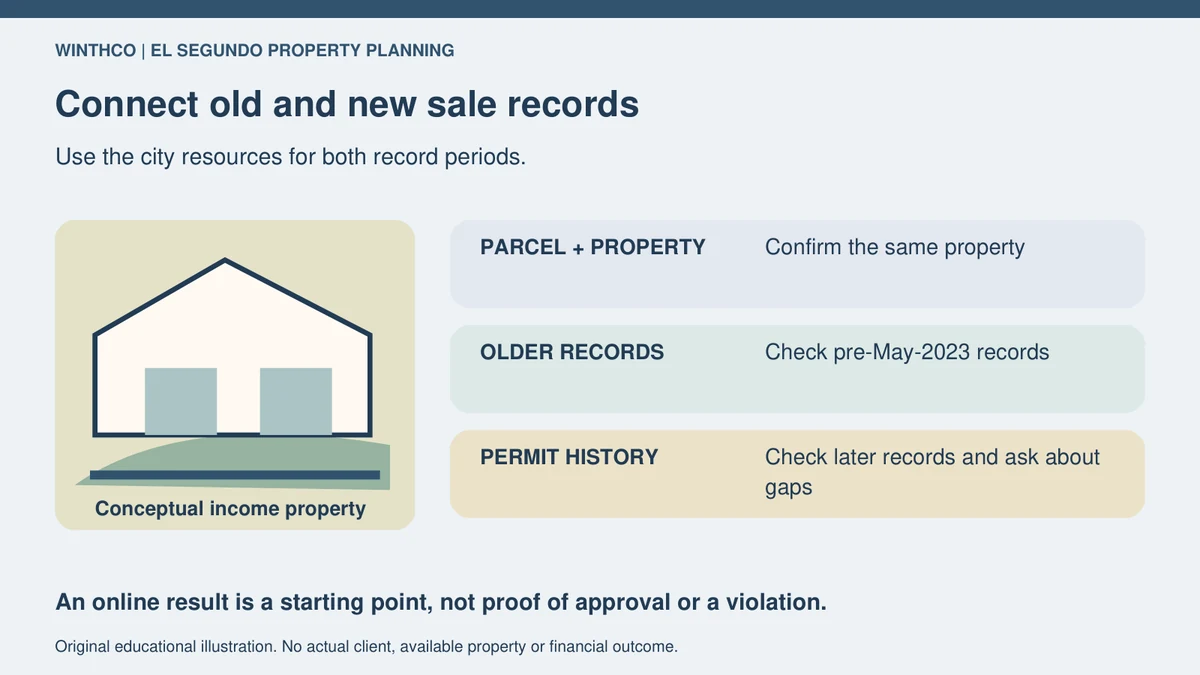
Start with a sale file that a buyer and the reviewing professionals can understand. Interview an appropriately licensed realtor or commercial broker about experience with the property's actual use, valuation evidence, marketing, fees and closing coordination. Ask how the broker would explain discrepancies between owner records, public records and current conditions. Verify licensing independently; this guide does not recommend a named broker or imply a Winthco brokerage office in El Segundo.
If a deferred exchange is contemplated, involve the CPA, attorney and qualified intermediary before closing or receiving sale proceeds. Compare the estimated net sale cash with debt payoff, transaction costs and money required outside an investment. Winthco's DST service overview provides introductory context, but selecting replacement property should follow a documented review of goals, eligibility and risks rather than a promise of hands-off income.
Share your timeline and investment range. A Winthco team member will follow up with you.
El Segundo's published permit FAQ separates building permit records before May 2023 from records after May 2023. It also distinguishes searching permits from viewing existing plans at the City Hall public counter, with plan duplication subject to requirements. Start with the official linked resources for both periods when relevant. A search that returns no recent permit is not evidence that no older record exists.
Build a dated discrepancy list for the broker and appropriate professionals: the parcel and address used, claimed improvements, records located and questions still open. Ask the city how to obtain missing information rather than treating an incomplete online search as proof of approval or a violation. This is a sale-preparation framework, not a determination about a particular property's authorized use or compliance.
Keep the local work proportional to the sale decision. Resolve material questions before marketing claims or closing assumptions rely on them, but do not confuse a cleaner property file with a completed replacement-investment analysis. The city-area map below identifies El Segundo geographically; it is not a Winthco office, parcel boundary or representation that a specific property is available.
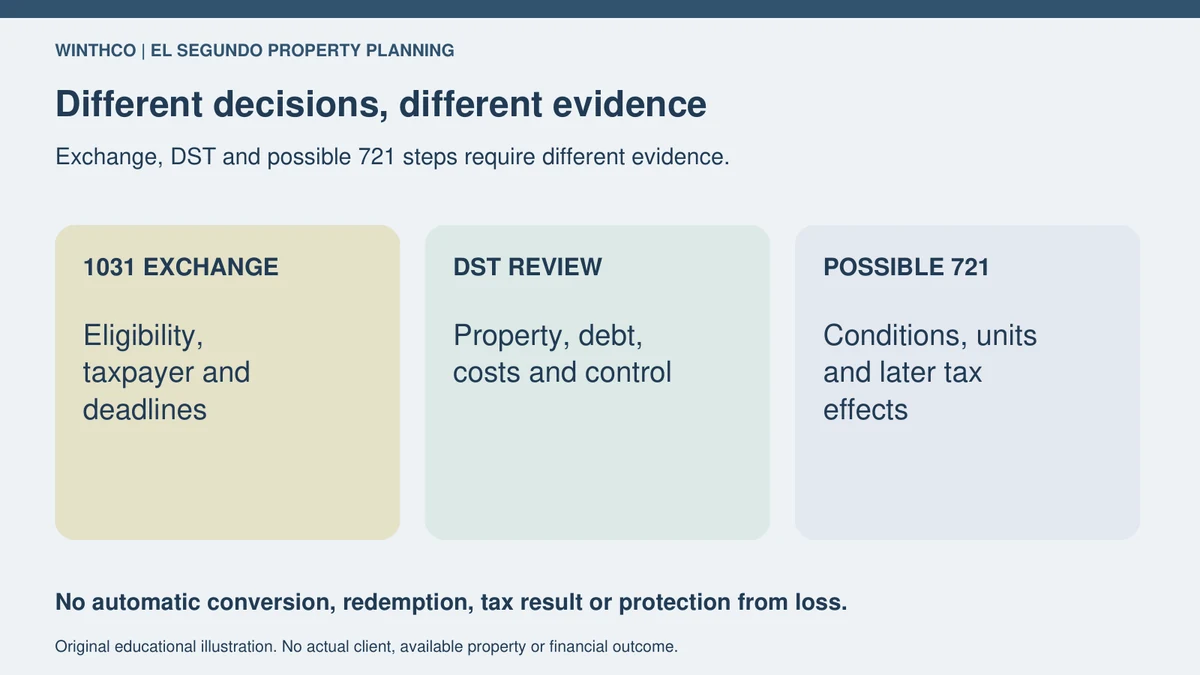
Section 1031 can defer eligible gain when business or investment real property is exchanged for qualifying replacement real property and the requirements are satisfied. Deferral is not tax elimination. Cash retained, nonqualifying property, debt changes and transaction details can affect recognized gain. Have the CPA explain the proposed transaction and reserves instead of assuming all gross sale proceeds are freely available for investment.
The IRS generally requires written identification within 45 days after transfer of the relinquished property. Receipt must occur by the earlier of 180 days or the applicable tax-return due date, including extensions. Review the identification method, taxpayer identity, closing dependencies and backup choices with the qualified intermediary and counsel. A broker's projected closing date does not itself establish compliance.
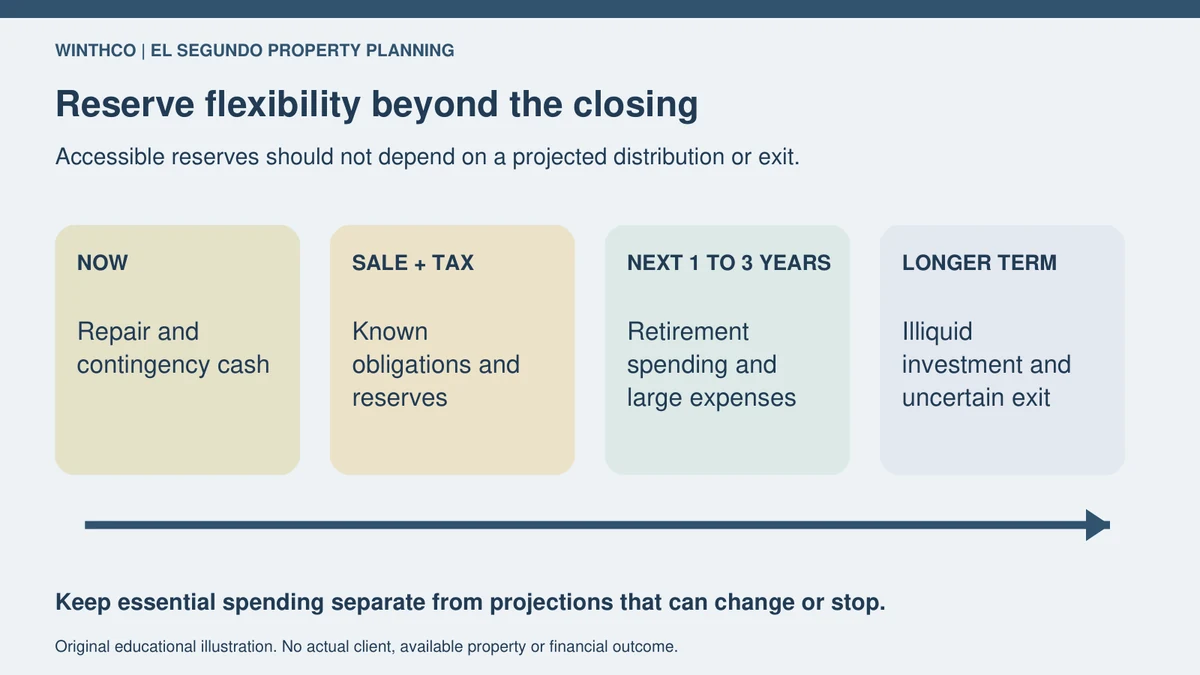
Compare direct replacement ownership with a qualifying DST interest on more than management effort. Ask what property exposure, control and liquidity each choice leaves with the household. Finishing a sale with less day-to-day work can still produce an investment that is unsuitable for essential near-term spending. The replacement review should remain independent of pressure created by a listing or an approaching exchange deadline.
Discuss your DST questions with Winthco →
IRS Revenue Ruling 2004-86 addressed a specified DST structure and permitted an exchange for its beneficial interests when the other Section 1031 requirements were met. It is not blanket approval of every trust or security labeled DST. Ask counsel to explain the actual structure, governing documents and tax opinion, including restrictions on trustee activity and responses to adverse events.
A DST advisor should explain the service scope, compensation, conflicts and limits of the review. Request the offering memorandum and supporting documents through the authorized diligence process. The DST evaluation questions can help organize that conversation. Distinguish property acquisition costs, distribution assumptions, financing and potential disposition charges rather than comparing one projected distribution number.
Review the actual property and operating assumptions: tenants, lease obligations, vacancy, repairs, insurance, property taxes and capital needs. Compare sponsor and manager responsibilities with what beneficial owners can actually direct. The property-tax assessment guide shows why a historical bill and a future operating budget are different records. An offering summary cannot replace the underlying documents or answer every property-specific question.
For leveraged property, ask about loan maturity, rate exposure, covenants and refinancing assumptions. Review reserve restrictions and the cash available after debt and other obligations. Ask what could reduce or stop distributions and what information investors receive when assumptions change. No general fee threshold, occupancy percentage or sponsor name establishes suitability or protects principal.
A separate contribution of property to an operating partnership in exchange for partnership interests may be considered under Section 721, subject to exceptions and transaction facts. Do not treat ordinary REIT shares or operating-partnership units as direct Section 1031 replacement real property. A proposed DST-to-partnership path needs its own analysis; it is not an automatic second step of every exchange.
If materials describe a possible later contribution, ask who controls the decision, what approvals remain, how interests would be valued and what fees or debt effects apply. Determine what happens if the event never occurs. Do not select today's property merely because a future transaction is presented as an anticipated solution to illiquidity or operating risk.
Review the resulting units' transfer, redemption and tax provisions with counsel and the CPA. A redemption option is not necessarily an immediate right to cash, and FIFO language does not guarantee tax-free withdrawals of basis. Compare the resulting concentration and reporting obligations with the original goals. The DST downside review helps keep the current investment case separate from an uncertain later event.
WATCH & LEARN
Winthco Wealth Management introduces general DST education. This is not El Segundo permit advice, an offering recommendation or a promise of income, liquidity or tax treatment. Original resource · Watch on YouTube ↗
Educational context only. The discussion does not establish the suitability, returns or tax treatment of an investment.
Consider a hypothetical owner with permit records in more than one city system, a planned rental sale and retirement spending approaching. This is not a client case or an available offering. One proposed path commits nearly all accessible resources to an illiquid replacement. Another preserves separately reviewed household liquidity but may involve a different tax result. Neither is automatically superior; the amounts, obligations and circumstances would control.
Ask the professional team to compare after-cost resources, potential recognized gain, distribution reductions and a delayed exit under each path. Keep the sale-record discrepancy list separate from the investment assumptions so one completed task does not imply the other is resolved. The useful outcome is a documented tradeoff, including reasons to decline or defer an investment, not a predetermined allocation.
DST ownership may reduce direct management, but it brings limited control, potentially prolonged illiquidity and property, tenant, sponsor, debt, fee, conflict, concentration and tax-law risks. Distributions can change or stop; principal can be lost. DST private placements are generally offered to accredited investors through offering documents. Eligibility does not establish suitability, regulatory endorsement or protection against loss.
The SEC warns that private placements can be highly illiquid and involve limited disclosure and total loss. FINRA emphasizes reviewing concentration and the ability to sell investments when cash is needed. Compare the proposed exposure with existing real estate, financial assets and accessible reserves. Several different investment names can still depend on similar property markets, financing conditions or tenants.
Connect the decision with 401(k)s, IRAs, retirement-income needs, asset allocation, large expected expenses and beneficiary or estate coordination. Qualified retirement accounts are not themselves 1031 exchange proceeds. Winthco's wealth-management conversation can include tax-professional coordination without assuming an account transfer, rollover or advisory engagement is appropriate. Compare relevant options, costs and services separately.
Use the prospect form to describe the planning question and current stage, not to upload leases, tax returns or account records. If later document review is needed, request an approved secure process. Keep the advisor, CPA, attorney, broker and qualified intermediary roles explicit, including who owns each unresolved question before listing, closing or committing to replacement property.
Geographic context, not a Winthco office or property-boundary determination.
| Decision | Evidence to request | What to avoid assuming |
|---|---|---|
| Sale readiness | Property identity and permit-record questions | An online search settles compliance |
| 1031 review | Taxpayer, eligibility and statutory deadlines | Any later purchase completes an exchange |
| DST review | Actual documents, costs, debt and control | Reduced management removes investment risk |
| Possible 721 | Conditions, valuation, units and taxes | Future conversion ensures cash liquidity |
The city's FAQ links separate resources for records before and after May 2023. Check the relevant periods and ask officials about missing records rather than inferring a legal result.
Do not assume that. The published city FAQ distinguishes permit searches from viewing plans and describes requirements for duplication.
No El Segundo office is claimed. The map shows the city area, not a Winthco office or a specific investment property.
No. A qualifying DST replacement interest and a separate partnership contribution involve different structures and requirements. Have counsel review the actual documents.
Ask about taxpayer identity, potential recognized gain, reporting and coordination with counsel and the intermediary. Do not assume an advisor also acts as your CPA.
Not without independent liquidity planning. Distributions and sale timing can change, and restricted interests may be difficult to sell.
Sources checked November 2, 2026. This article explains general concepts; your facts and the applicable documents control.
Winthco DST services · Winthco evaluation overview · Editorial standards
Property sale planning
Prepare a rental sale with broker questions, 1031 timing, DST and separate 721 review, and retirement planning before committing proceeds.
Read guide →DST due diligence
Review DST downside scenarios, cash-flow assumptions and exit risks before investing. Learn what a stress test can reveal and what it cannot promise.
Read guide →DST due diligence
Review DST property-tax assessments, bill timing, lease reimbursements and reserves before comparing projected cash flow. Prepare better questions.
Read guide →Explore Winthco’s main DST article collection
Share your timeline and investment range. A Winthco team member will follow up with you.