DST tax reporting
DST tax reporting after a 1031 exchange
Learn how DST tax reporting can involve Form 8824, owner statements, basis, depreciation, state filings and private-placement risks.
Read guide →
Home / Learning center / DST due diligence
DST due diligence
Winthco Wealth Management · Updated November 1, 2026
DST property-tax risk involves more than the current tax bill. Review the assessment basis, possible reassessment, payment timing, lease reimbursements and cash reserved for taxes. Federal 1031 gain deferral does not settle those operating questions. Ask how the actual property's tax assumptions affect projected cash flow and potential investor distributions.
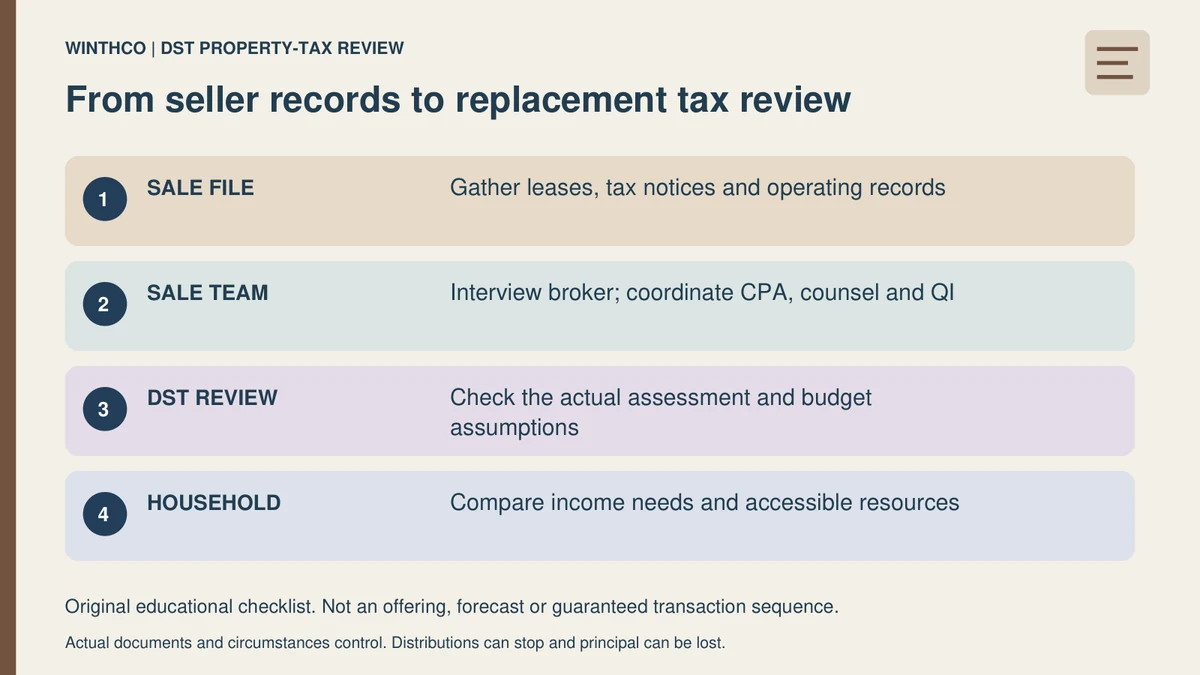
Begin with the property you intend to sell. Interview an appropriately licensed realtor or commercial broker about relevant property-type experience, valuation evidence, marketing, fees and closing coordination. Assemble leases, operating statements and tax notices. When comparing replacement choices, ask whether the proposed expense budget reflects the replacement property's circumstances rather than the familiar tax bill on your existing rental.
Bring the CPA, attorney and qualified intermediary into a contemplated deferred exchange before closing or receiving proceeds. The IRS generally requires identification within 45 days after transfer and receipt by the earlier of 180 days or the applicable return due date, including extensions. Gain deferral is not elimination. The DST evaluation framework can organize diligence, but a deadline should not turn an unsupported expense assumption into an acceptable one.
Share your timeline and investment range. A Winthco team member will follow up with you.
Separate three records: the property's assessed value, the bill payable to the collecting authority, and the expense assumption used in the investment model. Ask for the parcel, jurisdiction, valuation date, tax period and supporting documents behind each figure. An assessment notice is not interchangeable with a payment receipt, and a forecast is not evidence that the current obligation has been paid.
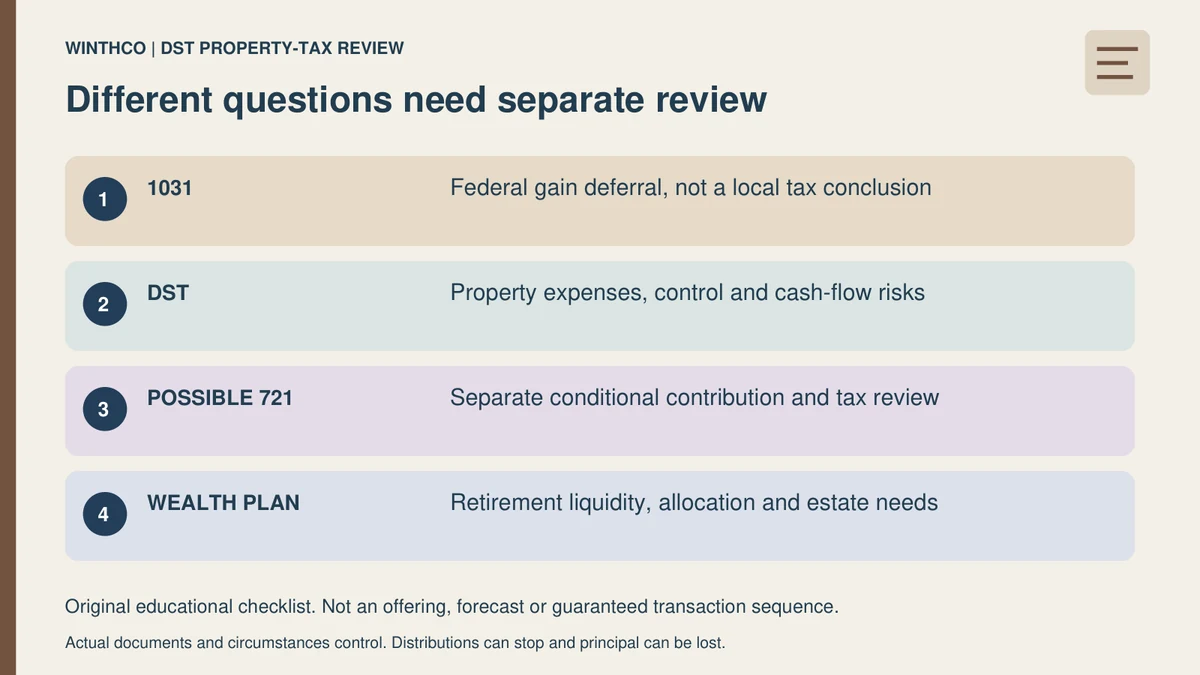
Property-level taxes also differ from the investor's federal income-tax reporting. Section 1031 addresses qualifying exchanges of investment or business real property; it does not establish the local assessment of every replacement asset. Ask the reviewing professionals to keep these analyses separate. The DST CPA coordination questions help define the tax professional's role without presenting an investment advisor as an accountant or promising a particular deduction.
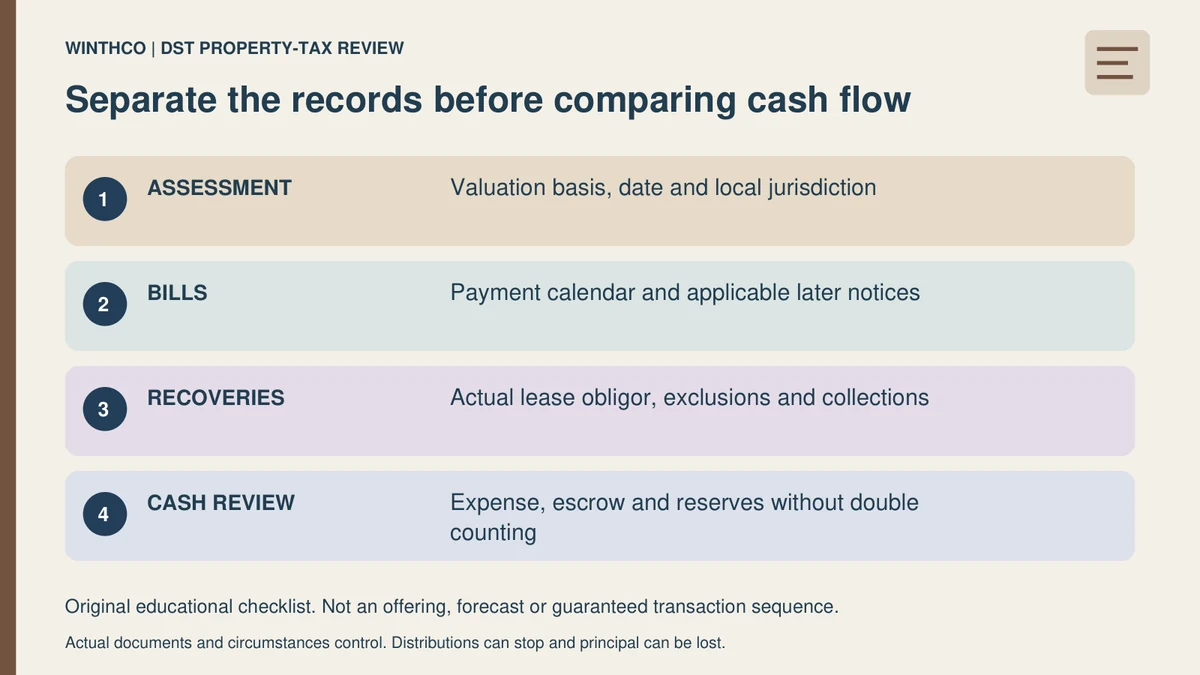
Ask whether the modeled expense uses a historical bill, an acquisition-related estimate or a later assessment already issued. Request the methodology and the name of the qualified professional who evaluated it. If the model assumes no material change, ask what supports that conclusion for the actual ownership structure and jurisdiction. A low historical expense is not, by itself, evidence of a low future expense.
California illustrates why jurisdiction matters. Its Board of Equalization explains that a county assessor determines whether a transaction constitutes a change in ownership and whether reassessment applies, with statutory exclusions potentially relevant. Do not generalize California rules nationally or assume buying any DST interest automatically causes reassessment. Ask local counsel and the responsible assessor how the particular transaction and entity facts are treated.
Separate uncertainty about valuation from uncertainty about timing. Ask whether the projected first-year expense reflects a full stabilized period or only part of a year. Request the assumptions used after that initial period. An expense presentation can be internally consistent yet still answer a different question from the one a prospective investor needs answered.
Discuss your DST questions with Winthco →
California's supplemental-assessment process can produce an additional bill reflecting a prorated assessment difference after a qualifying ownership change or new construction. The Board of Equalization distinguishes supplemental bills from the regular annual bill. This is a California-specific illustration, not a prediction that every DST will receive a supplemental bill or that all such adjustments increase tax.
For any jurisdiction, request a calendar of expected assessments, installments and applicable notices from the authorized reviewing team. Ask which obligations are already included in escrow, what remains outside it and who monitors later correspondence. A temporary difference between accrued expense and cash paid should be explained rather than described as extra earnings available for investors.
Ask how prior-owner prorations, pending bills and any refunds are allocated under the actual acquisition documents. Counsel should explain who bears an adjustment discovered after closing. Keep an unresolved assessment or appeal visible in the diligence notes, with the responsible party and next review date. Do not treat a pending challenge as a completed reduction or assume a successful outcome in the base budget.
Read the actual tax provisions and identify the obligor. Ask whether payments are made directly, reimbursed after billing or collected through estimates and later reconciliation. Determine which taxes or assessments are covered, whether caps or exclusions apply and how disputes are handled. A lease label alone does not explain the economic responsibility for every charge.
IRS Revenue Ruling 2004-86 considered a specified DST arrangement whose net lessee was obligated to pay property taxes and other costs. That particular fact pattern is not proof that every DST uses the same lease or that every tenant will perform. Review the actual lease, master-tenant structure and financial capacity rather than extending the ruling into an investment guarantee.
If reimbursements are expected, ask how collection delays or nonpayment appear in the cash-flow analysis. Identify any affiliate relationships and who enforces the obligation. The master-lease responsibility review helps distinguish the property owner, master tenant and occupants. Contractual allocation can shift responsibility, but it does not make the counterparty's ability to pay irrelevant.
WATCH & LEARN
Equity Advantage 1031 Exchange discusses the time and energy demands of direct ownership and DSTs as a possible alternative. This permitted third-party embed supplies general management context, not property-tax advice, an endorsement or a promise of distributions or liquidity. Original resource · Watch on YouTube ↗
Educational context only. The discussion does not establish the suitability, returns or tax treatment of an investment.
Ask for a bridge from the modeled tax expense to expected cash payments, tenant recoveries, restricted escrow and other reserves. Confirm which amounts are already counted so the same cash is not treated as available twice. Review the DST reserve checklist for permitted uses and funding assumptions. A reserve balance is a resource with limitations, not a promise that every future obligation can be covered.
Consider a hypothetical comparison, not an actual offering: two properties display similar initial cash-flow projections. One uses a recently reviewed assessment estimate and explains delayed collections; the other extends an old bill without documenting its assumptions. The difference identifies a diligence gap, not a conclusion that one investment is suitable or that the other will fail.
Ask the team to show a supported downside case with a higher tax expense, slower reimbursements and a bill arriving before expected collections. Then review the effects alongside debt service, repairs, fees and other obligations. The DST downside-scenario guide explains why several stresses can overlap. Do not assume the trustee can simply obtain additional capital: the IRS ruling analyzed restricted trustee powers, including a prohibition on additional contributions in its stated arrangement.
A possible later contribution to an UPREIT operating partnership is a separate, conditional proposal. Section 721 generally concerns property exchanged for partnership interests, subject to exceptions and transaction facts. It does not establish a local property-tax exemption. Ask counsel to analyze any state or local assessment consequences independently of federal contribution treatment.
Review who controls a proposed contribution, its valuation process, required approvals, debt effects, fees and restrictions. It may never occur. Operating-partnership units and ordinary REIT shares generally are not direct Section 1031 replacement real property. A possible later event does not promise liquidity or tax-free FIFO basis withdrawals. Evaluate today's operating budget without assuming a future transaction will repair an inadequately supported tax estimate.
A DST may reduce direct management responsibilities, but investors accept limited control and potentially prolonged illiquidity. Property, tenant, sponsor, leverage, fee, conflict, concentration and tax-law risks remain. Distributions can change or stop, and principal can be lost. DST private placements are generally available to accredited investors through offering documents; eligibility does not establish suitability or protection from loss.
FINRA emphasizes reviewing concentration and the difficulty of selling illiquid holdings. Compare potential reductions in property cash flow with accessible savings, other real estate and retirement spending. Similar exposures across several investments can matter even when each has a different name. Do not budget essential expenses on the assumption that an investment can always be sold promptly.
Connect the sale decision with existing financial assets, 401(k)s, IRAs, retirement-income needs, asset allocation and beneficiary or estate coordination. Winthco's wealth-management conversation can include coordination with tax professionals without assuming an account transfer, rollover or advisory engagement is appropriate. Compare relevant options, costs and services separately. Use the prospect form for your planning question, not tax notices or confidential account records; request an approved secure process if documents are needed later.
| Decision | Evidence to request | What to avoid assuming |
|---|---|---|
| Assessment record | Valuation basis, date and jurisdiction | An old bill establishes the future expense |
| Payment calendar | Annual and other applicable obligations | Accrued expense equals cash already paid |
| Lease allocation | Actual obligor, exclusions and collection timing | A lease label removes all tax exposure |
| Cash-flow bridge | Expense, recoveries, escrow and available reserves | The same reserve can fund every obligation |
No. Federal gain-deferral requirements and property-level assessment obligations are separate questions. Ask professionals to review both for the actual transaction.
Do not assume a universal result. Jurisdiction, ownership structure, transaction facts and applicable exclusions require qualified local review.
No. The Board of Equalization describes supplemental bills as additional to regular annual bills. Other jurisdictions have different systems.
Not necessarily. Read the actual allocation, exclusions and collection mechanics. The obligor's performance and financial capacity still matter.
Not without checking restrictions and purpose. Ask how the model separates committed cash from resources available for other expenses.
No. Describe the planning question without confidential records. Request an approved secure document process if a later review requires them.
Sources checked November 1, 2026. This article explains general concepts; your facts and the applicable documents control.
Winthco DST services · Winthco evaluation overview · Editorial standards
DST tax reporting
Learn how DST tax reporting can involve Form 8824, owner statements, basis, depreciation, state filings and private-placement risks.
Read guide →DST investment due diligence
Review who owes rent in a DST master lease, what supports payment, and how lease risks fit a property sale, 1031 exchange and retirement plan.
Read guide →DST due diligence
Before exchanging a rental into a DST, review repair budgets, restricted reserves and funding limits. Know which questions to ask before committing.
Read guide →Explore Winthco’s main DST article collection
Share your timeline and investment range. A Winthco team member will follow up with you.