Texas property transition guide
Leaving Texas: Capital Gains, 1031 & Election Results
Selling Texas land or rental property before a move? Review 1031 tax deferral, DST risks, home-sale rules and the 2026 election context.
Read guide →
Home / Learning center / Texas property transition guide
Texas property transition guide
Winthco Wealth Management · Updated November 21, 2026
A right-of-way offer is not automatically a Section 1033 event. If Texas investment land is condemned or sold under a genuine threat of condemnation, review Section 1033 with your attorney and CPA. If the sale is voluntary, a possible Section 1031 exchange follows a different set of rules that generally need attention before transfer.
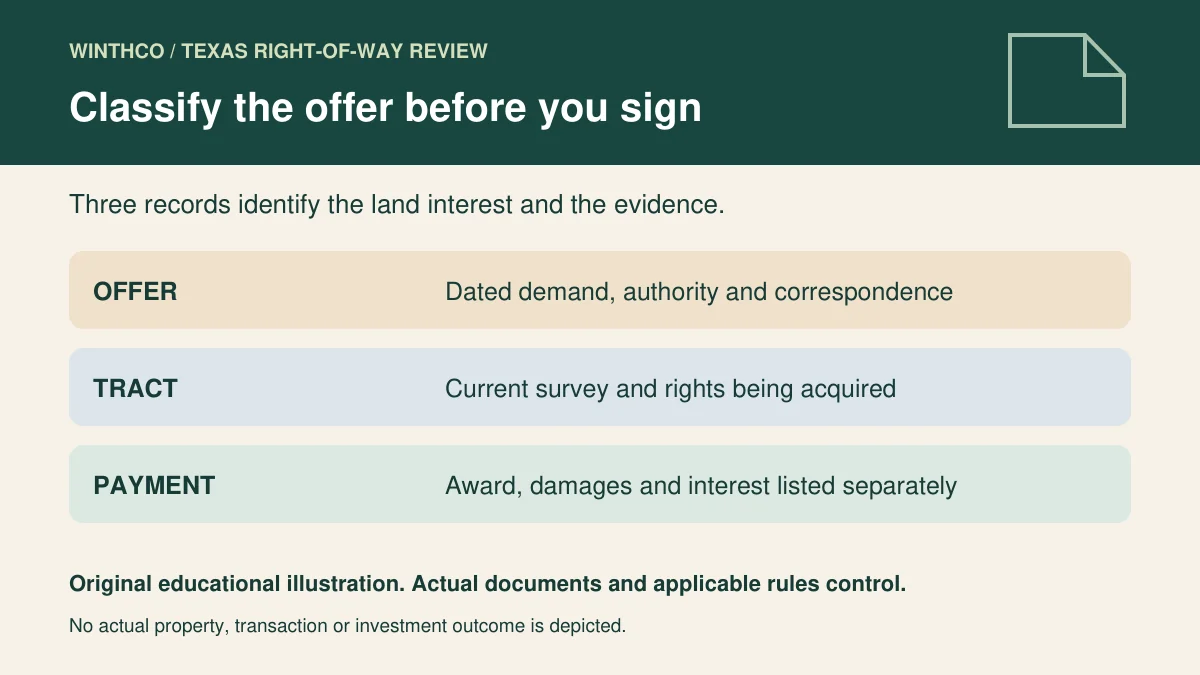
A Texas landowner planning a move may receive an offer for a road widening or another public project before listing the property. Ask a Texas condemnation attorney who is seeking which interest, whether the entity has the power it claims, and what the correspondence and dates establish. Save the original offer, envelope or email, subsequent notices, appraisal and mapped legal description. An early inquiry, a project map or a neighbor’s experience does not settle your legal or tax position.
The Texas Attorney General’s Landowner’s Bill of Rights and TxDOT acquisition instructions explain the state process. Federal tax treatment is a separate question. Section 1033 can apply to a qualifying condemnation or sale under threat or imminence of condemnation; a negotiated sale is not automatically voluntary merely because no court judgment has arrived. Conversely, a public buyer does not make every negotiated sale an involuntary conversion. Begin with the broader Texas property-sale and relocation guide if the owner is considering a separate voluntary sale as well.
Share your timeline and investment range. A Winthco team member will follow up with you.
Overlay the proposed fee strip or easement on the current legal description. Ask counsel and the appraiser to distinguish the interest acquired from the land you keep, and to distinguish any payment for the acquired rights from compensation for damage to the remainder. Gather the original closing statement, improvement and depreciation records, prior parcel splits and purchase allocations. An award line labeled damages or interest does not necessarily receive the same treatment as compensation for the property interest. The tax team should build the allocation from the documents and applicable law, not treat the whole payment as one number.
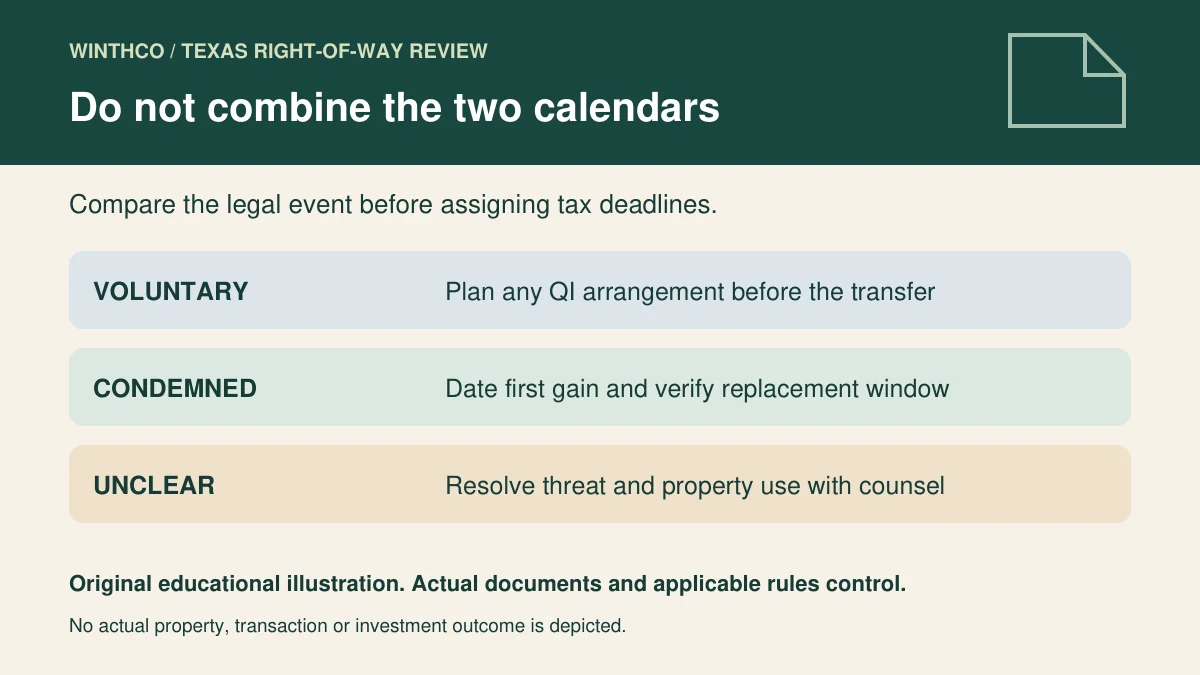
For a qualifying cash condemnation, Section 1033 generally permits an election to postpone gain to the extent eligible replacement cost covers the relevant amount realized, within the applicable period. IRS Publication 544 says the replacement period generally begins at the earlier of disposition or the beginning of the threat. For qualifying condemned real property held for investment or business, not property held primarily for sale, the period generally ends three years after the end of the first tax year in which any part of the gain is realized. Exceptions apply. The first gain year may not be the year a dispute finally settles; have the CPA consider any earlier amount already available to the owner.
For an otherwise qualifying voluntary deferred Section 1031 exchange, identification generally is due within 45 days after disposition and acquisition by the earlier of 180 days or the return due date including extensions. Discuss actual and constructive receipt and get the qualified intermediary involved before transfer; an owner’s later purchase does not automatically fix mishandled proceeds. Review the 1031 closing paperwork for that separate path. The existence of a possible Section 1033 election does not change a voluntary Section 1031 calendar.
Discuss your DST questions with Winthco →
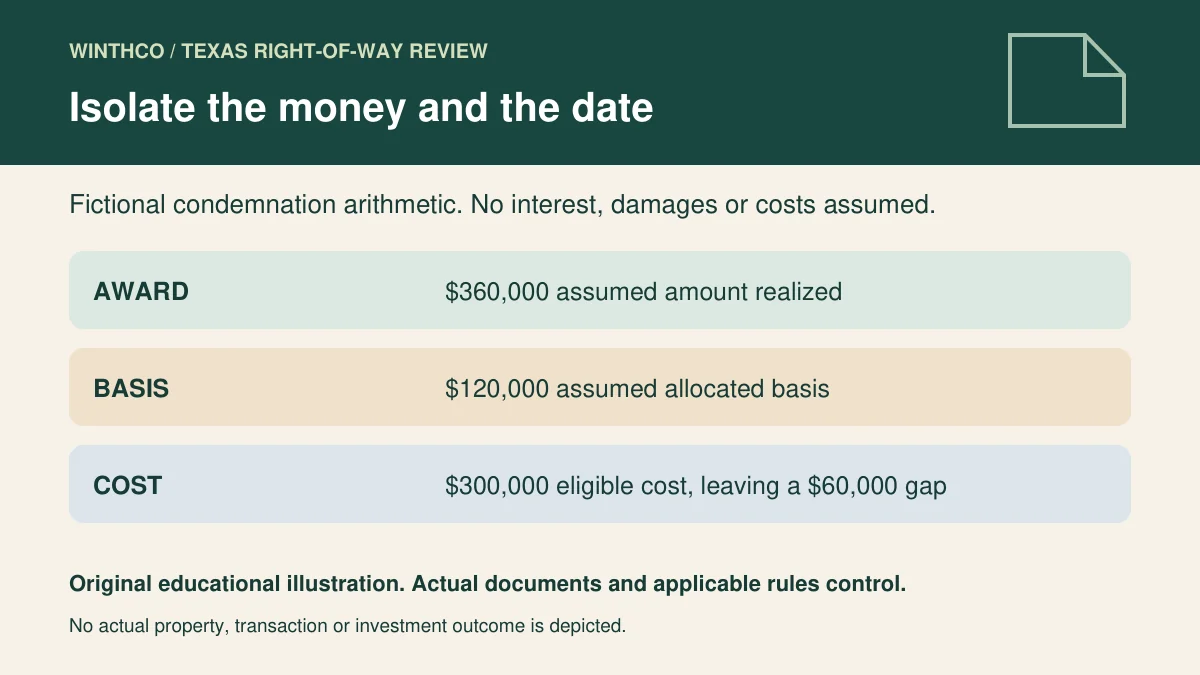
Assume a calendar-year owner’s tax team determines a qualifying cash condemnation of investment land. For illustration, assume $360,000 amount realized, $120,000 allocable adjusted basis, no separate damages, interest or expenses, and the first gain in 2026. The simplified gain is $240,000. If eligible replacement real estate costs $300,000 and all other conditions are met, up to $60,000 of the gain would still be recognized in this simplified example because replacement cost is $60,000 below amount realized. The remaining $180,000 would be deferred, not erased. The general three-year rule in the assumed circumstances points to December 31, 2029. Change any allocation, timing, kind of property or eligibility assumption and this illustration may no longer apply.
A personal-use home usually is not Section 1031 property. Section 121 has separate rules for eligible home-sale gain; ask the CPA to address its relationship to any involuntary-conversion facts if the property is or was a home. Ask separately about any federal capital gains, depreciation-related tax, possible net investment income tax and any state residence/source issues. Texas’s lack of an individual income tax does not erase federal taxes or decide the destination state’s rules.
If the separate voluntary exchange path leads to a DST discussion, learn how a DST can fit an exchange and compare the details in a DST offering memorandum. A qualifying trust structure is not proof that every interest, investor or transaction qualifies. Confirm accreditation if applicable and review fees, leverage, concentration, sponsor risk and limited liquidity. Do not assume any DST qualifies for your particular Section 1033 replacement or guarantees a later Section 721 contribution, distributions, principal or a redemption.
WATCH & LEARN
Accruit explains the qualified intermediary for the voluntary-sale comparison only. This third-party video is not an endorsement or guidance about condemnation, Section 1033 or any specific Texas offer. Original resource · Watch on YouTube ↗
Educational context only. The discussion does not establish the suitability, returns or tax treatment of an investment.
Give the attorney the dated offer and legal description. Give the CPA the basis packet, property-use history and itemized proposed compensation. If a voluntary exchange remains a realistic path, give the intermediary the unsigned proposed terms and closing dates. Ask each who owns the next decision, what fact is missing, and the last date to have it resolved. Set aside cash for the move independently of any unverified tax result or illiquid replacement.
| Decision | Evidence to request | What to avoid assuming |
|---|---|---|
| Acquire or threaten to condemn | Legal authority, written evidence and tract description | Start with counsel, not the buyer’s label |
| Compensation | Award, remainder damages and interest separated | Ask CPA to apply the rules and determine basis |
| Voluntary transfer | Written intermediary process before transfer | Keep this calendar separate from condemnation |
| Replacement review | Eligible property, timing and cash cost | Compare tax and liquidity before committing |
No. The facts of the condemnation or genuine threat, property, award and replacement transaction matter. Preserve dated records and get specific legal and tax advice.
It may, if the facts show a qualifying threat or imminence of condemnation and the other requirements are met. Do not rely on the buyer’s identity alone.
No. The general three-year rule discussed here is for qualifying condemned investment or business real estate and has exceptions. Have your CPA determine the start, the first gain year and the actual deadline.
The 45-day identification rule discussed here is for a deferred Section 1031 exchange. A qualifying Section 1033 conversion has its own replacement rule.
No. The move does not erase federal gain and does not settle another state’s residence or source rules. Ask for advice for the actual dates, property and jurisdictions.
Sources checked November 21, 2026. This article explains general concepts; your facts and the applicable documents control.
Winthco DST services · Winthco evaluation overview · Editorial standards
Texas property transition guide
Selling Texas land or rental property before a move? Review 1031 tax deferral, DST risks, home-sale rules and the 2026 election context.
Read guide →Texas property transition guide
A Texas rental-sale guide to separating the purchase contract, qualified intermediary documents and closing instructions before a possible 1031 exchange.
Read guide →DST fundamentals
Understand DST ownership, potential 1031 exchange eligibility and the practical trade-offs of passive real estate investing.
Read guide →Explore Winthco’s main DST article collection
Share your timeline and investment range. A Winthco team member will follow up with you.