1031 exchange planning
Inherited property 1031 exchange into a DST
Learn when inherited investment property may enter a 1031 exchange, how basis and ownership matter, and how to evaluate a DST replacement.
Read guide →
Home / Learning center / Texas property transition guide
Texas property transition guide
Winthco Wealth Management · Updated November 21, 2026
Leaving Texas does not require paying every dollar of eligible capital gains tax immediately. A properly structured 1031 exchange can defer eligible gain on business or investment real estate, including certain land and rentals. Plan before closing. Personal residences generally do not qualify, and moving alone does not remove federal tax.
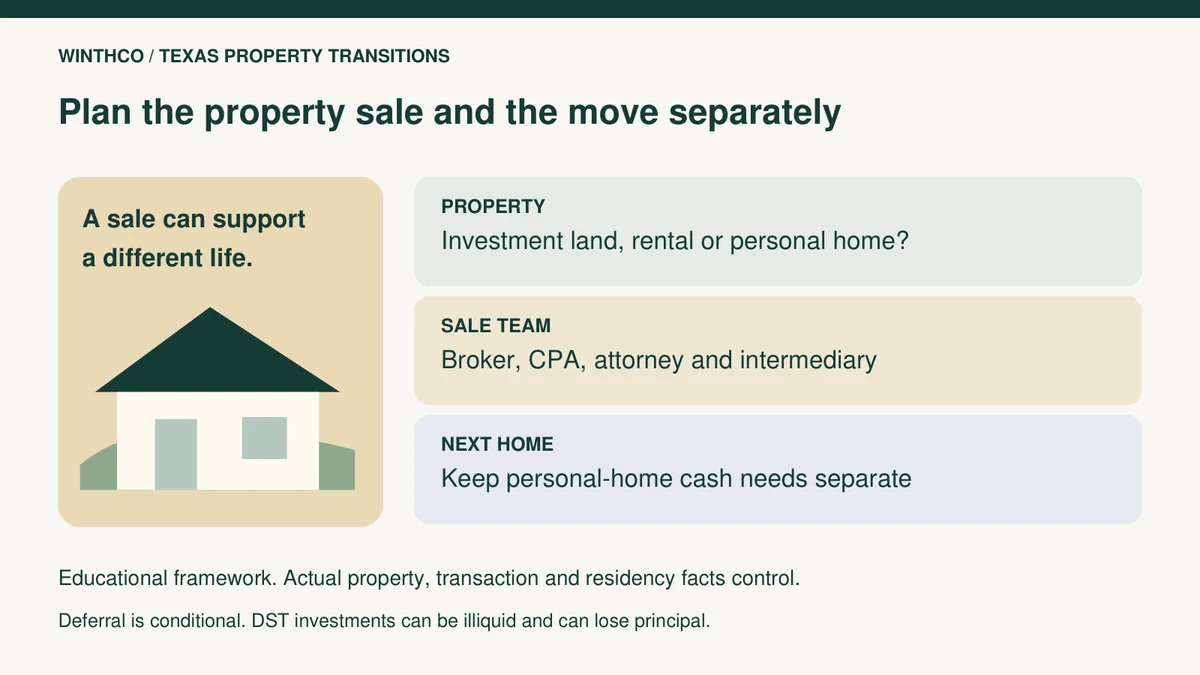
If you are ready to leave Texas, start with what you own and what you want the sale to accomplish. A move closer to family, a change in lifestyle or less property-management work can be considered alongside the tax cost. Separate money needed for your next home and near-term expenses from money you can keep invested in real estate. A qualifying exchange may preserve more capital for reinvestment, but cash retained for personal use can create taxable gain. For the practical sequence, the Texas rental sale and moving timeline checklist separates household cash, residency questions and exchange deadlines. Before listing a long-held tract, use the long-held Texas land basis checklist to separate acquisition evidence, improvements and unresolved tax questions. Selling a home together with a separate rental or business area requires its own review; use the Texas home and separate rental planning guide to organize the property-use and allocation questions. Before an interstate move, use the Texas residency evidence checklist to organize residence dates, sale records and later-payment questions. If a rental sale is under contract, review the Texas rental exchange paperwork at closing to separate the sale agreement, intermediary paperwork and disbursement records. If a road or public project affects the property, learn how a Texas condemnation differs from a voluntary sale before applying an exchange deadline.
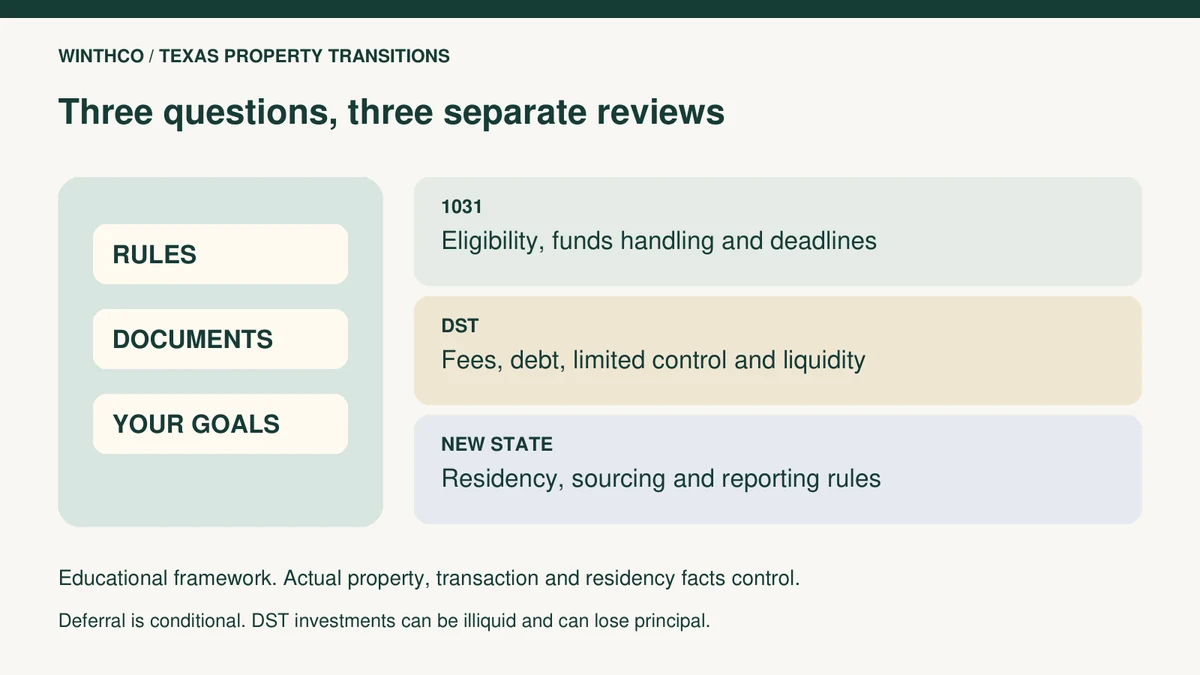
Interview a Texas-licensed broker with experience in your type of land, ranch, rental or commercial property. Ask about comparable sales, marketing, compensation, leases, title issues and a realistic closing calendar. Bring your CPA, attorney and qualified intermediary into the discussion before closing or receiving proceeds, preferably while the contract is being reviewed. Winthco’s DST services overview can help frame a planning conversation; it does not replace your broker, intermediary or independent tax and legal review.
Share your timeline and investment range. A Winthco team member will follow up with you.
As checked November 5, 2026, the Texas Secretary of State results page, updated November 4 at 4:59 p.m., reported Gina Hinojosa with 5,230,789 votes and Greg Abbott with 4,524,527 in the governor race. It reported James Talarico with 5,444,982 and Ken Paxton with 4,249,373 in the U.S. Senate race. Those are reported vote totals, not certified results. The state’s canvass calendar follows Election Day; this guide does not declare a certified winner. See the linked official results for other candidates and races.
An election result does not itself amend federal Section 1031 or establish a new capital-gains rate. Campaign proposals, legislative votes, signed law and effective dates are separate events. The IRS exchange guidance cited here remains the basis for this general planning discussion. Do not accelerate a sale on an assumption that an election has already eliminated an exchange rule or will cause a particular tax change.
A different election has already produced a specific state-law change. Texas voters adopted Proposition 2 on November 4, 2025, adding Article VIII, Section 24-b, which bars the state legislature from imposing a tax on realized or unrealized capital gains of an individual, family, estate or trust. This Texas restriction does not repeal federal capital-gains tax, provide a federal 1031 exchange or determine what your destination state can tax. The constitutional provision preserves specified property, sales and use taxes; it is not a blanket exemption from Texas taxes.
Discuss your DST questions with Winthco →
Section 1031 applies to qualifying real property held for investment or productive use in a trade or business. Rental homes, apartment buildings, commercial buildings and investment land can fit that category, depending on their actual use and ownership. Property held primarily for sale, such as dealer inventory, does not qualify. A long holding period or a large gain does not establish eligibility by itself.
U.S. real property can generally be exchanged for qualifying U.S. real property in a different state. The replacement need not be the same property type or be located where you move. U.S. and foreign real estate are not like-kind to each other. If your plans include moving abroad, keep the personal move separate from the replacement-property analysis and obtain cross-border tax advice.
Before assuming a decades-old Texas property has a large taxable gain, reconstruct its adjusted basis. Gather purchase and closing records, capital improvements, depreciation schedules, prior exchange documents and any gift or inheritance records. Gain is not simply the amount left after paying off a mortgage. Ask the CPA to distinguish capital gain, depreciation-related treatment and other potentially taxable items.
Inherited property often starts with a basis tied to its fair market value at the owner’s death, subject to exceptions and applicable estate valuation rules. Gifted property follows different rules. Family ownership alone does not tell you the current basis or whether the property is held for investment. Read the inherited-property exchange guide and farmland exchange guide before treating a family parcel like an ordinary rental sale.
WATCH & LEARN
Equity Advantage 1031 Exchange discusses time, energy and DST ownership as general educational context. This third-party discussion is not Texas election reporting, destination-state tax advice or an offering recommendation. Original resource · Watch on YouTube ↗
Educational context only. The discussion does not establish the suitability, returns or tax treatment of an investment.
For a standard deferred exchange, arrange the qualified-intermediary agreement and closing instructions before the relinquished property transfers. Actual or constructive receipt of sale proceeds can prevent the intended deferred-exchange treatment. A later purchase of a DST with cash already received does not retroactively turn a taxable sale into an exchange. Confirm the same taxpayer and ownership structure with the professionals handling both closings.
Generally, identify replacement property in writing within 45 days after transfer. Receive replacement property by the earlier of 180 days after transfer or the due date of the federal return for that year, including extensions. These periods run together; the 180 days are not added after the 45 days. Use our exchange deadline guide to prepare questions, and have the intermediary confirm the actual deadlines and identification limits.
A Delaware statutory trust can hold real estate for beneficial owners. A qualifying DST replacement interest may let an eligible exchanger reinvest without choosing another property to manage personally. IRS Revenue Ruling 2004-86 addresses a specific structure with restricted trustee powers; the label DST alone does not establish qualification. Ask counsel and your tax adviser to evaluate the actual trust and the entire exchange.
The trade-off is meaningful: you may give up decisions about tenants, maintenance, financing and the timing of a property sale. Moving to another state does not make the underlying real estate risk disappear. Compare a DST with direct replacement ownership and a taxable sale that leaves more accessible cash. The right comparison considers your time, cash needs, concentration and capacity for loss, not only the tax deferred at closing.
Obtain the actual offering memorandum and ask for a written explanation of acquisition, placement, financing, management and disposition costs. Review debt maturity, tenant concentration, lease expirations, capital reserves and assumptions about a later sale. Winthco’s DST evaluation overview provides questions for that review. A tax illustration is not evidence that an investment is appropriately priced or suited to your needs.
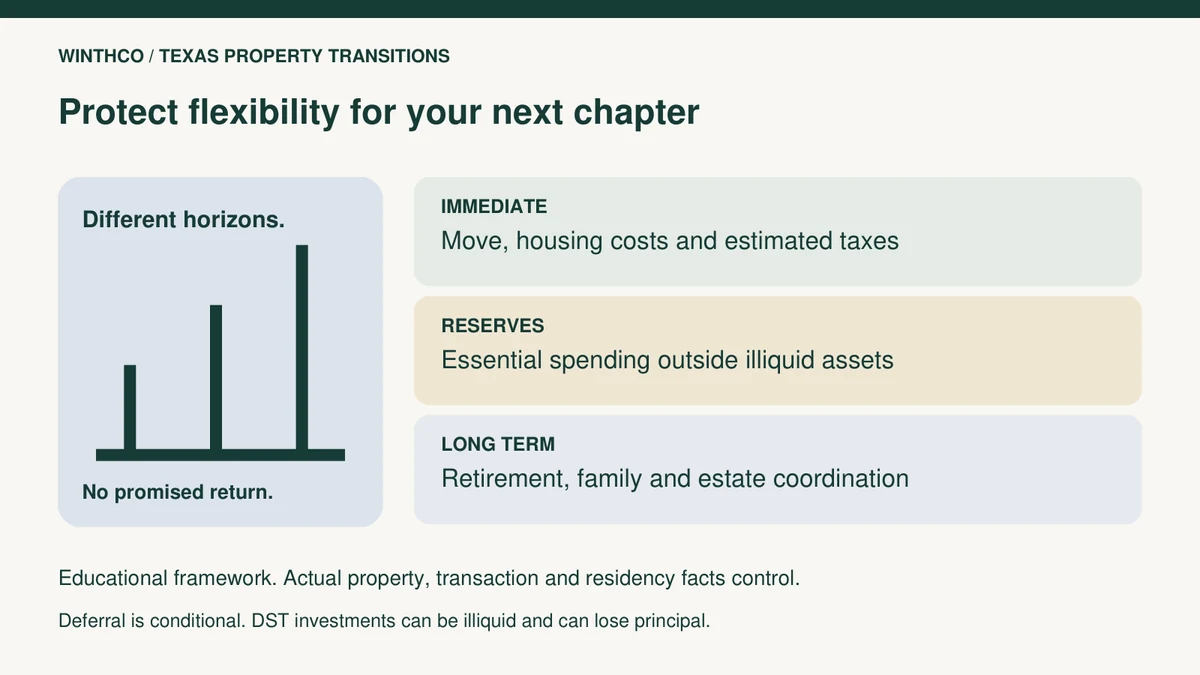
Private DST interests generally have transfer restrictions and no readily available resale market. A holding period can last longer than expected. Distributions can fall or stop, and principal can be lost. Private-placement eligibility, including accredited-investor requirements where applicable, is separate from suitability. Do not commit money needed for a home purchase, relocation costs or essential retirement expenses based on projected distributions or a hoped-for exit.
Suppose a Texas owner sells investment land and wants both a real estate replacement and cash for a new personal residence. The personal home is not qualifying replacement property merely because sale proceeds help purchase it. Cash received, nonqualifying property and net debt relief can cause recognized gain, often called boot. A CPA and intermediary should model the exchange before closing, including debt, new cash and transaction costs.
This is a hypothetical planning example, not a client result or tax calculation. Full deferral generally requires careful reinvestment and liability analysis; buying one DST does not automatically defer all gain. If accessible cash matters more than maximum deferral, compare a partial exchange or taxable sale deliberately. Do not let a tax target force a household into an illiquid investment it cannot afford to hold.
Texas currently has no state personal income tax, but that does not remove federal tax on a property sale. Your new state can introduce residency, sourcing, reporting or conformity questions. Review the dates of residency, closing, exchange completion and later payments with a CPA familiar with both states. An address change alone is not a tax strategy.
California provides a useful caution, not a rule for every destination. FTB Publication 1100, section C, example 4, describes a Texas rental sold on installments before the seller became a California resident. Capital-gain and interest income received after the move was taxable by California in that example. Ask about destination-state treatment before accepting seller financing or choosing a sale schedule; this example is not a finding about your transaction.
A Section 721 contribution to an operating partnership is a separate transaction with its own conditions and exceptions. A DST purchase does not promise a later contribution or conversion. Operating partnership units and ordinary REIT shares are not direct Section 1031 replacement real property. Any proposed later transaction needs a fresh review of documents, liabilities, tax treatment, costs and the parties who control the decision.
Ask how transfer restrictions, a later redemption and the possibility of a taxable event affect your plans. A possible UPREIT outcome should not serve as the cash reserve for a move. Compare the actual alternatives without assuming that one arrangement can supply permanent tax avoidance, guaranteed distributions or liquidity on demand.
Before choosing replacement property, review the tax estimate, cash reserve, retirement spending and other investments together. For long-time owners, the sale may change both work responsibilities and the family balance sheet. Review 401(k)s, IRAs, taxable accounts, beneficiary designations and estate documents with the appropriate professionals. Retirement accounts are separate from exchange proceeds, and a rollover or account transfer is not automatically appropriate.
Use the contact forms or call Winthco at 805-583-2720 to discuss your property type, expected timing and goals. You can ask about eligible 1031 deferral and the trade-offs of DST ownership before committing to a sale or investment. Bring questions and a general description first. Do not send Social Security numbers, account credentials or private tax documents through an initial inquiry.
| Decision | Evidence to request | What to avoid assuming |
|---|---|---|
| Investment land or rental | Actual use, title, basis and exchange structure | Every property sale qualifies for deferral. |
| Primary residence | Section 121 ownership/use tests and exclusions | Buying a new home or DST makes the gain deferrable. |
| Inherited property | Date-of-death value and estate documents | The decedent’s original purchase price is always your basis. |
| Election headline | Official returns, enacted text and effective date | A reported result changes the tax code immediately. |
| Move to a new state | Residency, sourcing, timing and reporting analysis | Leaving Texas makes the federal gain disappear. |
Potentially. A properly structured Section 1031 exchange can defer eligible gain when the property, taxpayer, proceeds handling, identification and completion requirements are met. Moving alone does not create eligibility.
A personal residence generally does not qualify for Section 1031. Section 121 may exclude up to $250,000 of eligible home-sale gain, or $500,000 for qualifying married joint filers, subject to ownership, use and other requirements. Mixed-use or former rental property needs separate analysis.
Not by itself. Review Section 121 and your actual facts. Reinvesting in a new personal residence is not the general rule for deferring home-sale gain.
The reported election returns cited here do not themselves amend Section 1031. This guide relies on the linked IRS rules and distinguishes unofficial returns from enacted law. Confirm any later legislation and effective date before acting.
No. Qualification depends on the structure and transaction. Cash received, debt relief or other nonqualifying consideration may create taxable gain, and investment losses are possible.
Contact your CPA immediately about the actual facts. Purchasing a DST afterward generally does not retroactively establish a standard deferred 1031 exchange. Do not move funds based only on a marketing description.
Sources checked November 21, 2026. This article explains general concepts; your facts and the applicable documents control.
Winthco DST services · Winthco evaluation overview · Editorial standards
1031 exchange planning
Learn when inherited investment property may enter a 1031 exchange, how basis and ownership matter, and how to evaluate a DST replacement.
Read guide →1031 exchange planning
Learn how retiring landlords can compare a DST 1031 exchange with direct real estate, including control, liquidity, debt, income and risk.
Read guide →Farmland 1031 planning
Learn how farmland owners can evaluate a 1031 exchange into a DST, including asset allocation, deadlines, debt and investment risks.
Read guide →Explore Winthco’s main DST article collection
Share your timeline and investment range. A Winthco team member will follow up with you.