Texas property transition guide
Leaving Texas: Capital Gains, 1031 & Election Results
Selling Texas land or rental property before a move? Review 1031 tax deferral, DST risks, home-sale rules and the 2026 election context.
Read guide →
Home / Learning center / Texas property transition guide
Texas property transition guide
Winthco Wealth Management · Updated November 11, 2026
Before a Texas property sale and interstate move, build a dated file separating where you live, where the property is located, when gain is recognized and when payments arrive. Moving does not erase federal gain. Qualifying 1031 deferral and destination-state tax treatment require separate reviews, preferably before signing final closing instructions.
Long-held Texas land or rental property can carry years of records into a new state. Before interviewing a listing broker, gather the deed, acquisition and improvement records, depreciation schedules and any prior exchange documents. Ask an appropriately licensed professional about valuation and realistic closing timing, while your CPA and attorney review tax issues independently.
Use this file alongside the Texas property transition master guide. The tool below is an organizer for professional review, not a residency test, a recommendation to move, or a promise that changing the closing date will reduce tax. Separate verified dates from estimates, and assign someone to resolve each missing document.
Share your timeline and investment range. A Winthco team member will follow up with you.
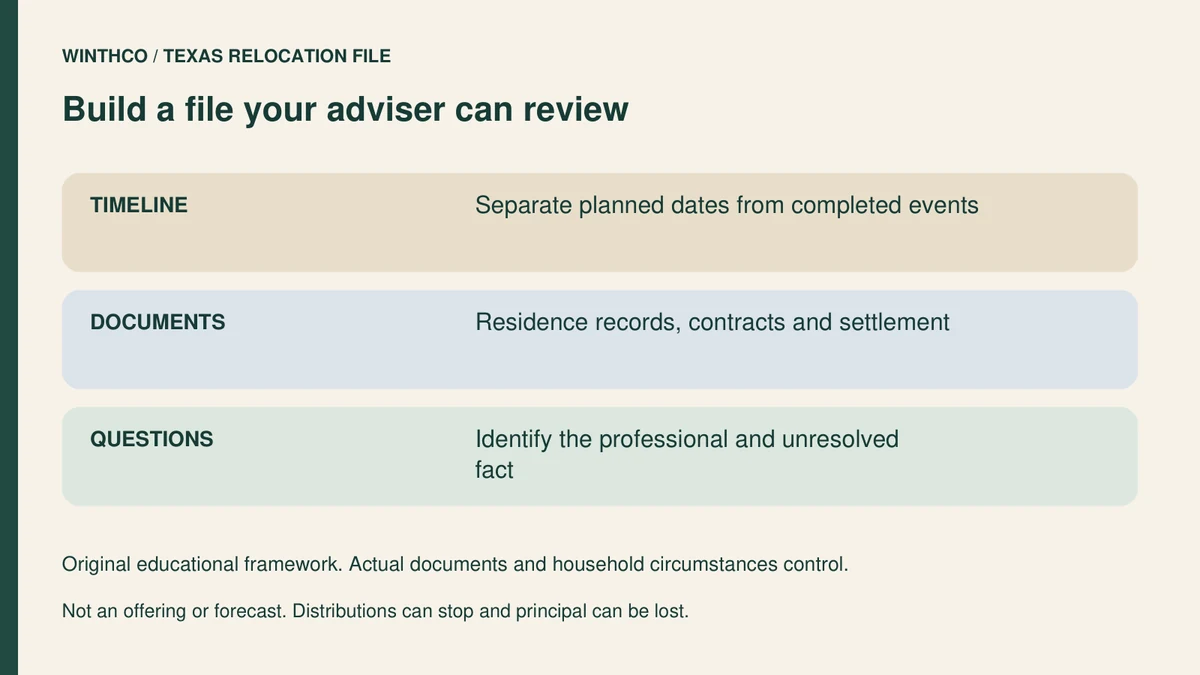
Create four columns: event, date and status, supporting document, and adviser question. Enter the proposed move, actual arrival, change in living arrangements, property transfer, exchange identification, replacement acquisition and any later seller payments. Mark each date planned or completed. A moving-company reservation is not the same evidence as a completed property transfer.
Attach the purchase and sale agreements, final settlement statement and intermediary documents when available. Keep a separate residence folder with leases or home purchases and records of actual living arrangements. Give your tax adviser the complete facts, including retained homes and business connections. Do not manufacture evidence, backdate records or assume a single administrative change settles residence.
Texas has no individual state income tax, but federal capital-gains and depreciation-related taxes may still matter. Net investment income tax can apply depending on income and other requirements. Moving does not itself cancel a realized gain. Have the CPA distinguish the federal tax estimate from each potentially relevant state calculation.
California illustrates why this separation matters. Its Franchise Tax Board says part-year residents generally owe tax on worldwide income while resident and California-source income while nonresident. That is not a rule for every destination. Ask counsel to identify the applicable residence, source and recognition rules in your actual new state rather than borrowing a California answer.
Discuss your DST questions with Winthco →
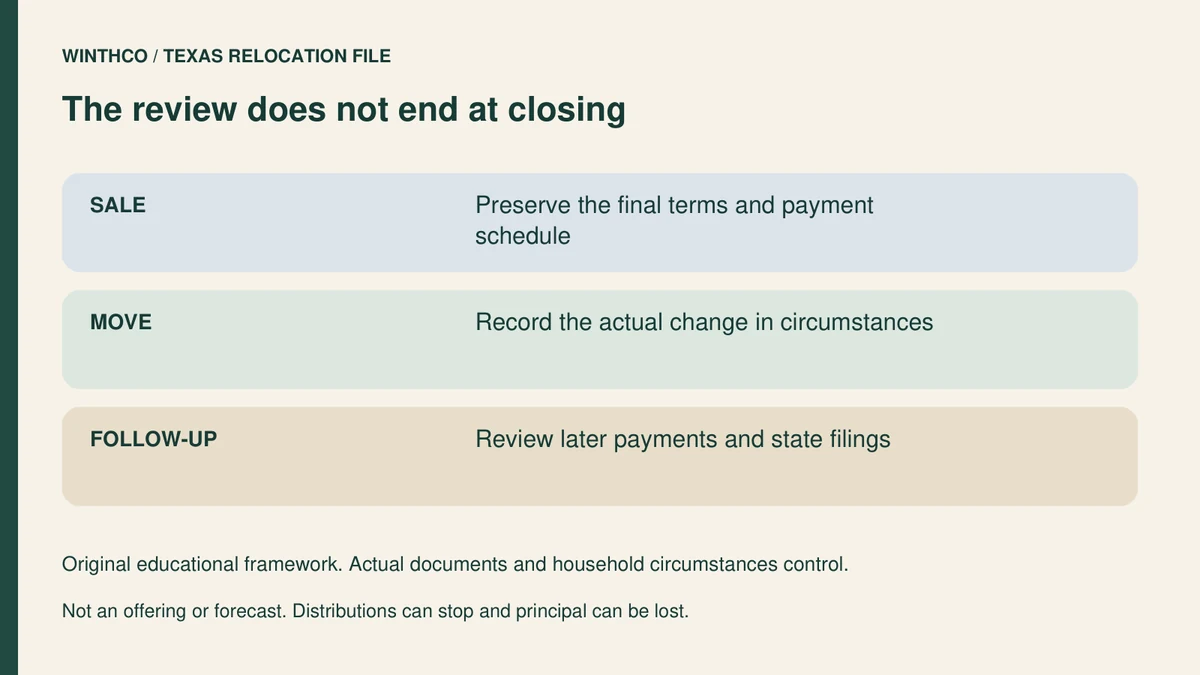
A seller-financed transaction may produce payments after relocation. FTB Publication 1100, section C, example 4, discusses a Texas rental sold on installments before the seller moved to California, with later capital-gain and interest income taxable in California in that example. This is an official illustration, not a conclusion about your sale.
Add a future-payments sheet listing expected payment dates, principal, interest and the documents that explain them. Ask the CPA whether installment treatment is available and how a residence change affects reporting. Do not treat this as a recommendation to finance a buyer, or as a technique for eliminating tax. Buyer default and collection risk need separate review.
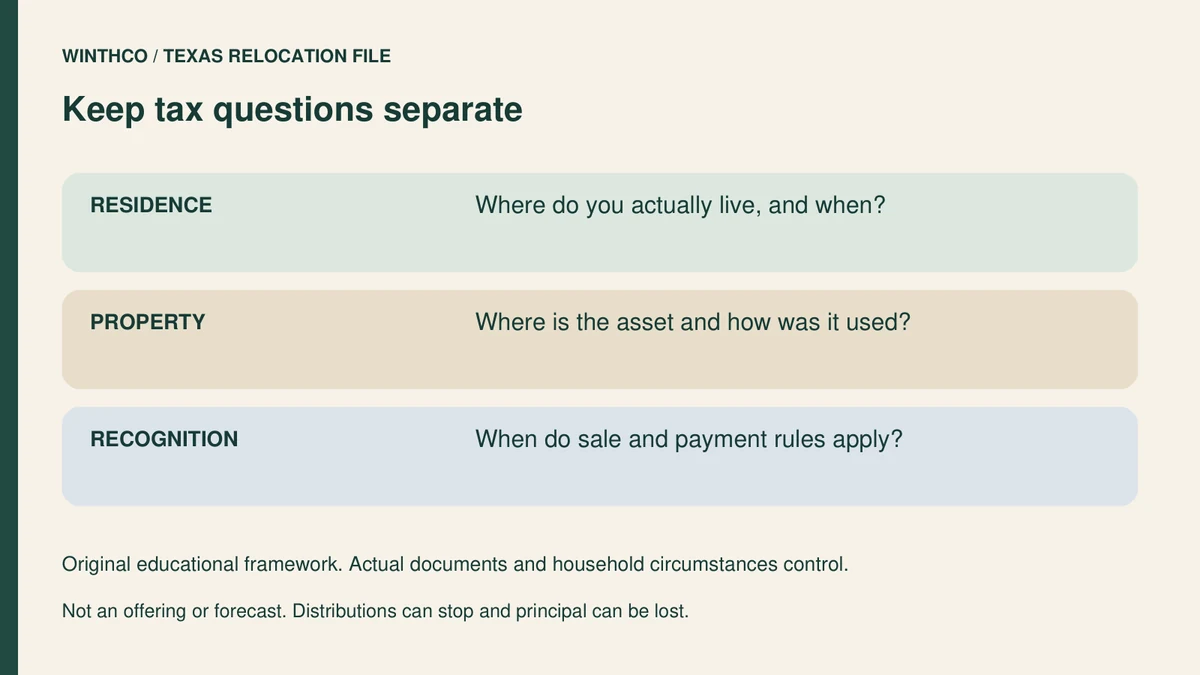
Suppose an owner plans to move on November 20, close a Texas rental sale on December 10 and receive seller-financed payments the following year. These are hypothetical dates, not a recommended schedule. The file should contain three distinct questions: when residence changes under the destination rules, how the property sale is reported, and how later payments are treated.
If the move occurs earlier or the contract changes to a cash sale, update the timeline and ask for a new analysis. Do not carry an old estimate into closing merely because the total sale price stayed the same. The useful output is a written list of assumptions, unresolved facts and filing obligations, not a guessed tax bill.
WATCH & LEARN
Equity Advantage’s older educational discussion provides context on direct management and relocation. It is not state-residency advice. DSTs retain fees, illiquidity, leverage and loss risks. Original resource · Watch on YouTube ↗
Educational context only. The discussion does not establish the suitability, returns or tax treatment of an investment.
Section 1031 generally concerns real property held for investment or business, not a personal-use home. Section 121 may exclude eligible home-sale gain under separate rules; an exclusion is not an exchange deferral. A long ownership period alone does not prove either treatment. Your property-use history belongs in the file.
For a proposed deferred exchange, arrange the qualified intermediary before closing and address actual or constructive receipt. Receiving proceeds and investing them later does not automatically repair an exchange. Generally identify replacement property within 45 days after transfer and receive it by the earlier of 180 days or the return due date, including extensions. Have the intermediary confirm your exact deadlines and documents.
A qualifying DST interest may be replacement real property in some 1031 exchanges under the structure described by IRS Revenue Ruling 2004-86. That does not mean every trust qualifies or that everyone is eligible. Winthco’s DST services overview can orient the discussion, but the actual offering and tax documents control.
The move may make direct management less convenient, yet a DST still exposes you to market, tenant, sponsor, leverage and concentration risks. Fees reduce the capital available to work for you, distributions can change or stop, and principal can be lost. Private interests can be difficult to sell. Review accreditation and offering-specific eligibility separately from whether the investment fits your needs.
Use the DST document evaluation guide to organize questions about fees, financing, property concentration, control and liquidity. Ask the tax adviser what future income and sale reporting the actual replacement assets may create after relocation. Do not assume that leaving Texas means the next investment creates no state filing obligations.
A Section 721 contribution to an operating partnership is distinct from buying a qualifying DST replacement interest. It has its own conditions and exceptions. A DST-to-UPREIT transaction, redemption or future liquidity is not promised; OP units and ordinary REIT shares are not direct 1031 replacement real estate. Preserve any proposed transaction documents for a fresh review rather than assuming a guaranteed sequence.
Before committing, compare the proposed sale and investment with cash needed for housing, relocation, emergencies and retirement. Do not use projected distributions or an assumed redemption to fund an unavoidable moving expense. A taxable sale, partial exchange or continued ownership may warrant comparison, depending on the facts.
Bring a general property description, timetable and questions to an initial Winthco planning conversation. Review the wider portfolio, retirement accounts and beneficiary arrangements with the appropriate professionals without assuming a transfer or rollover is suitable. Do not send tax returns, account credentials or Social Security numbers through a prospect form. Sources were checked November 11, 2026; this guide makes no claims about election winners, migration or new legislation.
| Decision | Evidence to request | What to avoid assuming |
|---|---|---|
| Residence change | Actual living arrangements and relevant ties | An address update decides tax residence |
| Texas property transfer | Contract, settlement statement and use history | Moving erases federal gain |
| Later payments | Note, payment dates and tax classification | Closing ends all state-tax questions |
| Replacement investment | Offering, intermediary and reporting documents | A DST means no future filing obligations |
No. Give your adviser the actual living arrangements and connections; the applicable state rules control.
No. Federal gain recognition and any eligible deferral or exclusion need separate analysis.
A personal-use home generally is not qualifying Section 1031 property. Review possible Section 121 exclusion separately.
Later payments can create reporting questions after a residence change. Ask your CPA to review their timing and character.
Sources checked November 11, 2026. This article explains general concepts; your facts and the applicable documents control.
Winthco DST services · Winthco evaluation overview · Editorial standards
Texas property transition guide
Selling Texas land or rental property before a move? Review 1031 tax deferral, DST risks, home-sale rules and the 2026 election context.
Read guide →Texas property transition guide
Moving out of Texas after selling a rental? Coordinate cash needs, residency dates, 1031 deadlines and DST risks before closing.
Read guide →Texas property transition guide
Before selling long-held Texas land, organize basis, improvements and ownership records to compare a taxable sale, 1031 exchange and DST risks.
Read guide →Explore Winthco’s main DST article collection
Share your timeline and investment range. A Winthco team member will follow up with you.