1031 exchange planning
1031 exchange deadlines: the 45-day and 180-day rules
Plan the identification and completion periods for a deferred 1031 exchange, including the earlier tax-return deadline.
Read guide →
Home / Learning center / Texas property transition guide
Texas property transition guide
Winthco Wealth Management · Updated November 5, 2026
A Texas rental sale and an interstate move need coordinated but separate plans. A qualifying 1031 exchange may defer eligible gain, while your moving costs and new personal home require accessible money outside the exchange. Review residency, proceeds handling and replacement-property deadlines before closing, rather than relying on your moving date.
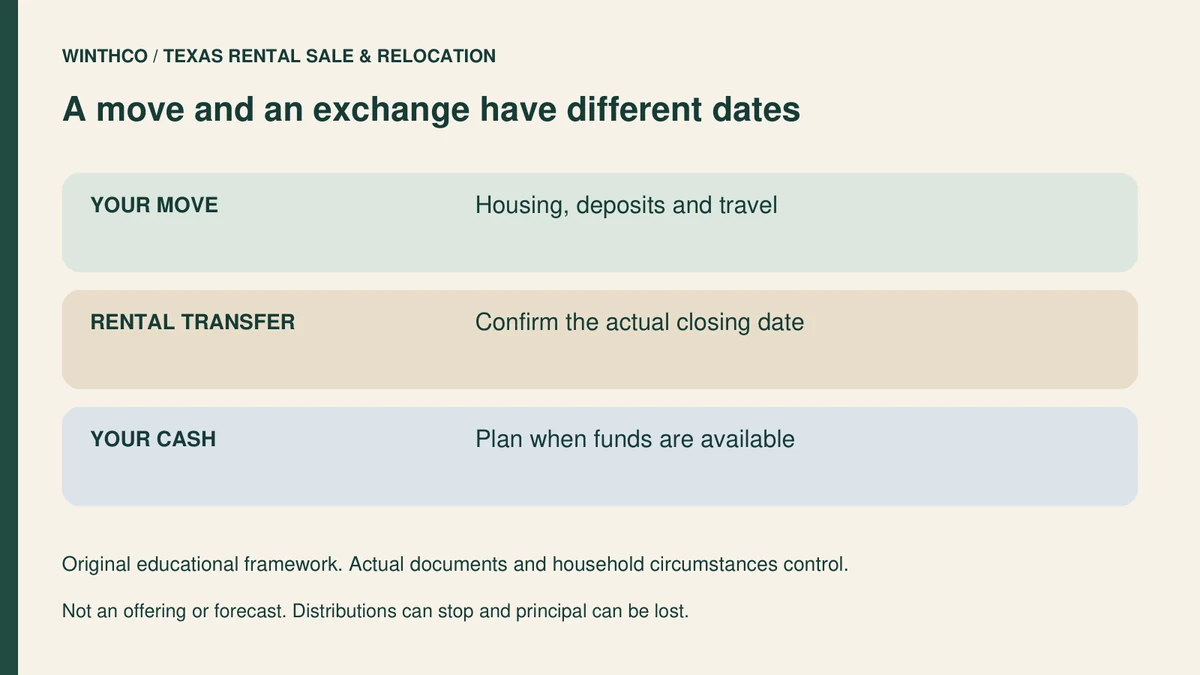
Write down the rental sale milestones beside the personal move milestones: listing, buyer contingencies, expected transfer, temporary housing, arrival in the new state and purchase of a personal home. Add a third column for when money is actually available. A property closing, a change of residency and an exchange completion are different events. Our Texas property transition master guide explains the broader capital-gains and election context; this checklist focuses on coordinating the dates and cash.
Interview an appropriately licensed Texas real estate broker who understands occupied rentals, comparable sales, tenant records and closing coordination. Ask how lease terms, repairs, marketing costs and buyer financing could change the schedule. Bring the CPA, attorney and qualified intermediary into the planning before closing or receiving proceeds, preferably during contract review. Do not assume the broker handles tax eligibility or that Winthco is acting as your real estate broker or intermediary.
Share your timeline and investment range. A Winthco team member will follow up with you.
Section 1031 generally applies to real property held for investment or productive business use. A genuine rental may qualify, but the ownership structure, actual use and entire transaction still matter. Property held primarily for sale does not qualify. A replacement investment can generally be in another U.S. state; it need not be near the home where you will live. U.S. and foreign real estate are not like-kind.
A personal residence generally is not 1031 replacement property. Section 121 instead may exclude up to $250,000 of qualifying home-sale gain, or $500,000 for qualifying married joint filers, subject to ownership, use and other requirements. Former rentals and mixed-use homes require extra analysis, including depreciation and periods of nonqualified use. Buying a new personal home does not itself defer the tax on a rental sale.
Discuss your DST questions with Winthco →
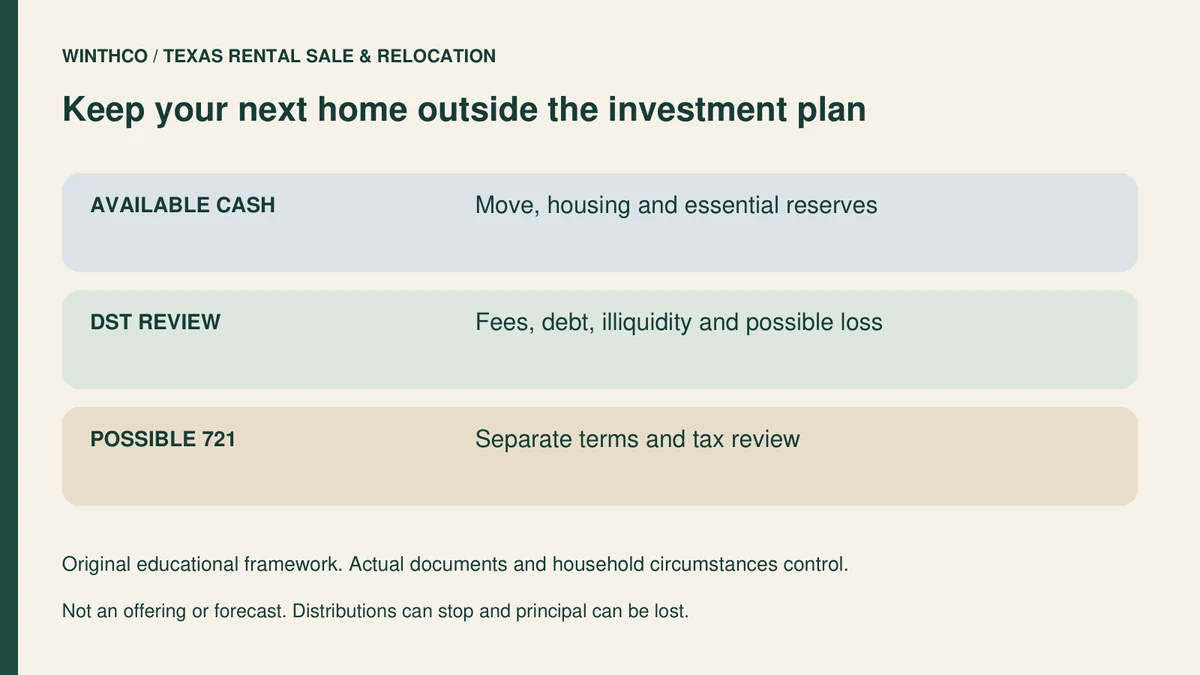
Ask your CPA to estimate adjusted basis, realized gain, depreciation-related treatment, transaction costs and potential taxes. A mortgage payoff reduces cash available but is not itself the calculation of taxable gain. List moving costs, temporary rent, a personal-home down payment, household reserves and estimated taxes separately. Include dates for those expenses so that a cash shortage is visible before the sale contract becomes difficult to change.
If the household needs some sale proceeds, discuss a deliberately structured partial exchange or a taxable sale. Cash received, nonqualifying property and net debt relief can create taxable gain, commonly called boot. Keeping cash does not mean the entire transaction necessarily fails, but a precise calculation is essential. Use the partial-exchange cash guide for the general mechanics. Do not treat the intermediary account as a checking account for moving expenses.
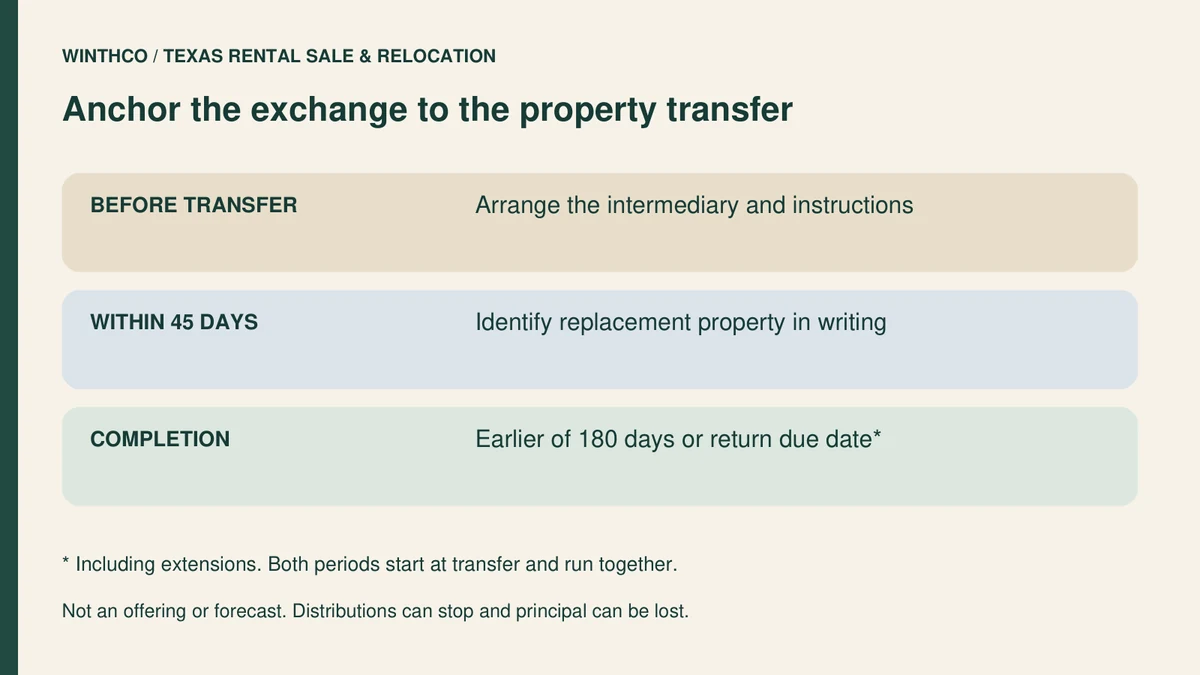
For a standard deferred exchange, have the qualified-intermediary agreement and settlement instructions arranged before the rental transfers. Actual or constructive receipt of proceeds can prevent the intended deferred-exchange treatment. Buying a DST later with cash already received does not retroactively establish the usual exchange structure. Confirm who owns and sells the property, who acquires the replacement, and who may control funds.
Generally, identify replacement property in writing within 45 days after the relinquished property transfers. Receive it by the earlier of 180 days after transfer or the federal tax-return due date for that year, including extensions. The periods run together. A family move, delayed home purchase or change of address does not restart them. Have the intermediary confirm identification rules and the CPA review any filing extension or specifically applicable relief.
WATCH & LEARN
Winthco Wealth Management’s introductory video provides general context. It is not destination-state tax advice, an election forecast or a recommendation of a particular offering. Original resource · Watch on YouTube ↗
Educational context only. The discussion does not establish the suitability, returns or tax treatment of an investment.
Consider a hypothetical Texas landlord who plans to relocate in December while a buyer expects to close on the rental in January. The household needs cash for a rental deposit and moving services before any sale proceeds exist. Those expenses need a separate funding plan. If the property transfer later shifts, update the exchange calendar from the actual transfer date rather than the original contract estimate.
This example does not recommend a closing month or calculate tax. Ask the CPA how the move affects residency and recognized income in each state. Ask the intermediary how a changed closing date affects identification and completion. Ask the adviser whether adequate money remains outside an illiquid investment. Each answer should be settled on its own facts before committing to a replacement or personal-home purchase.
A move does not erase federal gain, and destination-state rules need their own review. California, for example, taxes a part-year resident on worldwide income during the resident period and California-source income during the nonresident period. Other destinations can differ. Give the CPA the actual residency facts, rental location, transfer date, exchange structure and expected payment dates rather than asking for a conclusion based only on a mailing address.
An installment note adds another timing issue. FTB Publication 1100 includes an example of a Texas rental sold on installments before the seller became a California resident. Capital-gain and interest income received after residency began were taxable by California in that example. Closing before a move therefore is not a universal solution to later state taxation. Ask about conformity, reporting and future income before accepting seller financing or finalizing an exchange.
A qualifying Delaware statutory trust interest may offer replacement real estate without the same direct tenant and maintenance responsibilities. IRS Revenue Ruling 2004-86 addresses a particular trust structure with restricted powers. The DST name alone is insufficient; the actual documents and exchange must qualify. Winthco’s DST services overview provides an introduction, while independent tax and legal advisers determine how the rules apply to you.
For a relocating owner, limited control is both practical and consequential. You may no longer manage repairs, but you generally cannot set the property sale date to match a future home purchase. Review the sponsor, tenants, property condition, geographic exposure, financing and debt maturity. Compare direct replacement ownership, a suitable qualifying DST and a taxable sale with greater accessible liquidity rather than assuming one structure fits every move.
Request the offering memorandum and a written explanation of acquisition, placement, financing, management and disposition fees. Review reserves, lease expirations and the assumptions behind projected distributions. The DST document evaluation guide helps organize those questions. Ask what would happen to your household if distributions were reduced or stopped while you were paying relocation costs or settling into retirement.
Private DST interests can be difficult to resell, may have transfer restrictions and may need to be held longer than expected. Sponsor, property, tenant, debt and concentration risks can lead to loss of principal. Accredited-investor eligibility, where required, is not a finding that an investment is suitable. Keep essential spending needs separate from uncertain distributions, and review the actual investment rather than relying on a tax illustration.
A possible later Section 721 contribution to an operating partnership is a separate transaction, with its own conditions, approvals, documents and tax analysis. It is not an automatic continuation of every DST investment or a substitute for completing the current exchange. Ordinary REIT shares and operating-partnership units are not direct 1031 replacement real estate.
Ask who controls any proposed contribution, what fees and restrictions apply, how liabilities and built-in gain are treated, and whether redemption or conversion could produce tax. Do not fund an upcoming personal-home purchase on the assumption that units can be redeemed when needed or that a withdrawal will be tax-free. The existence of a possible exit does not establish its availability or timing.
As checked November 5, 2026, the Texas Secretary of State page reports November 3 election returns and displays a November 4 update. This article does not treat those returns as certified winners or predict policy changes. Election returns, campaign proposals, enacted legislation and effective dates are distinct. The exchange discussion here relies on the current IRS materials linked below, not an assumption that an election has already changed Section 1031.
Before the sale, bring the proposed transaction and move budget into a broader financial-planning conversation. Review taxable investments, IRAs, 401(k)s, retirement-income needs, estate documents and beneficiary designations alongside the real estate concentration. These accounts are separate from exchange proceeds. A property sale does not by itself make an account transfer, rollover or new advisory relationship appropriate.
Winthco describes wealth-management and DST planning services on its main website. You can request a conversation using this page’s prospect form or call the office to discuss the timeline and questions to take to your CPA, attorney and intermediary. Start with the information needed for planning; do not send account passwords, Social Security numbers or sensitive documents through a general inquiry.
| Decision | Evidence to request | What to avoid assuming |
|---|---|---|
| Personal move | Expense dates and cash already available | The exchange account can pay household bills. |
| Rental transfer | Executed settlement date and intermediary instructions | The moving date starts the 45-day clock. |
| Destination state | Residency facts, payment dates and state tax advice | Closing before moving removes every later state tax. |
| DST selection | Offering documents, fees, liquidity and downside review | Projected distributions will fund the new home. |
| Possible 721 contribution | Separate approvals, documents and tax analysis | The next transaction or redemption is automatic. |
A move does not by itself prevent a qualifying 1031 exchange. Review the rental’s actual investment use, transaction requirements and the destination state’s residency and income rules before deciding the closing schedule.
A personal home generally is not qualifying replacement real estate. Cash retained for personal needs may create taxable gain, so have the CPA and intermediary plan any partial exchange before closing.
No ordinary extension arises merely because you move. The identification period generally runs from transfer of the relinquished property, with completion due by the earlier of 180 days or the applicable federal return due date, including extensions.
No income amount should be assumed. Distributions can decrease or stop, and the investment may be difficult to sell; plan relocation and essential spending with accessible resources.
Not necessarily. Residency, sourcing, payment timing and state rules matter. California’s published Texas installment-sale example shows that later payments received as a resident can still be taxable there.
Election returns do not themselves enact tax law. Check enacted legislation and effective dates with your tax adviser rather than relying on predictions or treating preliminary returns as certified results.
Sources checked November 5, 2026. This article explains general concepts; your facts and the applicable documents control.
Winthco DST services · Winthco evaluation overview · Editorial standards
1031 exchange planning
Plan the identification and completion periods for a deferred 1031 exchange, including the earlier tax-return deadline.
Read guide →1031 exchange planning
Can you keep cash and use a DST in a partial 1031 exchange? Review boot, debt, timing and retirement liquidity before selling your rental.
Read guide →Texas property transition guide
Selling Texas land or rental property before a move? Review 1031 tax deferral, DST risks, home-sale rules and the 2026 election context.
Read guide →Explore Winthco’s main DST article collection
Share your timeline and investment range. A Winthco team member will follow up with you.