1031 exchange planning
DST debt replacement: boot and added cash
Understand DST debt replacement, added cash and mortgage boot with a worked example and questions for your CPA and qualified intermediary.
Read guide →
Home / Learning center / 1031 exchange planning
1031 exchange planning
Winthco Wealth Management · Updated October 15, 2026
A partial 1031 exchange may let you acquire qualifying replacement property, including a qualifying DST interest, while retaining some cash. Cash received can trigger recognized gain, and debt relief can also matter. Plan the exchange and cash-release terms before closing with your qualified intermediary, CPA and attorney; do not assume all proceeds remain tax-deferred.
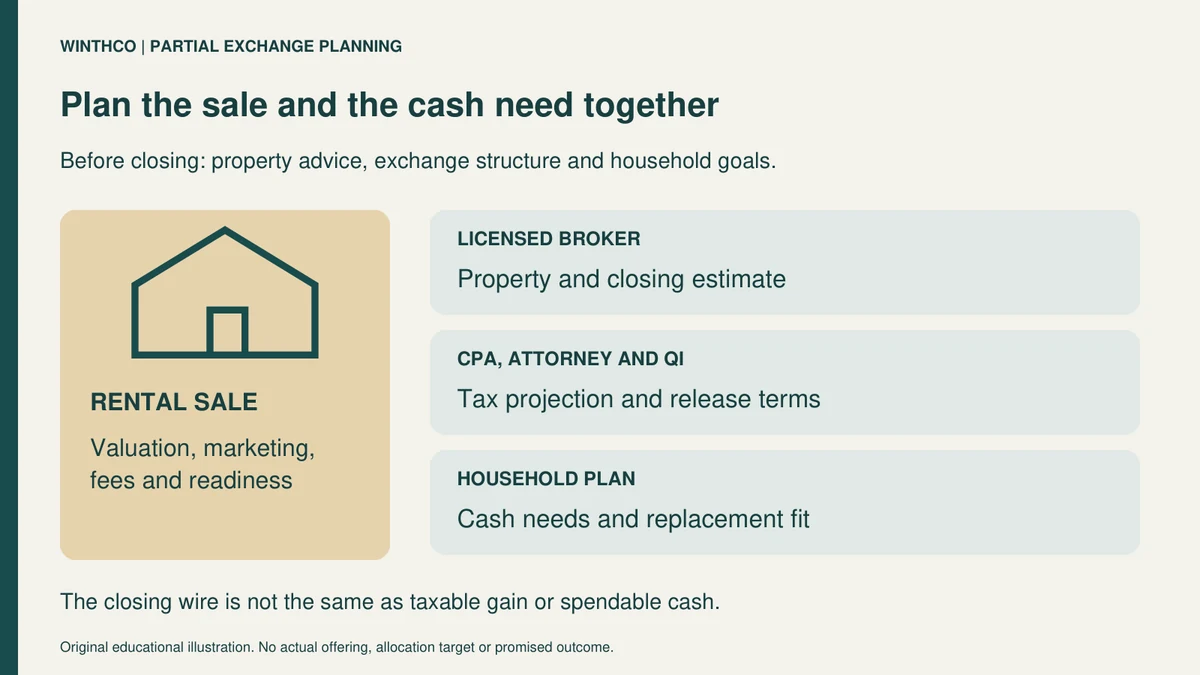
Selling a rental can create two competing goals: leaving day-to-day property management and keeping money available for life outside real estate. When interviewing an appropriately licensed realtor or commercial broker, ask about valuation, marketing, fees, property-type experience and sale readiness. Request a preliminary closing estimate, but do not mistake the expected wire amount for a tax calculation or an investable budget.
Bring the CPA, attorney and qualified intermediary into the planning before closing or receiving proceeds. Explain which funds you may need soon and which could remain invested. Winthco's replacement-property options for a planned exchange can frame the investment discussion, while the tax team evaluates eligibility and consequences. The objective is an informed balance between deferral and accessible resources, not the largest possible subscription.
Share your timeline and investment range. A Winthco team member will follow up with you.
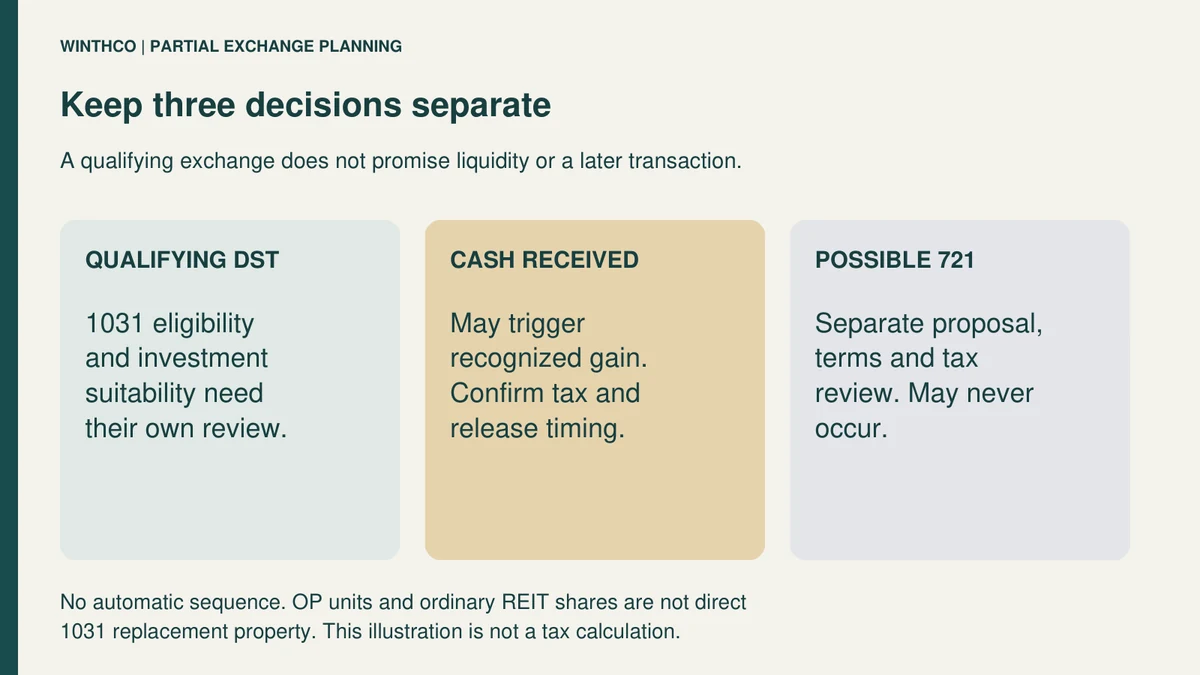
IRS Publication 544 describes partially nontaxable exchanges in which qualifying property and money or other non-like-kind property are received. In a gain transaction, some gain may be recognized now while other eligible gain remains deferred. The cash and other non-like-kind value are often called boot. A partial exchange is not a special DST product, and using a DST does not itself make retained cash tax-free.
Keep three questions separate: how much cash will be received, how much gain must be reported, and how much tax is due. They are not interchangeable amounts. Adjusted basis, liabilities, exchange expenses and the character of gain affect the analysis. Ask the CPA for a written projection using the actual transaction records, rather than applying one assumed tax rate to the sale price or cash balance.
Do not describe the retained cash as simply taking back your original investment first. Tax basis is part of the gain and replacement-basis calculations, not a separate pocket you can automatically withdraw tax-free. If you want to keep a particular amount after tax, ask the professional team to work backward from that goal and identify the assumptions that could change before closing.
A property's selling price, loan payoff and net equity tell different stories. The Form 8824 instructions include certain net liabilities assumed by another party in the amount considered alongside cash and other property received. That is why receiving little cash does not, by itself, establish that no gain is recognized. Have the CPA reconcile liabilities on both sides of the exchange.
Use Winthco's mortgage considerations in a 1031 exchange as background for questions about debt replacement, then review the actual DST allocation and documents. Taking on more replacement debt does not automatically cancel the tax effect of cash received. Form 8824's examples illustrate that distinction. Ask the tax professional to show the calculation rather than relying on a slogan about replacing the mortgage.
Borrowing is also an investment decision. A leveraged DST may introduce debt-service, refinancing and lender-control risks, even if its structure fits part of the exchange plan. Compare the proposed interest with alternatives on property quality, fees, leverage and household exposure. Do not accept unwanted financial risk solely to pursue a projected tax result.
Discuss your DST questions with Winthco →
Exchange proceeds are not an ordinary checking balance. Treasury Regulation 1.1031(k)-1 and the IRS guidance on deferred exchanges address actual and constructive receipt and limits on access to funds. Your written exchange agreement matters. Ask the qualified intermediary and counsel to explain any planned cash distribution, the permitted release conditions and how the remaining exchange will be protected.
Do not instruct escrow to send the entire sale balance to your personal account with a plan to put some back later. Nor should you assume you can borrow against funds held for the exchange or request an unrestricted withdrawal whenever a household bill arrives. Have the team approve the structure and timing before giving closing instructions, and independently verify wiring instructions through an established channel.
The standard deferred-exchange deadlines still apply: identify replacement property within 45 days after transferring the relinquished property and receive it by the earlier of 180 days or the applicable return due date, including extensions. A partial exchange does not create a longer shopping period. Put identification, acquisition, tax-payment planning and expected cash availability on one calendar with the responsible professional named for each.
Under the specified facts of Revenue Ruling 2004-86, a beneficial interest in the described trust is treated as an interest in its real property for Section 1031 purposes. That ruling does not approve every trust or every offering. Ask your tax and legal professionals to evaluate the particular structure and your investment-use requirements before relying on exchange treatment.
A DST can change management responsibility because investors generally are not making daily property decisions. That difference does not make the investment liquid. Review the private placement memorandum, trust agreement, transfer restrictions, sponsor conflicts, property assumptions and all fees. Private DST offerings are generally limited to accredited investors. Eligibility is only an entry condition, not a conclusion that the investment fits your finances.
For a hypothetical retiring landlord, the useful comparison might be a larger qualifying replacement investment with less accessible cash versus a smaller replacement investment and a professionally estimated current tax cost. Neither choice is automatically better. Ask whether essential spending remains funded if distributions decline or stop. Also compare a fully taxable sale and continued ownership where appropriate, without assuming that an exchange must be completed at any investment cost.
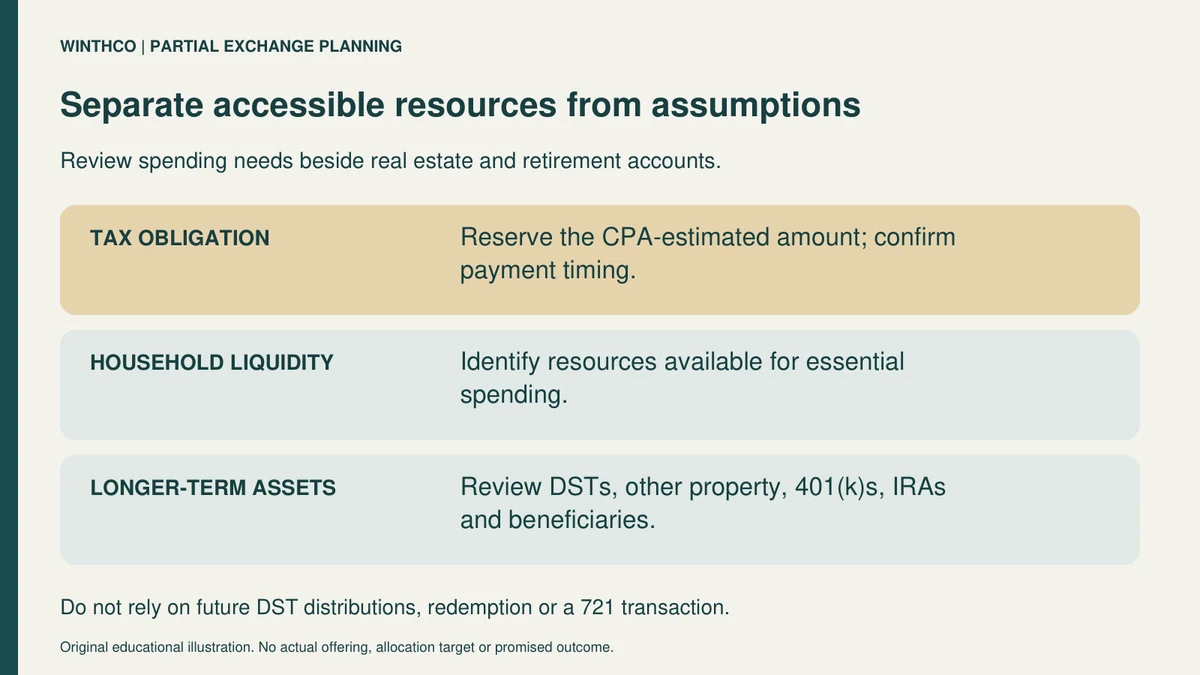
Separate a property's operating reserves from your personal reserve. Money held within the investment is not necessarily available for household withdrawals. Ask what you could access without selling a restricted interest, and test the plan if the anticipated property sale is delayed. This is a planning exercise, not a recommendation for a particular cash percentage or holding period.
WATCH & LEARN
Winthco Wealth Management provides general DST and property-sale planning background. This introductory video is not a partial-exchange tax calculation or a promise of income, liquidity or tax treatment. Review the current IRS sources and your transaction with qualified professionals. Original resource · Watch on YouTube ↗
Educational context only. The discussion does not establish the suitability, returns or tax treatment of an investment.
Treat a possible Section 721 contribution as a separate transaction, not the final guaranteed step in a 1031 exchange. Winthco's 721 UPREIT structure overview provides background for that conversation. Ordinary REIT shares and operating-partnership units generally do not qualify as direct Section 1031 replacement real property. A future contribution may be unavailable, declined or subject to terms that do not fit your needs.
IRS Publication 541 explains the general partnership-contribution framework and exceptions, including circumstances involving related transfers of money or property. Ask tax counsel to analyze the proposed structure, liabilities and any cash movement. Do not assume that combining steps under different tax provisions makes the whole sequence tax-free or that a later redemption avoids recognizing gain.
Review any lockups, redemption conditions, fees and issuer discretion before treating partnership interests as a liquidity solution. A conversion or redemption may have tax consequences, and FIFO does not guarantee tax-free withdrawals of basis. The current DST should make sense even if no later contribution occurs. Near-term expenses need a funding plan that does not depend on an uncertain future transaction.
The SEC warns that private placements can involve limited disclosures, restricted resale and loss of the entire investment. A partial exchange does not reduce those risks within the DST interest itself. Review sponsor, property, tenant, debt, fee and tax-law risks, limited control and exit provisions. Distributions are not guaranteed, and principal can be lost.
FINRA cautions that concentration can exist across investments sharing property types, geography or other exposures. Keeping some cash does not prove that the rest of your portfolio is diversified. Review remaining rentals, other DSTs, business interests and marketable assets together. Diversification cannot guarantee a profit or prevent loss. Use consistent valuations and avoid treating an appraisal or estimated exit value as available cash.
Ask the CPA to revisit the projection when the purchase price, closing costs, loan allocation or retained amount changes. Set aside the expected tax obligation separately from discretionary spending, using the professional's payment guidance. Preserve the final settlement statements and replacement-property records for reporting, including Form 8824 where required. A preliminary planning worksheet is not the filed return.
Bring the property decision into a broader conversation with Winthco's financial-advising and wealth-management team. Review existing financial assets, 401(k)s, IRAs, retirement-income needs and accessible reserves alongside the proposed real estate allocation. Distinguish essential expenses from optional spending, and ask how the household would respond to lower distributions or an extended holding period.
Coordinate beneficiary and estate questions with counsel and tax estimates with the CPA. Retirement accounts are not themselves 1031 exchange proceeds, and a rental sale does not automatically call for a rollover, transfer or advisory engagement. Compare relevant account options, costs and services independently. Use the prospect form to discuss your sale timeline and cash-planning questions; request a verified secure channel before sharing confidential financial documents.
| Decision | Evidence to request | What to avoid assuming |
|---|---|---|
| Closing estimate | Sale price, payoff and cash movements | The wire amount equals taxable gain |
| Tax projection | Basis, liabilities, expenses and recognized gain | Original investment can always be withdrawn first tax-free |
| DST review | Offering documents, fees, risks and transfer limits | A qualifying exchange interest is a cash reserve |
| Household plan | Accessible assets, tax obligation and spending needs | Future distributions or a 721 transaction will fund every expense |
A qualifying exchange can be partially nontaxable when money or other non-like-kind property is received. Cash can trigger recognized gain. Have the CPA and QI plan the actual structure before closing.
No. Cash received, recognized gain and tax due are separate calculations. Basis, liabilities, expenses and gain character can affect the result.
Not automatically. The Form 8824 liability and cash rules require a full calculation; additional replacement debt does not necessarily offset cash received.
Do not assume unrestricted access. The exchange agreement and applicable deferred-exchange rules limit release of funds. Ask the QI and counsel before giving instructions.
They should not be assumed to be. Distributions may change or stop, and resale restrictions can prevent timely access to principal. Review other accessible resources.
No. It requires a separate review and may not occur. Any redemption or conversion terms and tax consequences must also be evaluated.
Sources checked October 15, 2026. This article explains general concepts; your facts and the applicable documents control.
Winthco DST services · Winthco evaluation overview · Editorial standards
1031 exchange planning
Understand DST debt replacement, added cash and mortgage boot with a worked example and questions for your CPA and qualified intermediary.
Read guide →1031 exchange planning
Learn how retiring landlords can compare a DST 1031 exchange with direct real estate, including control, liquidity, debt, income and risk.
Read guide →1031 exchange planning
Learn how exchange expenses, closing costs, DST fees and settlement records can affect gain, basis and cash planning in a 1031 exchange.
Read guide →Explore Winthco’s main DST article collection
Share your timeline and investment range. A Winthco team member will follow up with you.