Risks and due diligence
DST fees and expenses: what investors should compare
Learn how to review DST acquisition costs, ongoing expenses, financing charges and exit fees without relying on a single headline number.
Read guide →
Home / Learning center / 1031 exchange planning
1031 exchange planning
Winthco Wealth Management · Updated October 12, 2026
Some closing costs can qualify as exchange expenses, but the label on a settlement statement does not control the tax treatment. IRS guidance specifically addresses items such as brokerage commissions, attorney fees and deed preparation fees. A CPA should classify every charge before exchange funds are used to buy a Delaware statutory trust interest.
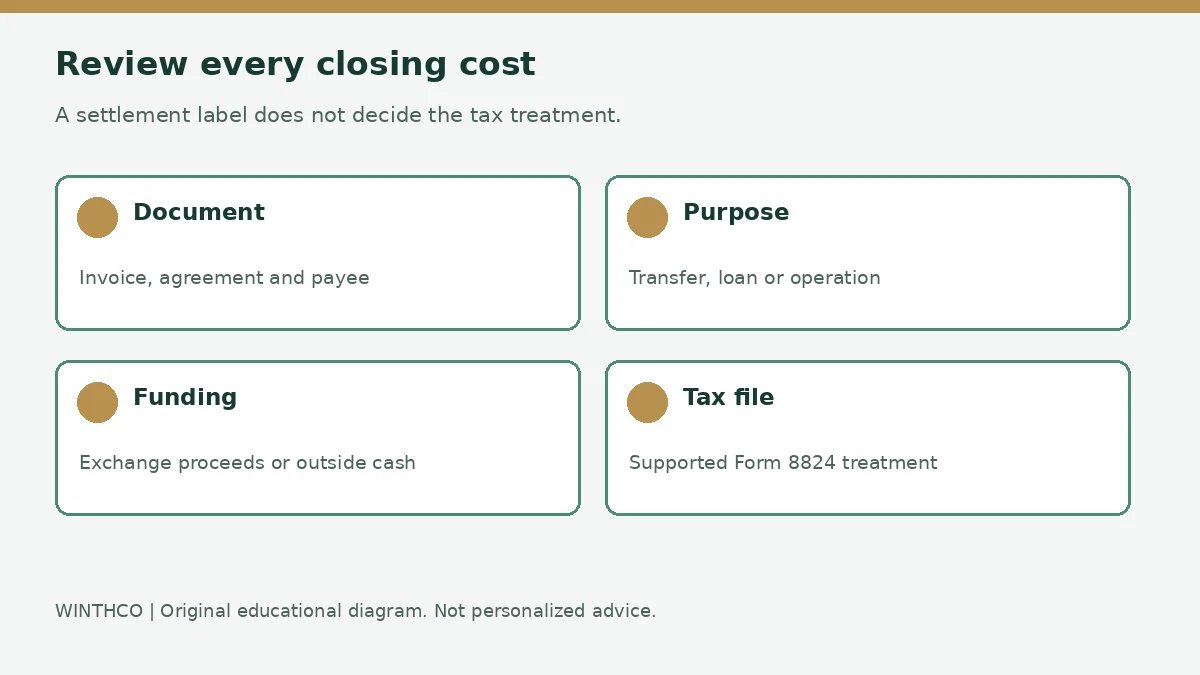
IRS Publication 544 says exchange expenses generally include closing costs paid on the disposition of the relinquished property, giving brokerage commissions, attorney fees and deed preparation fees as examples. Those examples are useful, but they are not a universal list for every charge that may appear in a modern sale or DST closing.
The expense must be connected to the exchange calculation, not merely shown on the same settlement statement. A charge can be commercially common yet still require separate tax treatment. Before closing, ask the CPA to mark each line as an exchange expense, a basis item, a financing cost, a property operating item, a proration or a personal payment.
Share your timeline and investment range. A Winthco team member will follow up with you.
The qualified intermediary can explain its document and fund-disbursement procedures, but the taxpayer's CPA or tax attorney should decide how a fee is reported. Winthco's 1031 exchange rules overview provides broader process context. It does not replace review of the actual sale agreement, closing statement, intermediary agreement and DST subscription documents.
Publication 544 instructs taxpayers to subtract qualifying exchange expenses from the consideration received when figuring the amount realized. If cash or non-like-kind property is received with replacement real property, the publication also uses exchange expenses in determining the limit on recognized gain. These calculations depend on the complete transaction, not on an isolated invoice.
The 2025 Form 8824 instructions similarly state that certain amounts on line 15 are reduced, but not below zero, by exchange expenses. The instructions also include exchange expenses in the line 18 computation except to the extent already used on line 15. Reusing the same cost twice would overstate the adjustment.
A closing-cost estimate is not a tax return. Sale price, adjusted basis, cash received, liabilities relieved or assumed, non-like-kind property, recognized gain and exchange expenses interact. Give the CPA both sides of the transaction so the Form 8824 workpapers reconcile to the final settlement statements and qualified-intermediary ledger.
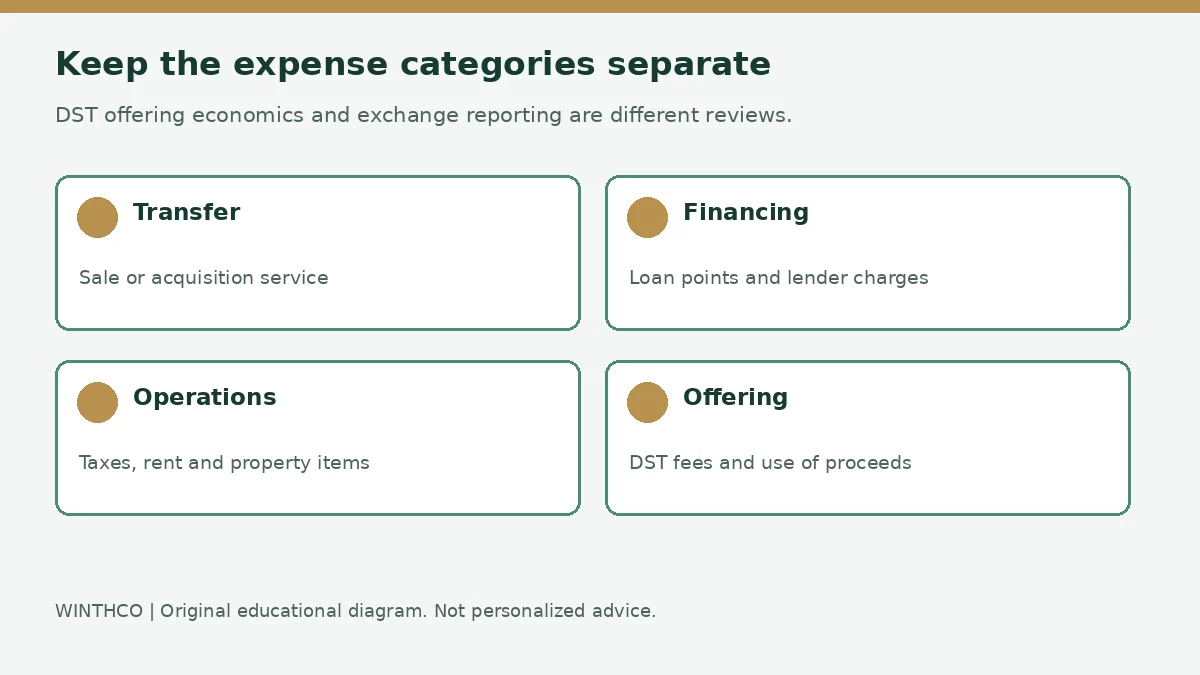
Broker commissions, attorney fees and deed preparation fees appear in the IRS examples of exchange expenses. Other transaction charges may be treated consistently with their purpose and governing authority, but a title such as processing fee, escrow fee, appraisal fee or inspection fee is not enough by itself. The agreement, recipient and reason for the payment matter.
Loan points, lender charges and costs incurred to obtain new financing may follow different rules from direct acquisition costs. Property taxes, rent, insurance, security deposits, utilities and association dues may be prorations or operating items rather than exchange expenses. Repairs, reserves and post-closing work should not be grouped with transfer costs simply because they are paid near closing.
Ask for a line-by-line classification before authorizing the intermediary or escrow holder to release funds. If the treatment is uncertain, use outside cash while the CPA evaluates the item rather than relying on a broad claim that every charge on a settlement statement is exchange eligible. The written tax position should match the final documents.
Discuss your DST questions with Winthco →
No. A DST offering can contain selling commissions, dealer-manager fees, organizational and offering costs, financing costs, reserves and property-level acquisition expenses. Those economics affect the amount invested and the investment's projected results, but they are not automatically the taxpayer's exchange expenses for Form 8824.
Revenue Ruling 2004-86 addresses the specific trust described in the ruling and concludes that its beneficial owners are treated as owning interests in real property for federal tax purposes. It does not classify every fee in a different DST offering. Review the private placement memorandum, trust agreement and subscription documents for the actual allocation of proceeds.
Use Winthco's DST tax reporting guide to organize documentation questions, then keep the tax analysis separate. The securities professional can explain offering charges and how proceeds are used. The CPA determines tax reporting. Neither role should promise that a sponsor fee will reduce recognized gain or increase basis without support.
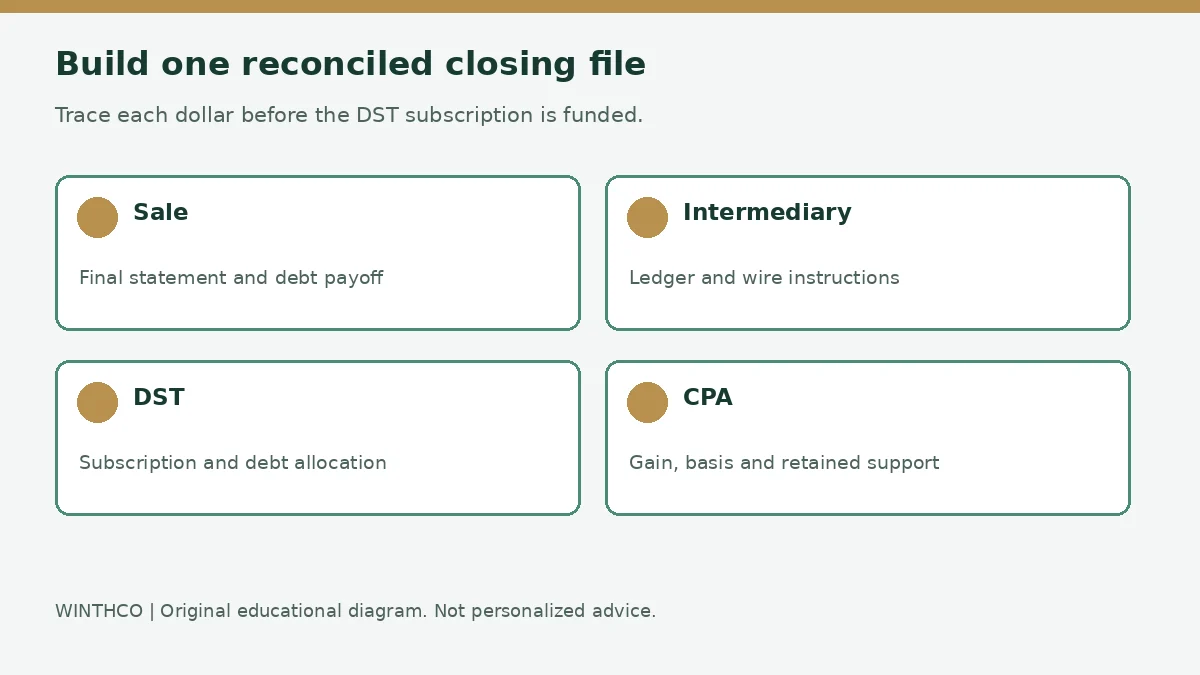
Start with a sources-and-uses schedule that traces gross sale proceeds, debt payoff, sale costs, intermediary deposits, cash retained, outside cash, replacement value and allocated DST debt. Reconcile the schedule to the qualified-intermediary ledger and every final closing document. Draft statements are not enough because last-minute credits can change the result.
For each charge, record the payee, contractual purpose, property side, amount, payment source and proposed tax category. Keep invoices for legal, brokerage, escrow, recording, title, environmental, inspection and financing services. The CPA may need more than the abbreviated label shown on a settlement statement.
Complete this review before the DST subscription is funded. A qualified intermediary planning resource can help frame the intermediary's role, but only the responsible professionals can approve disbursement mechanics and the reporting position. Preserve written instructions and confirmation that the replacement interest was acquired within the exchange structure.
WATCH & LEARN
Accruit discusses selling expenses that may be paid from exchange funds. This third-party video is educational, not a Winthco endorsement; IRS guidance, transaction documents and the taxpayer's professionals control. Original resource · Watch on YouTube ↗
Educational context only. The discussion does not establish the suitability, returns or tax treatment of an investment.
Yes, depending on the type of cost and the transaction. Publication 544 explains that the basis of replacement property in a like-kind exchange generally begins with the basis of the property transferred. In a partially nontaxable exchange, additional costs, liabilities, recognized gain, money and non-like-kind property can affect the final basis computation.
The term boot is common shorthand, but Form 8824 asks for specific money, property, liabilities, expenses and gain figures. Paying a questionable item from exchange proceeds can raise both recognized-gain and constructive-receipt questions. Do not assume that outside cash automatically cures a classification problem or that an intermediary's ability to send a wire settles the tax result.
If multiple DST interests are acquired, the CPA should allocate the supported replacement basis among them using the actual values and exchange workpapers. Retain that allocation with later sponsor tax packages. An unsupported full purchase-price basis can distort depreciation and the gain reported when an interest is eventually sold or exchanged.
Correct handling of exchange expenses does not make a DST suitable. The SEC warns that private placements can provide limited information, restrict transfers, be highly illiquid and expose investors to a total loss. Many DST interests are offered only to accredited investors, but accredited status is not a recommendation or proof of financial fit.
Read the private placement memorandum and evaluate property condition, tenants, leases, debt, reserves, sponsor experience, conflicts, fees, distribution assumptions and exit authority. Distributions can change or stop. Investors usually have limited control and may be unable to sell when cash is needed. A tax deadline should not compress investment review.
FINRA explains that concentration can arise by asset class, geography, security type and illiquidity. Several DST interests can still share a sponsor, lender, property type or tenant industry. Compare the proposed allocation with the investor's other real estate and private holdings, and retain liquid resources for taxes and personal needs.
Consider a hypothetical owner selling a small industrial property and planning to acquire two DST interests. The draft settlement statement includes a broker commission, deed preparation, property-tax proration, a loan payoff charge, an environmental report and an intermediary fee. This is an educational example, not a client story or tax conclusion.
The CPA requests each agreement and invoice, separates direct transfer costs from financing, operating and proration items, and builds a preliminary Form 8824 schedule. The qualified intermediary confirms which disbursements it can make under the exchange agreement. The securities professional supplies the offering documents, total subscription amount, debt allocations and offering-fee disclosures.
When the final statement changes, the team updates the schedule before funding. The owner uses outside cash for an unresolved item and retains the written classification analysis with the return. The two DST interests are evaluated separately for fees, property risk and liquidity, even though both are part of one exchange plan.
This guide uses AI-assisted research and drafting with Winthco Wealth Management organization attribution. IRS, SEC, FINRA and Accruit sources were checked on October 12, 2026. Confirm every expense, disbursement and reporting position with the professionals responsible for the transaction and tax return.
| Decision | Evidence to request | What to avoid assuming |
|---|---|---|
| Direct transfer cost | Invoice, contract, settlement statement and IRS guidance | Every item at closing receives the same tax treatment |
| Financing cost | Loan estimate, lender invoice and CPA classification | A lender charge is automatically an exchange expense |
| Proration or operating item | Lease, tax bill, closing credit and period covered | A customary proration always reduces recognized gain |
| DST offering fee | Private placement memorandum and use-of-proceeds table | Every sponsor fee belongs on Form 8824 |
| Final tax result | Complete Form 8824 workpapers and retained support | The qualified intermediary decides the return position |
No. The tax treatment depends on the purpose and authority for each payment. A qualified intermediary's operational ability to pay an item does not establish its tax classification.
IRS Publication 544 gives brokerage commissions, attorney fees and deed preparation fees as examples of closing costs generally included in exchange expenses. The taxpayer should still document the actual service and transaction.
Financing charges may follow rules different from direct sale or acquisition costs. Give the CPA the loan documents and invoices, and do not assume that paying the charge at closing makes it an exchange expense.
Not automatically. A DST offering's commissions and organizational costs are investment economics disclosed in the offering documents. The CPA must determine how the taxpayer's exchange expenses, cash and replacement basis are reported.
Reconcile the final version before funds move. Update the sources-and-uses schedule and obtain professional review of new credits or charges rather than relying on the draft analysis.
The taxpayer and retained tax professional are responsible for the return position. The qualified intermediary administers exchange documents and funds, while the securities professional explains the DST offering within that role.
Keep final settlement statements, invoices, intermediary records, Form 8824 workpapers, DST offering and subscription documents, the basis allocation and later sponsor tax packages. Those records support future depreciation and disposition reporting.
Sources checked October 12, 2026. This article explains general concepts; your facts and the applicable documents control.
Winthco DST services · Winthco evaluation overview · Editorial standards
Risks and due diligence
Learn how to review DST acquisition costs, ongoing expenses, financing charges and exit fees without relying on a single headline number.
Read guide →DST tax reporting
Learn how DST tax reporting can involve Form 8824, owner statements, basis, depreciation, state filings and private-placement risks.
Read guide →1031 exchange planning
Learn what a qualified intermediary does in a DST 1031 exchange and how to review agreements, fund controls, deadlines and professional roles.
Read guide →Explore Winthco’s main DST article collection
Share your timeline and investment range. A Winthco team member will follow up with you.