Farmland 1031 planning
Farmland 1031 exchange into a DST
Learn how farmland owners can evaluate a 1031 exchange into a DST, including asset allocation, deadlines, debt and investment risks.
Read guide →
Home / Learning center / Texas property transition guide
Texas property transition guide
Winthco Wealth Management · Updated November 7, 2026
Before listing long-held Texas land, build a documented adjusted-basis file rather than estimating tax from the sale price or county appraisal. Your CPA needs acquisition, improvement and prior tax records to evaluate the gain. Then compare a taxable sale with a properly arranged 1031 exchange before closing or receiving proceeds.
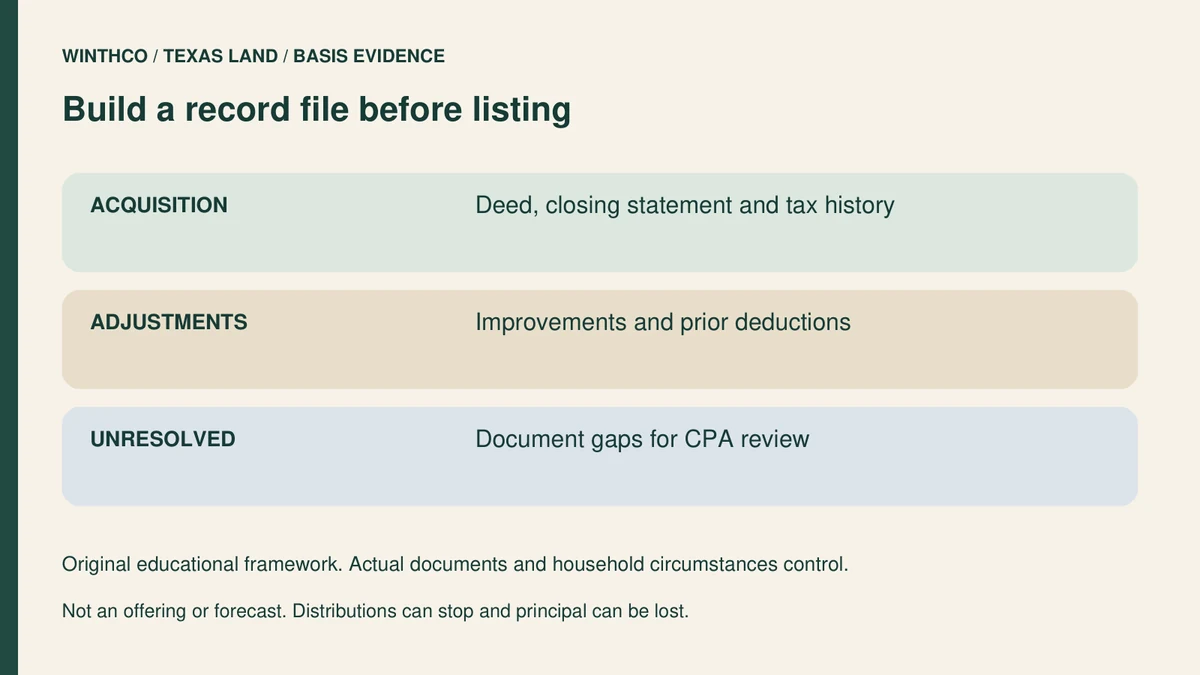
A Texas tract held for decades may have a simple-looking deed and a complicated tax history. Before agreeing to a listing price or promising family members a net amount, create a working folder for the parcel, its owner and its history. Use the Texas property transition master guide for the broader relocation and capital-gains choices; this article supplies a practical evidence checklist for the pre-listing meeting.
Interview a licensed Texas broker with experience in your property type, access rights, comparable land sales and likely buyers. Ask about surveys, leases, title exceptions, selling costs and realistic closing contingencies. Separately ask your CPA to reconstruct adjusted basis and your attorney to review ownership and contract terms. A broker price opinion answers a market question, not the tax-basis question. Bring a qualified intermediary into discussions before closing if an exchange remains a possibility.
Share your timeline and investment range. A Winthco team member will follow up with you.
Use one row for each event, with columns for date, description, amount, supporting document and CPA treatment. Add a separate unresolved column rather than filling gaps with estimates that look final. Suggested rows include acquisition, qualifying improvements, depreciation, prior exchanges, casualty adjustments, easement payments and partial sales. Keep the worksheet alongside the evidence, not as a substitute for it.
For each document, note the parcel or asset it concerns and who can explain it. A ranch invoice may cover a residence, equipment and investment land together. Ask the CPA to allocate and classify it rather than adding the entire invoice to land basis. Put uncertain entries in a review queue and record what would resolve them. This keeps a missing invoice from quietly turning into an unsupported tax deduction.
Discuss your DST questions with Winthco →
Start with the deed and closing statement, then identify whether the current owner bought, inherited, received a gift of, or exchanged into the property. Those routes can produce different starting bases. IRS Publication 551 explains purchase costs, inherited-property and gift rules; do not assume a family transfer resets basis to today’s market value. If there was an earlier exchange, locate its Form 8824 and supporting schedules.
Confirm the actual taxpayer before planning a sale. An individual, trust, estate or entity may appear in the history, and the person handling the paperwork is not necessarily the taxpayer selling the asset. Ask counsel to resolve inconsistent names or fractional interests. Do not transfer title casually to simplify the folder or assume every co-owner must make the same investment decision.
Collect invoices, payment evidence and depreciation schedules for structures, roads, fencing and other improvements. Capital improvements can affect basis, but routine deductible expenses generally are not added again. Basis reductions can include depreciation allowed or allowable and other adjustments. Land and depreciable improvements need separate treatment; a single gross number can conceal both an overstatement and an omission.
If records are incomplete, ask the CPA which alternative evidence is appropriate, such as prior returns, contractor records or closing files. Preserve the gap and its limitations. An appraisal may help with a valuation question but does not by itself establish what you paid for improvements. This process is about supportable reconstruction, not inventing a higher basis to reduce a tax estimate.
WATCH & LEARN
Equity Advantage’s 2020 educational discussion provides general context on management responsibilities. It is not Texas basis advice or a recommendation; DST investments retain fees, illiquidity and risk of loss. Original resource · Watch on YouTube ↗
Educational context only. The discussion does not establish the suitability, returns or tax treatment of an investment.
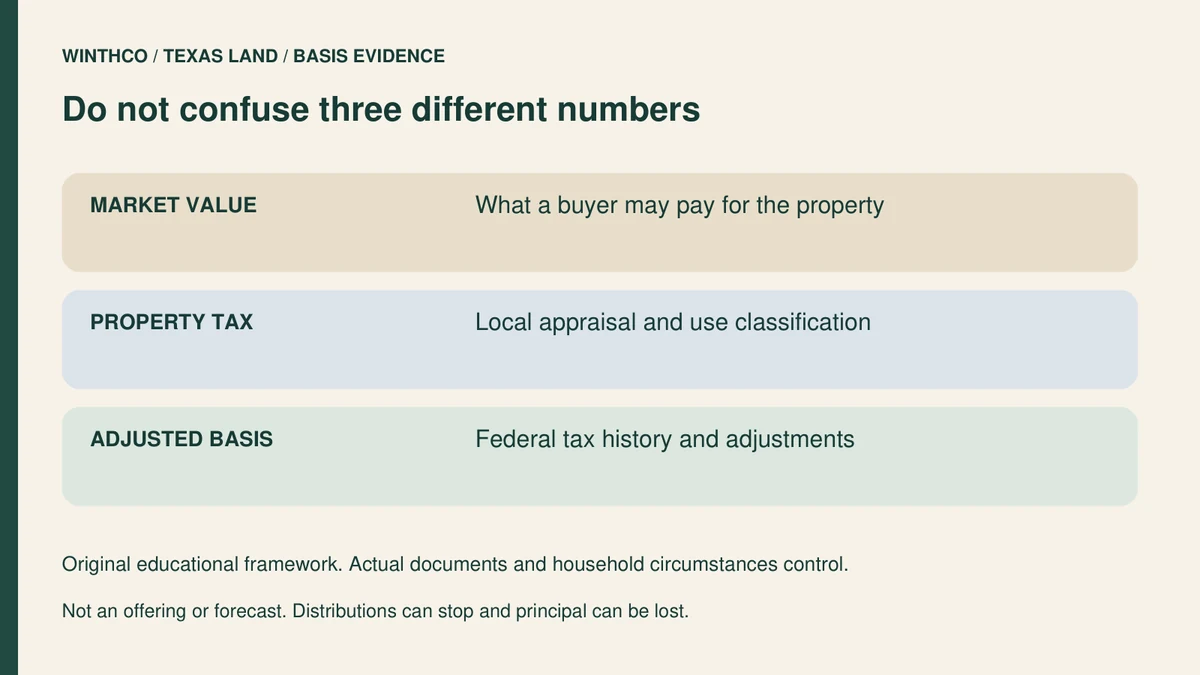
Texas agricultural or wildlife-management special appraisal concerns local property taxation. The Comptroller explains that qualifying land can be appraised based on productivity rather than market value. That figure is not automatically the federal adjusted basis used to calculate gain. Keep appraisal notices, qualification records and use history, but label them as property-tax documents.
A change to nonagricultural use can also raise rollback-tax questions. Ask the appraisal district and Texas counsel which classification, change-of-use rules and contract allocations apply to this parcel. Do not assume every land sale triggers the same charge, or that a federal 1031 exchange removes local property-tax obligations. These are separate reviews that should inform closing estimates.
Assume an investment tract sells for $1,200,000, with $60,000 of qualifying selling expenses and a CPA-verified adjusted basis of $300,000. A simplified gain illustration is $1,200,000 minus $60,000 minus $300,000, or $840,000. If a further $50,000 improvement is substantiated and properly capitalized, with no offsetting adjustment, the illustrated gain becomes $790,000. These assumptions are not an actual client result or tax calculation.
The example shows why documentation matters; it does not assign a tax rate or establish exchange eligibility. Debt payoff changes the cash available but is not simply subtracted as another basis item. Depreciation-related taxes, potential net investment income tax and state rules need separate analysis. Ask for taxable-sale and exchange scenarios using the same verified inputs, so that differences reflect the strategy rather than inconsistent numbers.
Section 1031 generally concerns real property held for investment or productive business use, not property held primarily for sale or a personal-use home. Long ownership alone does not settle the use question. Assemble leases, business records and the actual history of personal use or development activity. If the tract includes a home, tell the advisers rather than treating the entire parcel as investment land.
Section 121 may exclude eligible personal-residence gain when its requirements are satisfied; that is different from 1031 deferral. Mixed-use property requires allocation and tax review. Texas’s lack of an individual income tax does not eliminate federal taxes, and moving states does not erase a realized gain. Ask a CPA familiar with the destination state to assess residency, source rules and payment timing on your actual facts.
If a standard deferred exchange is appropriate, arrange the qualified intermediary and settlement instructions before transfer or receipt of proceeds. Actual or constructive receipt can defeat the intended structure. A later purchase of a DST with money already received does not automatically cure a failed exchange. Generally identify replacement property in writing within 45 days and receive it by the earlier of 180 days or the applicable federal return due date, including extensions.
Those deadlines run together from the property transfer. A complete basis file does not extend them. For the separate move and cash calendar, see the Texas rental sale and moving timeline. Have the intermediary and CPA explain identification, debt replacement, any taxable cash or other boot and reporting before you sign replacement documents.
A qualifying Delaware statutory trust interest can play a role in some 1031 exchanges under the structure addressed by Revenue Ruling 2004-86. The DST label alone is not enough. Start with the DST services overview, then review the actual offering, taxpayer eligibility and intermediary requirements. A potentially large tax bill does not make an unsuitable investment suitable.
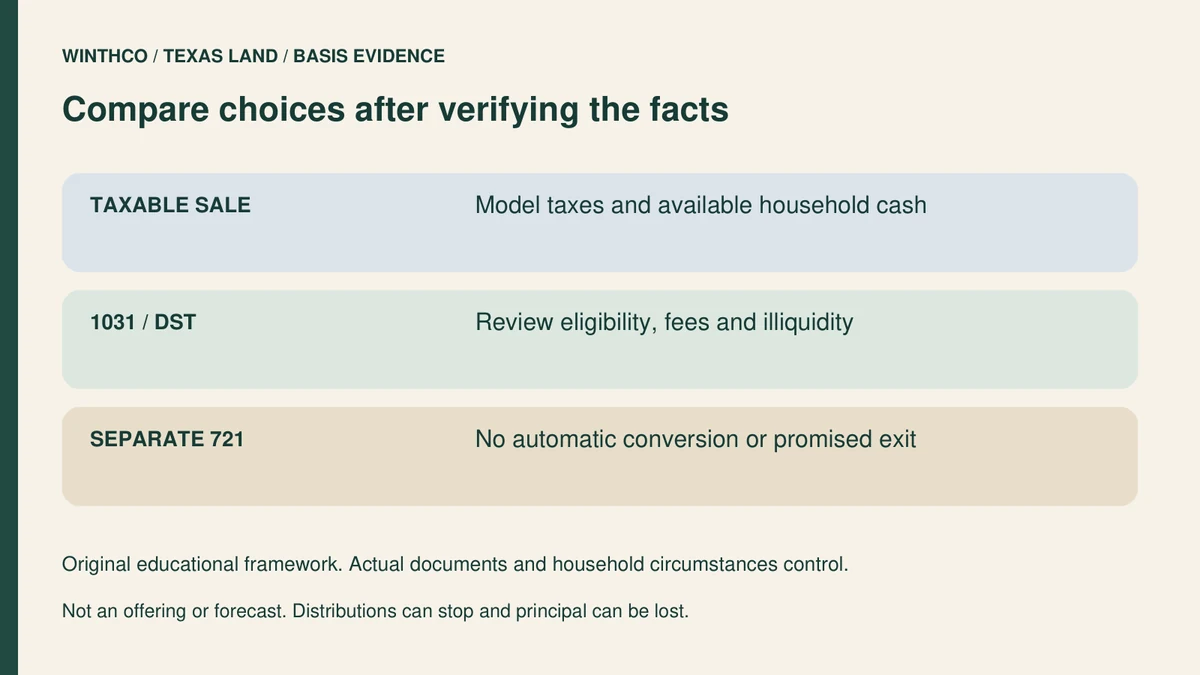
Ask for a written comparison of direct replacement ownership, a qualifying DST and a taxable sale with liquid proceeds. Review acquisition, placement, financing, management and disposition fees. Examine sponsor experience, property condition, tenants, leverage, debt maturities and concentration alongside the household’s needs. The DST document evaluation guide can organize that review. Distributions can fall or stop, interests may be illiquid, control is limited and loss of principal is possible.
A Section 721 contribution to an operating partnership is a separate transaction with its own documents, conditions and tax analysis. It is not an automatic DST conversion. Ordinary REIT shares and operating-partnership units are not direct 1031 replacement real estate. Ask who controls a proposed contribution and what fees, liability shifts and built-in-gain protections apply.
Neither redemption nor liquidity on a desired date is guaranteed. A contribution, later unit redemption or conversion may have tax consequences depending on the facts. Keep the original land records and exchange schedules accessible after any transaction; changing the investment structure does not make tax history irrelevant. Do not build a home purchase or essential retirement expense around an assumed tax-free withdrawal.
Before committing proceeds, list moving costs, reserves, healthcare spending and income needs alongside existing investments, 401(k)s and IRAs. Winthco can discuss financial advising and wealth planning in coordination with your independent tax and legal professionals. That conversation should test liquidity and concentration rather than assume every asset belongs in one strategy or account.
For the next meeting, bring the worksheet, unresolved-document list, proposed sale terms and a household cash budget. Ask which facts must be resolved before listing, before contract and before closing. This educational checklist was reviewed against the linked sources on November 7, 2026. It makes no claim about election winners, certified results, future migration or enacted tax changes resulting from an election.
| Decision | Evidence to request | What to avoid assuming |
|---|---|---|
| Purchased tract | Closing statement and subsequent adjustment records | County appraisal equals adjusted basis |
| Prior exchange | Form 8824 and carryover schedules | Latest purchase price resets the entire basis |
| Mixed-use property | Use history and supportable allocations | A personal residence qualifies for 1031 |
| Household move | Cash budget and state-residency review | Moving eliminates the realized gain |
No. County appraisal addresses property taxation; federal adjusted basis depends on acquisition and subsequent tax adjustments.
No. Your CPA must distinguish capital improvements from deductible expenses and account for prior deductions and adjustments.
No. Basis and deferred gain remain important to reporting and future dispositions.
Not automatically. Residency and federal exchange requirements are separate, and receipt of proceeds can prevent the intended deferred exchange.
Sources checked November 7, 2026. This article explains general concepts; your facts and the applicable documents control.
Winthco DST services · Winthco evaluation overview · Editorial standards
Farmland 1031 planning
Learn how farmland owners can evaluate a 1031 exchange into a DST, including asset allocation, deadlines, debt and investment risks.
Read guide →Texas property transition guide
Selling Texas land or rental property before a move? Review 1031 tax deferral, DST risks, home-sale rules and the 2026 election context.
Read guide →Texas property transition guide
Moving out of Texas after selling a rental? Coordinate cash needs, residency dates, 1031 deadlines and DST risks before closing.
Read guide →Explore Winthco’s main DST article collection
Share your timeline and investment range. A Winthco team member will follow up with you.