1031 exchange planning
DST 1031 exchange guide for retiring landlords
Learn how retiring landlords can compare a DST 1031 exchange with direct real estate, including control, liquidity, debt, income and risk.
Read guide →
Home / Learning center / Farmland 1031 planning
Farmland 1031 planning
Winthco Wealth Management · Updated October 8, 2026
Farmland held for investment or productive use in a business may be exchanged for other qualifying real estate, including an eligible DST interest, when Section 1031 requirements are satisfied. Farm sales often include equipment, crops, livestock or a residence, so classify each asset and coordinate the exchange before closing.
The IRS states that land, buildings and rental property are examples of real property that may qualify for Section 1031 when both the relinquished and replacement properties are held for investment or productive use in a trade or business. Like-kind does not mean farm for farm. IRS Publication 544 specifically says an exchange of city property for farm property, or improved property for unimproved property, can be like kind. Winthco's DST 1031 exchange structure page explains how a qualifying trust interest may fit into that broader real-property rule.
IRS Revenue Ruling 2004-86 concludes that beneficial owners of the specifically described, restricted Delaware statutory trust are treated as owning undivided interests in the trust's real estate. Under those facts, exchanging qualifying real property for the DST interests can qualify under Section 1031 if every other requirement is satisfied. The ruling does not approve every trust. Review the actual trust agreement, tax opinion and offering documents before identifying or funding a replacement.
Share your timeline and investment range. A Winthco team member will follow up with you.
Start with the farmer's purpose and ownership. Land held for farming, leasing or investment may be eligible, while property held primarily for sale or for personal use does not qualify under the same rule. Confirm whether an individual, married couple, partnership, corporation, trust or estate is the federal tax owner. The sale contract, deed, qualified intermediary documents and replacement subscription should align with that taxpayer.
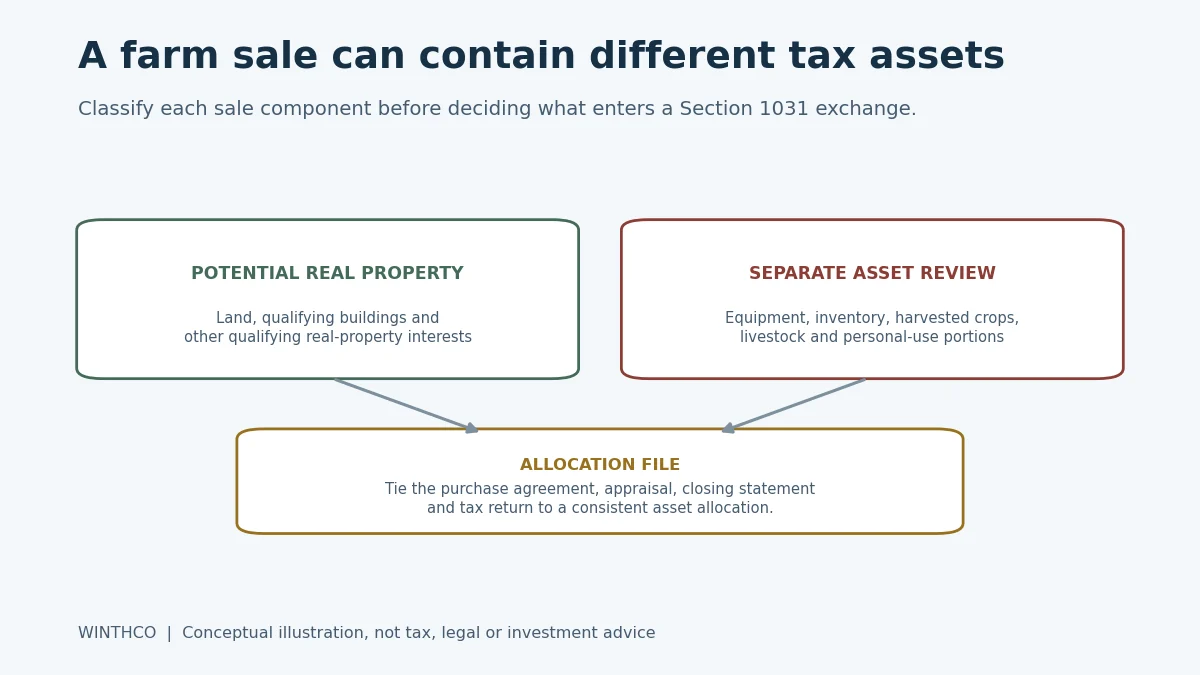
A farm sale can include several tax assets even when the buyer pays one price. Land and qualifying buildings may be real property, while tractors, vehicles, movable equipment, inventory, harvested crops, livestock and other personal property are not automatically eligible for Section 1031 treatment. IRS Publication 544 says a business sale must be analyzed asset by asset and that non-real-property assets are not like-kind property under the current exchange rules.
The purchase agreement should allocate consideration consistently with the appraisal, closing statement and tax reporting. Barns, irrigation systems, wells, storage structures, permanent improvements, water rights and mineral interests can require fact-specific federal and state classification. Do not assume that an item is real property merely because it is used on the farm or included in the deed. The CPA and attorney should document the classification before the taxpayer signs a final allocation.
Mixed-use property needs another layer. A farmhouse, family-use acreage, employee housing, leased ground and business land may have different uses and tax histories. Personal-use portions may not qualify for Section 1031, and Section 121 home-sale rules can interact with the transaction. Separate basis, value, improvements and depreciation for each component. Winthco's 1031 replacement-property options overview can help organize alternatives after the qualifying exchange amount is established.
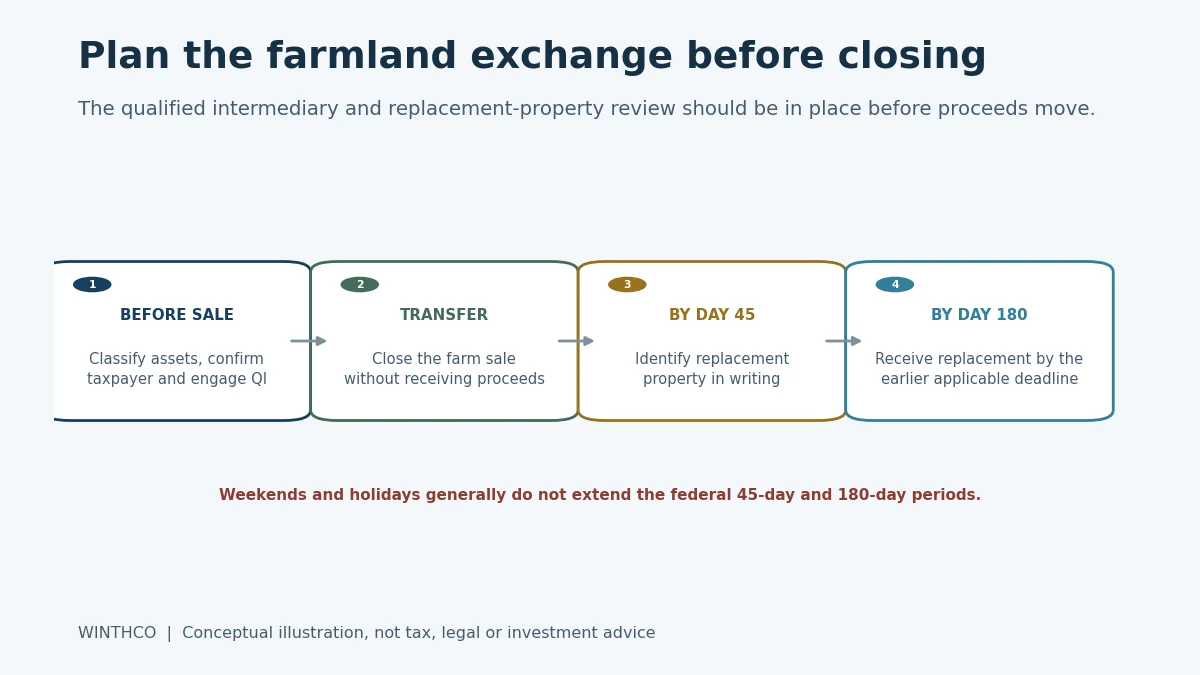
Engage a qualified intermediary before the farmland transfers. If the seller receives or controls the proceeds, the deferred-exchange safe harbor may be unavailable. Provide the intermediary with the correct taxpayer name, title records, sale agreement and expected closing date. At the same time, ask the CPA to calculate adjusted basis, depreciation, liabilities, exchange expenses and a preliminary allocation among real and non-real property.
The federal identification period generally ends 45 days after the relinquished property transfers. The replacement must generally be received by the earlier of 180 days after that transfer or the due date of the applicable federal return, including extensions. Identification must be written, signed and delivered to a permitted party, and the replacement property must be clearly described. Weekends and holidays generally do not extend these periods.
Do not wait until closing to begin DST review. A private placement requires time to examine the property, tenants, leases, valuation, debt, reserves, sponsor, fees, conflicts, trust restrictions and subscription requirements. The farm owner may also need to compare a direct replacement farm, commercial property, professional management, a mixed replacement plan and a taxable sale. Tax deferral is one factor, not the entire decision.
Discuss your DST questions with Winthco →
A complete tax model should compare the farm's sale value, adjusted basis, liabilities, cash received and replacement consideration. Receiving cash or other non-like-kind property can cause recognized gain. A reduction in liabilities can also affect the calculation unless offset by other consideration under the applicable rules. The owner should not treat debt replacement as a simple dollar-for-dollar investment target without the CPA's full Form 8824 analysis.
Basis generally carries into qualifying replacement property subject to statutory adjustments. Farm improvements may have separate depreciation histories, and recapture rules can vary by asset. Preserve depreciation schedules, cost-segregation studies, improvement records, conservation or easement documents, water-right records and the final purchase-price allocation. The DST's annual tax package does not replace the historical farm records needed to support the exchange and a later disposition.
State rules can add withholding, deferred-gain tracking and nonresident returns. A California farm exchanged for out-of-state DST property, for example, can create annual Form FTB 3840 reporting until the California-source deferred gain is recognized. A multi-state DST may also create filing obligations where the underlying properties operate. Ask for a sample tax package and a list of property states before investing.
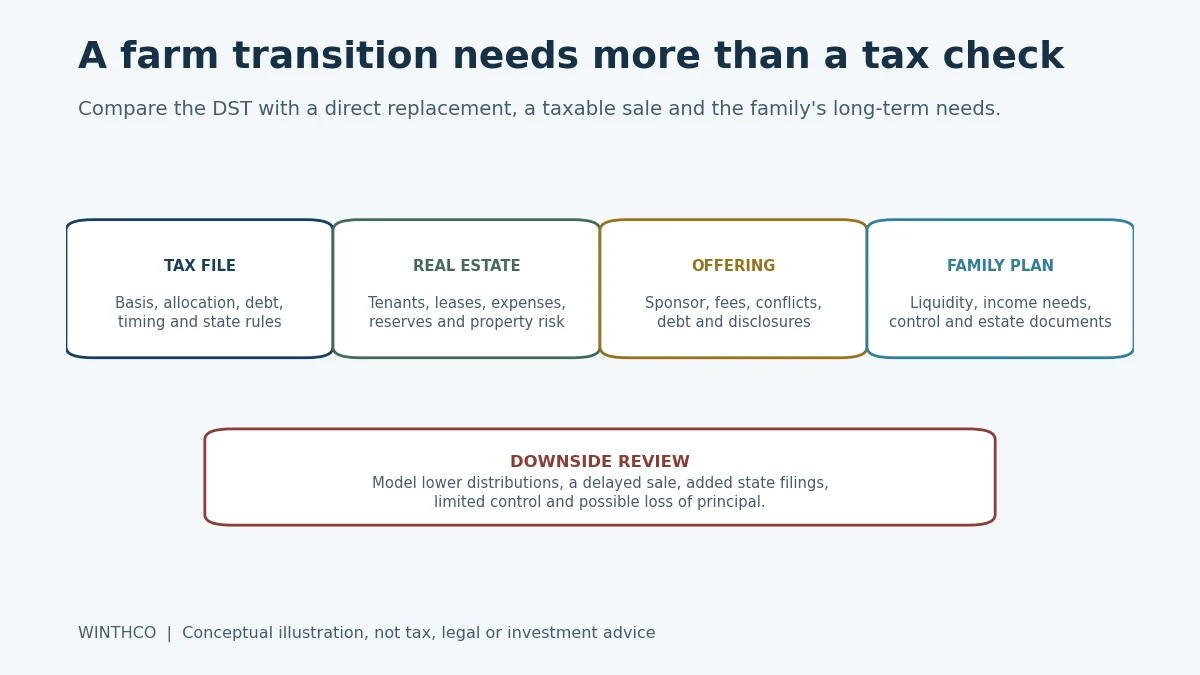
Begin with the real estate rather than the projected distribution. Review purchase price, independent valuation evidence, leases, tenant credit, occupancy, local supply, insurance, property taxes, operating costs, capital needs and reserves. If the trust owns several properties, examine each property and the allocation of revenue and debt. Professional management can reduce farm duties, but it also removes direct control over leasing, financing and sale timing.
Then trace every layer of compensation and financing. Review acquisition, selling, organization, financing, asset-management, property-management, servicing and disposition fees, along with affiliate relationships. Read the loan rate, maturity, amortization, extension rights, covenants and lender remedies. Rebuild projected cash flow after vacancy, expense growth, capital work, reserves and debt service. Distributions can decline or stop, and the sponsor may sell earlier or later than expected.
Finally, measure household concentration and liquidity. Selling one large farm and purchasing one or several DST interests may change property type and geography, but the household can remain heavily concentrated in illiquid real estate. Map common sponsors, tenants, lenders, markets and economic drivers. Keep sufficient liquid assets outside the DST for taxes, emergencies and family needs. Winthco's DST estate-planning considerations page can support the family discussion, but current legal documents and independent advice control.
WATCH & LEARN
Top Producer Podcast host Paul Neiffer speaks with Jim Parry and Cameron Rafati of Iron Ridge Advisors about farmland sales, Section 1031 exchanges and DSTs. This third-party discussion is educational background, not a Winthco endorsement; current law, offering documents and the investor's advisers control. Original resource · Watch on YouTube ↗
Educational context only. The discussion does not establish the suitability, returns or tax treatment of an investment.
DST interests used in exchanges are generally private placements. The SEC warns that private placements may involve limited disclosure, high illiquidity, transfer restrictions and possible total loss. A Form D filing is not SEC approval. The investor should read the private placement memorandum, confirm accreditation requirements, check the professionals involved and be prepared to hold the interest without a dependable secondary market.
FINRA cautions investors to understand complex products, costs and concentration risk. Several DSTs do not automatically create effective diversification if they share a sponsor, lender, tenant, property type or region. A long hold can conflict with family liquidity, farm succession, retirement spending or estate settlement needs. Beneficial owners generally cannot direct repairs, refinancing, leasing or the property's sale.
Use a written comparison before committing. Score the DST, direct replacement property, professionally managed farm, partial exchange and taxable sale for control, workload, liquidity, income variability, debt, fees, tax reporting, estate planning and downside risk. Coordinate the qualified intermediary, CPA, attorney and securities professional before closing and again before funding. A DST may change management responsibilities, but it cannot promise tax deferral, distributions, liquidity, sale timing or return of principal.
| Decision | Evidence to request | What to avoid assuming |
|---|---|---|
| Farm sale assets | Land, buildings, improvements, equipment, crops, livestock and residence use | The full farm sale is one qualifying real-property asset |
| Exchange procedure | Taxpayer, qualified intermediary, written identification and receipt dates | The exchange can be organized after sale proceeds are received |
| DST tax review | Trust powers, tax opinion, Form 8824 model, basis and liabilities | Any product labeled DST qualifies for Section 1031 |
| Investment review | Property, tenants, debt, reserves, sponsor, fees and conflicts | Tax eligibility establishes investment suitability |
| Family fit | Liquidity, control, income needs, estate documents and downside cases | A DST guarantees income or an easy exit |
Potentially. The land must be real property held for productive use in a trade or business or for investment, and the transaction must satisfy the other Section 1031 requirements.
Potentially. Like-kind real estate can differ in grade or use, and Revenue Ruling 2004-86 recognizes the specifically described DST interests as interests in the underlying real estate.
Generally not under the current real-property-only rules unless a particular item meets the federal definition of real property. Equipment and other sale assets require separate classification.
They are not automatically qualifying real property. The purchase agreement and tax analysis should allocate value among the farm's separate assets before closing.
The business or investment portion may require separate analysis from personal residence use. Section 121 and Section 1031 can interact, so the taxpayer should obtain individualized tax advice.
In a deferred exchange, replacement property generally must be identified in writing within 45 days after the relinquished property transfers and received by the earlier applicable 180-day or return-due-date deadline.
No dependable secondary market should be assumed. DST interests are generally illiquid private placements with transfer restrictions and sponsor-controlled sale timing.
Sources checked October 8, 2026. This article explains general concepts; your facts and the applicable documents control.
Winthco DST services · Winthco evaluation overview · Editorial standards
1031 exchange planning
Learn how retiring landlords can compare a DST 1031 exchange with direct real estate, including control, liquidity, debt, income and risk.
Read guide →California 1031 planning
Learn how California owners can evaluate a DST replacement, federal deadlines, Form FTB 3840 reporting, liquidity and investment risks.
Read guide →1031 ownership planning
Learn how co-owners and LLC members evaluate separate 1031 exchange paths, DST replacements, ownership rules, deadlines and risks.
Read guide →Explore Winthco’s main DST article collection
Share your timeline and investment range. A Winthco team member will follow up with you.