1031 exchange planning
Qualified intermediary for a DST 1031 exchange
Learn what a qualified intermediary does in a DST 1031 exchange and how to review agreements, fund controls, deadlines and professional roles.
Read guide →
Home / Learning center / Texas property transition guide
Texas property transition guide
Winthco Wealth Management · Updated November 19, 2026
A contract clause saying you intend to do a 1031 exchange does not set up the exchange. Before the Texas rental transfers, ask your attorney, qualified intermediary and closing agent to reconcile the signed sale contract, written exchange agreement, any assignment and notice, and proceeds instructions. Do not assume returning an accessible wire will fix an exchange.
A sale can be in motion before the owner has chosen a replacement investment. Interview a Texas broker or agent who regularly handles the property type. Ask for a price range, likely inspection and financing conditions, estimated costs and a closing schedule that leaves time for legal and tax review. Have your CPA verify that the current use supports an investment-property analysis and have your attorney check the contract and title before the dates harden.
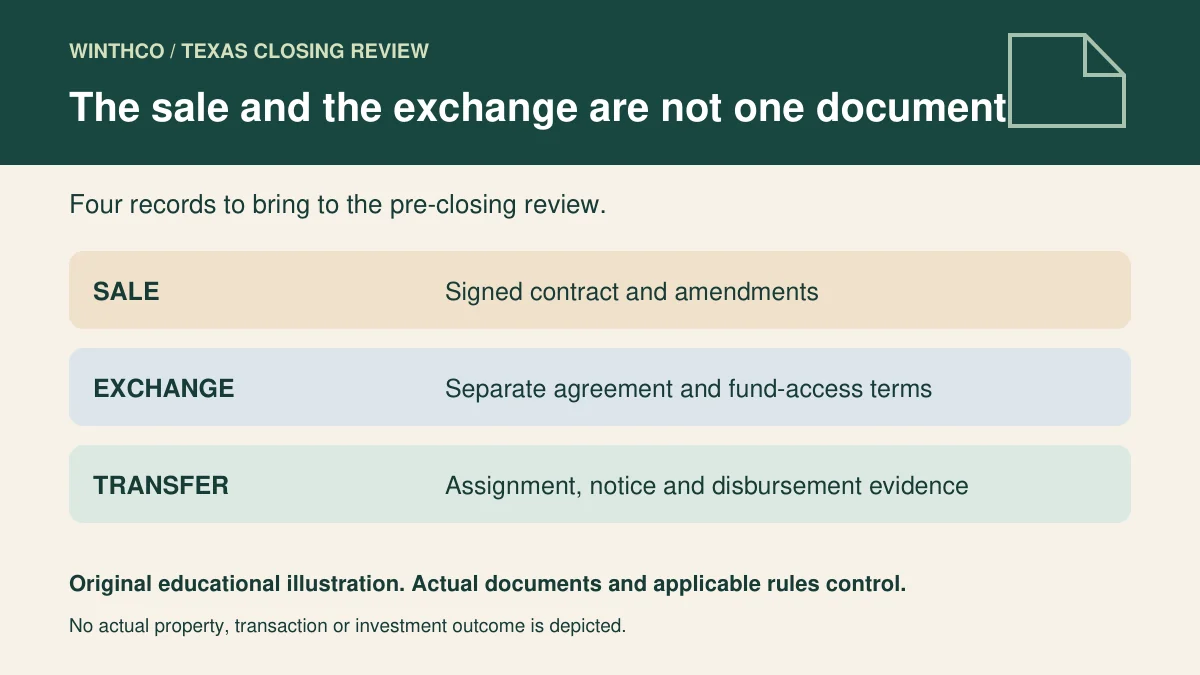
Before the transfer, send the actual signed contract and amendments to your advisers for review. Do not rely on the version in an email chain or assume the closing agent can fill in exchange paperwork at the last minute. Take the closing date, change notices and destination-state questions from the Texas property-sale and relocation guide and put them next to your contract checklist.
Share your timeline and investment range. A Winthco team member will follow up with you.
First, the purchase and sale agreement defines the deal between buyer and seller. A cooperation provision may set expectations for handling an exchange without moving the closing or shifting costs to the buyer. Ask counsel to review what the actual sale contract permits. A provision describing what you plan to do does not establish that the assignment happened.
Second, the written exchange agreement governs the role of the qualified intermediary, or QI. Under the regulation’s QI safe harbor, the QI must meet the applicable definition, and the agreement restricts the seller’s rights to receive, pledge, borrow or otherwise obtain the covered funds. The person helping negotiate the sale is not necessarily eligible to serve as QI. Ask the QI and your attorney to confirm the arrangement and review fund custody and release terms separately from the buyer’s cooperation language.
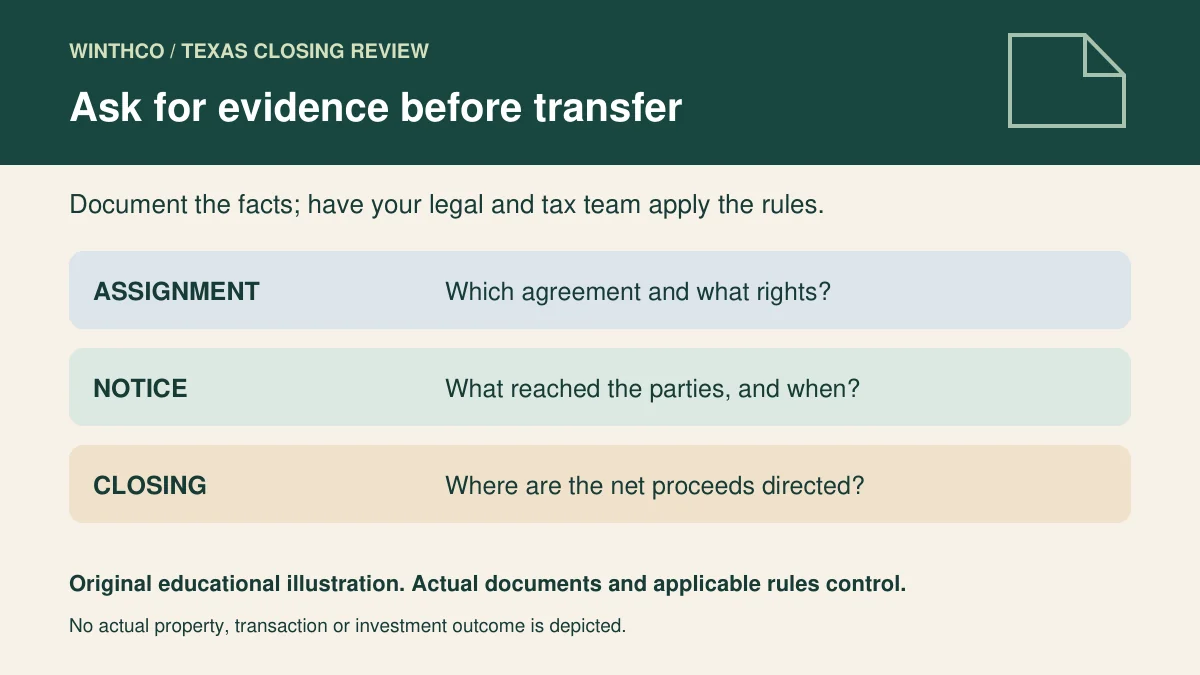
Third, when relying on assignment to treat the QI as entering into an agreement under the safe harbor, the relevant contractual rights are assigned and all parties to that agreement must be notified in writing on or before the relevant transfer. Confirm the executed assignment, which version of the agreement it refers to, when written notice was delivered and who retains the evidence. Make the equivalent inquiry about replacement-side documents; an earlier notice is not proof of compliance for a different agreement.
Fourth, the settlement statement and accepted disbursement instructions show how money is intended to move. Reconcile the legal seller, contract, exchange file and closing instructions. Verify routing using a known phone number rather than an emailed change. Have the team reconcile payoff, other disbursements, planned cash to the seller if any, and funds directed to the QI. The CPA should analyze any amount paid to the seller or any non-like-kind property, rather than guessing from the cash column.
A hypothetical owner is selling an investment rental near Fort Worth while moving out of Texas. The buyer signed a contract with an exchange cooperation clause. Two days before closing an updated settlement draft still directs the seller’s net proceeds to the seller’s personal account. The owner has also asked whether some sale cash can cover two months of housing and moving costs.
The useful action is to flag the mismatch before the transfer and have the closing team reconcile the contract version, the QI file, the assignment and notice if used, and the verified disbursement instructions. No one should infer a tax outcome merely because the buyer agreed to cooperate. Ask the CPA to evaluate the tax impact of any intentionally retained cash separately from the household’s need for it. If the seller already received or had unrestricted access to the proceeds, pause and obtain immediate tax and legal review instead of trying to reverse a completed payment on your own.
At that meeting, take one versioned packet rather than comparing papers from four inboxes. Give each document an owner, a revision date and a final confirmation step. If the parties agree to change the closing date, ask the attorney and intermediary whether any signed instructions or notices must change, and have the closing agent confirm which version will be used. Keep the final packet and delivery evidence together.
Discuss your DST questions with Winthco →
The identification period generally ends 45 days after the transfer of the relinquished property. The exchange period generally ends at the earlier of 180 days after that transfer or the federal return due date, including extensions, for that tax year. Ask the QI how it will record the actual transfer date and confirm the deadlines and identification process with your CPA. Keep a dated copy of the identification and proof of delivery. This is the exchange calendar, not the lease, move or home-purchase calendar described in the Texas move and exchange timeline.
Section 1031 generally applies to qualifying real property held for business or investment, not a personal-use home. A homeowner may be eligible for a separate Section 121 exclusion, which is not exchange deferral. Texas’s lack of an individual income tax does not remove federal gain, possible depreciation-related tax or applicable net investment income tax. The destination state may have its own residence, timing and sourcing rules. A mailing address by itself is not a tax conclusion.
An eligible fractional DST interest structured under the facts addressed in IRS Revenue Ruling 2004-86 may serve as like-kind real property; a DST label alone is not enough. Talk through how a DST can fit an exchange and confirm the exact legal interest, availability, accreditation or other eligibility where applicable, sponsor restrictions and how the transfer would be timed. Then compare the details in a DST offering memorandum, including up-front and ongoing fees, debt terms, tenants, concentration, conflicts and exit restrictions. Distributions can fall or stop and principal can be lost; a DST may have no liquid resale market.
A qualifying contribution to a partnership under Section 721 is a different transaction with a separate legal and tax analysis. Do not sign closing instructions on the assumption that a DST will later convert, that ordinary REIT shares or partnership units are direct Section 1031 replacement property, or that any resulting units can be readily redeemed. Ask what happens if there is no later transaction at all. Obtain independent tax and legal advice before relying on an expected conversion or sale.
WATCH & LEARN
Accruit explains why selecting a qualified intermediary matters. This third-party video is general education, not an endorsement or a substitute for reviewing the exchange agreement, assignment and actual funds instructions. Original resource · Watch on YouTube ↗
Educational context only. The discussion does not establish the suitability, returns or tax treatment of an investment.
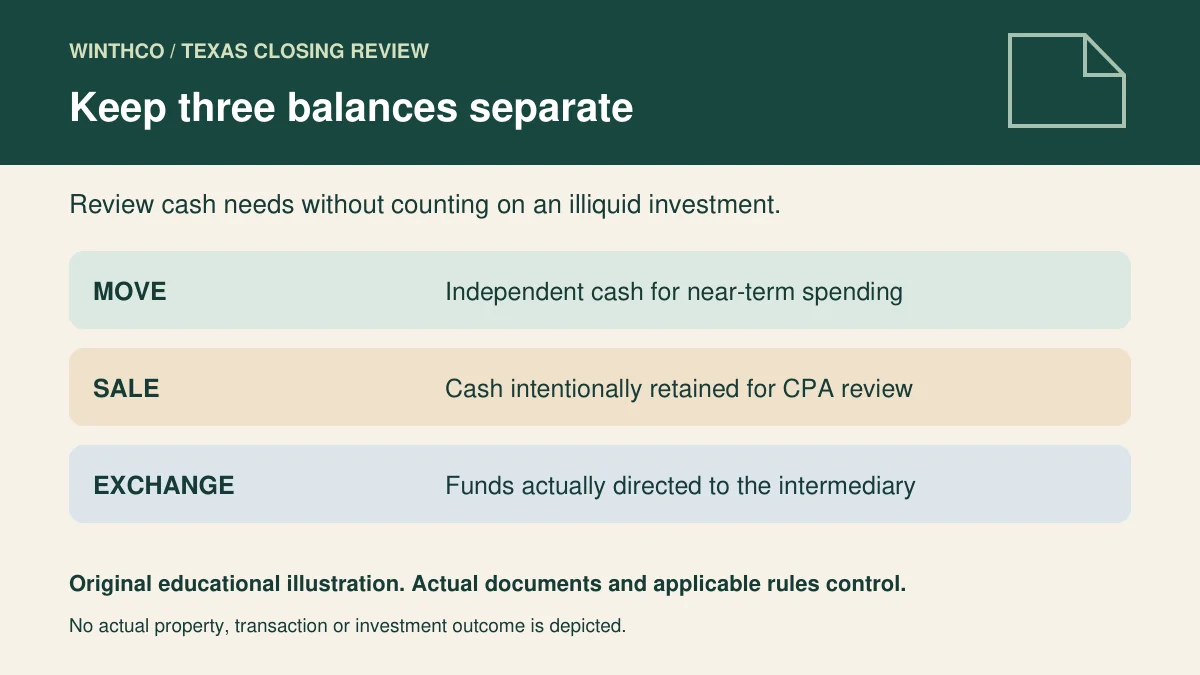
Create three separate balances: cash outside the transaction for the move and near-term expenses, planned taxable sale cash if any, and equity actually available to the exchange. Ask your advisers to run a plan without any DST distributions and without a future 721 event. If your move or retirement budget breaks in that scenario, the replacement decision needs more review. In a broader financial planning conversation, weigh taxable reserves, current 401(k) or IRA arrangements, diversification, spending and estate coordination together. Retirement accounts are not a substitute for exchange proceeds, and a rollover is not a precondition for comparing options.
Before signing final instructions, write down the name and role of the professional who owns each open question. Retain the actual closing packet and proof of transfer securely for the CPA preparing Form 8824 and any required federal or state returns. A completed checklist organizes the facts; it does not decide legal qualification or investment suitability.
| Decision | Evidence to request | What to avoid assuming |
|---|---|---|
| Sale contract | Buyer/seller terms, known amendments and cooperation language | Mistaking intention to exchange for completed exchange setup |
| Exchange agreement | Eligible QI, scope and access restrictions | Assuming the title agent and QI are interchangeable |
| Assignment and notice | Actual rights assigned and date-stamped written delivery | Assuming the original signature acknowledges a later assignment |
| Closing instructions | Validated recipient, actual transfer and verified disbursement records | Relying on a stale account number or repair after receipt |
No. It addresses cooperation under a sale agreement, not the separate exchange agreement, assignment mechanics, notices, proceeds restrictions or tax qualification.
The federal safe-harbor rule requires written notice to all parties to the relevant agreement on or before the relevant transfer when relying on assignment for that purpose. Have counsel and the QI check the actual agreement and notice evidence.
Do not assume unrestricted access is permitted or tax-free. Plan household cash separately and ask the CPA and QI to analyze any intentionally retained cash before signing instructions.
No. Review the specific DST as a standalone investment. Any separate partnership contribution depends on documented alternatives, eligibility and the facts at that time.
Sources checked November 19, 2026. This article explains general concepts; your facts and the applicable documents control.
Winthco DST services · Winthco evaluation overview · Editorial standards
1031 exchange planning
Learn what a qualified intermediary does in a DST 1031 exchange and how to review agreements, fund controls, deadlines and professional roles.
Read guide →Texas property transition guide
Selling Texas land or rental property before a move? Review 1031 tax deferral, DST risks, home-sale rules and the 2026 election context.
Read guide →Texas property transition guide
Moving out of Texas after selling a rental? Coordinate cash needs, residency dates, 1031 deadlines and DST risks before closing.
Read guide →Explore Winthco’s main DST article collection
Share your timeline and investment range. A Winthco team member will follow up with you.