Texas property transition guide
Leaving Texas: Capital Gains, 1031 & Election Results
Selling Texas land or rental property before a move? Review 1031 tax deferral, DST risks, home-sale rules and the 2026 election context.
Read guide →
Home / Learning center / Texas property transition guide
Texas property transition guide
Winthco Wealth Management · Updated November 9, 2026
A Texas property containing your home and a separate rental or business area may require more than one tax calculation when sold. Map actual use and obtain supportable allocations before closing. Section 121 may exclude eligible home gain, while Section 1031 may defer qualifying investment-property gain; neither applies automatically to the entire sale.
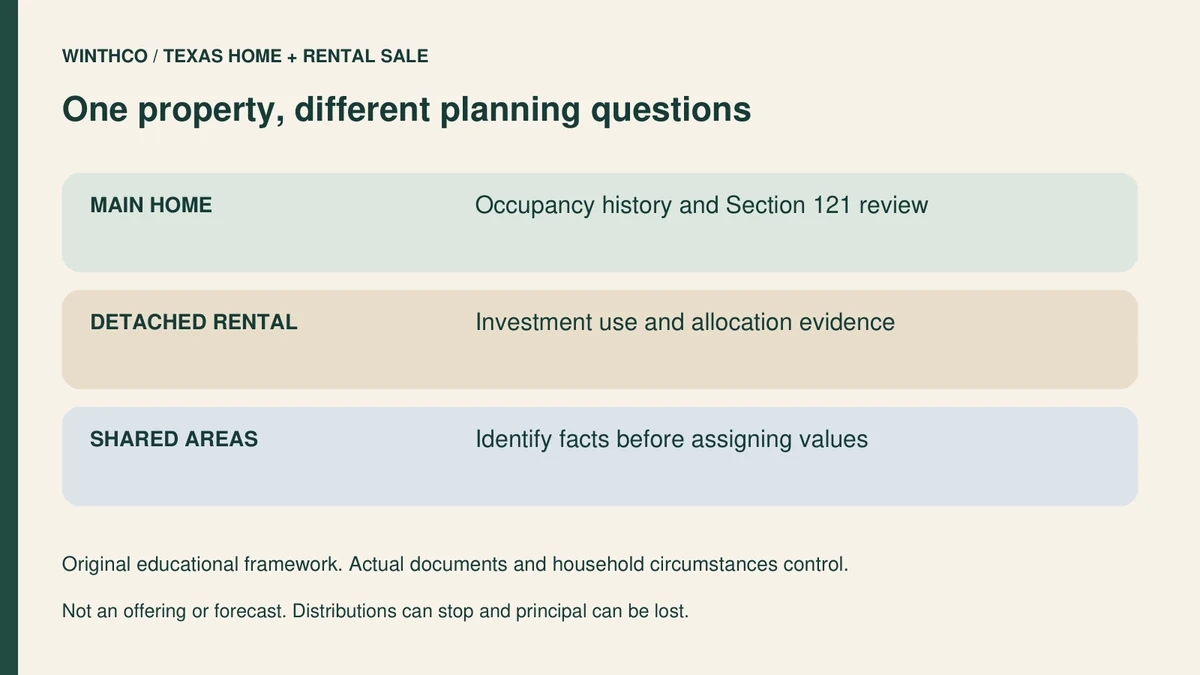
Start with a simple property-use map: the dwelling you occupied, any detached rental or business building, surrounding land and shared facilities. Note who used each area and when. A single street address, deed or sale contract does not make every portion a personal residence, and owning a property for decades does not establish that all its gain can be excluded.
Use this decision tool alongside the Texas property transition master guide. Its purpose is to identify questions for your CPA, attorney, qualified intermediary and appropriately licensed listing professional before a buyer sets the closing timetable. It does not decide eligibility from square footage alone or turn a mixed-use parcel into a recommended investment strategy.
Share your timeline and investment range. A Winthco team member will follow up with you.
Create one row for each distinct area. Record its use today, dates of personal occupancy, rental periods, relevant leases, acquisition and improvement evidence, prior depreciation and the valuation evidence still needed. Add an “unresolved” column rather than assigning a convenient percentage when documents are missing. This sheet is a meeting agenda, not a replacement for the tax return worksheets.
Ask a realtor or commercial broker with relevant mixed-use experience how a buyer will value the property and what permits, leases, disclosures or title issues affect marketing. Ask your CPA which allocation method is supportable. A broker price opinion may help the sale discussion without resolving every tax valuation question. Agree on professional responsibilities and fees before assuming someone else has addressed the allocation.
IRS Publication 523 distinguishes business or rental space within a dwelling from a separate nonresidential portion. A room used as an office inside the living area generally does not require the same gain allocation as a separate rental building. Depreciation adjustments can still limit the gain eligible for exclusion. The physical layout and actual use both matter.
For a detached rental never occupied as the seller’s main home, do not assume the home exclusion covers its gain. A working farm with a house can also present separate-use issues. Describe the real arrangement to your CPA, including shared entrances, utilities and land. Do not label an entire parcel “homestead” on a worksheet and treat that label as the federal tax conclusion.
Discuss your DST questions with Winthco →
Section 121 generally permits eligible taxpayers to exclude up to $250,000 of main-home gain, or up to $500,000 for a qualifying married couple filing jointly. Ownership and use requirements generally involve two years within the five-year period ending on the sale, with additional rules for joint filers, prior exclusions and exceptions. These are maximum exclusions, not promised tax savings.
Bring the dates of occupancy, marriage or ownership changes, earlier home sales and any rental conversion. Prior depreciation and periods of nonqualified use can require special treatment. An exclusion removes eligible gain from income under its rules; a 1031 exchange instead defers eligible gain into replacement-property tax history. Buying another personal home does not itself create a new exclusion or a 1031 exchange.
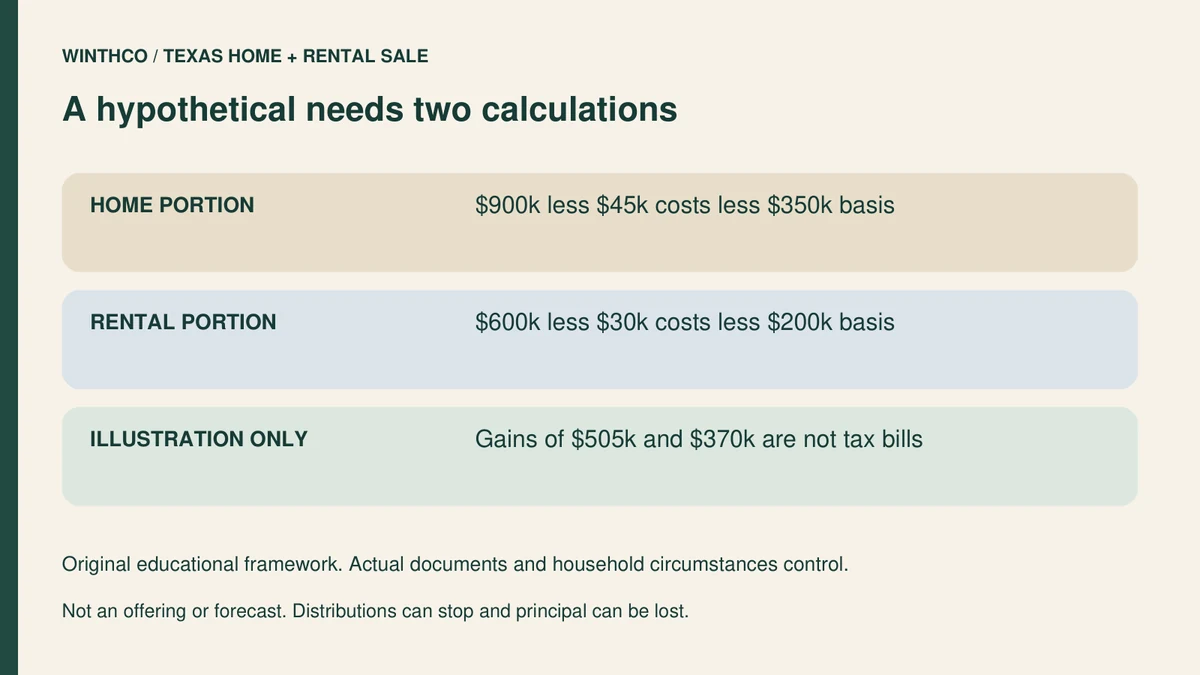
Assume a Texas owner sells a main home and a physically separate rental for $1,500,000. For illustration only, assume advisers substantiate a $900,000 allocation to the home and $600,000 to the rental. Assume allocated qualifying selling expenses of $45,000 and $30,000, and adjusted bases of $350,000 and $200,000 respectively. The simplified gains are $505,000 for the home and $370,000 for the rental.
Those numbers are not a tax bill. The home’s eligible exclusion must be established separately; the rental gain needs depreciation-related and other tax analysis. A possible exchange concerns qualifying investment real estate, not a blanket deferral of both figures. The 60/40 allocation is an assumption, not a recommended method. Debt, excluded personal property, entity ownership or different facts could change the analysis substantially.
WATCH & LEARN
David and Tom Moore of Equity Advantage discuss exchange identification. Third-party general education, not a determination of eligibility for a mixed-use Texas property. Original resource · Watch on YouTube ↗
Educational context only. The discussion does not establish the suitability, returns or tax treatment of an investment.
If the investment portion is eligible for a standard deferred 1031 exchange, involve the qualified intermediary and tax advisers before the property transfers or you receive proceeds. Ask them to coordinate the settlement statement and disbursement instructions with the closing agent. Keep the home, exchange and any taxable cash portions clearly identified without improvising the allocation at the closing table.
Actual or constructive receipt of exchange proceeds can defeat the intended structure. Sending money to a DST after receiving it does not automatically repair a failed exchange. Generally, replacement property must be identified in writing within 45 days of transfer and received by the earlier of 180 days or the federal return due date, including extensions. The periods overlap. Your intermediary should confirm the actual calendar and identification requirements.
A qualifying Delaware statutory trust interest can serve as replacement real estate in some exchanges under the conditions addressed by IRS Revenue Ruling 2004-86. It is not enough that a product uses the letters DST. The taxpayer, trust structure, offering requirements and transaction must qualify. The DST services overview provides introductory context; it does not replace the legal documents for a specific offering.
Use the DST document evaluation guide to organize questions about acquisition and placement fees, management expenses, leverage, debt maturity, tenant concentration and sponsor decisions. Accredited-investor requirements and other restrictions may apply. Interests may be illiquid, investors have limited control, distributions can decline or stop, and loss of principal is possible. Deferral is not a reason to overlook an unsuitable property, fee burden or concentration of household wealth.
Texas does not impose an individual income tax, but federal capital gains, depreciation-related taxes and potential net investment income tax can still matter. Moving does not erase a gain from a completed sale. Your destination state may have residency and sourcing rules that affect the timing and character of income. Review those rules before fixing move and closing dates, not after assuming a forwarding address settles residency.
For example, California’s Franchise Tax Board distinguishes income received while resident from California-source income during a nonresident period. That is a reason for individualized review, not a prediction of tax owed by every Texas seller. Give your CPA the contemplated destination, move dates, ownership structure and exchange plan. Avoid relying on a generic “sell before moving” slogan without examining your facts.
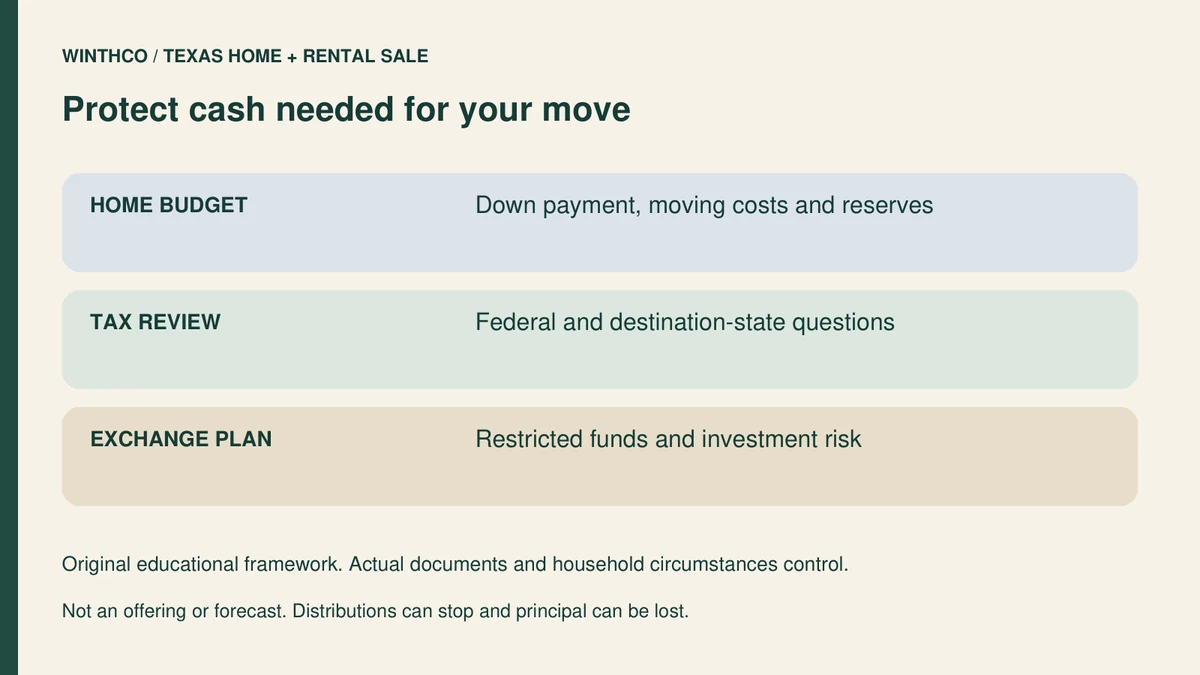
Prepare three cash estimates: money available after a fully taxable sale, money available after any eligible home exclusion, and accessible cash after a proposed exchange. Include moving expenses, the next home’s down payment, reserves and estimated taxes. Mortgage payoff changes cash available but does not simply reduce taxable gain dollar for dollar. Exchange money should not be treated as a checking account for relocation costs.
A separate Section 721 contribution to an operating partnership is not an automatic next step after a DST. Eligibility, liability shifts and later redemptions need their own analysis; future liquidity, a tax-free exit and future 1031 eligibility are not promised. Winthco can discuss the broader wealth and retirement plan in coordination with independent tax and legal advisers, including existing investments, IRAs and 401(k)s.
Bring the property-use sheet, deed, leases, occupancy calendar, available basis and depreciation records, proposed sale terms and a realistic relocation budget. Ask each professional which facts remain unresolved and what must be settled before contract, before closing and before choosing replacement property. Compare the taxable-sale alternative fairly rather than starting with a product and searching for a justification.
This guide is educational, with source checks on November 9, 2026 Pacific. It does not report election winners, certification, migration trends, price forecasts or new legislation arising from an election. Personal decisions to relocate require their own reasons and planning. The practical next step is a documented discussion of your actual property, not a promise that every Texas seller can defer every dollar of gain.
| Decision | Evidence to request | What to avoid assuming |
|---|---|---|
| Main dwelling | Section 121 eligibility and prior-use history | Every dollar of gain is excluded |
| Detached rental | Investment use, allocation and possible 1031 structure | The home exclusion covers the entire address |
| Office inside home | Depreciation and dwelling-specific rules | Identical treatment to a separate rental building |
| Next residence | Available cash and state residency review | A replacement home automatically defers tax |
Not simply because the property includes a rental. Your advisers must identify the qualifying investment portion and separately evaluate the personal residence.
Not automatically. IRS rules distinguish space within the dwelling from a separate business or rental portion, and prior depreciation still requires review.
Not by itself. The main-home exclusion and a qualifying investment-property exchange are different rules.
The allocation needs supportable facts and consistent reporting. Tax preference alone is not valuation evidence.
Do not assume that money is freely available. Ask the intermediary and tax adviser about restricted proceeds and taxable cash before directing payments.
Sources checked November 9, 2026. This article explains general concepts; your facts and the applicable documents control.
Winthco DST services · Winthco evaluation overview · Editorial standards
Texas property transition guide
Selling Texas land or rental property before a move? Review 1031 tax deferral, DST risks, home-sale rules and the 2026 election context.
Read guide →Texas property transition guide
Moving out of Texas after selling a rental? Coordinate cash needs, residency dates, 1031 deadlines and DST risks before closing.
Read guide →Texas property transition guide
Before selling long-held Texas land, organize basis, improvements and ownership records to compare a taxable sale, 1031 exchange and DST risks.
Read guide →Explore Winthco’s main DST article collection
Share your timeline and investment range. A Winthco team member will follow up with you.