Risks and due diligence
DST investment risks: a practical due-diligence checklist
Review DST liquidity, leverage, sponsor conflicts, fees and distribution assumptions before making an investment decision.
Read guide →
Home / Learning center / 1031 replacement property comparison
1031 replacement property comparison
Winthco Wealth Management · Updated October 10, 2026
A direct triple-net lease property can give a 1031 investor title and decision-making authority, while a Delaware statutory trust provides beneficial ownership with sponsor management and limited investor control. Either may involve long leases, debt and illiquidity. The better fit depends on the actual property, documents, household liquidity and exchange requirements.
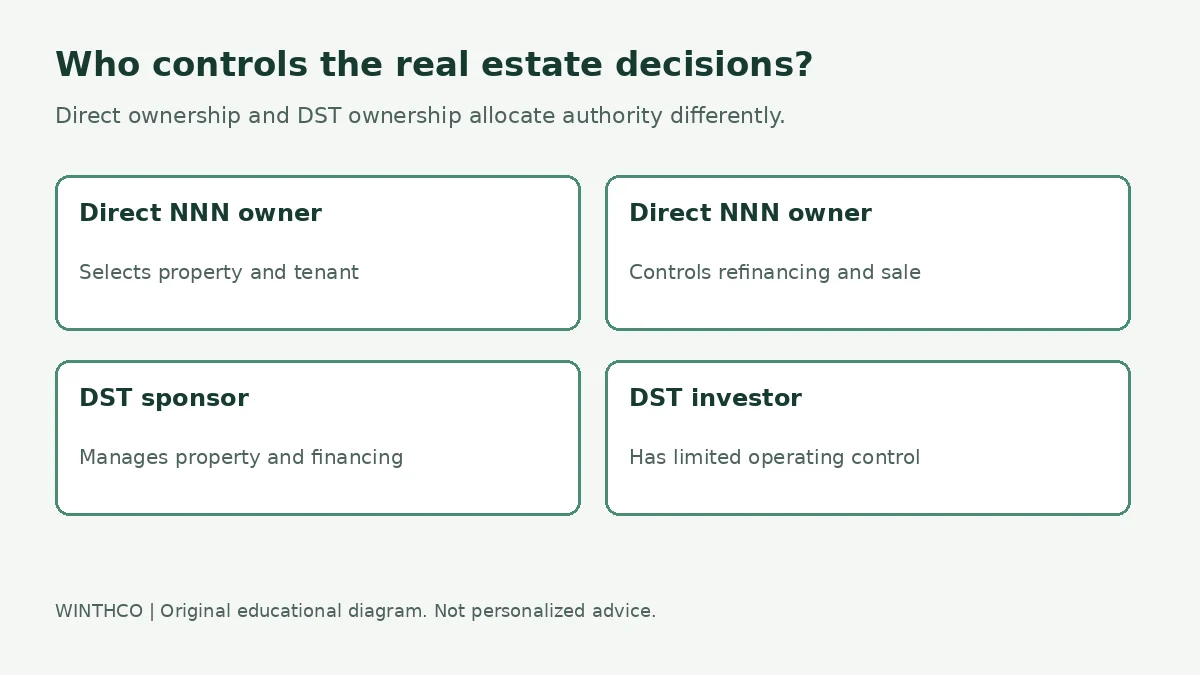
A triple-net lease, often called NNN, generally allocates specified taxes, insurance and maintenance obligations to the tenant, but the lease controls the details. The buyer usually owns the real estate directly and remains responsible for ownership decisions, lender obligations and costs the lease does not shift. A long lease or recognizable tenant does not make the investment risk free. Winthco's 1031 exchange investment options page provides broader context for replacement-property choices.
A DST investor acquires a beneficial interest in a trust that owns one or more properties. The sponsor and contracted managers make most operating, financing and sale decisions under the trust and offering documents. A DST portfolio can include triple-net leased real estate, so the comparison is not simply one property type against another. It is also direct control versus a restricted, sponsor-managed ownership structure.
Share your timeline and investment range. A Winthco team member will follow up with you.
IRS Revenue Ruling 2004-86 treated owners of the particular DST described in that ruling as owning undivided interests in the trust's real estate for federal tax purposes. It does not approve every trust, lease or offering. The investor's CPA, attorney and qualified intermediary should review the actual structure and transaction before funding.
A direct NNN owner generally chooses the property, negotiates the purchase, signs the loan and decides when to refinance or sell, subject to contracts and law. The tenant may handle many property expenses, but the owner still monitors rent, lease compliance, insurance, taxes, environmental issues, title and lender covenants. Roof, structure, parking areas or capital work may remain the owner's responsibility depending on the lease.
A DST investor usually cannot direct leasing, improvements, financing or sale timing. That reduction in landlord work comes with reduced authority. Trust restrictions can also limit the sponsor's response to changing conditions. Review the private placement memorandum, trust agreement and any master lease to understand who may repair, replace a tenant, fund a shortfall or address a loan problem.
Compare the work honestly. A single-tenant NNN property can be less operationally intensive than an apartment building, but it still requires asset oversight and decisions. A DST can outsource those functions, but management fees, conflicts and execution risk remain. Passive administration is not the same as a passive economic outcome.
Section 1031 generally applies to real property held for productive use in a trade or business or for investment. The IRS says property held primarily for sale does not qualify. In a deferred exchange, replacement property generally must be identified within 45 days after the relinquished property transfers and received within 180 days or by the federal return due date, including extensions, whichever is earlier.
Arrange the qualified intermediary before the sale closes and before the seller can receive or control proceeds. Confirm that the same taxpayer requirement, title plan and written identification procedure fit the intended purchase. A direct property identification must describe the real estate correctly. A DST identification should follow the intermediary's instructions for the specific beneficial interest and offering.
Do not let the deadline replace underwriting. Availability can change, and identifying an asset does not reserve it. Maintain backup plans that comply with the identification rules and leave time for title, financing, lease, environmental and property review on a direct acquisition or the complete offering review on a DST.
Discuss your DST questions with Winthco →
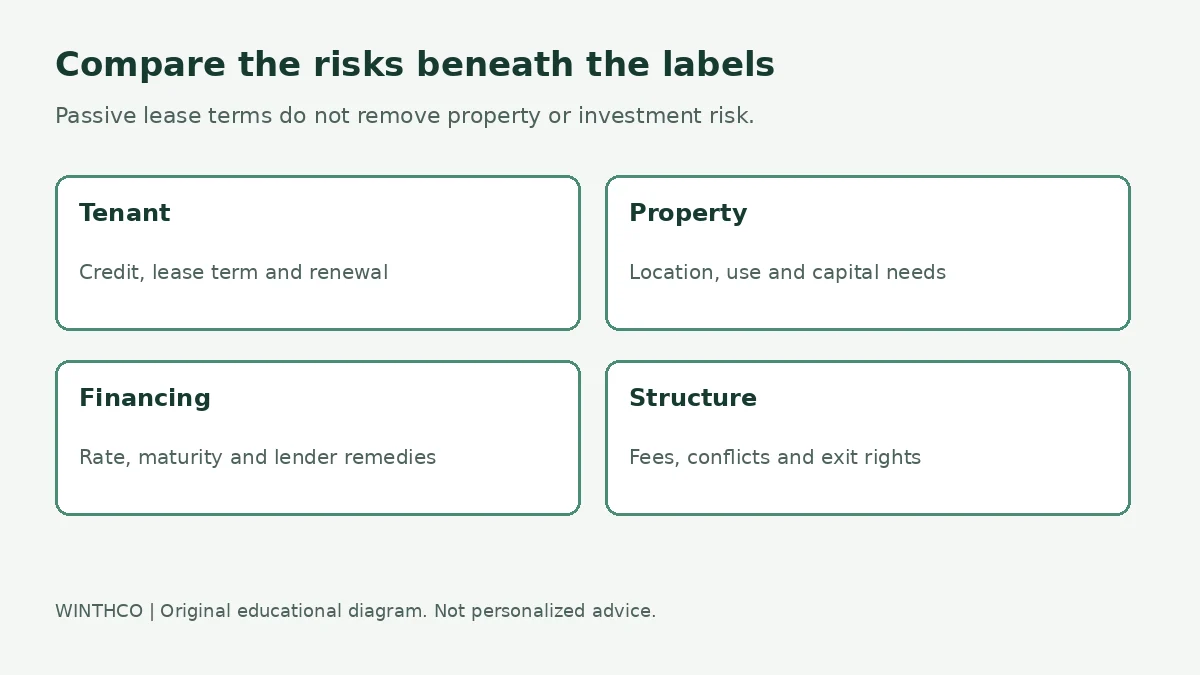
For a direct NNN acquisition, examine tenant credit, guaranties, lease term, renewal options, rent increases, assignment rights and termination clauses. Test whether the building can be released or adapted if the tenant leaves. A strong corporate name does not ensure that the lease guarantor is the parent company or that the location remains useful. Local supply, traffic, zoning and property condition still affect value.
For a DST, trace the same property-level facts through the offering. Multiple buildings or tenants may spread some exposure, but they can still share a sector, region, lease structure or sponsor. A single-property DST may remain highly concentrated. Winthco's DST real estate overview explains the ownership concept, while the current offering documents disclose the assets and risks that must be evaluated.
FINRA describes concentration as the possibility of amplified losses when a large share of holdings depends on one investment, asset class or market segment. Count existing real estate, business interests and private investments when comparing the alternatives. Several differently named DST interests do not create meaningful diversification when their economic drivers overlap.
A direct buyer may select the lender and negotiate leverage, but financing contingencies, appraisal, recourse, interest rate, amortization, maturity and reserves affect both the closing and future risk. A DST's debt is arranged by the sponsor and may be treated as the investor's share of liabilities for exchange calculations, subject to tax review. Nonrecourse financing can still reduce property equity if the borrower defaults.
Ask the CPA to model adjusted basis, sale costs, debt relief, replacement debt, cash contributed and cash retained. Receiving money or other non-like-kind property can produce recognized gain to the extent required by the rules. Replacing a mortgage with a stated DST debt allocation is not, by itself, proof that all gain will be deferred.
Compare all costs in dollars and as percentages of equity. Direct ownership can involve brokerage, legal, title, inspections, loan costs, property management and future leasing commissions. A DST may include selling compensation, organization and offering expenses, acquisition costs, financing charges, reserves, asset or property management fees and disposition compensation. Winthco's how to evaluate a DST resource can help frame document questions, but the current fee tables and notes control.
WATCH & LEARN
Winthco Wealth Management's introductory video explains the DST and 1031 exchange context. It is general education, not a substitute for current offering documents, direct-property records or individualized tax, legal and investment advice. Original resource · Watch on YouTube ↗
Educational context only. The discussion does not establish the suitability, returns or tax treatment of an investment.
Neither alternative should be treated as cash equivalent. Selling a direct NNN property requires a buyer, due diligence and closing, and value may fall if the tenant weakens or the remaining lease term shortens. Still, the owner usually decides when to market the property and can consider refinancing, subject to the lease and lender.
A private DST interest may have transfer restrictions and no dependable secondary market. The investor normally cannot force a property sale or choose its timing. The SEC warns that Regulation D private placements may provide less information than registered offerings, can be difficult to resell and can result in total loss. A Form D filing is not SEC approval.
Keep accessible assets outside either investment for taxes, emergencies and planned spending. Treat projected distributions, sale dates and appreciation as assumptions rather than promises. Review downside cases in which rent stops, expenses rise, financing becomes costly or a sale occurs later and at a lower value.
Consider a hypothetical owner selling a small rental with $1.2 million of estimated exchange equity. One candidate is a directly owned pharmacy property under a long NNN lease. Another is a DST holding several net-leased and multifamily properties. This is an educational example, not a client experience or recommendation.
The direct property review finds strong current rent coverage but a specialized building, a lease guaranty from a subsidiary and a balloon loan in seven years. The DST review finds more tenants but significant sponsor fees, cross-property exposure to one region and limited investor control. Neither label answers the decision. The owner compares evidence, downside scenarios and household cash needs.
The CPA models the exchange and liability treatment. The attorney reviews title, lease and purchase contract for the direct property and legal rights in the DST documents. The intermediary confirms the identification language and deadlines. The securities professional explains compensation and offering risks. The owner may prefer either path, split qualifying replacement value when feasible or choose a taxable sale after professional review.
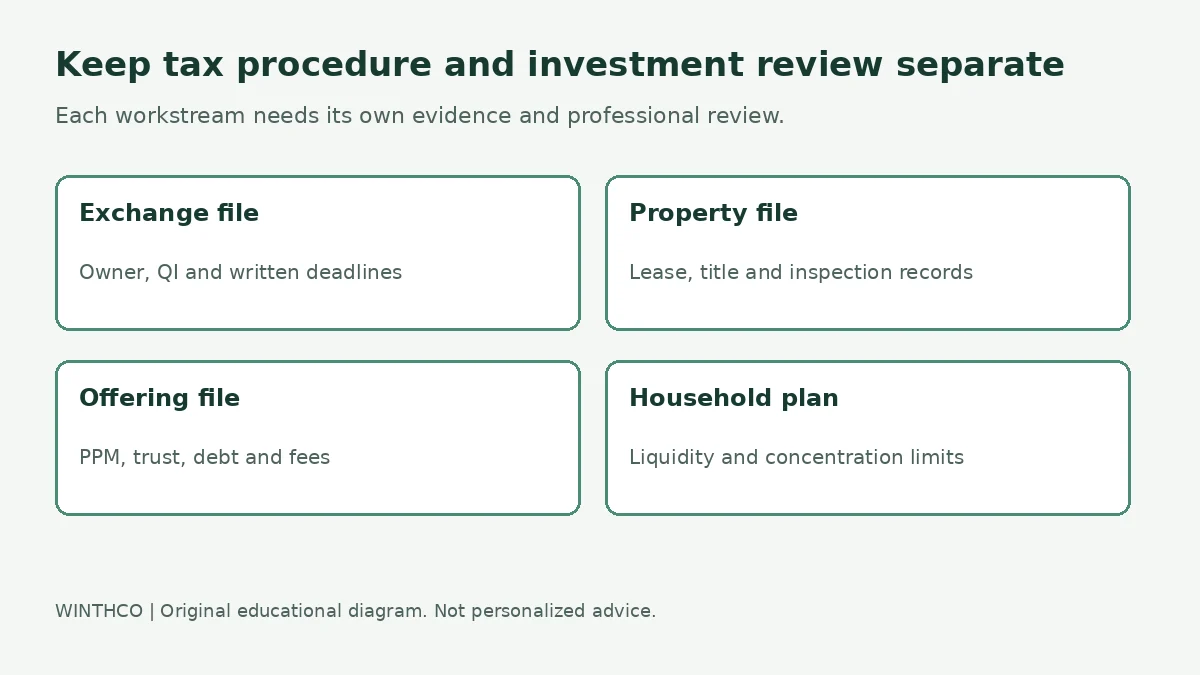
Create one side-by-side worksheet using the same categories: ownership rights, property and tenant exposure, debt, fees, reserves, projected cash flow, liquidity, control, tax assumptions and exit scenarios. Cite the lease, property reports, loan term sheet or private placement memorandum for every material claim. Mark estimates separately from contractual facts.
Verify the people and firms involved. Read the entire offering memorandum, request written fee disclosures and use FINRA BrokerCheck and SEC resources as appropriate. Inspect direct property records, lease amendments, environmental reports and physical condition. Resolve discrepancies before the identification or funding decision, not after.
A prospect form submission begins a conversation with Winthco; it does not reserve an offering, establish suitability, create a tax or legal engagement, or complete an exchange. Use secure channels for tax returns, account statements and identity documents. This guide uses AI-assisted research and drafting with Winthco Wealth Management organization attribution.
| Decision | Evidence to request | What to avoid assuming |
|---|---|---|
| Ownership and control | Direct title and owner decisions, subject to contracts and lender | Beneficial interest with sponsor-controlled operations and exit |
| Tenant exposure | Often one or a few tenants under reviewed leases | Depends on actual DST properties and leases |
| Financing | Buyer negotiates loan and bears property-level consequences | Sponsor arranges debt under offering documents |
| Liquidity | Owner can market the property, but sale is uncertain | Transfer restrictions and no dependable secondary market |
| Review documents | Purchase contract, title, lease, reports and loan terms | PPM, trust agreement, subscription documents and property reports |
No. The lease may shift specified expenses to the tenant, but the owner still has oversight, ownership, lender and residual property responsibilities. The actual lease controls.
Yes. A DST can hold net-leased real estate, so investors must examine both the property-level lease risks and the DST structure.
No. Eligibility depends on the properties, ownership, documents, timing and complete transaction. Tax deferral is not guaranteed.
Neither is readily liquid. A direct owner generally controls when to market the property, while a DST interest commonly has transfer restrictions and no dependable resale market.
No. Review the actual obligor, guaranty, lease clauses, property reuse, market and concentration rather than relying on the tenant's brand.
Potentially, if the properties and transaction satisfy the applicable rules. The intermediary, CPA, attorney and investment professional should coordinate the identification, allocation and closing.
Sources checked October 10, 2026. This article explains general concepts; your facts and the applicable documents control.
Winthco DST services · Winthco evaluation overview · Editorial standards
Risks and due diligence
Review DST liquidity, leverage, sponsor conflicts, fees and distribution assumptions before making an investment decision.
Read guide →Risks and due diligence
Learn how to review DST acquisition costs, ongoing expenses, financing charges and exit fees without relying on a single headline number.
Read guide →1031 exchange planning
Understand DST debt replacement, added cash and mortgage boot with a worked example and questions for your CPA and qualified intermediary.
Read guide →Explore Winthco’s main DST article collection
Share your timeline and investment range. A Winthco team member will follow up with you.