1031 exchange planning
1031 exchange deadlines: the 45-day and 180-day rules
Plan the identification and completion periods for a deferred 1031 exchange, including the earlier tax-return deadline.
Read guide →
Home / Learning center / Vacation rental 1031 planning
Vacation rental 1031 planning
Winthco Wealth Management · Updated October 9, 2026
A vacation rental may qualify for a Section 1031 exchange into an eligible Delaware statutory trust when it is held for investment or business use and every exchange requirement is met. Personal use creates an additional eligibility question, so review the IRS dwelling-unit safe harbor, rental records and exchange structure before the property is sold.
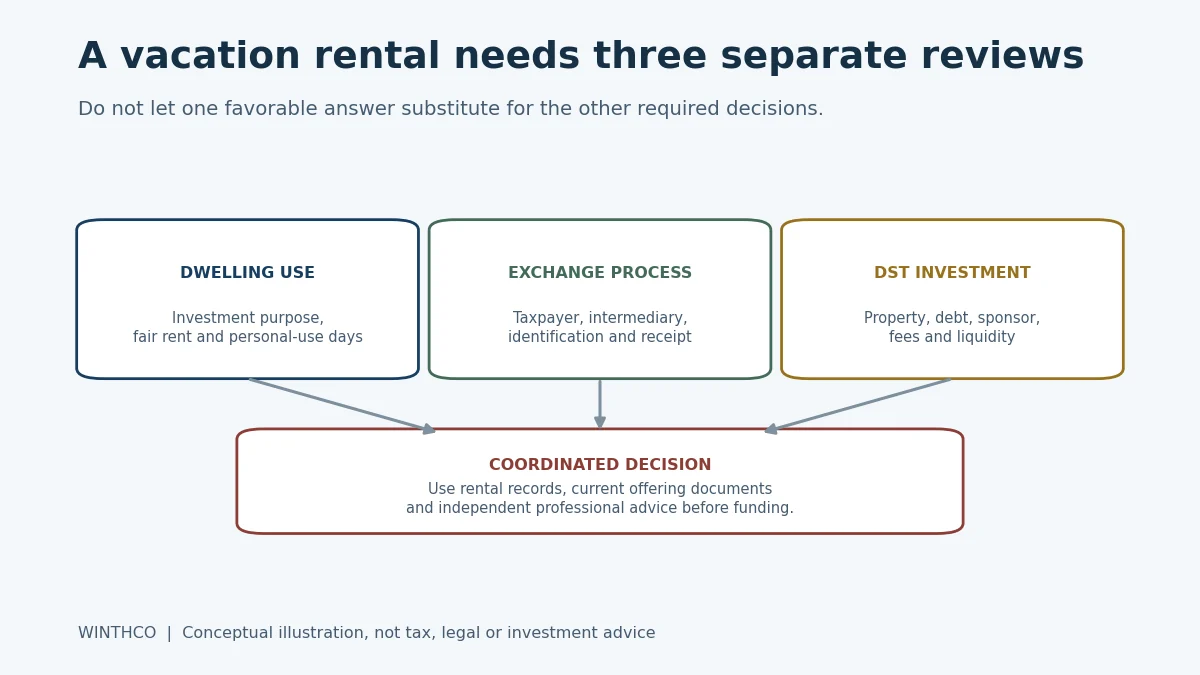
Section 1031 generally applies to real property held for investment or productive use in a trade or business. IRS Publication 544 says personal-use real estate does not qualify, but a dwelling unit can meet the held-for requirement when applicable standards are satisfied. A short-term rental, second home or cabin therefore needs a documented use analysis before the owner assumes it is eligible. Winthco's 1031 exchange rules overview offers broader planning context, while current IRS guidance and the owner's records control.
IRS Revenue Procedure 2008-16 creates a safe harbor for dwelling units that combine rental and occasional personal use. It addresses whether the property is held for investment or business use, not every element of a Section 1031 exchange. The taxpayer must still satisfy the qualified-intermediary structure, identification, receipt, taxpayer and like-kind requirements. Falling outside the safe harbor is a fact-specific tax question, not automatic permission or automatic disqualification.
Share your timeline and investment range. A Winthco team member will follow up with you.
The DST requires a separate analysis. IRS Revenue Ruling 2004-86 concludes that owners of the specifically described, restricted Delaware statutory trust are treated as owning undivided interests in its underlying real estate. Under those facts, the trust interests may qualify as replacement property if the other Section 1031 requirements are met. Review the actual trust agreement, tax opinion, offering memorandum and exchange documents rather than relying on the DST label.
For relinquished property, Revenue Procedure 2008-16 requires the taxpayer to own the dwelling unit for at least 24 months immediately before the exchange. During each of the two 12-month periods before the exchange, the unit must be rented to another person at a fair rental for at least 14 days. Personal use during each period cannot exceed the greater of 14 days or 10 percent of the days rented at a fair rental.
The same framework applies when the replacement property is another dwelling unit, measured over the 24 months immediately after the exchange. In each of those two 12-month periods, the unit must be rented at a fair rental for at least 14 days and personal use must remain within the same greater-of-14-days-or-10-percent limit. A taxpayer who reported the exchange expecting to meet those replacement-property standards may need to amend the return if the standards are later missed.
A DST replacement is different from a replacement vacation home. The dwelling-unit safe harbor primarily tests the vacation rental being relinquished, while the DST must qualify under its own structure and documents. Do not transfer the 24-month vacation-home test to the DST or assume the safe harbor validates the security. The CPA should document both analyses separately.
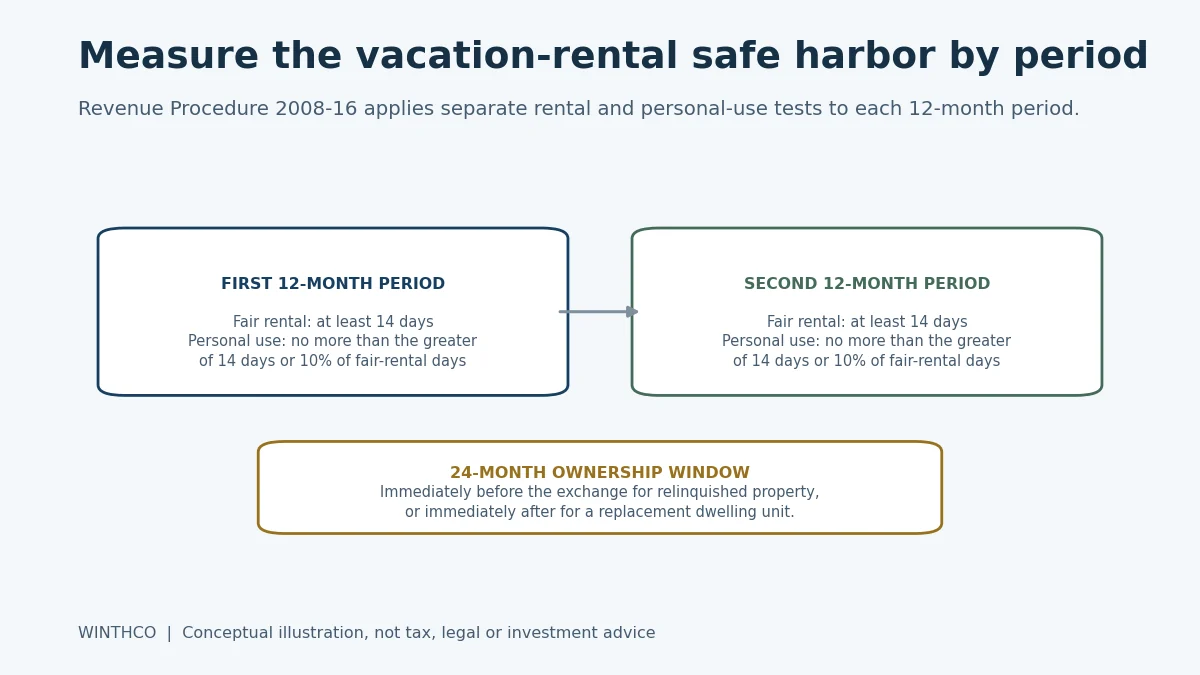
Create a calendar for each relevant 12-month period, not merely each calendar year. Record every rental, the nightly or weekly rate, the renter, payment evidence, platform statement and whether the rate was fair under the facts when the agreement was made. Preserve listings, comparable rates, leases, bank deposits, lodging-tax returns and management reports. Consistent records are more persuasive than a summary reconstructed after closing.
Track personal use with equal care. Revenue Procedure 2008-16 refers to the personal-use rules in Section 280A, which can include use by the taxpayer, certain family members, people using the property under reciprocal arrangements and occupants paying less than fair rental, depending on the facts. Days spent substantially full time repairing and maintaining the property can receive different treatment under Section 280A. Ask the CPA to classify questionable days rather than deleting them from the calendar.
Local vacation-rental rules matter operationally even though they do not replace the federal tax test. Preserve permits, business licenses, occupancy-tax filings, inspection records, association rules and local correspondence. A suspended permit, rental cap, insurance exclusion or homeowners-association restriction can reduce rental activity or value. Resolve those issues before marketing the property and before using expected proceeds in the exchange plan.
Discuss your DST questions with Winthco →
Engage a qualified intermediary before the property transfers. If the seller actually or constructively receives the proceeds, the deferred-exchange structure may fail. Confirm the taxpayer name, title, ownership entity and sale contract early. A late deed change, distribution from a partnership or transfer between spouses or entities can raise identity and holding-purpose questions that require tax and legal review.
The federal identification period generally ends 45 days after the relinquished property transfers. Replacement property must generally be received by the earlier of 180 days after that transfer or the due date of the applicable federal return, including extensions. The identification must be written, signed, delivered to a permitted party and clearly describe the replacement. Winthco's 1031 exchange timeline guide explains the process at a high level, but the qualified intermediary and CPA should confirm the taxpayer's exact dates.
Do not treat furniture, appliances, vehicles, memberships or prepaid booking rights as though they are automatically qualifying real property. IRS Publication 544 requires separate analysis of non-real-property assets in a transaction. Allocate value consistently among land, building, qualifying improvements and personal property using the purchase agreement, appraisal, depreciation records and closing statement. Cash, unlike property and debt changes can create recognized gain.
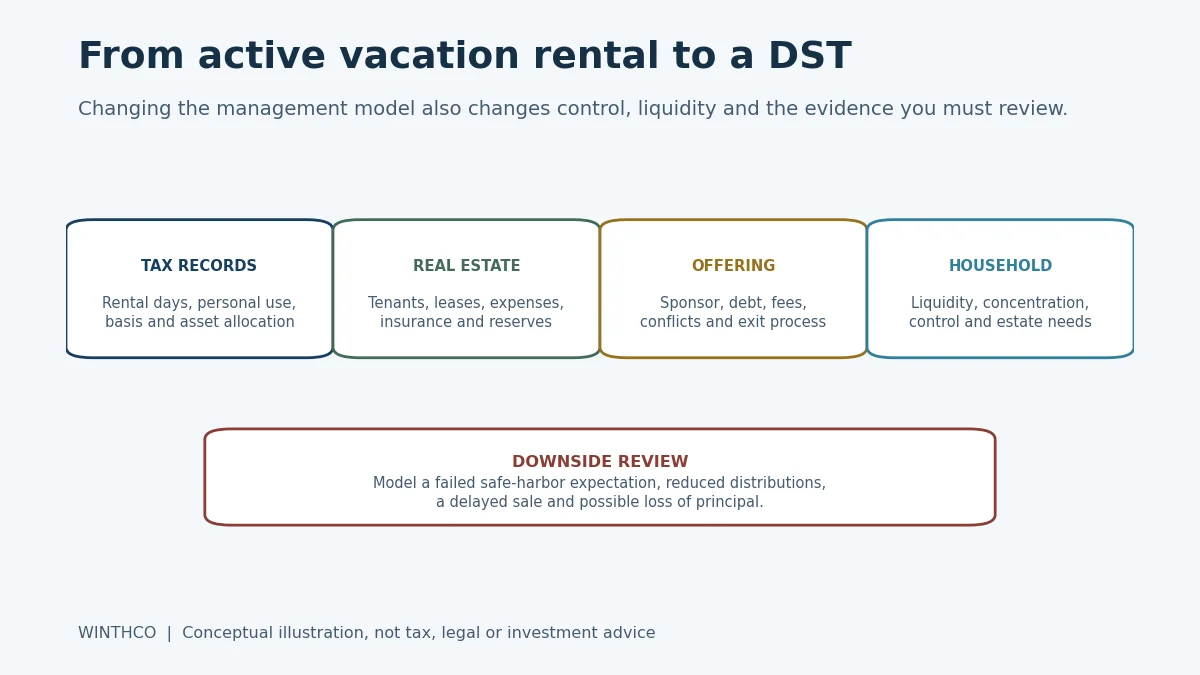
Start with the real estate rather than the exchange deadline. Review property type, location, tenants, leases, occupancy, operating history, insurance, taxes, capital needs and reserves. Compare the purchase price and valuation evidence with realistic operating assumptions. A vacation-rental owner may be leaving seasonal bookings and active management, but the DST's underlying properties still face tenant, market and expense risks.
Trace financing and compensation. Review loan rate, maturity, amortization, covenants, extension rights and lender remedies. Identify acquisition, selling, organization, financing, asset-management, property-management, servicing and disposition fees, including affiliate payments. Winthco's DST 1031 exchange structure page provides general context, but the current private placement memorandum, trust agreement and subscription package govern the investment.
Model household liquidity separately from exchange tax treatment. A DST interest may have no dependable secondary market, and the investor generally cannot direct leasing, repairs, refinancing or sale timing. Keep liquid assets outside the private placement for taxes, emergencies and spending. A projected holding period or distribution is an estimate, and a sponsor-controlled sale can occur earlier or later than expected.
WATCH & LEARN
David Moore of Equity Advantage discusses vacation and second homes in Section 1031 exchanges, including Revenue Procedure 2008-16. This third-party video is educational background, not a Winthco endorsement; current IRS guidance and the taxpayer's advisers control. Original resource · Watch on YouTube ↗
Educational context only. The discussion does not establish the suitability, returns or tax treatment of an investment.
DST interests commonly used in exchanges are private placements. The SEC's updated September 21, 2026 bulletin warns that private placements can have limited disclosure, transfer restrictions, illiquidity and the possibility of total loss. A Form D filing is not SEC approval. Confirm accreditation requirements, read the complete offering documents and verify the people and entities involved before funds move.
FINRA cautions that private placements and other illiquid investments may be difficult to sell quickly and that apparently separate holdings can remain concentrated when they share property types, regions, sponsors, lenders or economic drivers. Moving from one vacation rental to several DST interests can reduce hands-on work without necessarily reducing the household's overall real estate concentration.
Compare at least five paths in writing: another direct rental, a professionally managed vacation rental, a different property type, a mixed replacement plan and a taxable sale. Score control, workload, rental volatility, debt, fees, liquidity, state filings, estate needs and downside cases. A DST may fit some owners, but it cannot promise qualification, tax deferral, distributions, appreciation, a sale date or return of principal.
| Decision | Evidence to request | What to avoid assuming |
|---|---|---|
| Relinquished use | Investment or business purpose, 24-month safe-harbor period, fair rent and limited personal use | Owning a second home is enough |
| Rental records | Booking calendar, fair-rent evidence, payments, platform statements and lodging-tax filings | A Schedule E alone proves every use day |
| Exchange procedure | Qualified intermediary, taxpayer identity, written identification and receipt deadline | The exchange can be organized after closing |
| DST structure | Trust powers, tax opinion, offering memorandum, debt, fees and sponsor duties | Every DST qualifies or is suitable |
| Household fit | Liquidity, concentration, income variability, control and estate needs | Passive ownership removes investment risk |
Potentially. It must be held for investment or productive business use. Revenue Procedure 2008-16 provides a safe harbor for qualifying dwelling units that meet its ownership, rental and personal-use standards.
For the safe harbor, the taxpayer must own relinquished property for at least 24 months immediately before the exchange. A replacement dwelling unit has a corresponding 24-month period immediately after the exchange.
During each relevant 12-month safe-harbor period, it must be rented to another person at a fair rental for at least 14 days.
During each relevant 12-month period, personal use cannot exceed the greater of 14 days or 10 percent of the days the property is rented at a fair rental.
No. The safe harbor addresses the dwelling unit's held-for purpose. The DST and the rest of the exchange require separate review under Revenue Ruling 2004-86, Section 1031 and the actual documents.
Furniture and other personal property are not automatically qualifying real property. Allocate and analyze those assets separately with the CPA and attorney.
No dependable secondary market should be assumed. Transfer restrictions, sponsor control and the absence of ready buyers can prevent or delay a sale.
Sources checked October 9, 2026. This article explains general concepts; your facts and the applicable documents control.
Winthco DST services · Winthco evaluation overview · Editorial standards
1031 exchange planning
Plan the identification and completion periods for a deferred 1031 exchange, including the earlier tax-return deadline.
Read guide →Investor decision-making
Compare Delaware statutory trust ownership with directly owned rental property across management, control, diversification, financing and exit flexibility.
Read guide →1031 exchange planning
Understand the three-property, 200 percent and 95 percent identification rules before naming DST replacement property.
Read guide →Explore Winthco’s main DST article collection
Share your timeline and investment range. A Winthco team member will follow up with you.