1031 exchange planning
1031 exchange deadlines: the 45-day and 180-day rules
Plan the identification and completion periods for a deferred 1031 exchange, including the earlier tax-return deadline.
Read guide →
Home / Learning center / Local Guides
Local Guides
Winthco Wealth Management · Updated November 22, 2026
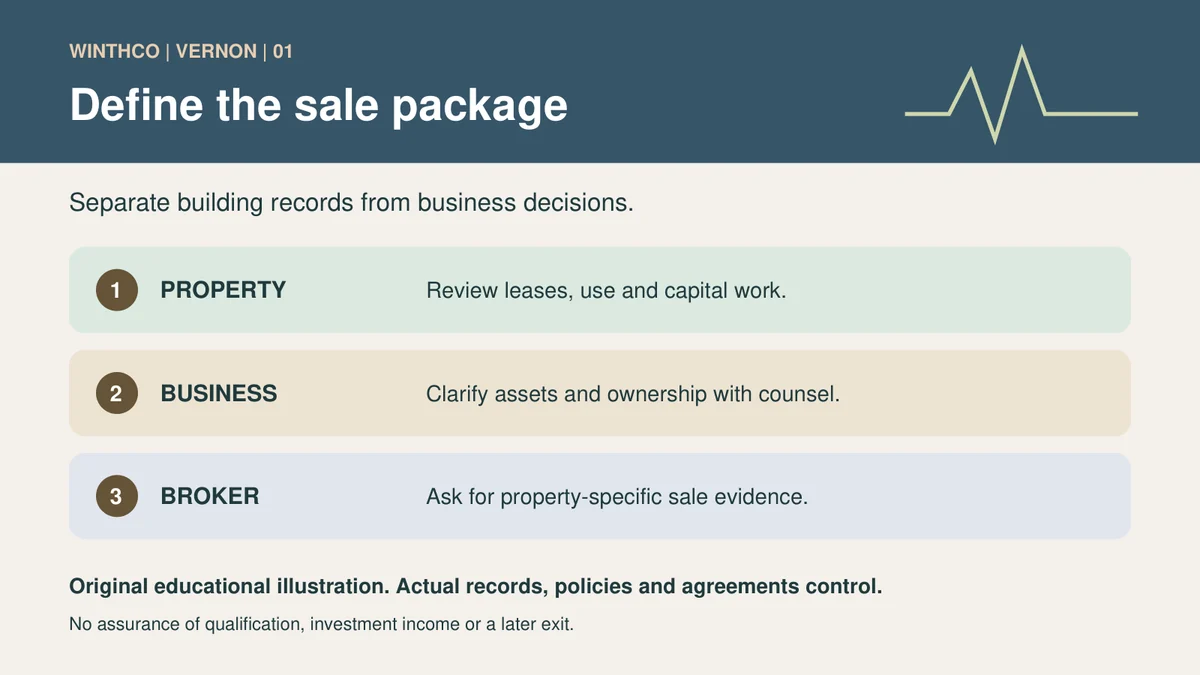
A Vernon DST advisor can help an industrial-property owner compare direct ownership with a passive replacement interest. Begin by separating the building sale from operating-business decisions, documenting property use and involving the tax and exchange team before closing. Then evaluate DST risks, possible separate 721 proposals and household liquidity together.
Vernon's municipal code establishes a General Industry Zone, mixed-use zones and specialized overlays. That makes the property's actual use and applicable district more useful starting points than a generic description such as commercial building. The code identifies City Center, Santa Fe South, Santa Fe North and Pacific Hampton mixed-use zones. These names are research context, not a conclusion that a particular parcel permits a buyer's intended operation.
Interview an appropriately licensed commercial broker about comparable sales, tenant demand, marketing, commissions and closing responsibilities for your property type. Ask how the broker will distinguish the building's characteristics from the value of an operating business. Winthco's explanation of DST replacement ownership belongs in a separate investment discussion; it does not replace a broker's valuation or establish a sale price.
Share your timeline and investment range. A Winthco team member will follow up with you.
Create a coherent sale file containing leases, rent collections, maintenance history, capital improvements, financing and available property approvals. Ask counsel how business equipment, fixtures, inventory or tenant-owned improvements should be described and allocated in the transaction. Do not assume that everything inside an industrial building receives the same tax treatment as the real estate. The CPA should evaluate those distinctions before documents are finalized.
For local land-use questions, start with Vernon's official zoning code and obtain parcel-specific guidance from the city and qualified counsel. Section 17.20.020 identifies the city's comprehensive zoning map and states that the code controls if it conflicts with the map. A buyer's proposed activity may require further review. Avoid treating a marketing description, existing tenant operation or map screenshot as a substitute for that review.
Hypothetical: an owner plans to sell a leased industrial building while retaining a separate business interest. Before accepting an offer, the owner asks the broker and attorney to clarify the sale package and the CPA to identify the tax questions. A qualified intermediary joins the discussion before closing. This invented scenario illustrates separate workstreams, not a completed client transaction or a predicted tax result.
Consult the CPA, attorney and qualified intermediary before closing or receiving proceeds when considering a deferred exchange. The QI facilitates the exchange structure and holds proceeds under the exchange arrangement; the broker manages the property-sale assignment. A search for a Vernon DST CPA should lead to verification of actual accounting credentials. A securities or financial-advisor title does not make someone your tax adviser or attorney.
Section 1031 may defer eligible gain on qualifying business or investment real property if its requirements are met. Deferral is not tax elimination. Ordinary deferred exchanges require identification within 45 days and receipt by the earlier of 180 days or the federal tax-return due date, including extensions. Cash and other non-like-kind consideration can produce recognized gain. Have advisers evaluate the specific ownership, proceeds and replacement arrangement.
Our 1031 deadline explanation helps organize the timing questions. Ask what happens if the real estate closes on a different date from another business transaction, if a document is incomplete or if a replacement is unavailable. Do not rely on an anticipated subscription or an informal allocation as proof that replacement ownership has been acquired. Set responsibilities for following up before the calendar becomes urgent.
Discuss your DST questions with Winthco →
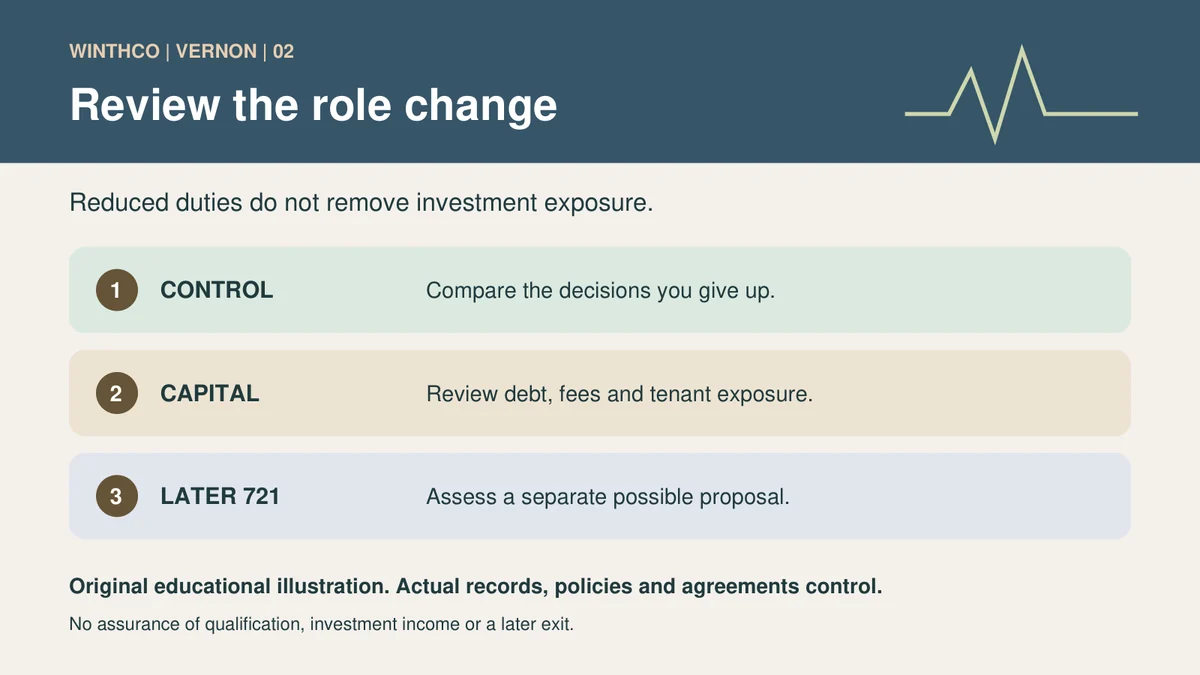
A qualifying Delaware statutory trust interest can provide passive exposure to real estate without requiring the investor to personally handle routine property decisions. IRS Revenue Ruling 2004-86 addresses a specific arrangement that can qualify for Section 1031 treatment. It does not approve every trust or every exchange. Have the professional team review the actual structure instead of assuming the initials DST settle the tax question.
The operational tradeoff is substantial. A direct owner may choose contractors, negotiate leases or decide when to pursue a sale. A DST investor generally cannot direct those matters independently. List the decisions you currently make and ask which rights would remain under the trust documents. Reduced involvement may be valuable, but it is not the same as transferring every financial consequence to someone else.
An owner familiar with one industrial building may be comfortable evaluating loading, tenant use and repair needs. That knowledge can inform questions about a replacement, but it should not create confidence in an unfamiliar property's economics. A DST holding a different property type or market requires its own review. Passive ownership changes how information reaches you, not the need to understand the asset.
Use Winthco's DST document evaluation guide to prepare a discussion of the private placement memorandum, financing and property information. Ask about lease expirations, tenant obligations, major capital work and the assumptions behind rent growth. Distinguish existing contracts from projected renewals or future tenants. An attractive presentation should not obscure which parts of the business plan depend on events that have not happened.
Read fees across the entire investment, including selling compensation, acquisition costs, ongoing charges and potential disposition expenses. Identify related-party services and ask how compensation affects the recommending professional's incentives. Our DST fee discussion explains useful categories, but the offering documents determine the actual charges. Do not compare a DST distribution objective with a building's gross rent as though they measure the same thing.
Review loan maturity, interest provisions, reserves and restrictions alongside operating assumptions. Ask how the property might cope with a tenant departure or repairs that exceed the budget. Consider more than the base-case illustration and distinguish property cash flow from cash available to investors. These questions help expose dependencies; they do not provide a forecast or establish a minimum distribution.
WATCH & LEARN
Tina Colson-Jones of Equity Advantage 1031 Exchange explains the QI's role. Third-party education, not a Winthco affiliation or individual tax advice. Original resource · Watch on YouTube ↗
Educational context only. The discussion does not establish the suitability, returns or tax treatment of an investment.
DST interests are generally available only to accredited investors and are offered through a private placement memorandum. The SEC describes private placements as illiquid investments with limited disclosure and potential total loss. Meeting eligibility criteria does not determine whether the investment fits your spending needs. Distributions may change or stop, principal may be lost and an intended holding period may become longer than expected.
FINRA Regulatory Notice 23-08 discusses reasonable investigation of recommended private placements. Ask the recommending professional what supports the property and sponsor claims, what independent information was examined and what remains uncertain. Review sponsor capacity, property operations and financing together. A familiar property category or a well-presented report is not a substitute for understanding the underlying assumptions and limitations.
A Vernon owner may already have exposure to industrial activity through a business, employment or another property. Buying several interests does not necessarily diversify that exposure if they share tenants, sectors, regions or a sponsor. Compare the proposed investments with the whole balance sheet. Diversification cannot eliminate loss, and neither a tax benefit nor reduced management makes an unsuitable concentration appropriate.
A possible later Section 721 contribution should be evaluated separately from the initial DST purchase. Ask a 721 UPREIT advisor who decides whether a proposal occurs, how value is determined and which conditions apply. Do not assume a later transaction is automatic or that the original investment can be justified solely by an expected future change in ownership.
Ordinary REIT shares and partnership units are not direct Section 1031 replacement real estate. Tax and legal advisers should explain any proposed structure, new restrictions, compensation and conflicts before a decision. A later contribution is not a promise of immediate liquidity, a specific redemption value or tax-free withdrawals. The original investment should remain workable if the proposal is delayed or never offered.
For an owner stepping away from active property management, the practical comparison is broader than which structure appears simpler. Consider information access, decision rights, concentration and the ability to fund personal obligations during a long holding period. Evaluate any later proposal on its actual terms at that time, rather than treating a possible sequence as a fixed retirement plan.
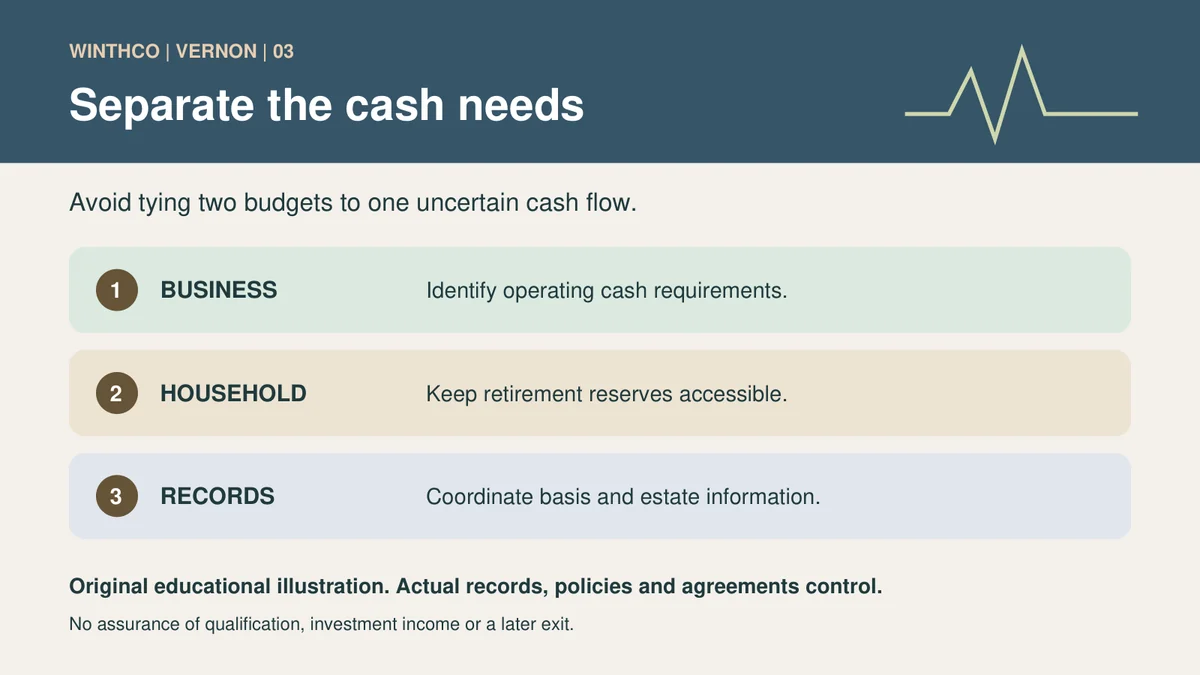
Keep the cash needs of an ongoing business separate from the household's retirement reserve. If both depend on the same property distributions, an interruption can affect two budgets at once. Review accessible savings, existing securities, 401(k)s, IRAs and planned spending with a financial advisor. Retirement accounts are not exchange proceeds, and a rollover or transfer requires its own comparison of costs, services, protections and access.
California owners exchanging into out-of-state property should ask their CPA about Form FTB 3840 when California-source gain or loss remains unrecognized. Reporting generally continues until the deferred amount is recognized. Keep basis, exchange and ownership records, and coordinate beneficiary and estate questions with counsel. Changing where you live does not by itself settle the reporting attached to an earlier exchange.
Winthco's wealth-management services can connect the property choice with broader planning without assuming every asset should be moved. Use either prospect form here or the dedicated contact page for general timing and goals; keep confidential business, tenant and tax documents out of an initial inquiry. The Vernon map shows city-area context only, not a Winthco office or an authoritative parcel boundary.
City-area context only, not a zoning determination or Winthco office.
| Decision | Evidence to request | What to avoid assuming |
|---|---|---|
| Sale planning | Separate building and business interests | Treat all proceeds identically |
| DST review | Compare duties, costs and remaining risks | Equate passive with riskless |
| Possible 721 | Assess a separate future proposal | Assume a scheduled exit |
| Retirement | Separate business and household liquidity | Depend on projected distributions |
No. Its code identifies a General Industry Zone, mixed-use zones and overlays. Confirm the rules for the specific parcel and proposed use.
Do not assume so. Have counsel and the CPA review the actual assets, ownership and allocations before closing.
No. It may reduce direct duties while leaving investment exposure and limiting control. Review the replacement on its own merits.
No. Verify accounting credentials separately and establish which professional is responsible for tax advice.
No. It is a separate possibility with its own terms and conditions. Do not budget around an assumed redemption date.
Sources checked November 22, 2026. This article explains general concepts; your facts and the applicable documents control.
Winthco DST services · Winthco evaluation overview · Editorial standards
1031 exchange planning
Plan the identification and completion periods for a deferred 1031 exchange, including the earlier tax-return deadline.
Read guide →Risks and due diligence
Learn how to review DST acquisition costs, ongoing expenses, financing charges and exit fees without relying on a single headline number.
Read guide →1031 exchange planning
Learn how multiple DSTs affect identification, closings, allocation and concentration risk in a 1031 exchange.
Read guide →Explore Winthco’s main DST article collection
Share your timeline and investment range. A Winthco team member will follow up with you.