1031 exchange planning
1031 exchange identification rules for DSTs
Understand the three-property, 200 percent and 95 percent identification rules before naming DST replacement property.
Read guide →
Home / Learning center / DST and 1031 strategy
DST and 1031 strategy
Winthco Wealth Management · Updated November 10, 2026
A ground lease may be relevant to a 1031 exchange, but first confirm whether you would buy the land subject to a lease or acquire the tenant's leasehold. Those interests carry different rights and risks. Compare the actual documents with a qualifying Delaware statutory trust, then evaluate tax eligibility and investment suitability separately.
Start with the investment property you own. Interview a licensed broker who has sold comparable properties and ask how current leases, physical condition and financing contingencies affect likely offers. Request a written estimate of brokerage costs, loan payoff, concessions and net proceeds under more than one closing scenario. Gather leases, title documents and operating records, and tell the broker if a proposed closing date depends on a buyer obtaining financing or a third party giving consent. If you want to reduce management work, explain which responsibilities you want to give up and which decisions you still want to control. Bring a CPA, real estate attorney and qualified intermediary into the exchange discussion before closing or receiving proceeds.
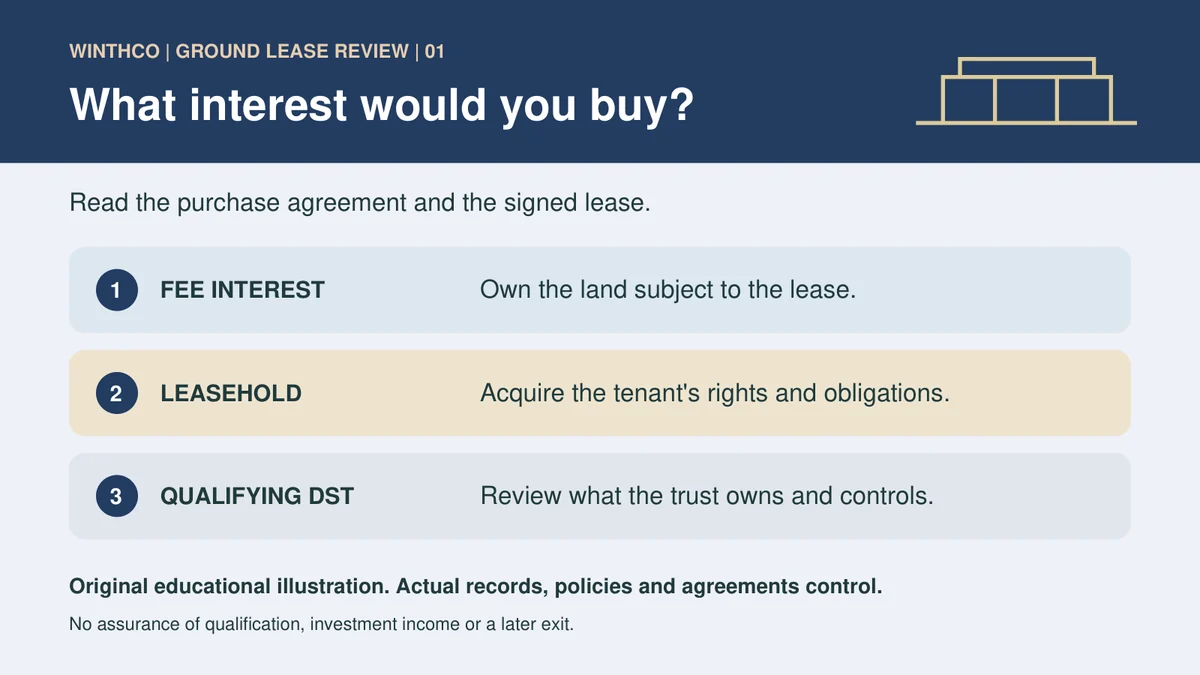
A ground lease generally separates ownership of the land from the tenant's right to use it for a stated term. An offering described as a ground-lease investment might sell the landowner's fee interest subject to the lease, or it might assign the tenant's leasehold. If you buy the fee, ask what rent and enforcement rights transfer and how the lease affects the land's use. If you buy the leasehold, ask what rent you owe, which obligations you assume and who controls or receives the improvements when the lease ends. Require the actual purchase agreement, title materials, signed lease and amendments. A marketing headline or a rent schedule does not tell you what legal interest you will receive.
Share your timeline and investment range. A Winthco team member will follow up with you.
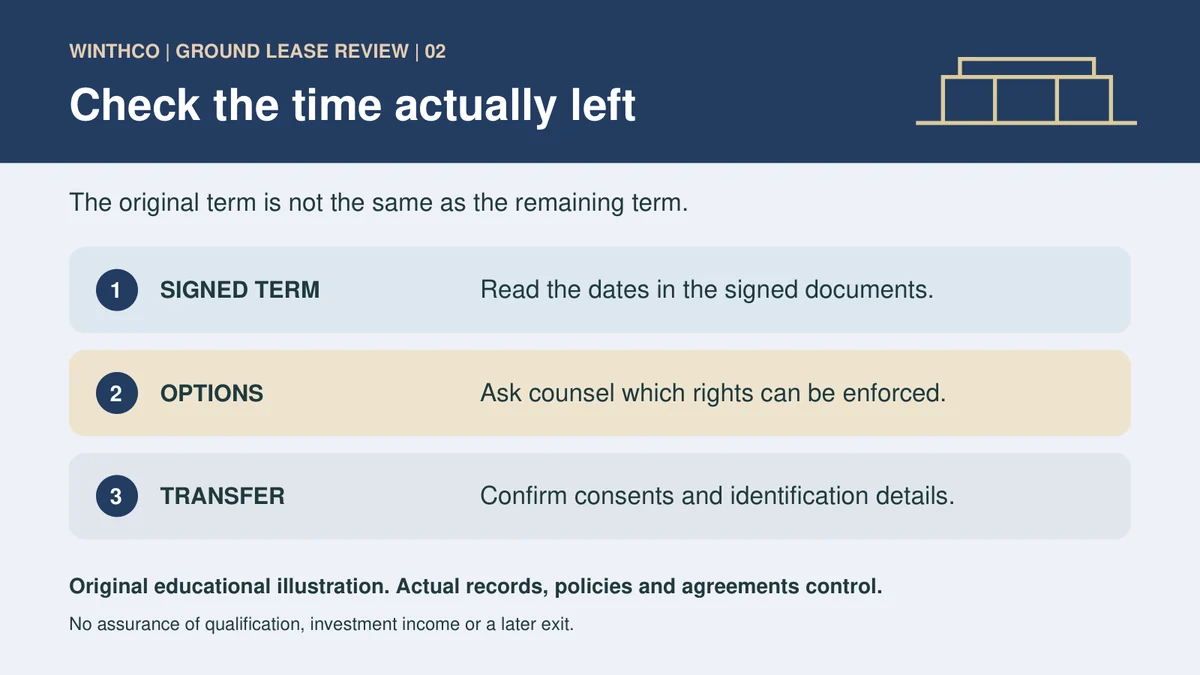
Treasury Regulation 1.1031(a)-3 includes a leasehold in its definition of real property for Section 1031. That classification does not decide whether two particular interests are like-kind. Treasury Regulation 1.1031(a)-1(c) gives an example of a leasehold with at least 30 years left exchanged for real estate, and IRS Publication 544 describes an exchange of owned real estate for a real estate lease that runs 30 years or longer. Do not use the number as approval of every deal or as a minimum lease term for buying fee ownership of leased land. For example, a lease originally signed for 50 years might have only 26 years left. Ask counsel to evaluate the remaining term, legally enforceable options and the actual interest being transferred. Do not simply add an extension that still requires negotiation.
Discuss your DST questions with Winthco →
In a typical deferred exchange, identify the replacement property within 45 days after the transfer of the relinquished property and receive it by the earlier of 180 days after transfer or the federal income tax return due date, including extensions, for the transfer year. Review the rules for structuring a deferred 1031 exchange and confirm your dates and written identification with the intermediary. Describe the specific property and have counsel confirm the interest and documents match what you intend to receive. Identify needed consents early. A negotiation over an assignment or lender approval does not restart the clock. Ask your CPA to review adjusted basis, depreciation, loan balances and whether cash, other non-like-kind property or net debt relief affects recognized gain.
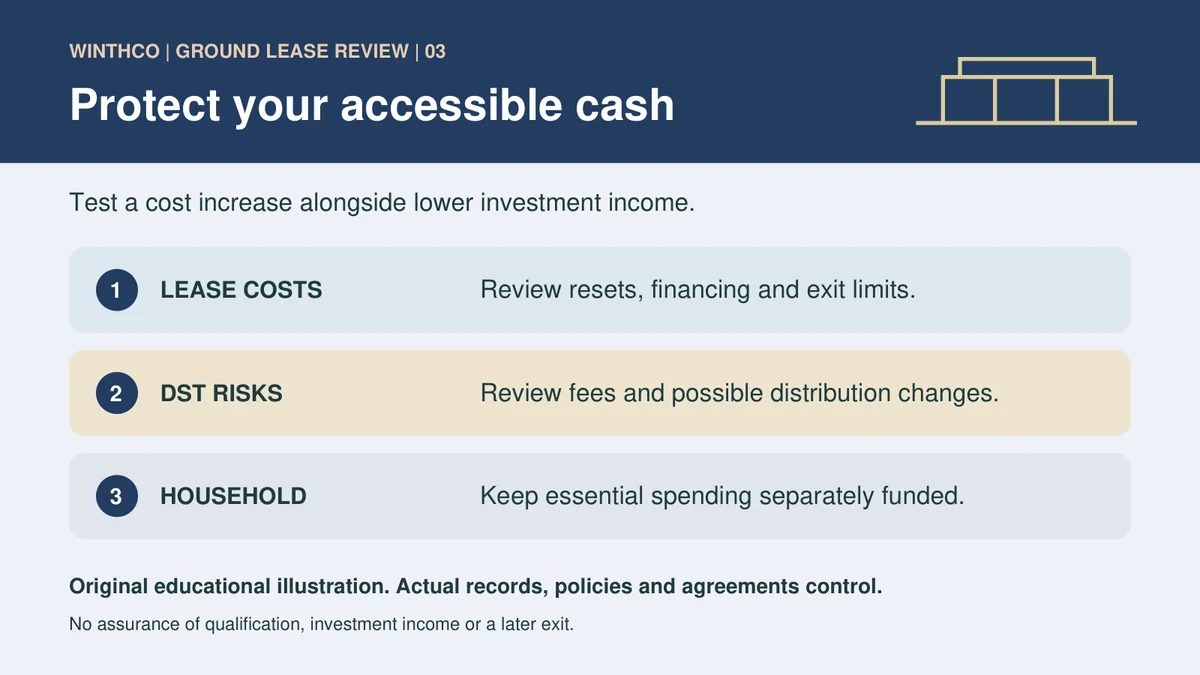
Read the rent-reset formula, escalation dates and any caps or floors. Ask which party pays taxes, insurance, maintenance and capital costs, and who bears a loss if casualty or condemnation interrupts use. Review default, notice and cure rights, the assignment process, and restrictions on borrowing or selling. If improvements are important to the purchase price, ask what happens to them at expiration or earlier termination. Consider a hypothetical leasehold buyer that expects to sell in ten years. A future purchaser or lender may value the interest differently once ten more years have passed, especially if a rent reset or consent is approaching. A long remaining term does not remove counterparty or financing risk.
WATCH & LEARN
Tina Colson-Jones of Equity Advantage 1031 Exchange discusses general examples. Current Section 1031 treatment is limited to qualifying real property; this video does not determine eligibility for a particular ground lease or DST. Original resource · Watch on YouTube ↗
Educational context only. The discussion does not establish the suitability, returns or tax treatment of an investment.
A Delaware statutory trust can reduce day-to-day ownership work, but an investor has less control over operations and sale timing. IRS Revenue Ruling 2004-86 addressed a particular trust and the nature of its beneficial interests under the ruling's facts. Use the guide to DST replacement-property requirements to prepare questions about the actual documents. Ask what real estate the trust owns, whether any property is subject to a ground lease and how cash reaches the trust. A master lease can add a separate payment dependency. Compare rent that is actually collected, financing costs, funded reserves and acquisition, ongoing and exit charges. Ask who decides when to sell or how to respond to a tenant or lender problem.
A single ground lessee or landowner can create counterparty exposure. Compare what happens if the tenant stops paying, the lessee cannot assign its rights or ground rent rises while property income falls. For a DST, review sponsor, property, debt, tenant and market concentrations together. Private placements are generally directed to accredited investors and can be hard to value and sell. Distributions can decline or stop, fees can reduce proceeds, principal can be lost and tax law can change. Compare both choices with a direct purchase without a ground lease or a taxable sale using the same cash needs and realistic holding assumptions. See the comparison of a net lease and a DST for a separate discussion of management and control.
Put the two candidates on the same timeline. For the leasehold, show when ground rent can reset and which renewals or consents would still be open at the point you expect to sell. For the DST, note major tenant expirations, loan maturity and any decisions that require trustee or lender approval. In each case, ask what would happen if income falls just as a major cost rises. Compare the cash you could access outside either investment and do not treat an advertised valuation as proceeds you could receive on demand.
A potential UPREIT contribution to an operating partnership is a separate transaction, not an automatic step in a 1031 exchange or a way to repair a missed closing. Ordinary REIT shares and operating partnership units are not direct Section 1031 replacement real property. If a transaction is offered, ask counsel and your CPA to review the interest transferred, consideration, valuation, fees, tax consequences and holding or redemption limits. Review what happens if the proposal never goes ahead. Keep future partnership distributions or redemptions out of your essential cash budget unless and until the relevant rights and availability are clear.
Write down the cash you need for taxes, reserves and household expenses. Then identify which assets can cover those costs without an early sale, lease assignment or projected DST payout. Review existing taxable investments, IRA and 401(k) options, account costs and services, income needs and beneficiary arrangements without assuming a rollover is appropriate. Winthco Wealth Management can help compare control, concentration and liquidity across these alternatives, alongside the work of your tax and legal professionals. Before choosing, ask for a short written summary: what transfers, what could delay closing, what costs can rise, and what money remains available if income stops.
A missing signed amendment, a disputed renewal option or an unclear assignment consent is a reason to get more information, not to fill in the gap with a best guess. Ask your intermediary which valid identification options are still available before the deadline. Keep the lease file, identification and closing paperwork consistent, and ask the advisers to revisit their analysis if the interest or terms change.
| Decision | Evidence to request | What to avoid assuming |
|---|---|---|
| Fee ownership subject to lease | Rent rights, tenant obligations and rights at expiration | Owning land means unrestricted use |
| Tenant leasehold | Remaining term, ground rent, consents and improvements | The original term is the time left |
| Qualifying DST | Actual assets, control, financing and fees | The DST label proves eligibility |
| Retirement liquidity | Cash available independent of investment income | A future exit will cover essential spending |
No. The fee owner buys the land subject to the lease. A leasehold buyer receives the tenant's rights and obligations under the applicable documents.
The regulation gives an example with 30 years or more to run. Ask counsel about your interest, remaining term and any enforceable renewal rights rather than relying on the original term alone.
Check the actual offering documents to see what the trust owns and what it owes. The presence of a lease does not decide exchange eligibility or suitability.
Do not assume it will. Have your intermediary confirm the applicable deadlines and discuss feasible alternatives before they pass.
No. Trust documents may limit transfers, and a secondary market may be limited or unavailable. Direct ownership may also be difficult to sell, depending on terms and buyer demand.
Sources checked November 10, 2026. This article explains general concepts; your facts and the applicable documents control.
Winthco DST services · Winthco evaluation overview · Editorial standards
1031 exchange planning
Understand the three-property, 200 percent and 95 percent identification rules before naming DST replacement property.
Read guide →1031 replacement property comparison
Compare control, tenant risk, financing, fees and liquidity when choosing a direct triple-net lease or DST for a 1031 exchange.
Read guide →DST investment due diligence
Review who owes rent in a DST master lease, what supports payment, and how lease risks fit a property sale, 1031 exchange and retirement plan.
Read guide →Explore Winthco’s main DST article collection
Share your timeline and investment range. A Winthco team member will follow up with you.