1031 exchange planning
1031 exchange identification rules for DSTs
Understand the three-property, 200 percent and 95 percent identification rules before naming DST replacement property.
Read guide →
Home / Learning center / DST and 1031 strategy
DST and 1031 strategy
Winthco Wealth Management · Updated November 8, 2026
A 1031 improvement exchange can let you receive qualifying real estate with work already in place. It does not count construction performed after you receive the property. A qualifying Delaware statutory trust interest is a different replacement option. Compare what can actually transfer by your deadline, who controls the work and what cash you need to keep available.
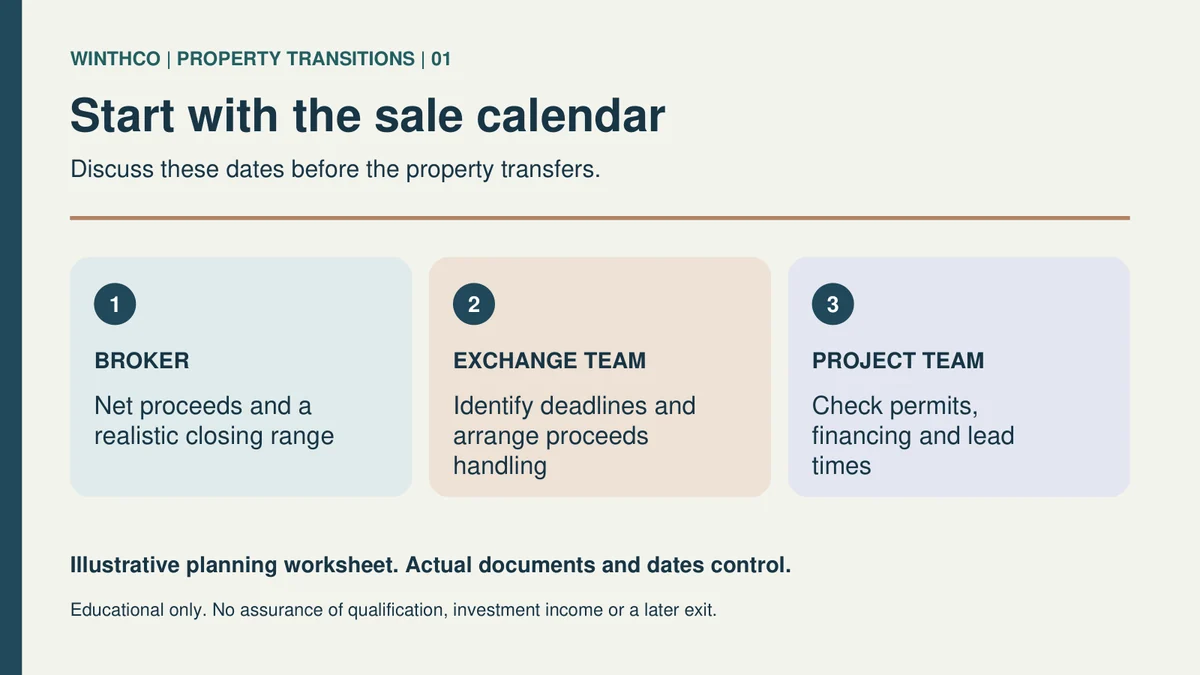
Start with the property you already own. Interview a licensed broker who has sold comparable investment properties and ask how existing leases, deferred maintenance and the buyer's financing could affect price and closing. Get a written estimate of commissions, concessions, debt payoff and net proceeds, then ask for a plausible range of transfer dates. If your next investment needs a substantial renovation, that range matters: the sale, building permits, contractor availability and lender funding may all follow different calendars. Bring your CPA, attorney and qualified intermediary into the discussion before closing or taking receipt of any proceeds. A sale plan that works for the buyer may leave too little time for the replacement project.
A build-to-suit or improvement exchange is about what real property you receive in an exchange, not just where you spend sale proceeds. Treasury Regulation 1.1031(k)-1(e) addresses property being produced. Additional work after the taxpayer receives the property is not treated as receipt of like-kind property. Before buying, ask counsel when receipt occurs under the actual transaction, what will be in place at that time and how it will be valued. Paying a deposit, signing a fixed-price contract or setting money aside for later work does not turn that later work into property received. The question is not whether the renovation will eventually add value; it is what you actually receive under the exchange rules.
Share your timeline and investment range. A Winthco team member will follow up with you.
In a typical deferred exchange, identify replacement property within 45 days of transferring the relinquished property. Receive it by the earlier of 180 days after that transfer or the due date, including extensions, of the federal return for the year of the transfer. For property being produced, describe the real estate unambiguously and include as much detail about the improvements as practicable at identification. Agree with your intermediary on who receives the written identification and how revisions are handled before the deadline. A tax return extension does not add time beyond the 180-day ceiling. Read Winthco's explanation of deferred exchange deadlines alongside the IRS instructions and confirm your actual dates.
Discuss your DST questions with Winthco →
A structured improvement exchange may use an exchange accommodation titleholder, or EAT, to hold the replacement property while work is underway. The qualified intermediary handles exchange arrangements and proceeds; the titleholder's role is to hold the property under the documented structure. Do not assume the roles are interchangeable. Revenue Procedure 2000-37 describes a safe harbor with a written accommodation agreement generally required within five business days of the titleholder receiving qualified indicia of ownership and limits on how long property can be held. Revenue Procedure 2004-51 excludes replacement property owned by the taxpayer within the preceding 180-day period specified in that procedure. Have counsel confirm the structure before any acquisition or transfer. Parking does not extend your deferred exchange deadline or cure an otherwise ineligible exchange.
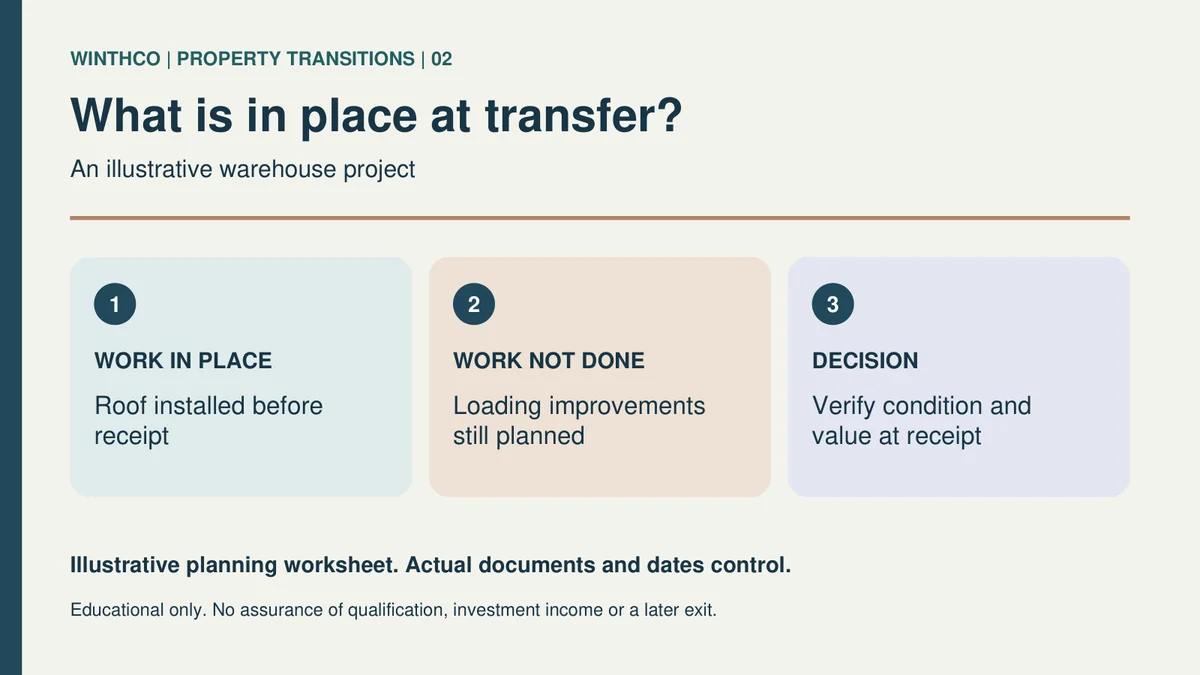
Unfinished production is not automatically fatal. The regulation has a rule for determining whether real property received before production is completed is substantially the same property identified. Only the portion that is real property under applicable law at receipt is treated as like-kind property under that rule. Suppose, hypothetically, a warehouse roof is installed before transfer but the planned loading improvements are not. Get evidence of the condition at transfer and have qualified professionals assess the actual property and value. Do not add future work or use the full construction budget as a proxy. Have the CPA model recognized gain if exchange funds remain or other non-like-kind consideration is received. The construction shortfall and the tax result are separate calculations.
WATCH & LEARN
Equity Advantage 1031 Exchange introduces the build-to-suit concept. For actual deadlines, incomplete work and prior ownership, rely on the linked Treasury and IRS sources and your own advisers. Original resource · Watch on YouTube ↗
Educational context only. The discussion does not establish the suitability, returns or tax treatment of an investment.
A Delaware statutory trust can hold real estate that is already operating, so an investor comparing such an offering does not need to deliver a construction project personally. IRS Revenue Ruling 2004-86 analyzes a particular trust and qualifying real-property interests on its facts. A DST label alone does not make an interest eligible, and an interest is not a reliable backup unless it is suitable, available, properly identified when needed and can actually close. Review the requirements for a DST replacement interest, then ask for the trust agreement, private placement memorandum, operating records and a written schedule of acquisition, ongoing and potential exit fees. Compare who makes decisions about operations and sale and how much discretion you give up.
An improvement exchange can give you more say over the finished property, but permits, overruns, contractor delays, construction loans and insurance can make an apparently feasible schedule unrealistic. Confirm who pays if work stops, who bears interim carrying costs and what the lender requires while title is parked. A DST may reduce hands-on work, but private placements are generally directed to accredited investors and can be difficult to value or sell. Sponsor decisions, limited trustee flexibility, vacancy, debt maturity and tenant or sector concentration can reduce or stop distributions. Principal can be lost and tax rules can change. In both cases, compare a downside scenario with a regular replacement purchase or a taxable sale instead of letting the tax deadline pick the investment.
Write down your decision points before you pay a nonrefundable deposit. For example, ask the contractor for the last workable date to order long-lead equipment, the lender for written approval of the ownership arrangement, and the intermediary for the last date you can submit or revise a valid identification. A delay in any one of those items should trigger an update to the budget and the expected condition at transfer. On a DST, ask for a comparable written check on current subscription availability, financing and the expected settlement date. Do not confuse a seller's or sponsor's estimate with a commitment. If a material assumption fails, use the alternatives your team has already reviewed rather than treating another property or security as automatically interchangeable.
Do not plan on it. A possible Section 721 contribution to an operating partnership is a separate transaction with separate eligibility, terms and tax analysis. A later transaction may never be offered, and operating partnership units or ordinary REIT shares are not direct Section 1031 replacement real property. If a proposal does arise, ask who can initiate it and what the documents say about costs, lockups, redemption, valuation and tax consequences. It does not change what real property you received by the original exchange deadline. Do not use potential redemptions as a source of near-term cash for completing work or covering household spending.
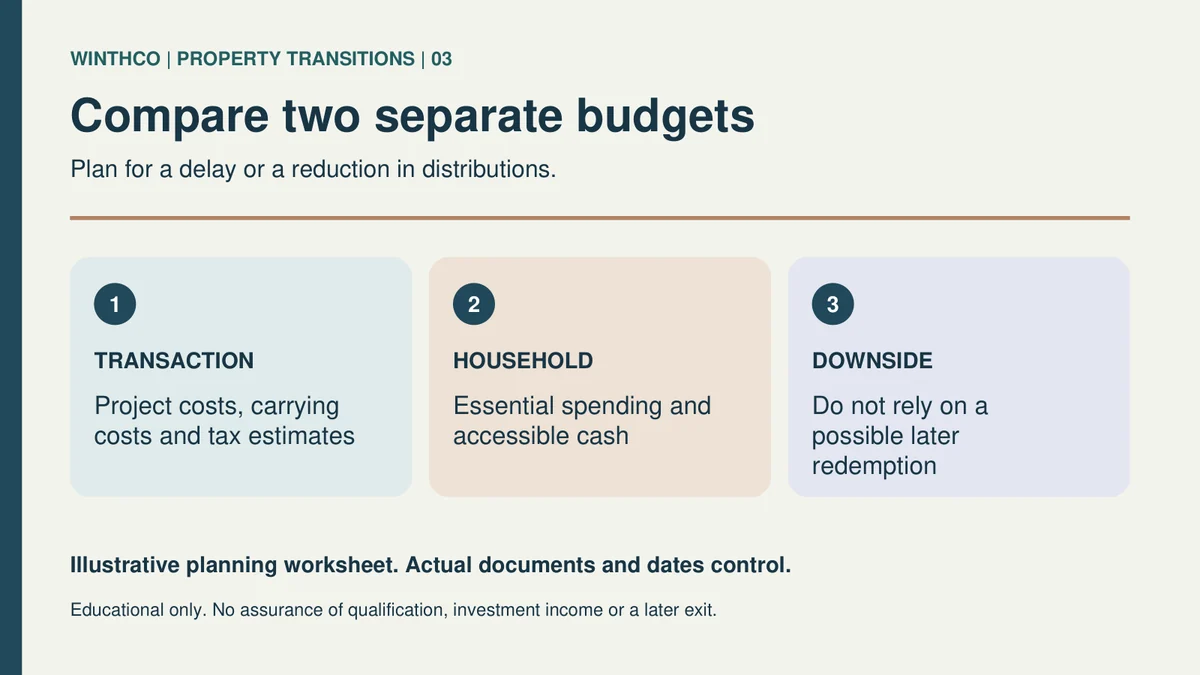
Make two budgets: one for the transaction and one for your household. The first should include construction contingencies, carrying costs and taxes your CPA estimates under several scenarios. The second should show which resources would still be available if construction runs late or DST distributions stop. Include taxable savings, retirement income needs, existing IRA and 401(k) assets and beneficiary or estate planning questions. Review account fees and options without assuming any rollover is appropriate. Use the guide to reverse exchange planning if the next property needs to be secured before your sale. Winthco Wealth Management can help compare portfolio exposure and liquidity alongside the work of your tax, legal and exchange professionals.
| Decision | Evidence to request | What to avoid assuming |
|---|---|---|
| Direct improvement exchange | Real property actually received; condition and value at receipt | Future work automatically counts |
| Title parking | Written arrangement, financing and separate timing constraints | Parking extends the federal deadline |
| Qualifying DST | Actual trust terms, availability, fees and downside cash flow | An alternative DST will always be available |
| Retirement plan | Accessible reserves, other income and essential spending | A future 721 event is dependable cash |
Additional production after receipt does not count as like-kind property received under the deferred exchange regulation. Have counsel confirm the receipt date and your CPA assess actual value.
Not necessarily. The regulations address incomplete production and substantial sameness, but that is not permission to count future work.
Revenue Procedure 2004-51 excludes specified replacement property you owned within the relevant 180-day lookback. Ask counsel about your ownership facts before assuming the safe harbor applies.
It can be considered if eligible and identified within the applicable rules. Confirm identification limits, actual availability and suitability before treating it as an alternative.
No. Any later partnership contribution is separate and should be evaluated on its own facts and documents.
Sources checked November 8, 2026. This article explains general concepts; your facts and the applicable documents control.
Winthco DST services · Winthco evaluation overview · Editorial standards
1031 exchange planning
Understand the three-property, 200 percent and 95 percent identification rules before naming DST replacement property.
Read guide →1031 exchange planning
Learn when a reverse 1031 exchange may involve a DST and which parking, timing, title, funding and investment risks to review.
Read guide →1031 exchange planning
Learn how exchange expenses, closing costs, DST fees and settlement records can affect gain, basis and cash planning in a 1031 exchange.
Read guide →Explore Winthco’s main DST article collection
Share your timeline and investment range. A Winthco team member will follow up with you.