Winthco Wealth Management · Updated October 9, 2026
An apartment building held for investment or business use may be exchanged for qualifying replacement real estate, potentially including an eligible Delaware statutory trust interest. The owner must protect the Section 1031 process, evaluate debt and equity, and underwrite the DST as a private real estate investment, not merely as a deadline solution.
Key takeaways
An apartment building may be exchanged for other qualifying real estate, not only another apartment property.
Revenue Ruling 2004-86 applies to the specifically described restricted DST and does not approve every trust.
Assemble tax, title, loan and operating records before the sale and exchange deadlines begin.
Model equity, debt, fees, reserves and possible taxable items with the taxpayer's advisers.
Underwrite a multifamily DST's real estate, financing, sponsor, fees and exit assumptions.
Reduced management comes with reduced control, limited liquidity and possible loss.
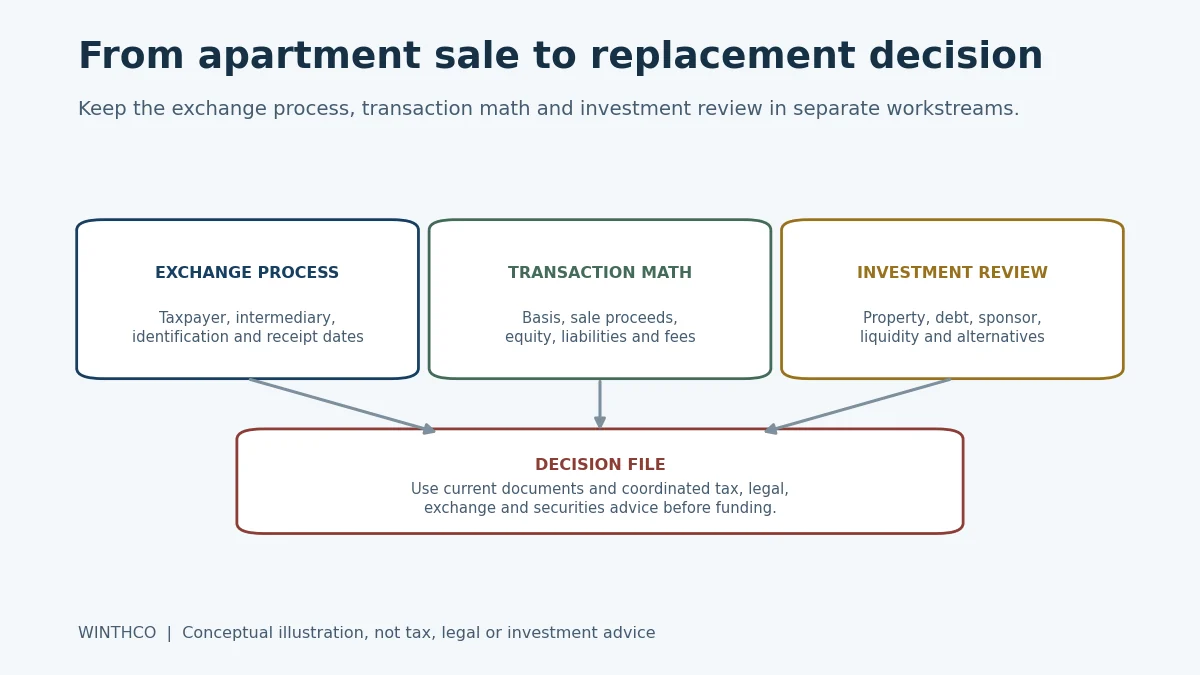
Original Winthco educational illustration. Separate exchange procedure, transaction math and investment review before selecting a replacement.
Can an apartment building be exchanged into a DST?
Section 1031 generally applies to real property held for productive use in a trade or business or for investment. The IRS explains that like-kind real estate can differ in grade or quality, so an apartment building does not have to be exchanged for another apartment building. A properly structured interest in another type of investment real estate may qualify. Winthco's DST 1031 exchange structure overview explains the basic trust and replacement-property framework.
IRS Revenue Ruling 2004-86 concludes that owners of the specifically described, restricted Delaware statutory trust are treated as owning undivided interests in its real estate. Under those facts, a taxpayer may exchange qualifying real property for the trust interests without current recognition of gain if the other Section 1031 requirements are satisfied. The ruling does not approve every trust or transaction, so the actual trust agreement, tax opinion and exchange documents matter.
Let’s talk about your DST options.
Share your timeline and investment range. A Winthco team member will follow up with you.
Eligibility is only the first screen. Apartment owners often want fewer tenant calls, payroll decisions, repairs and leasing responsibilities, but a DST replaces direct control with sponsor control and limited liquidity. Confirm the federal tax owner, property use and transaction sequence before the sale, then compare the investment on its own merits. A tax-deferred structure is not automatically a suitable investment.
What records should the apartment owner assemble?
Build a sale and tax file before accepting a replacement. Include the deed, entity documents, prior returns, depreciation schedules, cost-segregation studies, capital-improvement invoices, loan statements, closing estimates and any partnership or operating agreements. The owner and CPA need these records to estimate adjusted basis, depreciation recapture, liabilities, exchange expenses and potential recognized gain. Missing history can delay decisions while the exchange clock is running.
Create a separate operating file for the apartment property. Collect the current rent roll, leases, security-deposit ledger, trailing twelve-month income and expenses, delinquency report, concessions, payroll, service contracts, insurance claims, property-tax bills, utility history, inspection reports and deferred-maintenance list. These records support the sale and help the owner compare the economic reality of the relinquished property with the assumptions in a DST offering.
Confirm who owns the building for federal tax purposes. The taxpayer that transfers the apartment property generally needs to be the taxpayer that receives the replacement property, subject to fact-specific exceptions and structuring rules. A late plan to distribute partnership property or change title can create serious problems. Coordinate the qualified intermediary, CPA and attorney before signing changes to title, ownership or the sale contract.
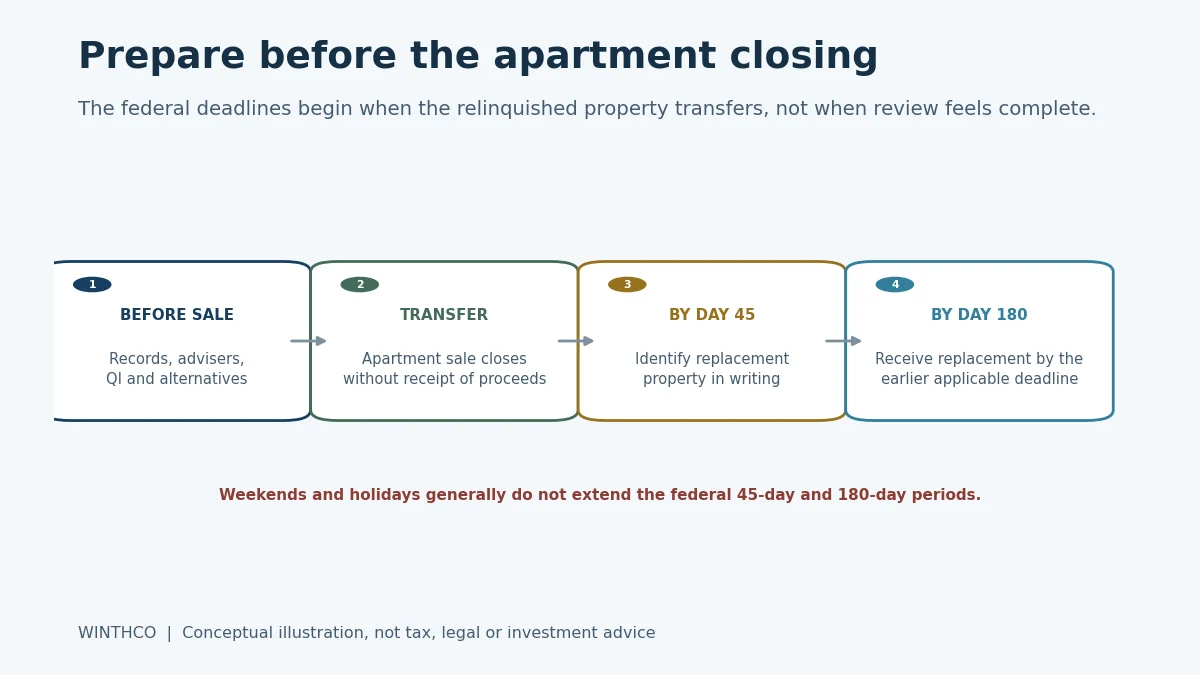
Original Winthco educational diagram. Organize records and the qualified intermediary before the sale, then protect the federal deadlines.
How do the 45-day and 180-day deadlines shape the review?
Engage a qualified intermediary before the apartment building transfers. If the seller receives or controls the proceeds, the deferred-exchange safe harbor may be unavailable. The federal identification period generally ends 45 days after the transfer. Replacement property must generally be received by the earlier of 180 days after the transfer or the due date of the applicable federal return, including extensions. Weekends and holidays generally do not extend these periods.
The written identification must clearly describe the replacement property and be delivered to a permitted party within the deadline. DST interests are not generic placeholders. The identification should match the offering and interest being considered, and the offering must remain available through subscription and funding. Review backup choices and the identification rules with the intermediary before the deadline instead of assuming that another offering can be substituted later.
Begin securities and property due diligence before the apartment sale closes when possible. Accreditation, subscription documents, entity review, source-of-funds requirements and custodian procedures can require time. The owner should also compare direct replacement property, professional third-party management, a mixed replacement plan and a taxable sale. A DST can simplify certain execution steps, but urgency should not replace analysis.
How should equity, debt and a partial exchange be modeled?
Start with a transaction worksheet showing expected sale price, selling costs, qualified-intermediary proceeds, adjusted basis and debt payoff. Then compare replacement equity, allocated DST debt and any outside cash. Receiving cash or other non-like-kind property can cause recognized gain, and a net reduction in liabilities can affect the calculation unless offset under the applicable rules. Only the taxpayer's advisers can apply those rules to the final numbers.
A leveraged DST may allocate a share of nonrecourse financing to the investor for tax analysis, but that does not make leverage harmless. Review the loan rate, maturity, amortization, covenants, extension options, reserves and lender remedies. A near-term maturity or aggressive assumptions can create refinancing or sale pressure. A debt-free DST avoids property-level borrowing but may require more equity to address the exchange worksheet.
The apartment owner may choose more than one replacement. A direct property and one or more DST interests can divide capital across strategies, and a partial exchange may preserve cash at the cost of some current tax. Winthco's 1031 replacement-property options page introduces the available paths. Model each choice after fees, reserves, debt service, taxes and realistic liquidity needs rather than maximizing deferral in isolation.
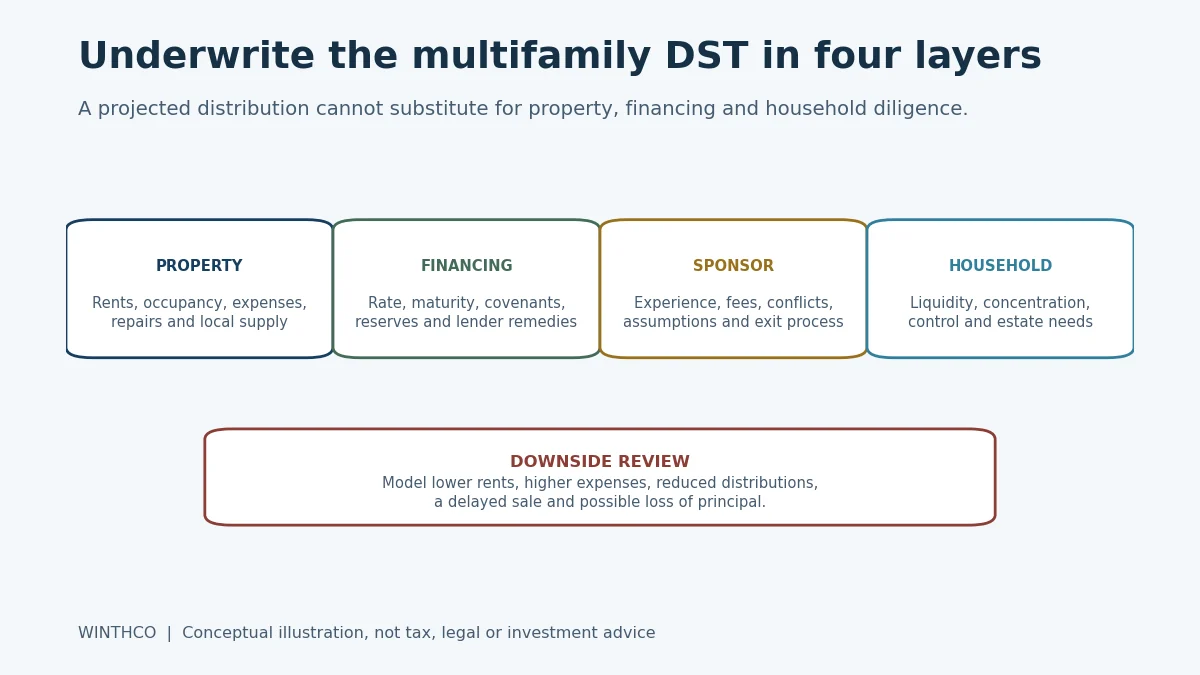
Original Winthco educational diagram. Property quality, financing, sponsor terms and household fit require separate diligence.
How should a multifamily DST be underwritten?
Treat the DST's apartment properties as if you were buying them directly. Review market rent, in-place rent, occupancy, bad debt, concessions, lease expirations, unit mix, resident turnover, payroll, utilities, insurance, property taxes and maintenance. Compare the sponsor's forecasts with recent operating statements and third-party market evidence. Winthco's multifamily DST property review page provides additional context, while the private placement memorandum and current property data control.
Examine the physical plan. Ask about unit interiors, roofs, plumbing, electrical systems, HVAC, parking, amenities, accessibility, environmental conditions and known code matters. Trace the renovation budget, timing, rent premiums and disruption assumptions. A value-add strategy can miss its targets because of higher construction costs, weak leasing, resident turnover or local supply. Reserves can be spent, and distributions can be reduced or suspended.
Then review the sponsor and every layer of compensation. Identify acquisition, financing, selling, organization, asset-management, property-management, servicing and disposition fees, including payments to affiliates. Compare purchase price with appraisal and other valuation evidence. Study sponsor experience through difficult markets, realized outcomes, conflicts and the proposed exit process. A projected hold or distribution is an estimate, not a promise.
WATCH & LEARN
Watch: an introduction to DST 1031 planning
Winthco Wealth Management's introductory video explains the DST and 1031 exchange context. It is general education, not a substitute for the current offering documents or individualized tax, legal and investment advice. Original resource · Watch on YouTube ↗
Educational context only. The discussion does not establish the suitability, returns or tax treatment of an investment.
What risks and alternatives should apartment owners compare?
DST interests commonly used in exchanges are private placements. The SEC warns that private placements can have limited disclosure, transfer restrictions, illiquidity and risk of total loss. A Form D filing is not SEC approval. Read the complete private placement memorandum, trust agreement, tax opinion and subscription documents, and verify the professionals and entities involved before funds move.
FINRA cautions that private placements and other illiquid investments can be difficult to sell quickly and that correlated holdings can leave a portfolio concentrated. Several apartment DSTs may still share the same property type, sponsor, lender, markets or operating assumptions. Measure the household's total real estate exposure and keep adequate liquid assets outside the DST for taxes, emergencies, healthcare and family needs.
Use a written comparison among the DST, another apartment building, a different direct property, professional management, a mixed replacement and a taxable sale. Compare control, workload, fees, debt, income variability, state filings, estate planning, liquidity and downside scenarios. A DST may reduce day-to-day landlord duties, but it cannot promise tax deferral, distributions, appreciation, a sale date or return of principal.
What should you ask about each decision?
Decision
Evidence to request
What to avoid assuming
Exchange eligibility
Taxpayer, investment use, intermediary, deadlines and actual DST structure
Any product labeled DST qualifies
Apartment records
Basis, depreciation, rent roll, leases, expenses, repairs and debt
A sale price is enough to plan the exchange
Multifamily underwriting
Rents, occupancy, concessions, expenses, insurance, taxes, reserves and supply
Projected distribution alone shows property quality
Financing
Rate, maturity, amortization, covenants, reserves and downside cases
Allocated nonrecourse debt removes leverage risk
Household fit
Liquidity, concentration, control, state filings and estate needs
Passive management means a simple or liquid investment
Your next-step checklist
Confirm the federal tax owner and investment or business use of the apartment property.
Engage the qualified intermediary before the sale transfers.
Collect basis, depreciation, improvement, title, loan and entity records.
Prepare the rent roll, leases, deposits, operating statements and repair history.
Calculate sale proceeds, liabilities, replacement equity and potential taxable items.
Record the 45-day identification and 180-day completion deadlines.
Review the DST trust agreement, tax opinion, offering memorandum and subscription package.
Underwrite rents, occupancy, concessions, expenses, capital work and reserves.
Review sponsor experience, conflicts, every fee and the property-level debt.
Compare direct property, professional management, mixed replacement and taxable-sale paths.
Keep adequate household liquidity outside the private placement.
Coordinate the intermediary, CPA, attorney and securities professional before funding.
Frequently asked questions
Can an apartment building be exchanged for a DST?
Potentially. The building must be qualifying real property held for business or investment, the DST interest must satisfy the applicable tax structure, and the transaction must meet the other Section 1031 requirements.
Must the replacement DST also own apartments?
No. Like-kind real estate can differ in grade or use. An apartment owner may consider a qualifying DST that owns another type of real property, subject to the actual documents and advisers' review.
When should a qualified intermediary be engaged?
Before the apartment building transfers. Receiving or controlling the sale proceeds can jeopardize the deferred-exchange structure.
Does DST debt count as replacement debt?
Allocated nonrecourse debt may be relevant to the exchange calculation, but liabilities, equity and taxable items require a complete analysis by the taxpayer's CPA and other advisers.
Are multifamily DST distributions guaranteed?
No. Occupancy, rent collection, expenses, capital work, reserves, financing and sponsor decisions can reduce or stop distributions.
Can a DST interest be sold whenever the investor wants?
Do not assume so. Private DST interests commonly have transfer restrictions and no dependable secondary market, with exit timing largely controlled by the sponsor.
Does using more than one apartment DST create diversification?
Not necessarily. Holdings can remain correlated by property type, sponsor, lender, geography, tenant profile and economic drivers.