1031 exchange planning
DST 1031 exchange guide for retiring landlords
Learn how retiring landlords can compare a DST 1031 exchange with direct real estate, including control, liquidity, debt, income and risk.
Read guide →
Home / Learning center / Local real estate planning
Local real estate planning
Winthco Wealth Management · Updated October 18, 2026
A Beverly Hills rental-property owner considering a DST should coordinate sale preparation, exchange planning and investment review before closing. Confirm the property's jurisdiction and rental records, compare the loss of direct control with reduced management work, and evaluate any separate 721 UPREIT proposal against household liquidity and retirement needs.
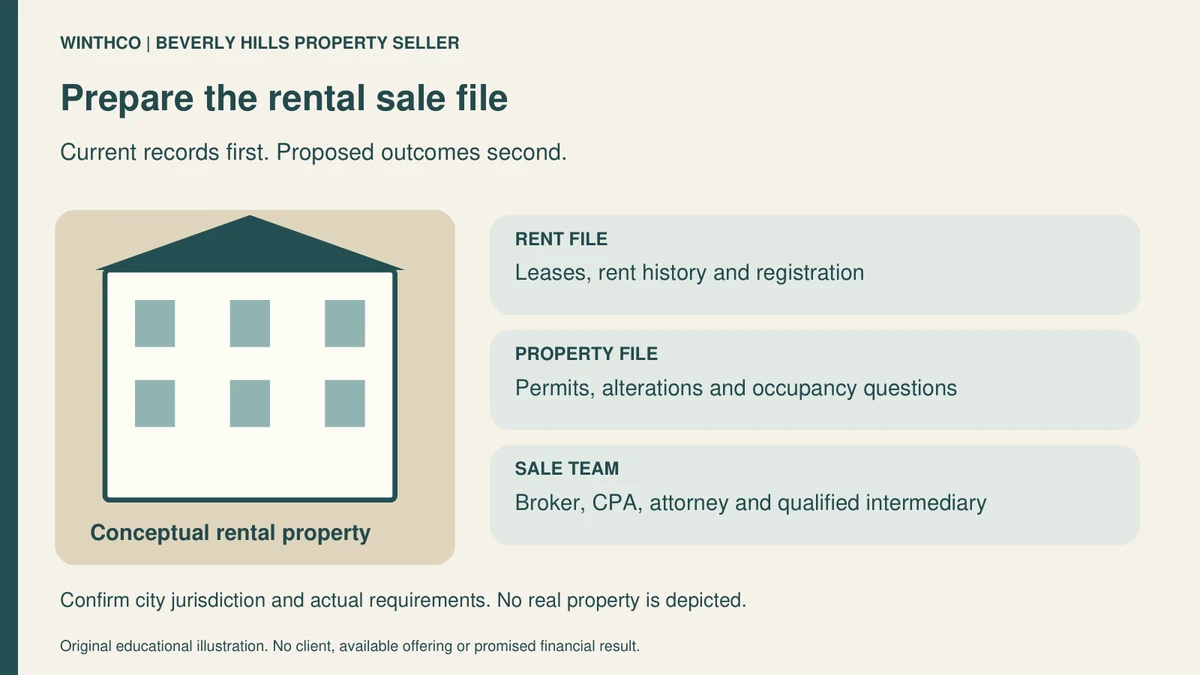
Begin with the reason for selling: fewer management duties, a different property exposure, family commitments or retirement spending. Interview appropriately licensed realtors or commercial brokers with experience in the actual property type. Ask how they will establish value, present occupied units, document operating results and handle buyer questions. Compare the proposed marketing plan and compensation, and verify the license with California's Department of Real Estate.
A sale estimate and an exchange proposal answer different questions. Bring the CPA, attorney and qualified intermediary into planning before closing or receiving proceeds. Have the broker explain which missing documents could delay a buyer's review; have the tax team identify ownership and basis issues. Winthco's overview of potential 1031 benefits is a starting point for discussion, not a promise that a sale or replacement investment will qualify.
Share your timeline and investment range. A Winthco team member will follow up with you.
Confirm that the parcel is governed by the City of Beverly Hills before applying its rules. The city's Rent Stabilization and Housing Division says its ordinance applies to most residential rental properties with two or more units and requires annual registration of most rental units. Ask city staff and counsel to confirm the property's coverage, registration status and applicable tenant requirements. Do not assume every unit has identical rules.
For an occupied property, assemble leases, rent histories, deposits, notices and documented expenses for professional review. Reconcile actual records before marketing a future rent assumption. The city publishes separate Chapter 5 and Chapter 6 rent-increase information; a general market-rent estimate does not establish what is permitted for a particular tenancy. This guide intentionally does not quote a changing rent cap or recommend a tenant action.
Beverly Hills also provides building-permit records through its Property Information Page and directs missing-record requests through the City Clerk. Plan duplication has a separate permissions process. Identify unresolved alteration or occupancy questions early. These resources help prepare a sale file; they do not certify a property's compliance, promise that plans will be immediately available or replace advice on required disclosures.
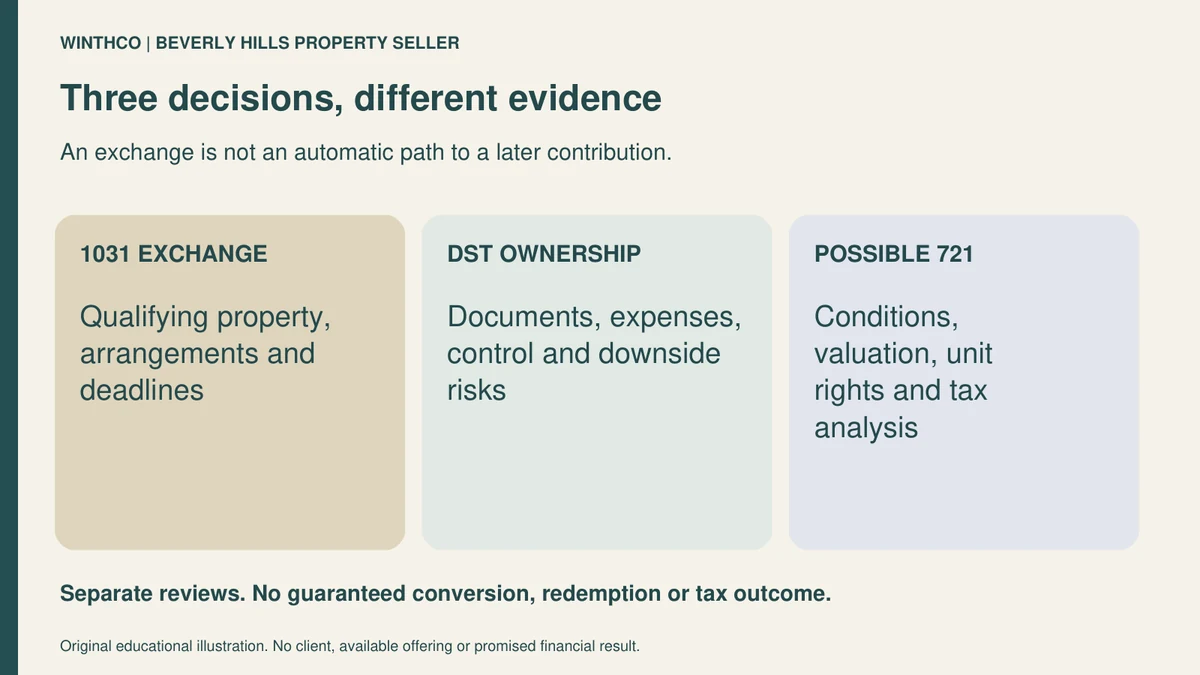
A qualifying Section 1031 exchange can defer eligible gain when business or investment real property is exchanged for qualifying replacement real property. Deferral is not elimination of tax. A personal residence does not qualify merely because its value increased. Compare an exchange with retaining the rental, engaging management or making a taxable sale, considering the household's needs rather than treating the tax mechanism as the objective.
For a standard deferred exchange, the IRS requires identification within 45 days after transferring the relinquished property. Replacement property must be received by the earlier of 180 days or the applicable tax-return due date, including extensions. The QI and counsel should address exchange agreements and restrictions on receipt of proceeds under Treasury Regulation 1.1031(k)-1. Ask the CPA to model cash, liabilities and other nonqualifying property that could produce taxable boot.
California reporting may remain relevant after acquiring property elsewhere. FTB generally requires Form 3840 when California property is exchanged for out-of-state property and California-source gain or loss remains deferred, with annual reporting until recognition. Assign responsibility for the ongoing records. Winthco's DST tax-preparation discussion can help frame questions, but verify the individual professional's credentials, engagement scope and fees rather than assuming an investment advisor also acts as your CPA.
Discuss your DST questions with Winthco →
A Delaware statutory trust can hold real estate for beneficial owners. IRS Revenue Ruling 2004-86 analyzes a specified trust arrangement whose beneficial interests are treated as interests in the underlying real property for federal tax purposes. That does not make every trust interest eligible for Section 1031. Your tax and legal professionals need to examine the actual arrangement and the rest of the exchange.
The practical tradeoff is control. A Beverly Hills landlord may currently approve repairs, choose a manager and participate directly in a sale decision. With a typical private DST, those decisions rest largely with others under the governing documents. Reduced day-to-day involvement can be useful, but it is not the same as reducing every financial risk. Ask who decides whether to spend reserves, respond to operating problems and pursue a disposition.
Compare the rental's actual cash remaining after expenses, debt service and reserves with the proposed DST's distribution assumptions. Do not compare gross rent with a net distribution percentage. Ask whether projected payments depend on lease escalations, reserve releases, tenant performance or other assumptions. The recent DST appraisal and investor-proceeds guide explains why a property valuation also should not be confused with cash an investor could receive.
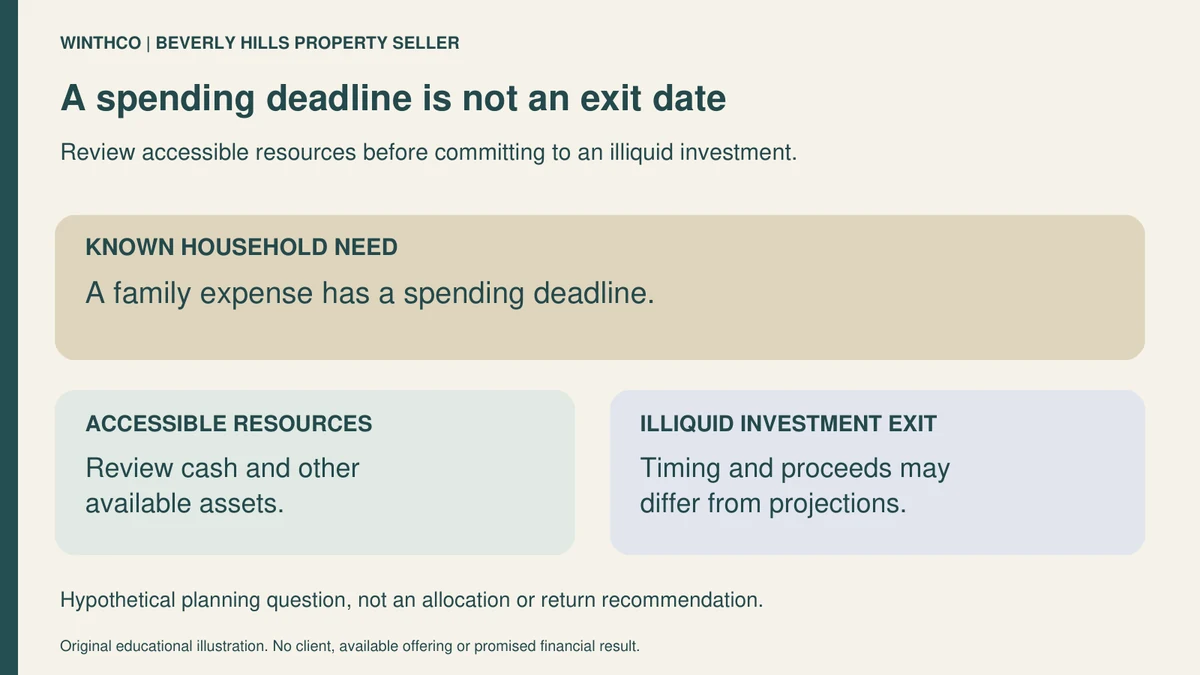
Request the current private placement memorandum and relevant financial, property, management and loan information. Review vacancy exposure, lease terms, repair needs, reserves and debt maturity. Identify the assumptions that matter most to the investment, then ask how the plan changes if those assumptions fail. A polished summary or a familiar property category is not enough to make that assessment.
Separate upfront costs, ongoing expenses, disposition charges and compensation to the selling professional. Ask for dollar examples tied to the actual documents, without assuming a published rate is the total economic cost. Private DST offerings are generally limited to accredited investors and offered through a private placement memorandum. Meeting an eligibility test does not establish that the concentration, time horizon or downside risk is appropriate for you.
Establish the subscription and exchange logistics without treating availability as assured. Ask when documents will be delivered, what acceptance conditions remain and what happens if the intended allocation is unavailable. Review permitted alternatives with the QI and investment professional. A deadline does not make an otherwise unsuitable investment suitable, and a prospect inquiry is not an accepted subscription.
WATCH & LEARN
Equity Advantage's David Moore and guest Robert Zink discuss management time and DST ownership in this third-party educational video. Reduced daily work does not remove investment, debt or liquidity risk, and nonrecourse borrowing does not eliminate economic exposure. This is background, not a Winthco endorsement or local rental-law advice. Original resource · Watch on YouTube ↗
Educational context only. The discussion does not establish the suitability, returns or tax treatment of an investment.
An UPREIT uses an operating partnership associated with a real estate investment trust. A Section 721 contribution generally exchanges property for a partnership interest, subject to exceptions and transaction-specific analysis. IRS Publication 541 describes the general contribution framework and exceptions. Winthco's 721 UPREIT planning overview introduces the concept, but the actual partnership and contribution documents control a proposed transaction.
Some DST documents contemplate a later operating-partnership transaction; others do not. Determine who controls acceptance, whether participation could be required, how value and unit allocations would be calculated, and what conditions may delay or prevent the event. Evaluate the DST itself before assigning value to a possible later contribution. Neither a target date nor a marketing diagram guarantees a conversion or cash exit.
OP units and ordinary REIT shares generally are not direct Section 1031 replacement real property. Ask counsel and the CPA about future sale or redemption restrictions, tax reporting and potential gain recognition. FIFO treatment alone does not guarantee tax-free withdrawals of basis. A possible 721 step should not be presented as a substitute for accessible household reserves.
Consider a hypothetical owner of an occupied Beverly Hills apartment property who wants fewer operational demands but expects a major family expense within three years. No real client, price, distribution or tax result is assumed. The sale team reconciles the rent file and requests a missing alteration record before marketing. Separately, the CPA compares the consequences of a taxable sale, a partial exchange and a full exchange.
The owner then compares any proposed DST with the need for accessible money. If the family expense can be met only by a hoped-for DST sale or later OP-unit redemption, the plan has an unresolved liquidity conflict. The response is to revisit the allocation and alternatives with the professionals, not to describe the projected exit as certain. Tax deferral and household flexibility are separate objectives that may involve tradeoffs.
The SEC cautions that private placements can have limited disclosure, severe illiquidity and potential total loss. DST review also needs to address sponsor, property, tenant, debt, fee and tax-law risks. Distributions can decline or stop. A stated holding period is not an enforceable investor withdrawal date, and professionally managed real estate can still lose value. Read the offering's actual restrictions rather than relying on a general description of passive ownership.
FINRA highlights concentration from correlated exposures and assets that are difficult to sell. Place the proposed DST beside remaining property, investments, 401(k)s and IRAs. Winthco's wealth-management discussion can cover retirement spending, accessible reserves, allocation and coordination with tax professionals. Assess what would happen if distributions stopped or the property sold later than expected, including whether essential spending could still be met.
Coordinate beneficiary choices and estate documents with qualified professionals. Retirement accounts are not Section 1031 proceeds, and selling property does not automatically justify a rollover, transfer or advisory engagement. Compare relevant account options, costs and services separately. Winthco's verified contact page lists its Simi Valley office; the Beverly Hills map is geographic context, not a Winthco office. Use the prospect form to discuss your timeline, and request a secure channel before sharing confidential records.
Map of Beverly Hills, California, for geographic context only. Not a Winthco office or a parcel-boundary determination. Confirm the property's jurisdiction with the relevant agencies.
| Decision | Evidence to request | What to avoid assuming |
|---|---|---|
| Rental sale | Leases, rent history, jurisdiction, permits and broker valuation | Advertised market rent is permitted rent |
| 1031 plan | Ownership, basis, QI arrangements, deadlines and possible boot | A tax objective resolves investment suitability |
| DST commitment | Offering documents, costs, control, reserves and loan terms | Projected distributions equal dependable spending money |
| Possible 721 step | Conditions, valuation, OP-unit rights and tax analysis | Conversion and redemption will occur on schedule |
No. The verified contact page lists the Simi Valley office. The map is a city-area reference and does not claim a local office.
The city describes coverage for most residential rental properties with two or more units. Confirm the particular property's status and obligations with the city and qualified counsel.
The city's Permit Records page links to its Property Information Page. Missing records and plan duplication follow different request procedures; confirm what is available before promising it to a buyer.
No. It may reduce daily management work while leaving property, sponsor, debt and other investment risks. The investor also generally has less control and limited liquidity.
Not necessarily. Verify credentials and the engagement for each role. Tax preparation, legal analysis, exchange implementation and investment advice have different responsibilities.
No. Read the actual documents to determine whether such a transaction is contemplated and under what conditions. Do not assume a contribution or redemption will occur.
Sources checked October 18, 2026. This article explains general concepts; your facts and the applicable documents control.
Winthco DST services · Winthco evaluation overview · Editorial standards
1031 exchange planning
Learn how retiring landlords can compare a DST 1031 exchange with direct real estate, including control, liquidity, debt, income and risk.
Read guide →Alternatives and comparisons
Compare DST distributions with rental cash flow, fees, tax reporting and retirement spending before selling an investment property.
Read guide →DST due diligence
Learn how to review DST appraisals, compare acquisition costs and separate property value from investor proceeds before a 1031 exchange.
Read guide →Explore Winthco’s main DST article collection
Share your timeline and investment range. A Winthco team member will follow up with you.