DST due diligence
DST Reserves and Capital Repairs: What to Review
Before exchanging a rental into a DST, review repair budgets, restricted reserves and funding limits. Know which questions to ask before committing.
Read guide →
Home / Learning center / Local real estate planning
Local real estate planning
Winthco Wealth Management · Updated October 19, 2026
A Camarillo property owner considering a DST should plan the sale and the replacement investment together, before closing. Verify property records, interview appropriately licensed brokers, and coordinate the CPA, attorney and qualified intermediary. Then compare DST ownership and any separate 721 proposal with retirement spending, liquidity and the control you would surrender.
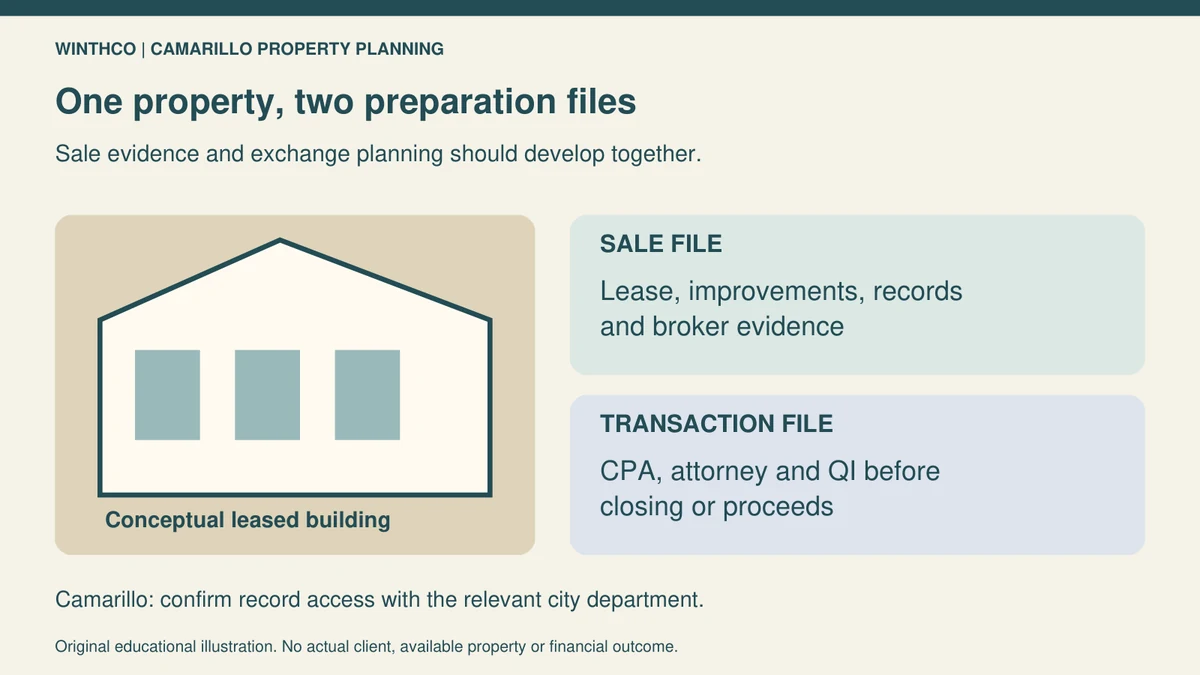
Start with the work you want to stop doing, not a promised investment yield. Are repair decisions becoming difficult, is a commercial lease approaching renewal, or does the family want less property-management responsibility? Interview appropriately licensed realtors or commercial brokers who understand your property type. Ask for the valuation method, comparable evidence, marketing strategy, expected buyer questions and a written explanation of compensation. Verify the professional through California's Department of Real Estate.
Keep two workstreams visible: sale readiness and the proposed use of proceeds. A broker's pricing opinion does not establish exchange eligibility, and an investment illustration does not resolve a missing property record. Bring the CPA, attorney and qualified intermediary into the discussion before closing or receiving sale proceeds. Winthco's discussion of 1031 replacement-investment alternatives can introduce choices, but the appropriate decision depends on the actual property, transaction and household.
Share your timeline and investment range. A Winthco team member will follow up with you.
Confirm the parcel's jurisdiction before relying on city procedures. Camarillo's Community Development Applications page describes zoning-verification requests for property history within city boundaries, including approved plans, prior permits and active code-enforcement issues. It directs certificate-of-occupancy inquiries to Building and Safety. Ask the broker and counsel which records matter to the proposed sale; the availability of a request process is not a certification of lawful use.
Distinguish submitting a new application from researching an older improvement. The city says new plan submissions moved to its OpenGov system beginning July 1, 2025. Separately, its Public Records page says building permits and plans must be viewed at City Hall's public-counter kiosks and provides a request route when records cannot be located. Confirm current access and copying arrangements with staff before promising a buyer a complete digital file.
For a leased commercial building, reconcile the lease, amendments, tenant responsibilities and documented improvements with the sale description. For a rental home, organize leases, deposits, maintenance and alteration records. These are practical preparation questions, not a statement that all buildings have the same requirements. Resolve an unexplained difference early rather than assuming an online search, an assessor description or the seller's memory settles it.
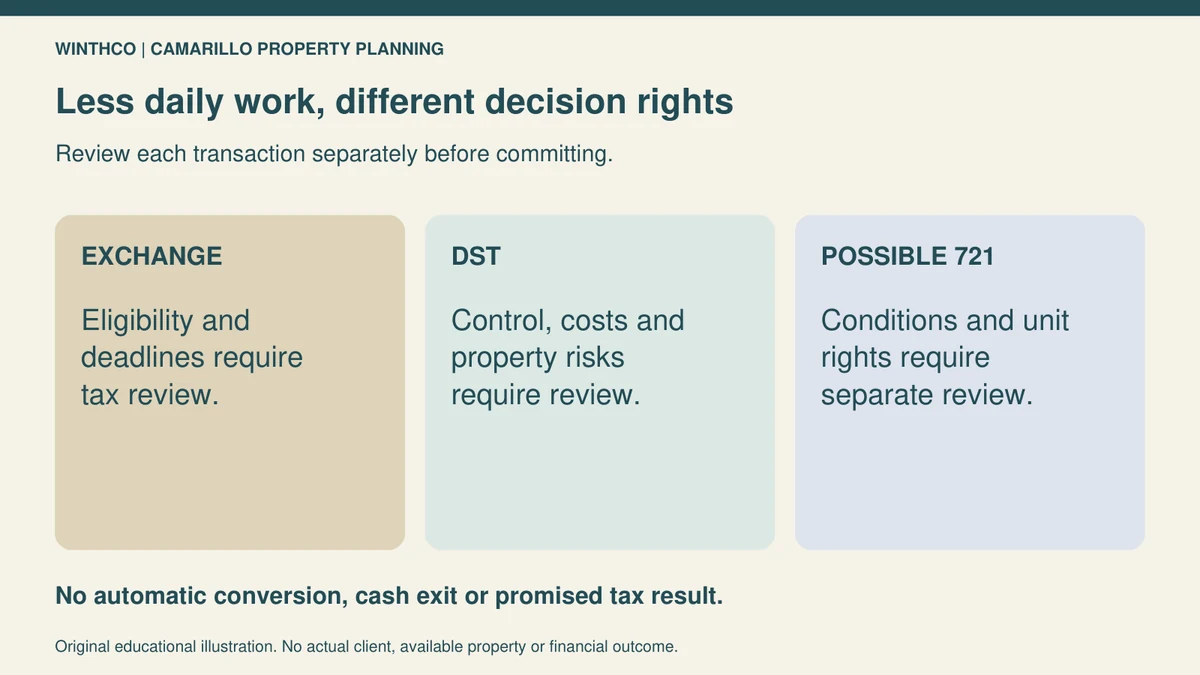
Section 1031 can defer eligible gain on an exchange of qualifying business or investment real property. It does not make a sale tax-free or establish that the replacement investment is suitable. Compare keeping the property with professional management, a taxable sale, a partial exchange and a full exchange. Have the CPA estimate the consequences using actual basis, expenses and liabilities, rather than applying a blanket tax percentage to the sale price.
For a standard deferred exchange, identification generally must occur within 45 days of transferring the relinquished property. Receipt of replacement property must occur by the earlier of 180 days or the applicable return due date, including extensions. Review the QI arrangements and restrictions on access to proceeds under Treasury Regulation 1.1031(k)-1 before closing. Cash, liability changes and other nonqualifying property can create taxable boot; debt treatment requires a transaction-specific calculation.
A Camarillo owner replacing California property with out-of-state property also needs state reporting advice. FTB generally requires Form 3840 for the exchange year and subsequent years while California-source gain or loss remains deferred. Assign responsibility for those records. A change in property location does not, by itself, erase the California reporting obligation.
Discuss your DST questions with Winthco →
A Delaware statutory trust holds assets for beneficial owners. IRS Revenue Ruling 2004-86 addresses a particular trust arrangement that can receive qualifying Section 1031 treatment when the other requirements are met. Do not read that ruling as approval of every trust, sponsor or subscription. The actual legal structure and exchange facts need professional review, independently of whether the property's operating story sounds attractive.
A direct owner can usually participate in selecting vendors, deciding whether to renovate and negotiating a sale. A private DST investor generally has much less control under its governing documents. That exchange of decision-making authority for reduced daily work is central to the choice. Ask who can approve expenses, respond to tenant problems, use reserves and initiate a disposition, and what information investors receive when the plan changes.
Review the actual private placement memorandum rather than treating the website or brochure as the complete investment. Winthco's questions for reviewing a DST provide a discussion starting point, not a sponsor rating or independent approval. Ask for relevant financial statements, property reports, lease information, management arrangements and loan terms. Identify missing evidence and who will answer the question before you commit, rather than filling a gap with an assumption.
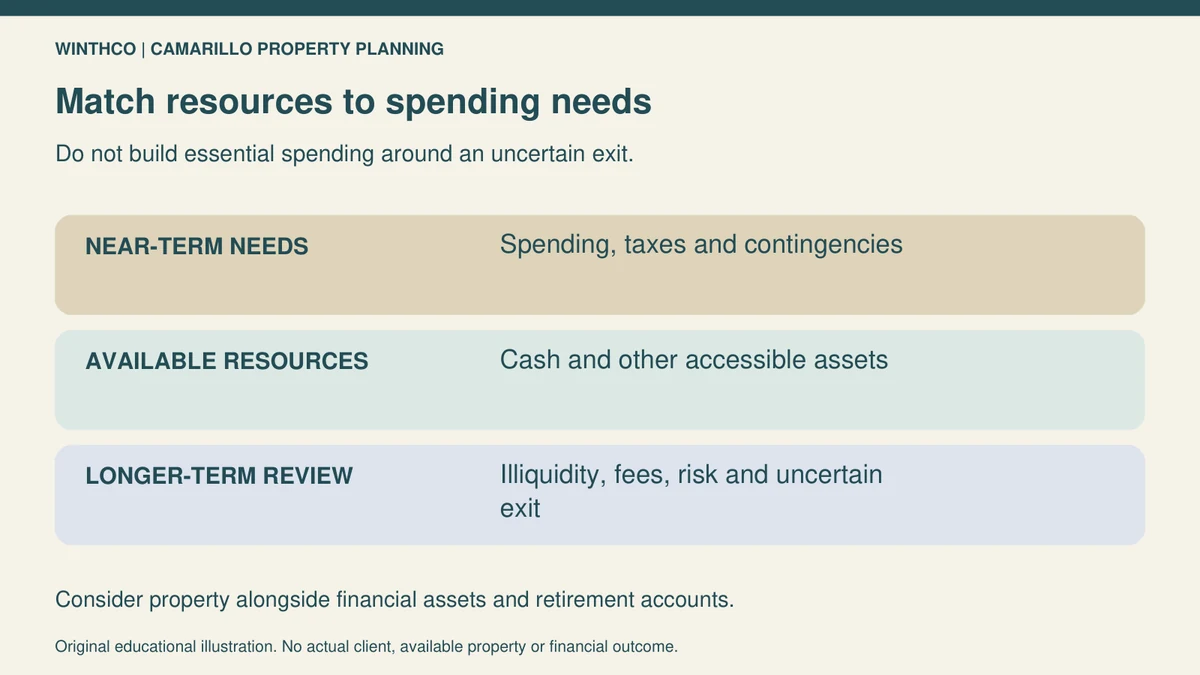
Build a common comparison between the property you own and the interest you might acquire. On the current rental, subtract operating expenses, management costs, debt service and realistic repair reserves from rent. On the proposed DST, examine the source of distributions, expenses already deducted and assumptions about occupancy or rent increases. The distribution figure is not necessarily the property's earned cash flow or the investor's total return.
Request a written account of acquisition costs, offering expenses, ongoing charges, disposition costs and professional compensation. Ask which amounts reduce funds available for property investment and whether any fees depend on performance or a transaction. Review loan maturity, lender restrictions and refinancing assumptions when debt is present. The recent DST loan-maturity guide explains why a scheduled loan payoff deserves its own review, even when current operations appear stable.
Do not replace this analysis with a single projected percentage. Test the planning question qualitatively: could the household meet essential expenses if distributions stopped, a repair cost more, or a sale occurred later and at a lower price? A trust owning several properties may still share exposure to a sponsor, tenant industry, financing conditions or geographic market. More line items do not necessarily mean less correlated risk.
WATCH & LEARN
Winthco Wealth Management introduces its DST planning discussion. This general welcome video is not a Camarillo property assessment, a current offering recommendation or a guarantee of tax treatment or investment results. Review the qualifications and risks in this guide. Original resource · Watch on YouTube ↗
Educational context only. The discussion does not establish the suitability, returns or tax treatment of an investment.
An UPREIT generally operates through a partnership associated with a real estate investment trust. Section 721 concerns property contributions for partnership interests, with exceptions and transaction-specific consequences. It is a different framework from a Section 1031 exchange. IRS Publication 541 explains the general partnership-contribution rule; the CPA and attorney must assess the proposed structure, liabilities and agreements rather than treating the section number as a guarantee.
Some DST programs contemplate a later contribution to an operating partnership, while others do not. A Camarillo seller should ask whether participation is optional or could be required, who controls timing, how value would be determined and what conditions remain. Evaluate the initial DST on its own merits. An anticipated future transaction cannot repair inadequate reserves, unfavorable debt terms or a household need for accessible money.
Operating-partnership units and ordinary REIT shares generally are not direct Section 1031 replacement real property. Any later redemption or sale needs separate analysis of restrictions and taxes. A proposed holding period does not promise liquidity, and FIFO selection alone does not guarantee tax-free basis withdrawals. Request the actual documents describing unit rights and potential conversion mechanics; do not assume a marketing diagram is an enforceable sequence.
Consider a hypothetical owner of a leased Camarillo commercial building whose tenant has made alterations and whose household expects retirement spending to increase soon. No actual client, property price or financial outcome is implied. Before marketing, the owner asks the sale team to reconcile the lease obligations and alteration records, using the city's relevant request process where appropriate. The tax team separately compares sale and exchange alternatives.
Suppose the owner is attracted to reduced management work but would need access to investment principal before any documented liquidity right exists. That conflict should remain visible in the recommendation. The owner could discuss a different allocation or a taxable or partial-exchange alternative with the professionals. The point is not to prescribe one solution; it is to avoid using hoped-for distributions or a possible 721 event to cover a known spending commitment.
Private DST offerings are generally limited to accredited investors and made through a private placement memorandum. Eligibility is not a suitability finding. The SEC warns that private placements can involve limited disclosure, severe illiquidity and total loss. Include sponsor, property, tenant, debt, fee and tax-law risks in the assessment. Distributions can decline or stop, and a projected exit is not a guaranteed withdrawal date.
A financial advisor should place the proposed interest alongside remaining real estate, financial assets, 401(k)s and IRAs, not consider it in isolation. FINRA's concentration guidance highlights correlated holdings and illiquid assets. Winthco's wealth-management discussion can connect the sale to spending, reserves, allocation and professional tax coordination. A property transaction does not itself justify an account rollover or transfer; compare relevant options, services and costs separately.
Use Winthco's DST estate-planning discussion to organize questions for qualified estate and tax professionals about ownership, beneficiaries and future decisions. Do not assume inheritance removes restrictions or creates an immediate cash exit. Retirement accounts are not themselves 1031 exchange proceeds. Winthco's verified office is in Simi Valley, not at the Camarillo map marker. Use the prospect form to discuss your timing and request a secure channel before sharing confidential documents.
Camarillo, California, shown for geographic context only. This is not a Winthco office or a parcel-jurisdiction determination.
| Decision | Evidence to request | What to avoid assuming |
|---|---|---|
| Sale preparation | Broker evidence, leases, improvements and local records | A missing online record proves approval or a violation |
| 1031 exchange | Eligibility, QI arrangements, deadlines and boot | Tax deferral establishes investment suitability |
| DST review | Documents, control, fees, reserves and debt | A projected distribution is dependable spending money |
| Possible 721 step | Acceptance, valuation, unit rights and tax analysis | A target date guarantees conversion or redemption |
This guide does not claim one. Winthco's verified contact page lists its Simi Valley office; the map shows Camarillo only for geographic context.
The city's Public Records page distinguishes general online records from building permits and plans viewed at City Hall kiosks. Confirm access and copying procedures with staff for the specific record.
Ask about relevant exchange and trust-reporting experience, the scope of the engagement, fees and responsibility for California follow-up filings. Do not assume your investment professional is also serving as your CPA.
No. Compare expenses, reserves, financing and distribution sources using actual documents. Distributions and principal are at risk.
No. The documents may or may not contemplate a later operating-partnership transaction, and conditions may prevent it. Review control, acceptance and unit rights separately.
A sale does not by itself establish that a rollover or transfer is appropriate. Review retirement-account options, costs and services separately from the exchange.
Sources checked October 19, 2026. This article explains general concepts; your facts and the applicable documents control.
Winthco DST services · Winthco evaluation overview · Editorial standards
DST due diligence
Before exchanging a rental into a DST, review repair budgets, restricted reserves and funding limits. Know which questions to ask before committing.
Read guide →DST due diligence
Review DST loan maturity, balloon payments and exit assumptions before exchanging a rental. Prepare questions about debt and household liquidity.
Read guide →DST fundamentals
Learn how a cash DST purchase differs from a 1031 exchange, what tax benefits it does not create, and which costs and liquidity risks to review.
Read guide →Explore Winthco’s main DST article collection
Share your timeline and investment range. A Winthco team member will follow up with you.