Vacation rental 1031 planning
Vacation rental 1031 exchange into a DST
Learn how vacation-rental use, IRS safe-harbor rules, deadlines and DST risks affect a potential 1031 exchange.
Read guide →
Home / Learning center / Local Guides
Local Guides
Winthco Wealth Management · Updated November 16, 2026
Before selling a Carpinteria vacation rental, confirm the property's license status and what a buyer could legally operate after transfer. A city license does not establish federal 1031 eligibility. Coordinate the broker, CPA, attorney and qualified intermediary before closing, then evaluate any DST replacement on its own costs, risks and fit with retirement needs.
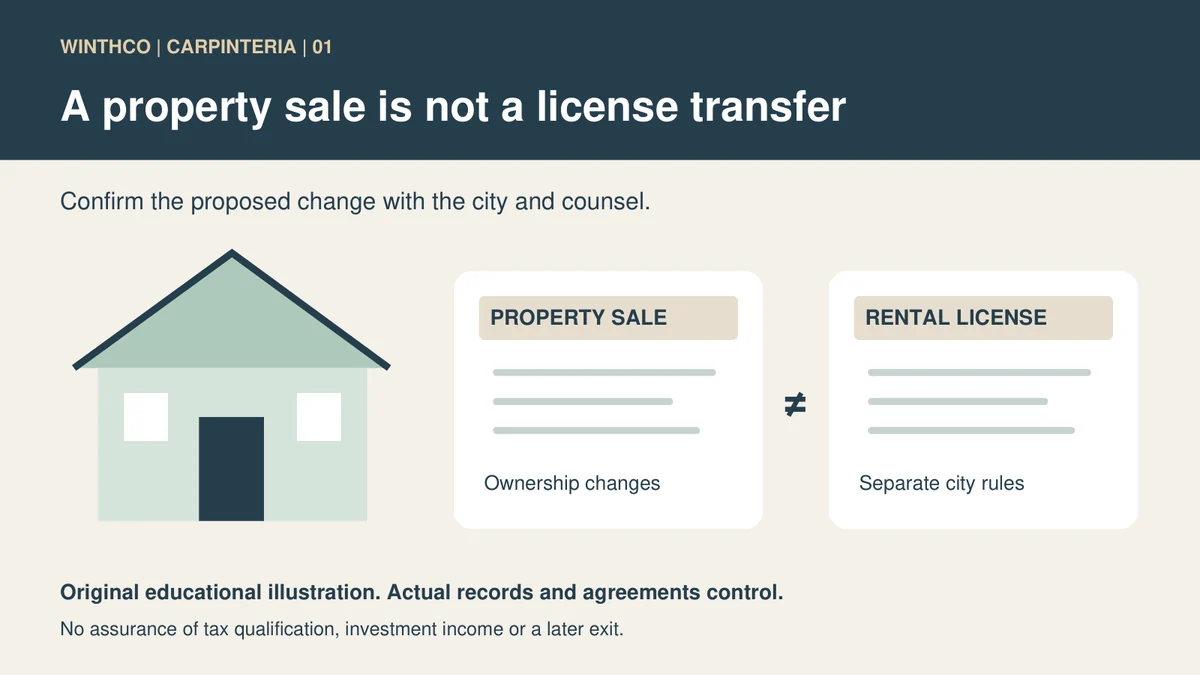
Start with the city boundary, parcel and actual license, not a listing's description. Carpinteria distinguishes owner-offsite vacation rentals from owner-onsite home stays. Its short-term rental information page says new vacation-rental licenses are limited to the Vacation Rental Overlay District and subject to area limits. Section IV(E) of the city's July 2025 administrative procedures says sale or transfer generally causes a vacation-rental license to expire. Limited ownership-change exceptions have application and documentation requirements. Ask the city and your attorney how the current rules apply to the proposed transaction before promising a buyer continued operation.
Interview a licensed realtor or broker who understands rental-property sales and local licensing. Ask how they will support valuation without assuming that your booking history transfers unchanged. Request comparable sales, a marketing plan, compensation details and a net proceeds estimate. Discuss existing reservations, deposits and disclosure obligations with the broker and attorney. Give your CPA the rental and personal-use records. Establish the qualified intermediary relationship before closing if an exchange is contemplated; a later investment purchase cannot simply repair having received the sale proceeds.
Share your timeline and investment range. A Winthco team member will follow up with you.
Permission to rent and federal investment use answer different questions. A property described as a vacation rental may also have substantial personal use. Ask your CPA to determine whether the actual facts support an exchange of real property held for business or investment. Do not infer qualification from a city license or a few rental receipts. Our vacation-rental exchange planning guide discusses that separate review. Identify any furniture or other non-real-property items in the proposed sale rather than treating the entire transaction as one interchangeable investment.
For an ordinary deferred exchange, written identification generally must occur within 45 days after the relinquished property transfers. Replacement receipt is due by the earlier of 180 days after transfer or the federal return due date, including extensions. Have the QI confirm the dates and identification requirements. Cash or other non-like-kind consideration can trigger recognized gain; deferral is not elimination. Winthco's DST interests as potential replacement real estate provides background on one option. If California property is exchanged for out-of-state property with California-source gain deferred, ask your CPA about Form FTB 3840 and ongoing reporting.
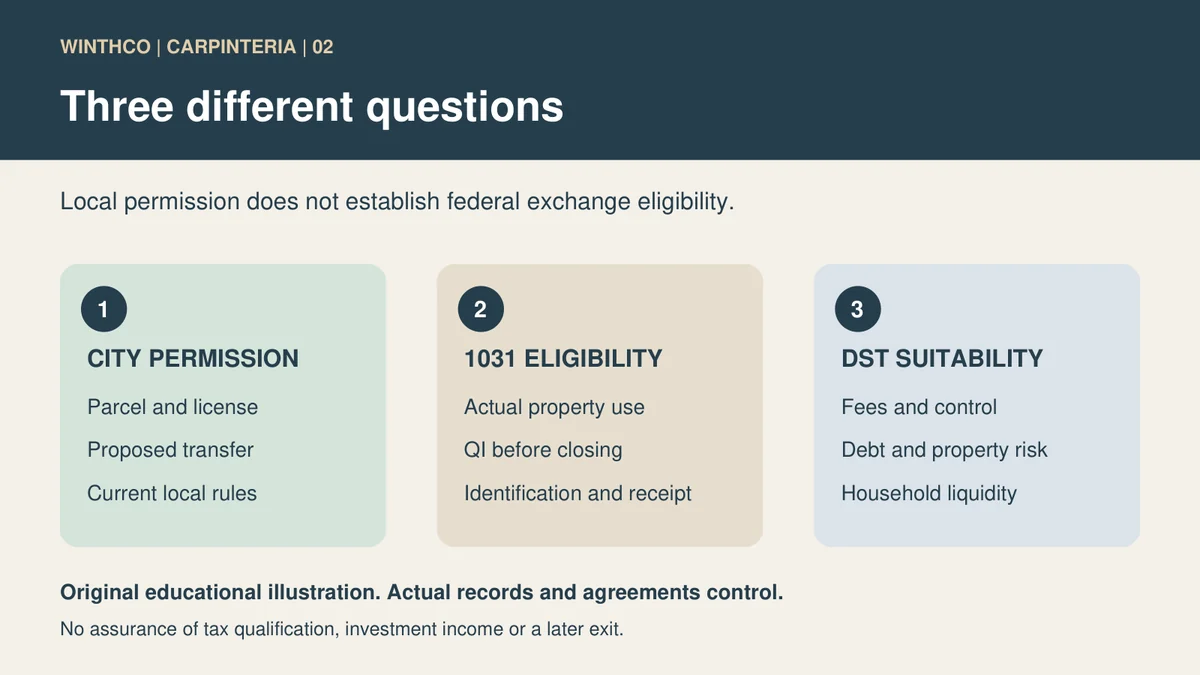
A qualifying Delaware statutory trust interest may let an investor replace direct landlord work with a beneficial interest in professionally managed real estate. Revenue Ruling 2004-86 addresses a particular trust structure; it does not qualify every trust or every investor's exchange. The reduction in day-to-day work comes with less decision-making power. Read who controls leasing, financing, reserves, distributions and sale timing. You may not be able to request a repair, change the property manager or sell your interest when your personal plans change.
Make the comparison at the household level. A vacation-rental owner may have handled guest communications, cleaning and seasonal maintenance personally. Assign realistic costs to that work when comparing alternatives, but do not confuse saving time with earning a higher return. A DST's stated distribution is not necessarily the same measure as the cash left from your rental after all costs. Request an explanation of distribution sources, the assumptions behind projections and the effect of reserves and financing. Ask what happens if the projection is not achieved.
Discuss your DST questions with Winthco →
Obtain the private placement memorandum and relevant trust, loan and lease documents before committing. Winthco's DST offering document review guide can help frame questions, but the actual offering terms control. List acquisition costs, selling compensation, asset-management charges, property expenses and disposition fees. Identify payments to affiliates and ask how conflicts are handled. Compare the total cash invested with the amount supporting the property's operations, not just the advertised distribution percentage.
Look through the property label to the income source. Is rent paid directly by end tenants or through a master tenant? When do significant leases expire? What evidence supports occupancy and rent assumptions? A portfolio of several buildings can still be concentrated in one tenant, industry or market. Ask whether a vacancy at the largest tenant would leave enough cash for taxes, insurance, maintenance and debt service. Review reserve funding and restrictions rather than assuming every reserve dollar is available for any purpose.
Examine debt maturity and the exit assumptions together. A planned sale before a loan matures is not an assurance that a buyer will be available on favorable terms. Interest rates, valuations and lender requirements can change. Ask how a slower sale, lower collections and an unexpected major expense would interact. Private placements may provide less public information than registered securities and can be difficult to resell. DST offerings are generally limited to accredited investors and offered through a private placement memorandum. Sponsor, property, leverage and concentration risks can reduce value; distributions may decline or stop, and principal can be lost.
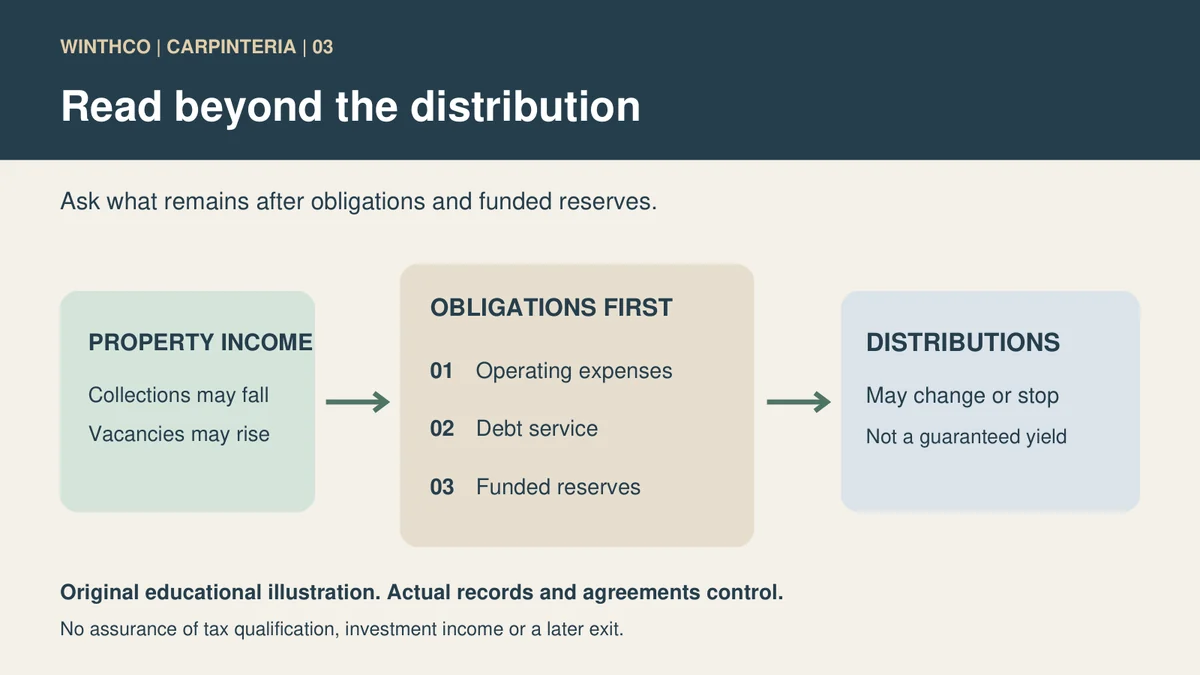
Hypothetical: A Carpinteria owner expects a buyer to continue the same short-term rental operation. Before marketing, the broker asks for the license record and the closing team obtains guidance on the proposed transfer. The owner revises the proceeds estimate instead of treating the historic booking revenue as proof of the buyer's future income. The CPA reviews property use, while the QI prepares the exchange process before transfer. None of those steps determines whether a particular replacement investment is suitable.
The owner compares a taxable sale, a direct replacement and an available qualifying DST. A taxable sale may leave more freedom over the remaining cash but requires a tax estimate. Direct ownership preserves more operational choices and responsibilities. A DST may reduce those responsibilities while imposing fees, transfer limits and reliance on sponsor decisions. Ask the recommending professional what investigation supports the recommendation and how compensation differs among alternatives. FINRA's private-placement guidance explains regulatory oversight; a filing with FINRA is not investment approval.
WATCH & LEARN
Tina Colson-Jones of Equity Advantage 1031 Exchange explains the qualified intermediary's role. Third-party education, not a Winthco affiliation or a determination of your property's eligibility. Original resource · Watch on YouTube ↗
Educational context only. The discussion does not establish the suitability, returns or tax treatment of an investment.
Only as a separate possibility with its own analysis. Section 721 concerns contributions of property to a partnership in exchange for a partnership interest, subject to applicable rules and exceptions. A later UPREIT transaction, if offered, may involve operating partnership units. It is not an automatic next step after a DST, and ordinary REIT shares or partnership units are not direct Section 1031 replacement real estate. Ask who can propose or approve the transaction and what happens if it never occurs.
If an offer is made, compare valuations, fees, conflicts, tax consequences and the rights attached to the new interest. Read transfer restrictions and redemption conditions, including who controls timing and whether a requested redemption can be limited. Do not treat a possible conversion to another interest as cash already available for retirement. Evaluate the current DST assuming the proposed later transaction does not happen. If the investment works only because a future deal is expected to rescue its liquidity, that is a reason to revisit the commitment before closing.
Start with spending needs and money that must remain accessible. Set aside a planning estimate for taxes, sale adjustments and household obligations, then review that estimate with the appropriate professionals. Test whether the remaining portfolio could support essential spending during a pause in property distributions. Consider how much real estate exposure would remain across all accounts, not just the replacement purchase. A smaller exchange or a taxable sale may warrant comparison even when maximum deferral is technically possible.
Bring existing taxable investments, 401(k)s, IRAs and retirement-income expectations into a broader planning conversation. Those accounts are separate from exchange proceeds; do not assume a rollover or transfer is appropriate. Compare costs, services and access restrictions, and coordinate beneficiaries and estate documents with your attorney. Winthco's prospect contact form can start that discussion using your general sale timeline and goals. Use this guide's form or the dedicated contact page, and keep tax returns, booking records and other sensitive documents out of the initial message.
City-area context only, not a parcel boundary, rental overlay map or Winthco office.
| Decision | Evidence to request | What to avoid assuming |
|---|---|---|
| Local license | City status and transfer rules | Historic bookings prove future permission |
| 1031 exchange | Investment use, QI and deadlines | A rental license establishes tax eligibility |
| DST offering | Fees, control, debt and downside cash flow | Less landlord work means less investment risk |
| Possible 721 | Actual offer, tax review and redemption terms | A future transaction guarantees liquidity |
Generally no. The city's procedures provide limited ownership-change exceptions with application and documentation requirements. Confirm the specific transaction with the city and counsel.
No. Your CPA must review the property's actual investment or business use, any personal use and the other exchange requirements.
It may reduce direct landlord responsibilities, but investors give up control and remain exposed to property, financing and sponsor risks.
No. Filing is not investment approval or a guarantee of the offering's merits.
No. A possible Section 721 transaction is separate and may never be offered or completed.
A general sale timeline, property type and planning goals are enough to begin. Do not include tax returns or sensitive tenant or guest information.
Sources checked November 16, 2026. This article explains general concepts; your facts and the applicable documents control.
Winthco DST services · Winthco evaluation overview · Editorial standards
Vacation rental 1031 planning
Learn how vacation-rental use, IRS safe-harbor rules, deadlines and DST risks affect a potential 1031 exchange.
Read guide →DST due diligence
Before exchanging a rental into a DST, review repair budgets, restricted reserves and funding limits. Know which questions to ask before committing.
Read guide →Exchange Planning
Selling a furnished rental? Separate real estate from personal property, understand the 15% rule, and evaluate a potential DST exchange.
Read guide →Explore Winthco’s main DST article collection
Share your timeline and investment range. A Winthco team member will follow up with you.