Vacation rental 1031 planning
Vacation rental 1031 exchange into a DST
Learn how vacation-rental use, IRS safe-harbor rules, deadlines and DST risks affect a potential 1031 exchange.
Read guide →
Home / Learning center / Exchange Planning
Exchange Planning
Winthco Wealth Management · Updated November 15, 2026
Furniture does not become qualifying 1031 replacement property because it is sold with a rental building. Section 1031 applies to eligible real property. The 15% incidental-property rules address limited identification and qualified-intermediary issues, not a tax-free furniture allowance. Separate the assets and their values before deciding how much can go into a DST exchange.
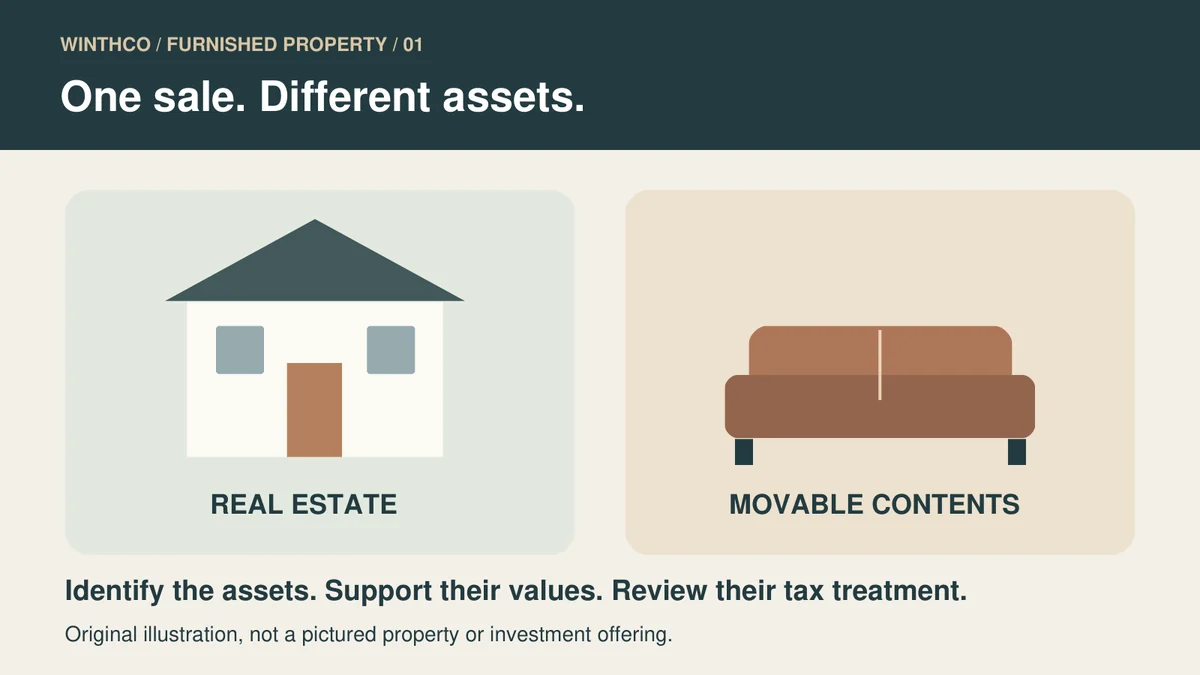
Start by separating what the buyer is acquiring: the land and building, movable furnishings, any equipment, and any other rights included in the contract. A single asking price does not answer the tax question for each asset. An owner moving away from active management may consider a qualifying DST interest for the real-estate portion, but buying a trust interest does not convert furniture-sale proceeds into deferred real-estate gain. Winthco's DST exchange structure overview explains the replacement-property setting; the contents of the sale still need their own review.
Interview a licensed realtor or commercial broker with experience selling furnished properties of the relevant type. Ask how comparable sales account for contents, whether buyers expect an inventory, how missing or damaged items are handled, and which fees affect the net proceeds. Give the proposed inventory and contract to your CPA, attorney and qualified intermediary before closing. Do not wait until the settlement statement is final to discover that everyone used a different allocation. A broker's marketing description is not a tax classification. The Carpinteria rental-sale planning guide connects local license questions with replacement-investment due diligence.
Share your timeline and investment range. A Winthco team member will follow up with you.
Not by itself. The federal real-property definition in Treasury Regulation 1.1031(a)-3 addresses land, improvements and specified interests. Structural components and movable contents require different analysis. Ask counsel to apply the relevant rules to the actual installation and applicable state or local law. A freestanding sofa is a different question from an integrated building system. Avoid treating everything described as fixtures, furnishings and equipment as one tax category.
Bring purchase records, depreciation schedules, prior cost-segregation work, photographs and descriptions of how questionable items are attached. Ask the CPA to reconcile the exchange classification with prior deductions and any recapture issues. The practical goal is a supported conclusion for each material asset, not an allocation chosen to reach a desired tax result. Have the buyer and seller address inconsistent descriptions before signing final documents. Simply stating that furniture is included at no charge does not establish that valuable furniture has no fair market value.
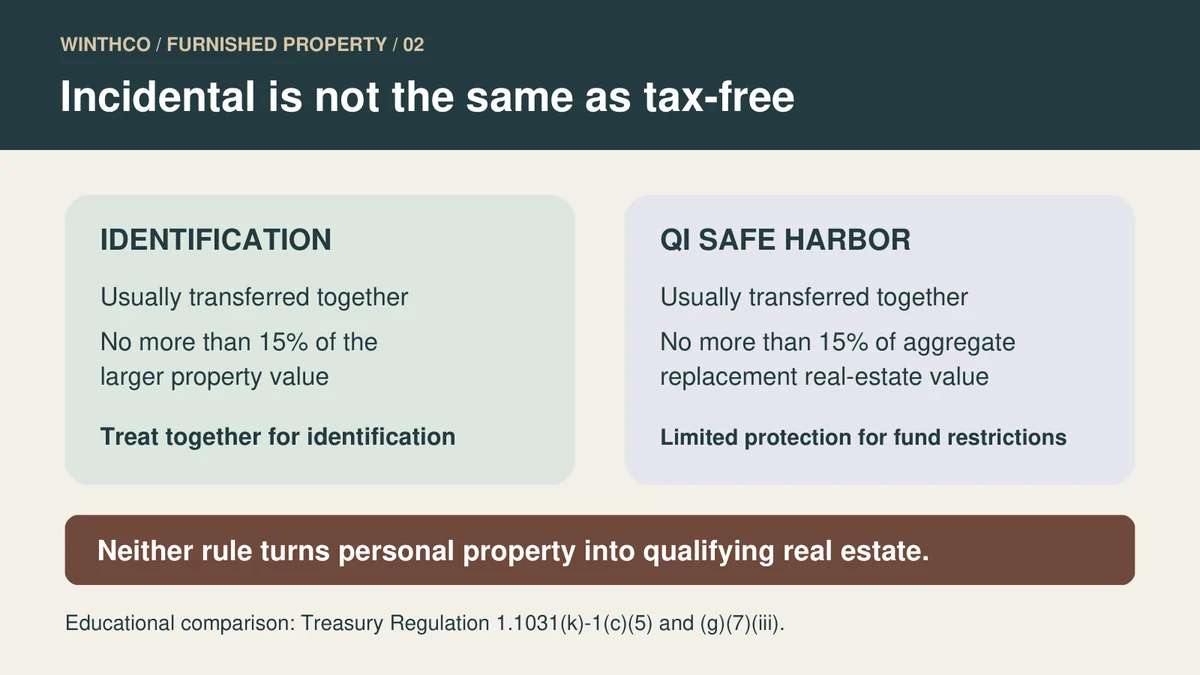
There are two related provisions to keep separate. For identification, Treasury Regulation 1.1031(k)-1(c)(5) allows incidental property to be treated with the larger property when it is normally transferred with it and its aggregate fair market value is no more than 15% of that larger property's value. IRS Publication 544 expressly warns that this does not determine whether the incidental property is like-kind for gain-recognition purposes.
For the qualified-intermediary safe harbor, Regulation 1.1031(k)-1(g)(7)(iii) addresses personal property typically transferred with replacement real estate whose aggregate value does not exceed 15% of the aggregate replacement real-estate value. It prevents that qualifying incidental receipt from defeating the specified restrictions on access to funds. It does not make the contents tax-free. The IRS Form 8824 instructions describe this narrow protection; neither provision is permission to label 15% of a sale as exempt.
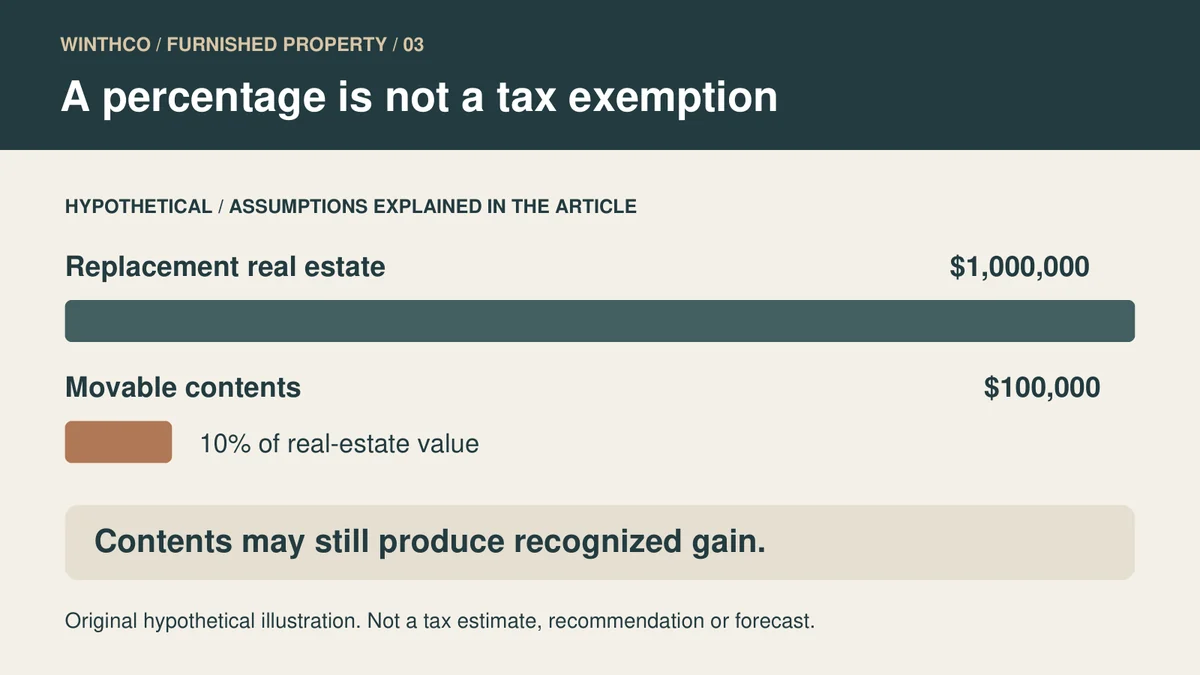
Hypothetical: An investor receives a replacement building worth $1,000,000 and movable contents worth $100,000, with no other cash, debt changes or non-like-kind items. Assume the customary-transfer conditions are met and the investor has $300,000 of realized gain. The contents are 10% of the real-estate value, but their $100,000 value can still produce $100,000 of recognized gain under Section 1031(b). This illustrates the distinction, not a tax estimate. Actual calculations require basis, liabilities, expenses and other facts.
Discuss your DST questions with Winthco →
On the sale side, ask the CPA to analyze the disposition of personal property separately from the qualifying real estate. The replacement-property incidental rules are not a general exemption for furniture you sell. On the purchase side, receiving non-like-kind property can create taxable boot, meaning value received that does not qualify for exchange deferral. The two questions can coexist in one transaction.
Ask for a written reconciliation of the total contract price, the supported values assigned to assets, the associated tax bases and the funds available for replacement real estate. Retain the evidence behind the estimates rather than only the final numbers. An owner may have little remaining basis in furnishings after deductions, but the current value and tax consequences still need analysis. Review our partial-exchange guide if the plan also includes keeping cash, and our closing-cost discussion for a separate review of expenses.
The real-estate exchange still needs timely execution. In an ordinary deferred exchange, identify replacement property within 45 days after transfer and acquire it by the earlier of 180 days after transfer or the applicable federal return due date, including extensions. Arrange the QI before closing or receiving proceeds. Asset classification does not extend those deadlines, and a looming deadline does not justify skipping investment review.
Potentially, if the property, taxpayer, exchange structure and replacement interest satisfy the requirements. Revenue Ruling 2004-86 analyzes a specific DST arrangement in which beneficial owners are treated as holding interests in underlying real estate for federal tax purposes. It is not approval of every trust or every bundled asset. Have advisers review the offering's tax analysis and allocation of assets rather than assuming the subscription price is entirely qualifying real property.
Request the private placement memorandum, trust agreement and subscription documents early. Compare how the sponsor describes the property, who owns any operating equipment, which expenses remain with the trust and what reserves are available. Ask for clarification where the property-level inventory and investor materials appear inconsistent. The objective is to understand the interest being purchased and its economic risks, not merely to find a security that can close quickly. Winthco's guide to evaluating a DST provides additional due-diligence context.
A later Section 721 contribution into an operating partnership is a separate transaction and is not assured. OP units and ordinary REIT shares are not substitutes for qualifying direct 1031 replacement real estate. Do not treat a possible later UPREIT transaction as a way to repair taxable personal-property proceeds from the original sale. Ask advisers what rights, restrictions and tax consequences would apply if such an option were actually offered.
WATCH & LEARN
Tina Colson and Jenni Anderson of Equity Advantage explain boot and the difference between value and equity. Their simplified examples are educational, not a tax calculation. Recognized gain, expense treatment and liabilities require individual review; the IRS sources above govern the incidental-property rules. Third-party content, not a Winthco endorsement or affiliation. Original resource · Watch on YouTube ↗
Educational context only. The discussion does not establish the suitability, returns or tax treatment of an investment.
A DST may reduce direct landlord responsibilities while leaving an investor exposed to property and securities risks. Review sponsor competence, tenant concentration, debt maturity, insurance and operating expenses, upfront and ongoing fees, and the consequences of vacancies or repairs. Distributions can decline or stop, principal can be lost, and investors generally have limited control over management or sale timing. Long holding periods and transfer restrictions can make the investment unsuitable for money needed soon. Tax law can also change.
Private DST offerings are generally limited to accredited investors and made through a private placement memorandum. Accreditation does not establish suitability. The SEC warns that private placements can involve limited disclosure and restricted resale. FINRA's private-placement guidance emphasizes reasonable investigation and attention to red flags; a recommendation is not a substitute for understanding the documents. Ask how your adviser is compensated and how competing investments were compared.
Keep enough accessible money for estimated taxes, household expenses and unexpected needs without relying on a DST distribution or early exit. Review the proposed allocation alongside taxable savings, 401(k)s, IRAs, retirement-income needs and beneficiary arrangements. Those retirement accounts are not themselves exchange proceeds, and a rollover or transfer should not be assumed appropriate. Winthco's wealth-planning discussion can connect the property decision to the broader household plan. Use either prospect form here or the dedicated contact page to request a conversation; keep tax returns and account details out of the initial message.
| Decision | Evidence to request | What to avoid assuming |
|---|---|---|
| Furniture sold with a rental | Asset inventory, supported values and basis | Bundling the price makes every asset real estate |
| Incidental replacement contents | The applicable identification and QI rules | A value below 15% means no taxable boot |
| DST subscription | Offering terms, underlying assets and tax analysis | A DST fixes the original sale allocation |
| Retirement allocation | Liquid reserves, taxes and household spending | Projected distributions will cover every expense |
No. The incidental-property provisions address limited identification and QI safe-harbor issues. They do not make personal property qualifying real estate.
A contract label alone does not establish fair market value. Ask your advisers to support the allocation with the actual assets and evidence.
Do not simply divide by the combined price. The QI provision compares incidental personal-property value with replacement real-estate value, while the identification provision refers to the larger item of property.
The percentage is not a blanket pass-or-fail test for the entire exchange. Your advisers must analyze the applicable identification, receipt and other exchange requirements.
Buying a DST does not turn a personal-property sale into an eligible real-estate exchange. Analyze the furniture disposition separately from the potentially qualifying property transaction.
Include a CPA, attorney and QI before closing, with the broker coordinating the sale. A financial adviser can separately evaluate the replacement investment and its fit with retirement and liquidity needs.
Sources checked November 15, 2026. This article explains general concepts; your facts and the applicable documents control.
Winthco DST services · Winthco evaluation overview · Editorial standards
Vacation rental 1031 planning
Learn how vacation-rental use, IRS safe-harbor rules, deadlines and DST risks affect a potential 1031 exchange.
Read guide →1031 exchange planning
Learn how exchange expenses, closing costs, DST fees and settlement records can affect gain, basis and cash planning in a 1031 exchange.
Read guide →1031 exchange planning
Can you keep cash and use a DST in a partial 1031 exchange? Review boot, debt, timing and retirement liquidity before selling your rental.
Read guide →Explore Winthco’s main DST article collection
Share your timeline and investment range. A Winthco team member will follow up with you.