1031 exchange planning
DST debt replacement: boot and added cash
Understand DST debt replacement, added cash and mortgage boot with a worked example and questions for your CPA and qualified intermediary.
Read guide →
Home / Learning center / DST tax planning
DST tax planning
Winthco Wealth Management · Updated October 12, 2026
A qualifying 1031 exchange into a Delaware statutory trust may defer current recognition of gain, but it does not erase prior depreciation or automatically reset tax basis. Carryover basis, any additional investment, cash received, liabilities and asset classifications affect the result. A CPA should calculate the exchange before the return is filed.
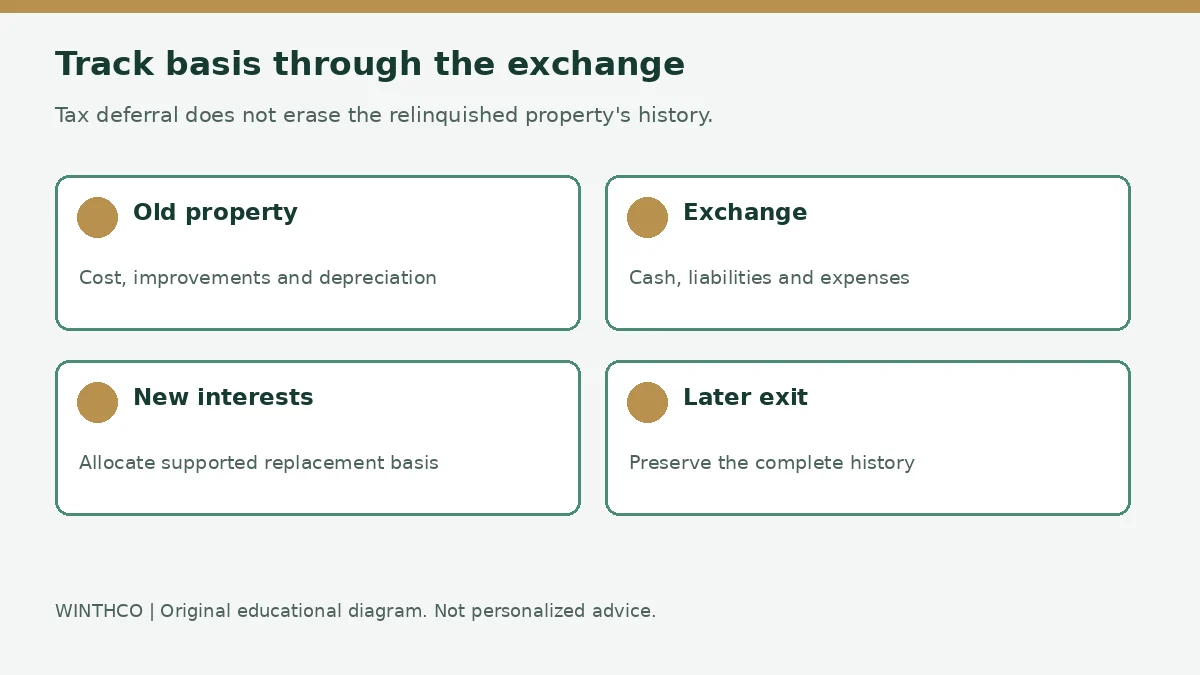
Section 1031 generally provides nonrecognition when business or investment real property is exchanged solely for qualifying like-kind real property. The 2025 IRS Form 8824 instructions say the form figures deferred gain, any gain reportable in the current year, and the basis of the replacement property. Tax is deferred under qualifying facts, not erased.
A property's adjusted basis usually reflects original cost plus capital improvements and certain acquisition costs, reduced by depreciation allowed or allowable and other adjustments. That basis helps determine realized gain when the relinquished property transfers. The depreciation history remains part of the tax file even when the replacement property is a DST interest.
Share your timeline and investment range. A Winthco team member will follow up with you.
Before comparing DSTs, give the CPA the original settlement statement, improvement invoices, prior depreciation schedules, cost segregation reports, casualty or insurance records, debt payoff and expected closing statement. Winthco's DST tax reporting overview provides related context, but the retained CPA must apply current law to the taxpayer, property and return.
IRS Publication 544 states that the basis of property received in a like-kind exchange is generally the same as the basis of the property transferred. Money paid can increase basis. Cash or non-like-kind property received, liabilities transferred, liabilities assumed, recognized gain and qualifying exchange expenses can change the calculation in a partially nontaxable exchange.
Revenue Ruling 2004-86 concludes that beneficial interests in the specific Delaware statutory trust described in the ruling are treated as interests in real property for federal tax purposes. It does not approve every DST or supply an investor's basis calculation. Review the actual trust agreement, offering memorandum, subscription documents and exchange records.
If one exchange acquires interests in several DSTs, the CPA must allocate basis using the actual values and exchange calculations. Do not divide the old basis by the number of investments or by a desired tax result. Keep the final Form 8824 workpapers and each sponsor's tax package so later depreciation and disposition reporting can be traced.
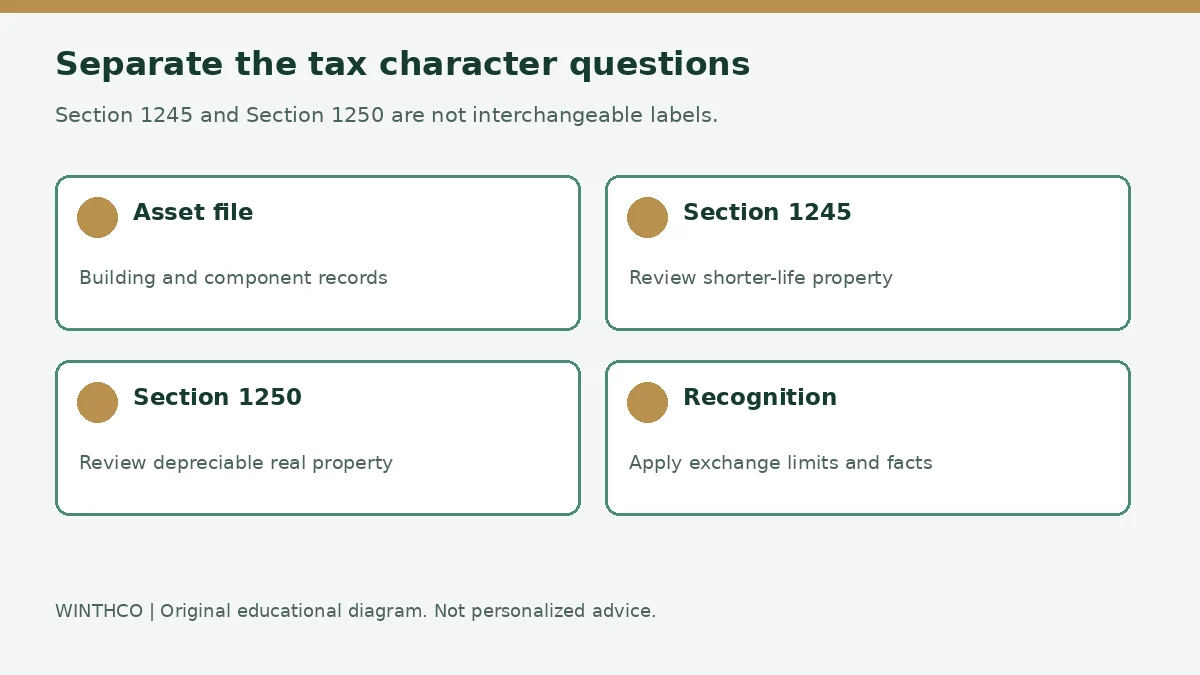
The phrase depreciation recapture is often used loosely. IRS Publication 544 separates Section 1245 property, Section 1250 property, ordinary-income recapture and other Section 1231 gain rules. Real estate can contain assets with different classifications, especially after a cost segregation study. The character of gain cannot be determined from total depreciation alone.
For Section 1250 real property, ordinary-income recapture generally focuses on additional depreciation as defined by the tax rules. A separate concept, unrecaptured Section 1250 gain, can affect the tax rate applied to part of a taxable gain. The amount and treatment depend on the property's history, depreciation method, dates, taxpayer and current return rules, so this guide does not estimate a tax rate.
The investment professional can explain a DST's property, fees, debt and offering risks, but should not prepare the taxpayer's recapture calculation without the required tax role and engagement. A DST CPA planning resource can help organize questions. The CPA or tax attorney should classify the assets and connect the relinquished schedule to the replacement schedule.
Discuss your DST questions with Winthco →
They can under some facts. IRS Publication 544 explains that a like-kind exchange of depreciable property generally does not create ordinary recapture unless money or non-like-kind property is also received, but it also provides special Section 1245 and Section 1250 limits. A mismatch between surrendered and received asset classes can matter even when the broader transaction involves real property.
Cost segregation can identify shorter-life components associated with a building. After the law limited Section 1031 to real property, the CPA must determine whether each asset is real property under the exchange regulations and how the recapture rules apply. A replacement that lacks corresponding qualifying components can produce a different result than another improved property.
A DST investor does not control the trust's asset allocation. Request the sponsor's property and tax information, but do not assume the offering document replaces the seller's depreciation study or the CPA's exchange analysis. The third-party video below discusses Section 1245 and Section 1250 matching as a planning issue; IRS guidance and the actual asset schedules control.
Form 8824 and Publication 544 distinguish realized gain from recognized gain. If the taxpayer receives cash or other non-like-kind property, gain is generally recognized up to the applicable limit. Net debt relief can also affect the calculation, while liabilities assumed and additional cash invested may offset or change that result under the exchange rules.
Recognized gain can carry different tax character. Publication 544 states that recognized gain may have to be reported as ordinary income from depreciation recapture, depending on the assets and limits involved. Taking cash does not necessarily mean every dollar has the same character, and replacing equity alone does not answer the liability or basis questions.
Build a written sources-and-uses schedule before closing. Show sale price, debt payoff, exchange expenses, qualified intermediary funds, cash retained, replacement values, DST debt allocations and outside cash. Compare it with Winthco's 1031 exchange rules guide, then have the CPA calculate the result rather than relying on a sales estimate.
WATCH & LEARN
CPEC1031's Jeff Peterson discusses a Section 1245 and Section 1250 matching issue in a 1031 exchange. This third-party video is educational, not a Winthco endorsement; IRS guidance, asset records and the taxpayer's professionals control. Original resource · Watch on YouTube ↗
Educational context only. The discussion does not establish the suitability, returns or tax treatment of an investment.
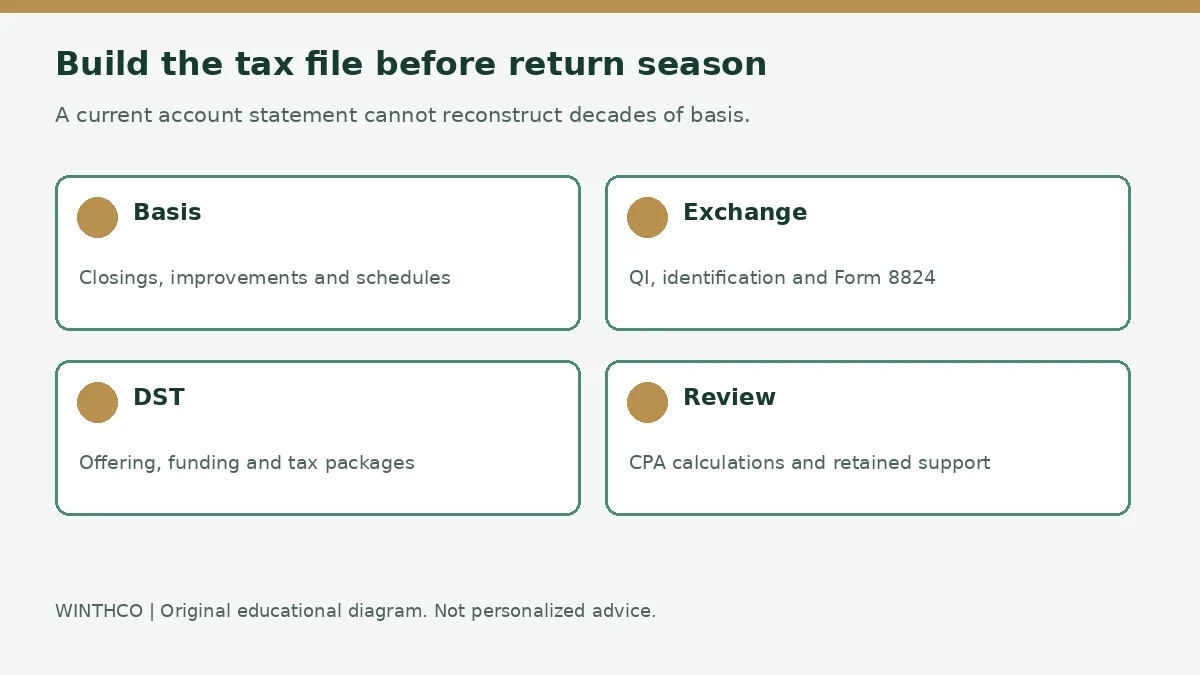
The exchange-year file should include Form 8824, the federal return, applicable Form 4797 or Schedule D workpapers, depreciation schedules, settlement statements, the qualified intermediary agreement, identification notice, closing evidence and proof of replacement-property receipt. Preserve records supporting every basis adjustment rather than only the final total.
For a DST, also retain the private placement memorandum, trust agreement, subscription agreement, contribution and funding evidence, debt allocation information, sponsor tax statements and correspondence sent to the CPA. If the trust owns property in several states, ask which state filings and basis schedules are needed. Tax packages may arrive after distributions begin, so plan the return calendar early.
Keep records through the eventual sale, trust liquidation or other disposition and for the period required under the taxpayer's circumstances. Each later exchange should carry forward the relevant history again. A new custodian, advisor or CPA cannot reliably reconstruct decades of basis from a current account statement alone.
A correct tax calculation does not make a DST suitable. The SEC warns that private placements may provide limited information, impose transfer restrictions, be highly illiquid and involve total loss. Many DST interests are offered only to accredited investors, but accredited status is an eligibility threshold rather than an investment recommendation.
Review the real estate, tenants, leases, debt, reserves, sponsor, fees, conflicts, distribution assumptions and exit authority. Distributions can change or stop. The trust may sell at an unfavorable time, and investors generally have limited control. A tax deadline should not compress the review of the private placement memorandum and financial assumptions.
FINRA explains that concentration can arise across asset classes, regions, security types and illiquid investments. Several DST interests may still share a sponsor, lender, tenant industry or property type. Measure the proposed allocation alongside other real estate and private holdings, and retain liquid resources for taxes, emergencies and planned spending.
Consider a hypothetical owner selling an apartment property after many years of depreciation and a prior cost segregation study. The owner plans to reinvest through two DST interests and keep some cash. This is an educational scenario, not a client example, offering recommendation or forecast of a tax result.
Before closing, the CPA reconciles original cost, improvements, depreciation and remaining basis, then separates the building and shorter-life components. The qualified intermediary confirms exchange mechanics and fund restrictions. The securities professional supplies current offering documents, debt allocations, fees and risk information without promising that the transaction will defer every category of gain.
The CPA models the realized gain, current recognized gain, recapture character and basis allocated to each replacement interest using the actual settlement and subscription figures. The owner compares that result with a taxable sale and other replacements. If records are missing or the classifications cannot be supported, the team pauses rather than inserting estimates designed to reach a preferred outcome.
This guide uses AI-assisted research and drafting with Winthco Wealth Management organization attribution. IRS, SEC, FINRA and CPEC1031 sources were checked on October 12, 2026. Confirm every calculation and reporting position with the professionals responsible for the transaction and return.
| Decision | Evidence to request | What to avoid assuming |
|---|---|---|
| Adjusted basis | Original records, improvements and depreciation schedules | Current market value is the tax basis |
| Exchange basis | Form 8824, cash, liabilities, recognized gain and expenses | Every new DST starts with full purchase-price basis |
| Asset character | Section 1245, Section 1250 and cost segregation records | All depreciation has identical tax treatment |
| DST evidence | Offering, trust, subscription and sponsor tax documents | Revenue Ruling 2004-86 approves every DST |
| Investment fit | Fees, liquidity, debt, concentration and downside cases | Tax deferral establishes suitability |
No. A qualifying exchange may defer recognition under the applicable rules, but prior depreciation and basis history remain relevant. Current recognition can still arise from cash, non-like-kind property, liabilities or asset-class rules.
Not necessarily. IRS guidance generally begins with carryover basis and adjusts for items such as additional money, liabilities, cash received, recognized gain and exchange expenses. The CPA should allocate the final basis among replacement interests.
No. Section 1245 ordinary recapture, Section 1250 ordinary recapture and unrecaptured Section 1250 gain are distinct concepts. The property's tax history and current rules determine the character.
Yes. Shorter-life components can create classification and matching questions. Give the CPA the original cost segregation report and request available property tax information from the DST sponsor.
Cash can create current recognized gain up to the applicable limits. The character of that gain may include recapture, so the CPA should calculate it from the complete transaction rather than applying one assumed rate.
The taxpayer and retained tax professional are responsible for the return position. The qualified intermediary handles exchange mechanics, while the sponsor and investment professional provide offering and property information within their roles.
Keep the original property basis and depreciation records, Form 8824 workpapers, exchange documents, allocated replacement basis, annual tax packages and later disposition statements. The full history may be needed to calculate a future taxable sale or exchange.
Sources checked October 12, 2026. This article explains general concepts; your facts and the applicable documents control.
Winthco DST services · Winthco evaluation overview · Editorial standards
1031 exchange planning
Understand DST debt replacement, added cash and mortgage boot with a worked example and questions for your CPA and qualified intermediary.
Read guide →1031 exchange planning
Learn how one 1031 exchange can combine directly owned real estate and a DST, including allocation, identification, closing and risk review.
Read guide →DST tax reporting
Learn how DST tax reporting can involve Form 8824, owner statements, basis, depreciation, state filings and private-placement risks.
Read guide →Explore Winthco’s main DST article collection
Share your timeline and investment range. A Winthco team member will follow up with you.