DST due diligence
DST Reserves and Capital Repairs: What to Review
Before exchanging a rental into a DST, review repair budgets, restricted reserves and funding limits. Know which questions to ask before committing.
Read guide →
Home / Learning center / DST due diligence
DST due diligence
Winthco Wealth Management · Updated October 20, 2026
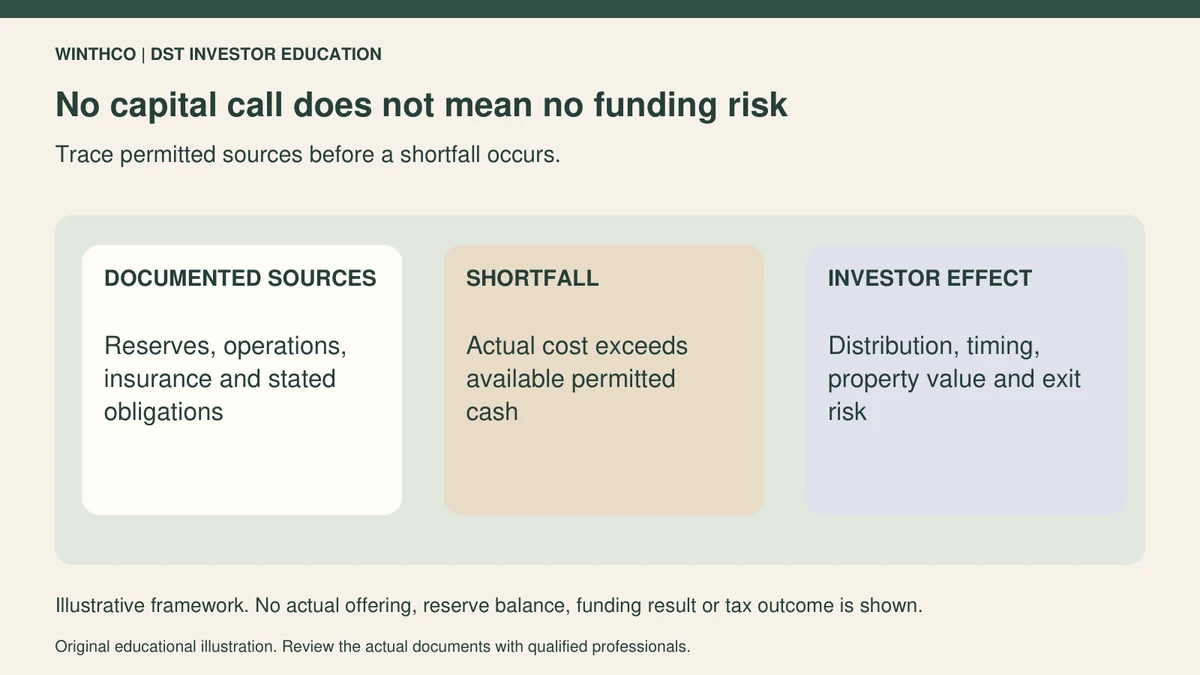
A Delaware statutory trust structured around Revenue Ruling 2004-86 generally cannot accept additional investor capital after closing. That does not eliminate funding risk. A reserve shortfall may reduce distributions, delay work, pressure a sale or trigger another documented mechanism. Review the actual offering, reserve plan and emergency provisions before investing.
A rental-property owner may want to stop handling repairs, tenants and emergency funding decisions. Before listing, interview appropriately licensed realtors or commercial brokers about property-type experience, valuation, marketing, compensation and closing coordination. If a deferred exchange is under consideration, bring the CPA, attorney and qualified intermediary into the plan before closing or receiving sale proceeds.
A DST may reduce an investor's direct management role, but the underlying property still needs cash for operations, insurance, repairs and debt obligations. Winthco's DST requirements overview introduces the structural limits that apply to a qualifying arrangement. Ask a more specific question before selecting replacement property: if an unexpected cost exceeds the available reserves, what can the trust do, what can it not do and who controls the response?
Share your timeline and investment range. A Winthco team member will follow up with you.
Revenue Ruling 2004-86 analyzes one specified Delaware statutory trust. In that ruling, the trust agreement says the trustee may not accept additional contributions of assets, including money. That fact supports the IRS conclusion that the trustee lacks power to vary the certificate holders' investment and that the described trust is treated as an investment trust.
Do not turn that conclusion into a universal statement that every entity with DST in its name has identical terms. The ruling concerns the described arrangement, and Section 1031 treatment still depends on satisfying the other exchange requirements. Investors and their tax counsel should review the actual trust agreement, tax opinion and private placement memorandum rather than relying on a slogan about no capital calls.
The practical question is narrower: does the offered structure prohibit additional investor contributions after the offering, and what provisions address a serious shortfall? Ask the sponsor to identify the controlling document sections. A verbal assurance that investors will never be asked for money does not explain the consequences if reserves, insurance proceeds, operating cash or other sources are insufficient.
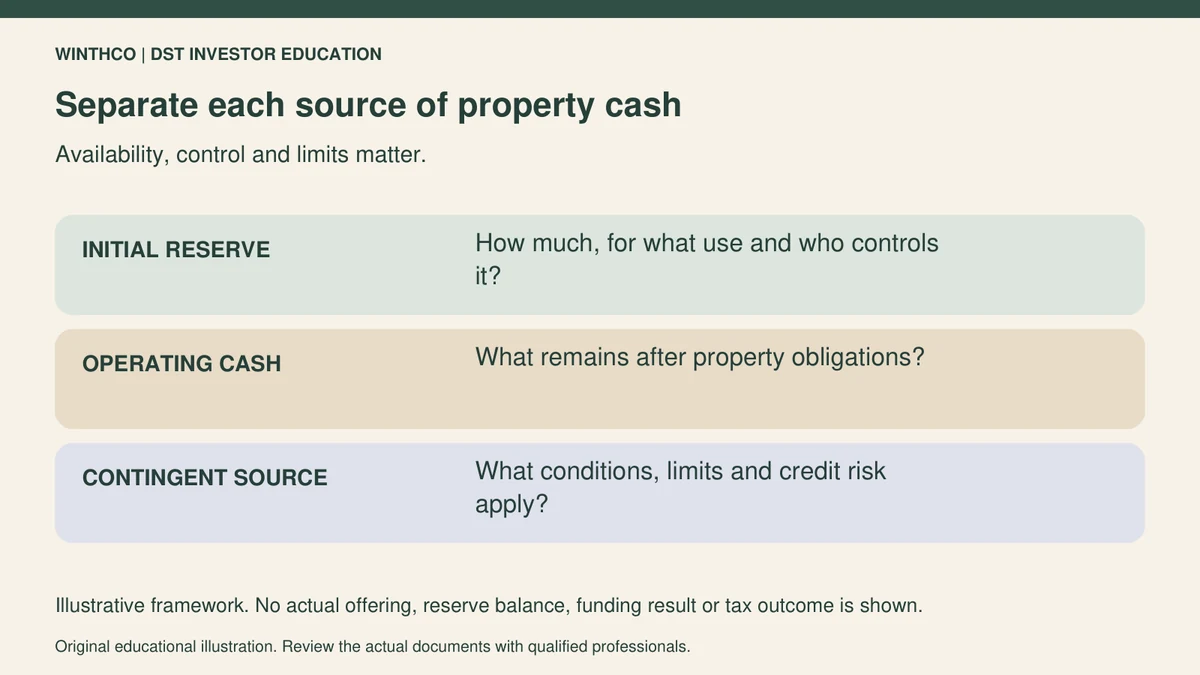
A capital-call restriction governs one potential source of money. It does not guarantee that the property will have enough cash. Rent collections can decline, expenses can rise, a tenant can fail, insurance may not cover every cost and loan obligations can continue. A DST can also have limited authority to refinance debt, enter new leases or make major structural changes, depending on the governing arrangement.
Start with the sources-and-uses budget. Compare initial working capital, repair reserves, lender reserves, insurance deductibles and expected capital work with the assumptions in the offering documents. Our DST reserve and repair review explains why a reserve balance should be evaluated by amount, permitted use and funding assumptions, not treated as an unlimited emergency account.
Ask what happens in a moderate shortfall before asking about a severe one. Could distributions be reduced or suspended? Could planned work be deferred? Is a master tenant or another party responsible for particular expenses? Are there contractual support arrangements, and what are their limits, duration and credit risks? Do not treat an affiliate's role as a guarantee unless an enforceable document actually says so.
Discuss your DST questions with Winthco →
Read the risk factors, trust agreement, property-management and master-lease provisions, reserve disclosures, debt documents and any springing-entity language together. A document may allocate responsibility without proving that the responsible party has unlimited resources. Identify termination rights, caps, reimbursement rights, conflicts and the conditions under which a different structure could take control of the property.
If the materials describe a springing LLC or similar emergency mechanism, ask what events trigger it, who decides, what rights change and what tax reporting may follow. Do not assume activation is tax neutral or that it creates a new source of cash. Tax and legal professionals should assess the actual provisions and consequences. A possible conversion is a contingency, not a promise that loss will be avoided. Winthco's discussion of DST failures offers broader downside questions without predicting a result for any current offering.
Review financing separately. A lender may control reserve releases, require additional deposits, impose covenants or exercise remedies after default. Nonrecourse property debt generally limits an investor's personal loan liability under the stated structure, but it does not remove foreclosure risk, equity loss or the effect of debt service on distributions. Confirm the current loan terms and maturity rather than assuming refinancing will be available.
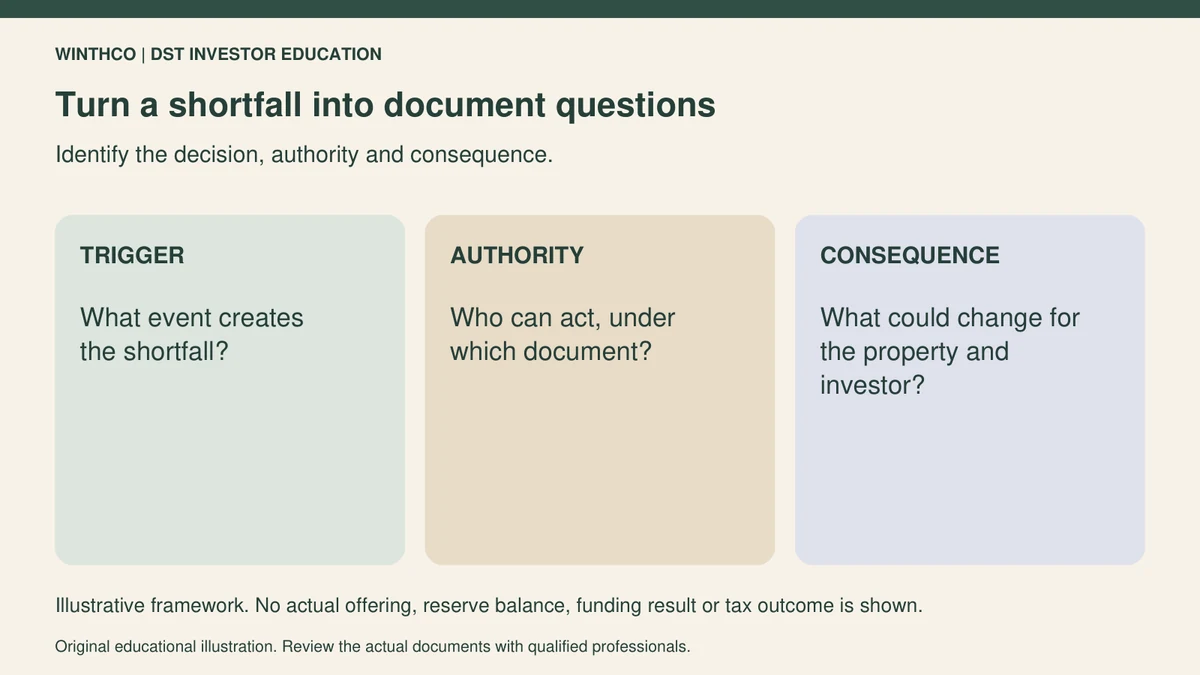
Consider a hypothetical DST property that needs a repair costing more than the unrestricted reserve. This is not an actual offering or prediction. Write down the funding sequence described in the documents: insurance proceeds, operating cash, applicable tenant obligations, permitted reserves and any emergency mechanism. Then identify which sources are uncertain, restricted or controlled by another party.
Next, ask how the shortfall could affect timing and investor cash flow. A distribution reduction may preserve cash but does not itself repair the property. Deferring work may have operational consequences. Selling the property may depend on market conditions and lender consent. The useful output is not a single worst-case number; it is a list of decision points, responsible parties and unresolved risks that can be compared across alternatives.
Finally, connect the scenario to the household. Could essential retirement spending continue if distributions stopped for an extended period? Is enough accessible cash held outside the DST? Would the investor be forced to sell another asset at an unfavorable time? FINRA's concentration guidance emphasizes that illiquid holdings can be difficult to tap quickly or efficiently.
WATCH & LEARN
Winthco Wealth Management provides general DST context. This video is not a capital-call opinion, offering recommendation or assurance that reserves will cover a shortfall. Original resource · Watch on YouTube ↗
Educational context only. The discussion does not establish the suitability, returns or tax treatment of an investment.
The sponsor prepares the offering and manages or arranges management under the documents. Ask it to explain reserve assumptions, property obligations, funding priorities and emergency authority in writing. The investment professional should help compare the offering's risks, fees, conflicts, concentration and fit with the investor's objectives. Winthco's DST evaluation framework provides a broader due-diligence checklist.
The CPA and attorney evaluate tax and legal consequences within their respective roles. The qualified intermediary safeguards exchange funds and administers the exchange process, but ordinarily does not underwrite the DST or guarantee its performance. Keep those roles separate. A properly administered exchange does not prove the replacement investment is suitable or that its reserves are adequate.
The SEC warns that private placements can involve limited disclosure, illiquidity and total loss. Ask for missing information, but recognize that a private offering does not provide the same disclosure as a registered offering. Review changes or supplements before subscribing. If a key funding mechanism cannot be explained from the documents, treat that as an unresolved diligence issue rather than filling the gap with an assumption.
A capital-call review does not pause the exchange clock. Treasury regulations generally require identification within 45 days and receipt of replacement property by the earlier of 180 days or the return due date, including extensions. The qualified intermediary and tax adviser should coordinate deadlines, ownership and reinvestment before any replacement closing. Cash retained or other boot can produce recognized gain.
A later Section 721 contribution is a separate partnership framework, not an automatic repair for a DST funding shortfall. Ordinary REIT shares and operating-partnership units generally are not direct Section 1031 replacement real property. If an offering discusses a possible future UPREIT transaction, review conditions, decision authority, valuation, liquidity restrictions and tax consequences. A proposal does not guarantee conversion, cash access or a tax-free FIFO withdrawal.
The absence of a routine capital call can reduce one direct obligation while increasing the importance of pre-funded reserves, sponsor execution and structural planning. DSTs remain private, illiquid investments generally offered to accredited investors through a private placement memorandum. Distributions can change or stop, property value can fall and investors can lose principal.
Review the property decision alongside financial assets, 401(k)s, IRAs, retirement-income needs, beneficiary plans and accessible cash. A DST, possible sale and possible 721 transaction should not become the only funding plan for an essential expense. A broader Winthco planning conversation can help organize those questions without assuming every account should be transferred or that a rollover is appropriate. Compare services, costs and alternatives separately.
Use the prospect form to describe the property-sale stage and the funding question you want to review. Do not send tax returns, account numbers or confidential offering documents through an ordinary message. Request a secure channel for sensitive records, and rely on the actual offering documents and qualified professionals before acting.
| Decision | Evidence to request | What to avoid assuming |
|---|---|---|
| Initial reserves | Cash established before or at closing | Every unexpected expense will be covered |
| Operating cash | Property receipts available under the documents | Collections will remain stable |
| Insurance proceeds | Covered loss after terms, deductibles and claims | Every repair or interruption is covered |
| Tenant or affiliate obligation | A documented responsibility subject to terms and credit | The responsible party has unlimited resources |
| Emergency structure | Contingent authority defined in the documents | Activation avoids loss or has no tax effect |
Revenue Ruling 2004-86 describes a trust whose trustee cannot accept additional contributions. Review the actual trust agreement and tax analysis for the offered structure rather than assuming every entity uses identical terms.
No. A funding shortfall can still affect repairs, distributions, debt performance, sale timing and principal value. The investment can lose value, including all principal.
The answer depends on the documents, available operating cash, insurance, tenant obligations, lender controls and emergency provisions. Ask the sponsor to explain the sequence and limits in writing.
Do not assume that. The described Revenue Ruling 2004-86 trust has restricted authority over existing debt. Review the actual loan and trust documents and any emergency mechanism.
No. It may provide different authority after specified events, but it does not guarantee financing, prevent loss or establish a particular tax result.
A QI administers the exchange and safeguards exchange funds, but ordinarily does not underwrite the replacement investment. Reserve diligence belongs with the investor and appropriate investment, tax and legal professionals.
Sources checked October 20, 2026. This article explains general concepts; your facts and the applicable documents control.
Winthco DST services · Winthco evaluation overview · Editorial standards
DST due diligence
Before exchanging a rental into a DST, review repair budgets, restricted reserves and funding limits. Know which questions to ask before committing.
Read guide →DST due diligence
Review DST loan maturity, balloon payments and exit assumptions before exchanging a rental. Prepare questions about debt and household liquidity.
Read guide →DST due diligence
Review DST affiliated-party transactions, compensation, valuation and possible 721 conflicts before committing property-sale proceeds.
Read guide →Explore Winthco’s main DST article collection
Share your timeline and investment range. A Winthco team member will follow up with you.