DST due diligence
How to evaluate a DST sponsor
Learn how to evaluate a DST sponsor's history, property underwriting, debt, fees, conflicts, liquidity and exit plan before a 1031 exchange.
Read guide →
Home / Learning center / DST due diligence
DST due diligence
Winthco Wealth Management · Updated October 19, 2026
Reviewing DST conflicts of interest means identifying who controls decisions, who receives compensation and whether related parties benefit from a transaction. Before committing sale proceeds, request the actual agreements and written explanations. Disclosure is a starting point, not proof that pricing is fair, incentives align or the investment fits your needs.
An owner considering a rental or commercial-property sale often wants fewer management duties. Begin by interviewing appropriately licensed realtors or commercial brokers familiar with the property type. Compare valuation evidence, marketing plans, compensation and potential relationships with buyers or service providers. A coordinated sale team can help organize the process, but a referral does not establish that the recommended replacement investment is appropriate.
Bring your CPA, attorney and qualified intermediary into planning before closing or receiving proceeds. Compare keeping the property with professional management, a taxable sale, a partial exchange and a full exchange. Establish what the household needs from the transaction before reviewing a DST pitch. Otherwise, a desire to finish the sale can quietly become pressure to accept an investment whose decision-making arrangements you have not understood.
Share your timeline and investment range. A Winthco team member will follow up with you.
A conflict exists when a party's incentives or responsibilities could pull in a different direction from the investor's interests. It is not automatically evidence of misconduct. For example, consider a hypothetical arrangement in which an affiliated company sells property to the trust and another affiliate manages it. That relationship raises questions about price and service terms even if every participant intends to perform its obligations.
Start with Winthco's overview of DST sponsor roles, then request an entity-by-entity description for the actual offering. Distinguish the trust, sponsor, trustee, property manager, master tenant if present, seller and distributing financial firm. Similar branding does not explain ownership or guarantees. Write down who signs each agreement, who can amend it and which entities are related, rather than treating the entire structure as one interchangeable organization.
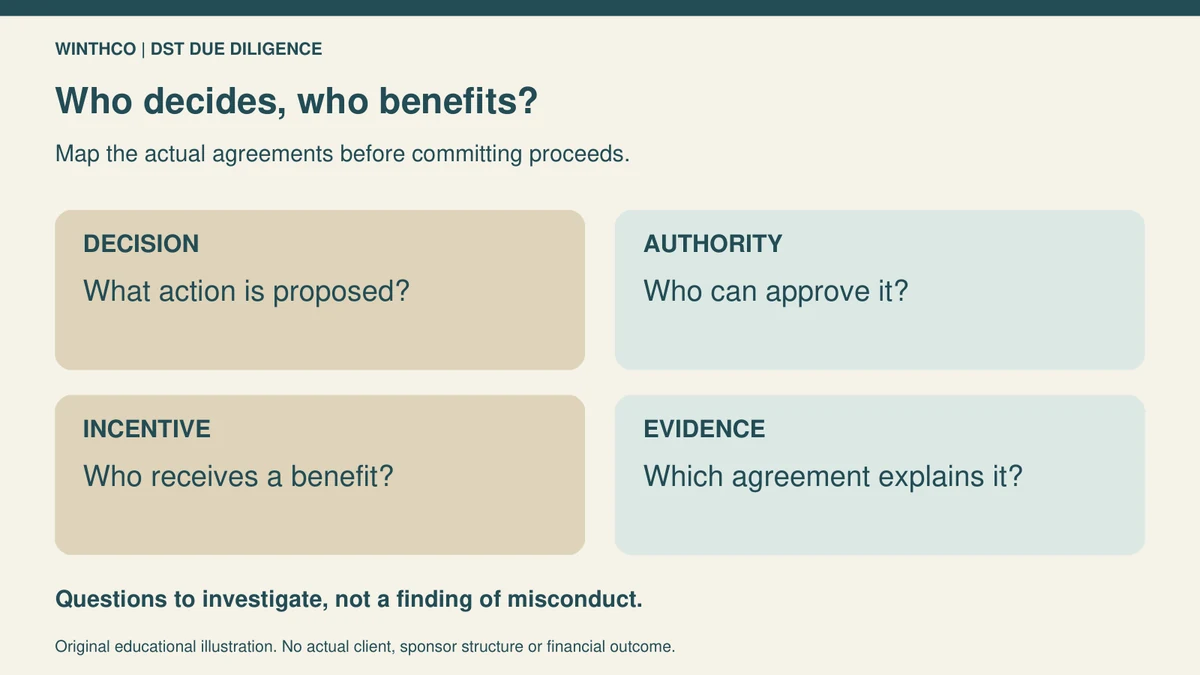
Build a simple question sheet with four columns: decision, decision-maker, financial beneficiary and document supporting the answer. Use it for acquisition pricing, service contracts, reserves, financing and disposition. This is a practical reading method, not a legal test or a rating system. Ask counsel to explain important terms and unanswered questions; do not infer investor veto rights from a presentation's references to alignment.
FINRA's Regulatory Notice 23-08 identifies transactions and payments involving an issuer's affiliates and offering proceeds as an area for reasonable investigation. Its guidance includes examining related-party terms and material-conflict disclosure. For an investor, the useful takeaway is to request the underlying explanation, not simply note that a conflicts section exists. The notice is directed at member firms and does not certify a particular DST.
Ask whether the property was acquired from an affiliate, how the trust's acquisition price was established and what work or risk supports any difference from an earlier purchase price. Request the relevant closing-cost, improvement and carrying-cost explanation where applicable. An appraisal can inform the discussion, but it should be read with its date, assumptions and scope. Our DST appraisal and purchase-price guide separates those questions from the subscription's total cost.
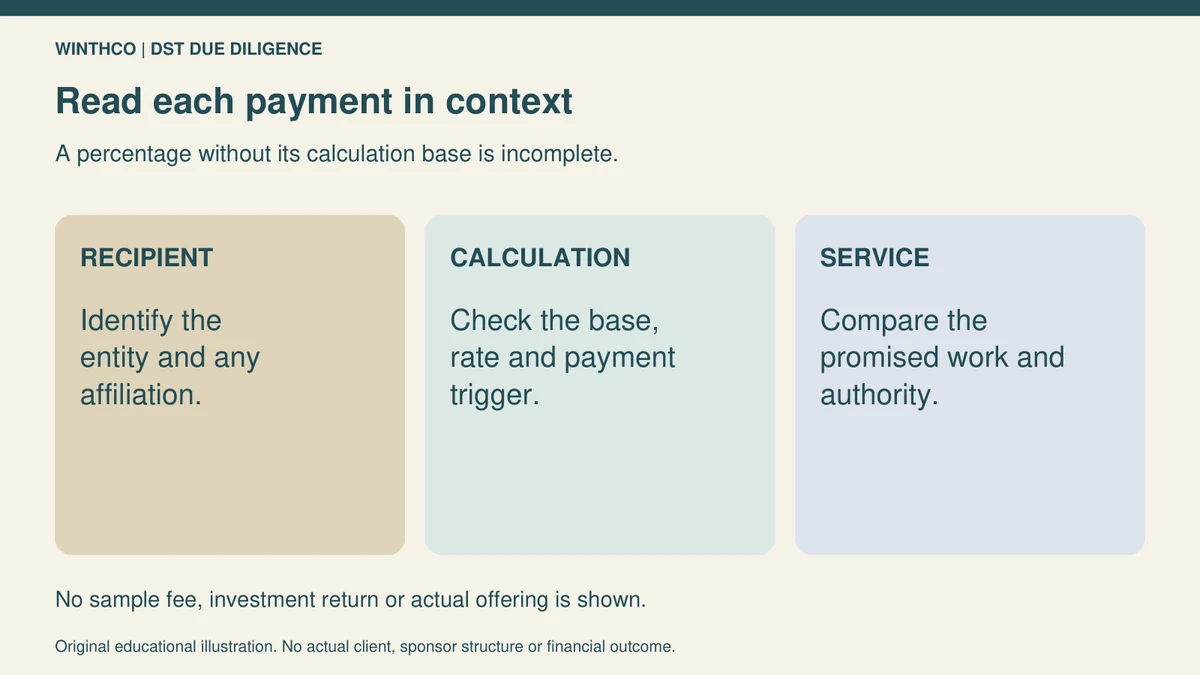
For a related manager or master tenant, ask what services are promised, how compensation is calculated, how performance is monitored and what remedies exist if obligations are not met. Identify who may enforce or change the agreement. Do not assume a familiar company name supplies a parent guarantee, or that replacing an underperforming provider is a choice you personally control. The signed documents determine the available rights.
Discuss your DST questions with Winthco →
Ask the recommending professional to describe the capacity in which the firm is acting, the services included and how both firm and individual are compensated. The SEC's Form CRS resource explains that a relationship summary addresses services, fees, conflicts, conduct standards and disciplinary information. Read the actual firm's summary and relevant disclosures. A professional title alone does not answer whether a particular recommendation is brokerage, advisory or another service.
Separate compensation at the investor relationship level from expenses inside the offering. Ask which charges are paid initially, recur while assets are held or arise on a sale or other transaction. Request a written explanation of whether compensation differs among available investments or whether the product menu is limited. Do not add percentages with different calculation bases and call the result an accurate total cost.
FINRA emphasizes that disclosure alone does not satisfy a broker's best-interest obligation. That does not make every disclosed arrangement unsuitable, nor does it eliminate the need to understand costs and alternatives. Ask why the particular interest fits your circumstances and what alternatives were considered. Winthco's discussion of choosing a DST investment can help frame the conversation, but a general educational page cannot establish the suitability of a specific recommendation.
Yes. Continue the same questions through the proposed holding period. Could a fee increase with assets, revenue, a transaction or another event? Which decisions affect that calculation? Ask how the documents address circumstances in which preserving investor capital, maintaining distributions and completing a transaction point toward different actions. There may be sensible explanations, but those explanations should be specific enough to compare with the actual agreement.
Consider a hypothetical trust facing a major repair while its household investors want stable distributions. Ask who decides how available cash is used, what lender restrictions apply and whether affiliated service providers participate in the work. This example does not allege a problem with any sponsor. It illustrates why understanding authority and incentives before investing is more useful than assuming that reduced management work means no difficult decisions remain.
Also establish how information reaches you. Ask about reporting frequency, financial statements, material-event communication and the person responsible for responding to questions. Keep the original documents and later notices together so that changes can be evaluated against the original terms. An investor's ability to ask a question should not be confused with a right to direct operations, remove a manager or demand an immediate sale.
WATCH & LEARN
Equity Advantage's discussion provides background on delegating property-management work, which makes oversight and decision rights important. It is not a conflicts review or an endorsement of an offering. Simplified debt language does not eliminate economic risk: property debt can affect distributions and principal. Original resource · Watch on YouTube ↗
Educational context only. The discussion does not establish the suitability, returns or tax treatment of an investment.
A qualifying Section 1031 exchange can defer eligible gain, not eliminate tax or prove an investment is sound. In a standard deferred exchange, identify replacement property within 45 days; receipt generally must occur by the earlier of 180 days or the applicable return due date, including extensions. Cash, liability changes and nonqualifying property can produce boot. Have the CPA and QI apply the rules to the actual transaction.
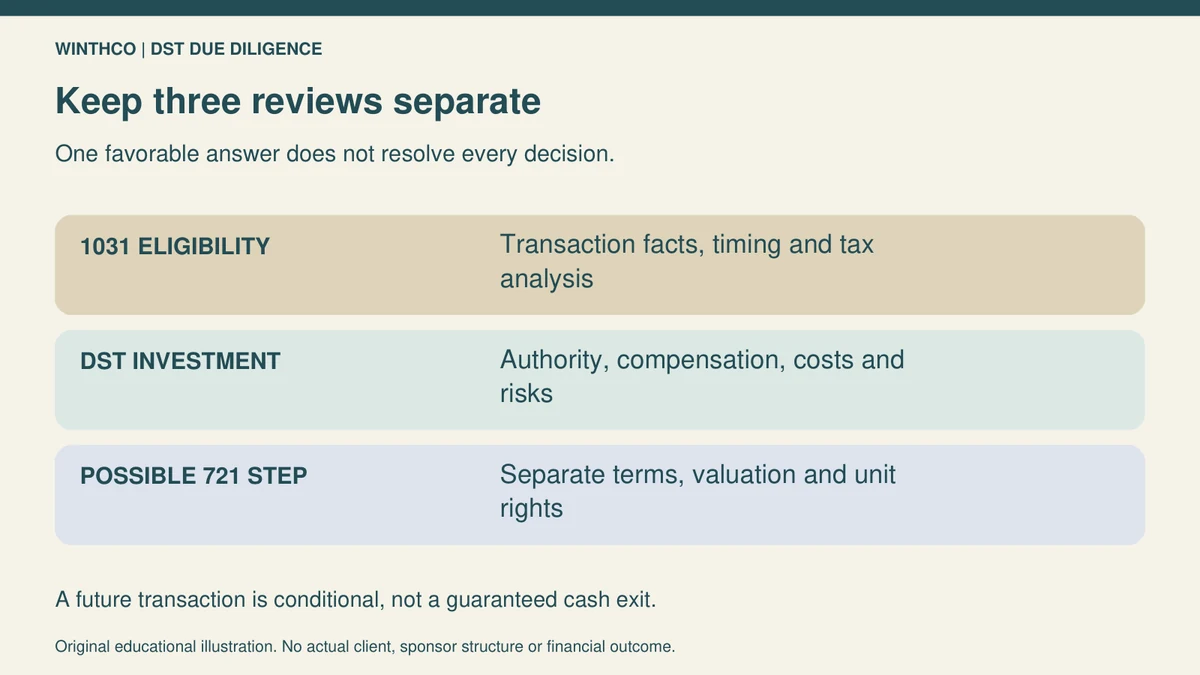
IRS Revenue Ruling 2004-86 addresses a specified trust arrangement, not every product using the DST label. Separately examine any proposed later Section 721 contribution to an operating partnership. Publication 541 describes the general partnership-contribution framework and exceptions. Ask whether a future transaction is optional, who decides its timing, how consideration would be valued and whether related parties participate on different sides. These are questions, not claims that every program has such terms.
An anticipated 721 event is not a guaranteed conversion or cash exit. Operating-partnership units and ordinary REIT shares generally are not direct 1031 replacement real property. Review unit rights, restrictions, liabilities and later redemption taxes with independent tax and legal professionals. FIFO selection alone does not promise tax-free basis withdrawals. Evaluate the initial DST even if the proposed later transaction never occurs, rather than using a future plan to excuse current uncertainties.
An understandable compensation arrangement cannot remove property, tenant, sponsor, debt, fee or tax-law risk. Private DST offerings are generally limited to accredited investors and offered through a private placement memorandum. The SEC warns that private placements may have limited disclosure, severe illiquidity and potential total loss. Distributions can fall or stop. Review Winthco's discussion of 1031 DST investment risks alongside the actual offering, not in place of it.
Use a separate household review before committing proceeds. Would essential spending remain covered if distributions stopped or an exit took longer than expected? Consider other properties, financial assets, cash reserves, 401(k)s and IRAs together. FINRA's concentration guidance notes that correlated and illiquid holdings can create exposures that are not obvious from the number of investments. A different sponsor name alone does not establish diversification.
Close the sale-planning conversation with retirement, tax, estate and beneficiary coordination rather than another product decision. A real estate sale does not automatically justify a retirement-account rollover, and qualified retirement accounts are not themselves 1031 exchange proceeds. Use the prospect contact form to discuss your sale stage and the questions you want answered. Request a secure channel before providing private financial statements or offering documents.
| Decision | Evidence to request | What to avoid assuming |
|---|---|---|
| Acquisition | Seller relationships, pricing evidence and costs | An appraisal proves every acquisition term is fair |
| Operations | Service contracts, authority and monitoring | Investors can replace any provider whenever they wish |
| Recommendation | Capacity, compensation, menu and alternatives | Disclosure alone settles the investment decision |
| Possible 721 transaction | Valuation, related parties and unit rights | A proposed transaction guarantees liquidity |
No. A relationship creates questions about incentives and terms, not proof of wrongdoing. Review the documents and specific facts with qualified professionals.
No. Understand the arrangement, costs, alternatives and household fit. A disclosure is not a guarantee of fair value or investment performance.
Do not assume uniform compensation. Request the actual offering and relationship disclosures and ask how charges are calculated and who receives them.
No. Plan early so the tax deadline does not substitute for investment review. Discuss feasible alternatives with the CPA and QI before committing.
No. Ask separately about decision authority, valuation, affiliate relationships and unit rights. A proposed future transaction may not occur.
Do not assume that right exists. Read transfer and liquidity restrictions before subscribing. An ability to request information is not an on-demand redemption right.
Sources checked October 19, 2026. This article explains general concepts; your facts and the applicable documents control.
Winthco DST services · Winthco evaluation overview · Editorial standards
DST due diligence
Learn how to evaluate a DST sponsor's history, property underwriting, debt, fees, conflicts, liquidity and exit plan before a 1031 exchange.
Read guide →DST investment due diligence
Selling a rental property? Learn how to review a DST private placement memorandum, compare fees and risks, and assess separate 721 UPREIT terms.
Read guide →DST due diligence
Learn how to review DST appraisals, compare acquisition costs and separate property value from investor proceeds before a 1031 exchange.
Read guide →Explore Winthco’s main DST article collection
Share your timeline and investment range. A Winthco team member will follow up with you.