DST investment due diligence
DST Private Placement Memorandum: What to Review
Selling a rental property? Learn how to review a DST private placement memorandum, compare fees and risks, and assess separate 721 UPREIT terms.
Read guide →
Home / Learning center / DST due diligence
DST due diligence
Winthco Wealth Management · Updated November 3, 2026
A Delaware statutory trust property manager may be replaceable, but the right belongs to the party named in the governing agreements, not automatically to investors. Before selling a rental and selecting a DST for a 1031 exchange, check who hires the manager, what permits termination, and who can keep operations running during a transition.
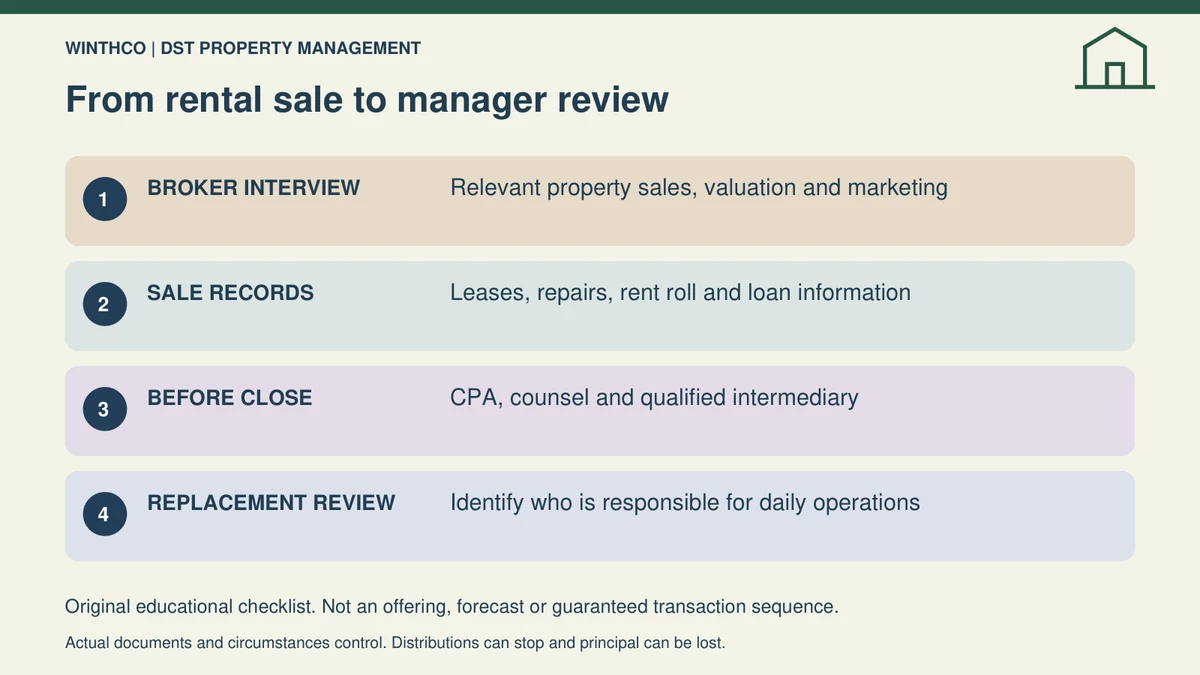
Interview an appropriately licensed realtor or commercial broker with recent experience selling your property type. Ask how they support their valuation, who would buy the property, what fees and marketing expenses apply, and how they would schedule diligence and closing. Assemble rent rolls, leases, repair records and loan information early. Compare your reasons for selling, including which operating responsibilities you want to give up and which risks you are willing to keep.
Bring in a CPA, attorney and qualified intermediary before closing or taking control of the proceeds if you are considering a deferred exchange. Section 1031 can defer eligible gain on qualifying real property held for business or investment; it does not erase tax. Generally, identify replacement property within 45 days and receive it by the earlier of 180 days or the federal return due date, including extensions. Cash or other non-like-kind property can lead to recognized gain. Use Winthco’s overview of Delaware statutory trusts to frame your questions, then have your own professionals evaluate eligibility, costs and deadlines.
Share your timeline and investment range. A Winthco team member will follow up with you.
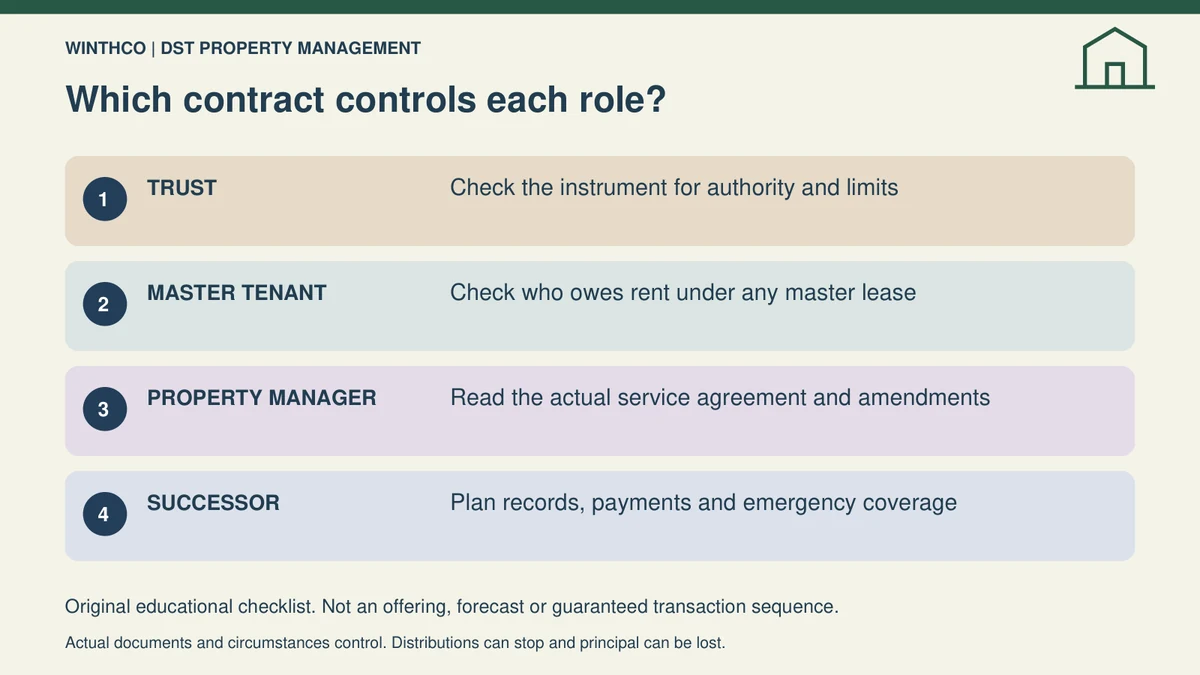
Start with the job, not the company name. A property manager might collect rent, supervise maintenance and coordinate vendors. A master tenant, where the offering uses one, leases the property under a separate contract and may subcontract operations. An asset manager might monitor budgets and performance at a different level. The same business group may fill several roles, but replacing a vendor does not necessarily change the lease, the ownership structure or the entity that owes rent.
Discuss your DST questions with Winthco →
Find the management agreement and any amendments. Identify the exact entity on the signature line, who can send a termination notice, and who can retain a successor. If a master tenant signed, ask whether the trust has a direct contractual remedy or must work through the master tenant. If the trust signed, check who can act for it. Ask counsel to reconcile the agreement with the trust instrument, leases and any relevant lender approvals. Use Winthco’s guide to evaluating a DST offering memorandum to organize the documents, but do not treat an offering summary as the operative contract.
Revenue Ruling 2004-86 describes a specific trust whose trustee had limited powers, including limits on renegotiating the property lease or entering a new lease, with a narrow exception tied to tenant bankruptcy or insolvency. It addresses federal tax classification and potential exchange treatment on the stated facts. It is not a universal rule granting or forbidding replacement of a property management vendor. Ask tax counsel whether a proposed action changes only a service agreement or would also alter a lease, financing or another feature relevant to the tax analysis.
WATCH & LEARN
Equity Advantage 1031 Exchange discusses the time and effort of direct property ownership. This third-party video provides general context, not advice about termination rights or any specific DST. Original resource · Watch on YouTube ↗
Educational context only. The discussion does not establish the suitability, returns or tax treatment of an investment.
Read the triggering events and the procedure together. A performance complaint may not be a contractual default. A default might require written notice and time to cure. A no-cause termination clause, if present, might still require a notice period or payment. Ask for the exact provision that supports each answer. Also ask who can access the operating accounts, whether consent is needed to transfer responsibilities, and who bears any termination, transition or overlapping fees.
Consider a hypothetical property where the manager repeatedly misses monthly reports and vendor invoices are backing up. The master tenant may have the contractual right to replace the manager, but that does not mean trust investors can send the notice. A practical response starts by documenting the failures, locating notice and cure requirements, and naming someone authorized to supervise the handoff. Ask who will take over rent collection, emergency maintenance and payment approvals before the old manager leaves.
Ask for a written transition plan covering lease files, tenant notices, deposits, balances, vendor contracts, insurance claims, open work orders, access credentials and accounting records. The responsible party should reconcile cash and records rather than assuming a handoff is complete when an account login is delivered. Ask who covers a weekend emergency and how tenants can verify new payment instructions. Even a permitted change can disrupt collections or delay vendor payments if the operating plan is weak.
An affiliated manager can offer continuity, but common ownership can make it harder to judge whether fees and termination terms are competitive. Compare the fee schedule, reimbursable expenses, renewals and transition charges with what is disclosed in the offering documents. Ask who evaluates service failures, whether a nonaffiliated replacement is allowed and what practical alternatives exist. Look for the process and incentives, not a general assurance that the sponsor monitors its own affiliate.
A stronger operator cannot remove vacancy, tenant concentration, debt obligations or property repair needs. A transition can cost money while the property still owes ordinary operating expenses. DST interests are typically offered through private placements, generally to accredited investors; information can be limited and resale can be difficult. Investors may have little control, may hold longer than planned, and can lose principal. Distributions can fall or stop. Compare sponsor, manager and property exposure across your portfolio rather than assuming different offerings provide different operating teams.
No. A later contribution to an operating partnership under Section 721 is a separate, conditional transaction. Review the actual offer, approvals, liabilities, restrictions and tax effects with counsel and a CPA. Ordinary REIT shares and operating partnership units are not direct replacement real property for Section 1031. Do not assume an UPREIT transaction will occur, provide a prompt exit or make a property management problem irrelevant.
Separate the operating symptoms from the legal obligations. Late vendor payments and missing reports call for a different inquiry than a missed payment under the master lease. Ask for evidence of which entity received rent, which one owed each payment and whether the problem arose before or after the funds changed hands. Then ask whether the party with a remedy has enough staff and liquidity to use it. Replacing the manager would not by itself restore a master tenant's ability to pay. Read the master lease risk guide for the separate lease analysis.
Ask for one written summary that names the decision maker, the applicable clause, the required approvals and the earliest practical handoff. Compare that summary with the underlying agreements. If an explanation depends on a discretionary lender approval or a future payment by an affiliate, list it as a contingency rather than an established remedy. Ask when updated information will be available and set a review date with your exchange team. If an important question remains unanswered, discuss available alternatives with your advisers while there is time to evaluate them. An exchange deadline does not improve the contract or make an illiquid investment a better fit.
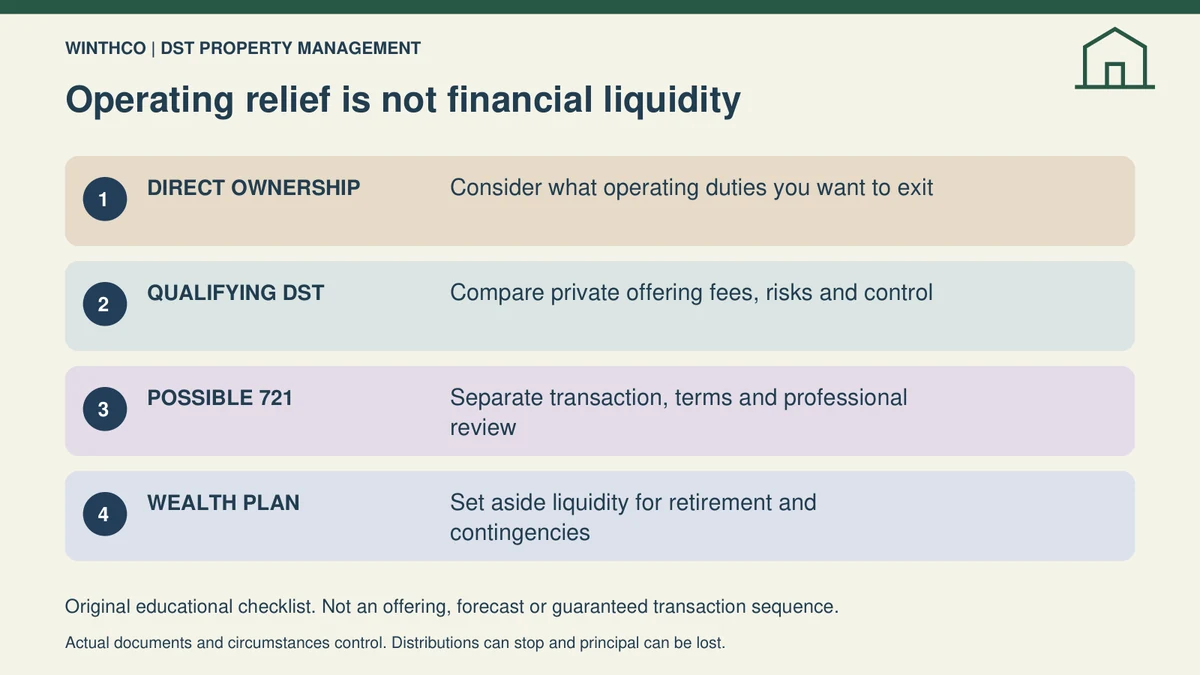
Compare the operating relief you want with the control and liquidity you would give up. Map near-term spending, cash reserves, other real estate exposure and what happens if distributions stop. Review your IRAs, 401(k)s, taxable investments, beneficiary designations and estate needs separately from exchange proceeds. A Winthco wealth planning conversation can help you organize those decisions alongside your tax and legal team without assuming any rollover, asset transfer or DST purchase is appropriate. Use the prospect forms here or the site’s contact page to start a conversation.
| Decision | Evidence to request | What to avoid assuming |
|---|---|---|
| Management agreement | Who hires or dismisses the vendor? | A beneficial owner can issue notice. |
| Master lease, if any | Who owes rent and can hire operating vendors? | The vendor and tenant obligations are interchangeable. |
| Trust and loan documents | What authority or consent limits apply? | A service clause alone resolves every approval. |
| Transition plan | Who holds records, funds and emergency access? | Operations will continue without a handoff. |
Do not assume so. Identify the party with that right in the management agreement and ask what remedies or voting rights, if any, the trust documents give investors.
No. Management services and a lease are separate contractual roles even when affiliated entities perform them. Counsel should review any action that would also change the lease.
The ruling considers specific trust powers and tax facts; it is not a blanket service-vendor retention rule. Analyze the proposed action and the actual documents with tax counsel.
Ask whether counsel can review it or whether the sponsor can identify the operative provisions in writing. Treat unresolved authority, costs or handoff rights as unknowns rather than assuming favorable terms.
It can contribute to disruption through transition costs, delayed collections or administrative problems. Actual distributions also depend on property performance, reserves, debt and the governing documents.
Sources checked November 3, 2026. This article explains general concepts; your facts and the applicable documents control.
Winthco DST services · Winthco evaluation overview · Editorial standards
DST investment due diligence
Selling a rental property? Learn how to review a DST private placement memorandum, compare fees and risks, and assess separate 721 UPREIT terms.
Read guide →DST investment due diligence
Review who owes rent in a DST master lease, what supports payment, and how lease risks fit a property sale, 1031 exchange and retirement plan.
Read guide →DST due diligence
Review DST affiliated-party transactions, compensation, valuation and possible 721 conflicts before committing property-sale proceeds.
Read guide →Explore Winthco’s main DST article collection
Share your timeline and investment range. A Winthco team member will follow up with you.