1031 exchange planning
Qualified intermediary for a DST 1031 exchange
Learn what a qualified intermediary does in a DST 1031 exchange and how to review agreements, fund controls, deadlines and professional roles.
Read guide →
Home / Learning center / Due Diligence
Due Diligence
Winthco Wealth Management · Updated November 21, 2026
DST subscription acceptance depends on the offering's actual agreements and closing process. A signed application, reserved allocation or sent wire should not be treated as interchangeable proof of completed ownership. Ask the responsible parties to identify the acceptance conditions, remaining requirements and documents your qualified intermediary and tax advisers need.
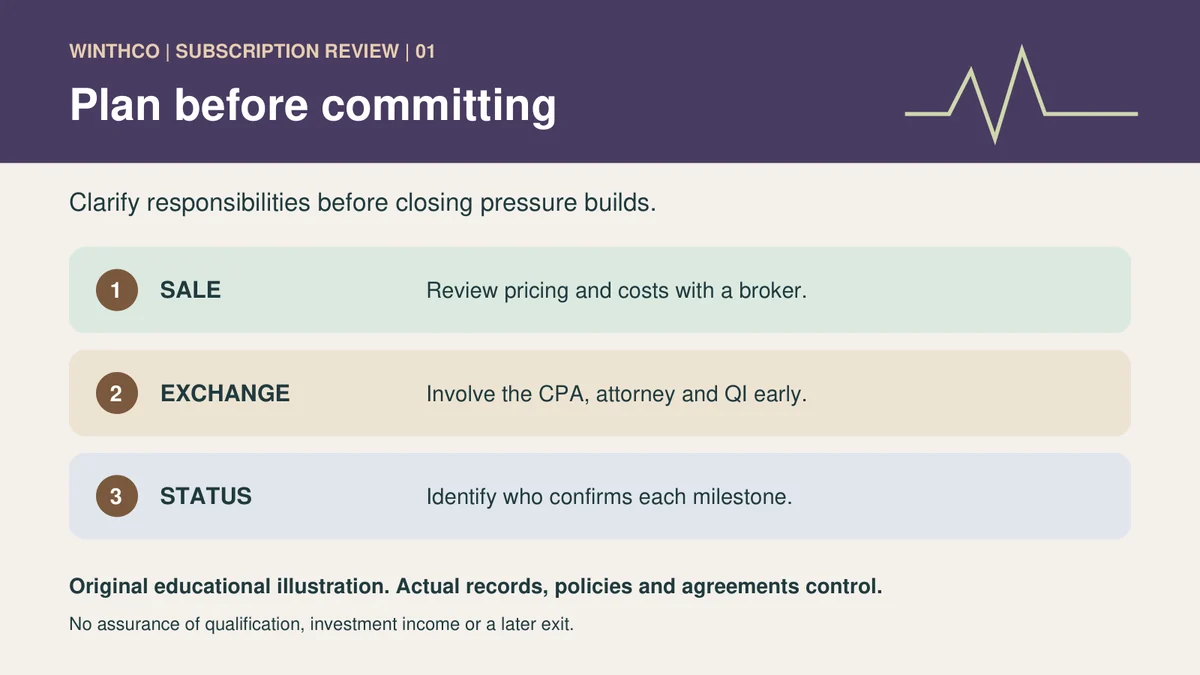
Preparing a rental sale begins with an appropriately licensed realtor or commercial broker who understands the property type. Discuss pricing evidence, marketing, commissions, tenant access and a realistic closing schedule. A buyer's preferred date should not become the only date on your planning calendar. If a deferred exchange is contemplated, bring the CPA, attorney and qualified intermediary into the conversation before closing or receiving proceeds.
Winthco's overview of buying a DST helps frame the replacement-property discussion. This article addresses a narrower question: what evidence shows that the proposed investment has progressed beyond an application? Establishing that evidence early helps the parties distinguish a task somebody has started from a transaction somebody has confirmed. It does not turn the process into an assurance of tax qualification.
Share your timeline and investment range. A Winthco team member will follow up with you.
The SEC urges investors in private placements to understand the subscription agreement as well as the offering memorandum. Read those documents together. Ask counsel to explain which provisions govern your commitment, who has authority to accept it, whether acceptance can be conditional and what remains to be delivered. There is no universal acceptance timetable that can be inferred from the label Delaware statutory trust.
Separate investor representations from issuer obligations. A signature may acknowledge receipt of documents, financial qualifications, investment risks or transfer restrictions. It should reflect information you have actually reviewed and answers you can accurately provide. Ask for clarification when an acknowledgment refers to an attachment you have not received. Do not assume a sales presentation supplies the missing terms.
Identify any conditions addressing minimum subscriptions, allocation, document completeness or the proposed closing. Ask what happens if those conditions are not met and where the agreement explains the handling of funds. These are questions for the actual offering, not claims that every DST has the same conditions. Keep the written response with the document version to which it relates.
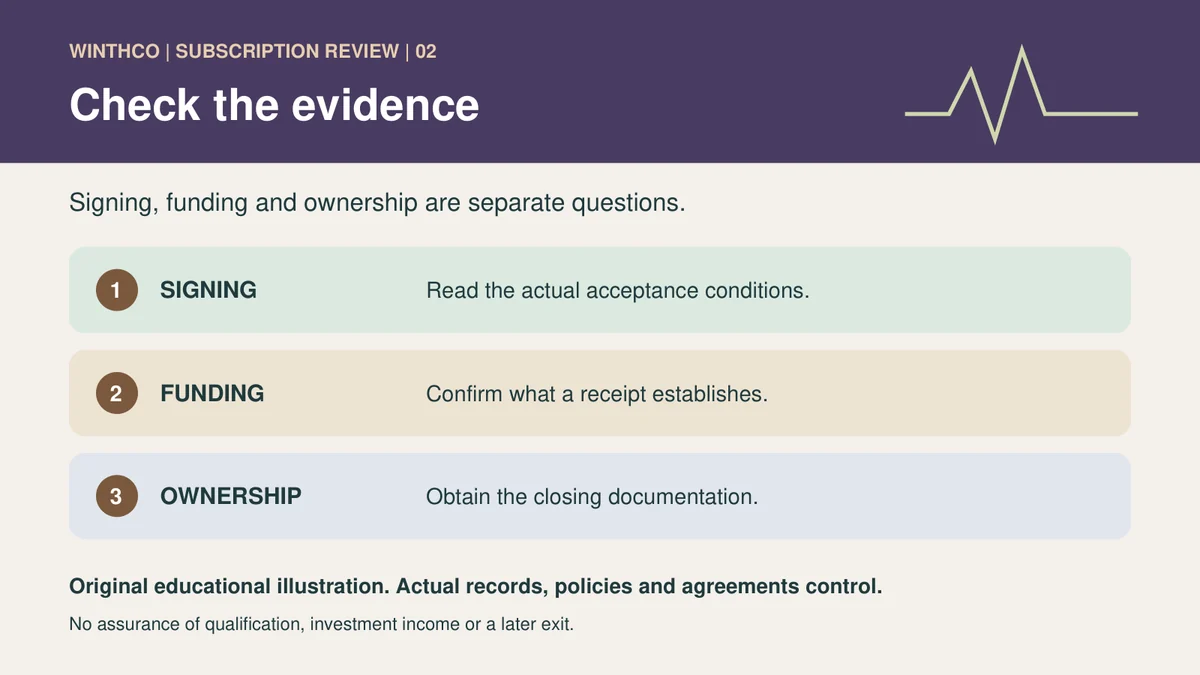
An expression of interest, an allocation discussion, submitted paperwork, transmitted funds and completed acquisition describe different activities. Ask each responsible party which activity its status message confirms. A portal marked complete may describe an administrative checklist rather than your legal ownership. Counsel and the transaction parties should explain the operative documents instead of leaving the investor to interpret a progress indicator.
Ask what written evidence will identify the accepted investment amount, ownership name, effective date and acquired interest. Reconcile that evidence with the executed documents and the QI's closing records. If one record uses an entity name and another uses an individual's name, have the professional team determine whether a correction is needed. Do not resolve tax ownership questions by changing a form without advice.
Payment verification is a separate concern. Our funding-instruction discussion addresses the destination of a payment; it does not establish acceptance of the investment. Similarly, an acknowledgment that money arrived does not by itself explain whether every closing condition was satisfied. Ask the receiving party to state exactly what has been confirmed and what remains outstanding.
Discuss your DST questions with Winthco →
IRS Publication 544 describes the ordinary deferred-exchange deadlines: identify replacement property within 45 days, and receive it by the earlier of 180 days or the federal return due date, including extensions. Have the QI and tax advisers calculate the dates for the actual transaction and explain what constitutes receipt. Do not assume that signing a subscription before the deadline substitutes for receiving qualifying replacement property.
Section 1031 can defer eligible gain when its requirements are met; it does not erase tax. Cash or other non-like-kind consideration may result in recognized gain. IRS Revenue Ruling 2004-86 addresses qualifying treatment for a particular DST arrangement, not blanket approval of every trust. Acceptance under an agreement and qualification under tax rules are related questions that still require separate analysis.
Use our exchange deadline guide to prepare questions, not to replace the transaction team's calendar. Ask about processing lead time, who follows up on missing information and how an unresolved item will be escalated. An estimate of a few business days is not an extension of a federal deadline. Discuss incomplete-exchange consequences before time pressure makes every alternative feel unavailable.
Ask for the current offering documents and all applicable supplements before making the final decision. Compare the version reviewed with the version you are asked to sign. If a property, financing assumption, fee or other material term differs, request an explanation of the effect on the recommendation. Avoid reducing the review to whether the investment's marketing name stayed the same.
FINRA Regulatory Notice 23-08 emphasizes reasonable investigation of recommended private placements and warns about offering schedules that leave insufficient investigation time. Ask your recommending professional what supports the recommendation and how new information has been evaluated. An earlier review of a sponsor does not answer every question about the present transaction. A deadline is a reason to coordinate, not a reason to stop investigating.
Hypothetical: a seller has sent a subscription package but receives a request for additional documentation shortly before the intended closing. The seller asks the issuer, adviser, counsel and QI to clarify status, conditions and realistic next steps in writing. This invented scenario has no assumed successful outcome. Its lesson is to surface uncertainty promptly, not to assume an allocation will remain available.
WATCH & LEARN
Accruit explains DST replacement ownership. Third-party background, not confirmation of an individual subscription, tax qualification or a Winthco affiliation. Original resource · Watch on YouTube ↗
Educational context only. The discussion does not establish the suitability, returns or tax treatment of an investment.
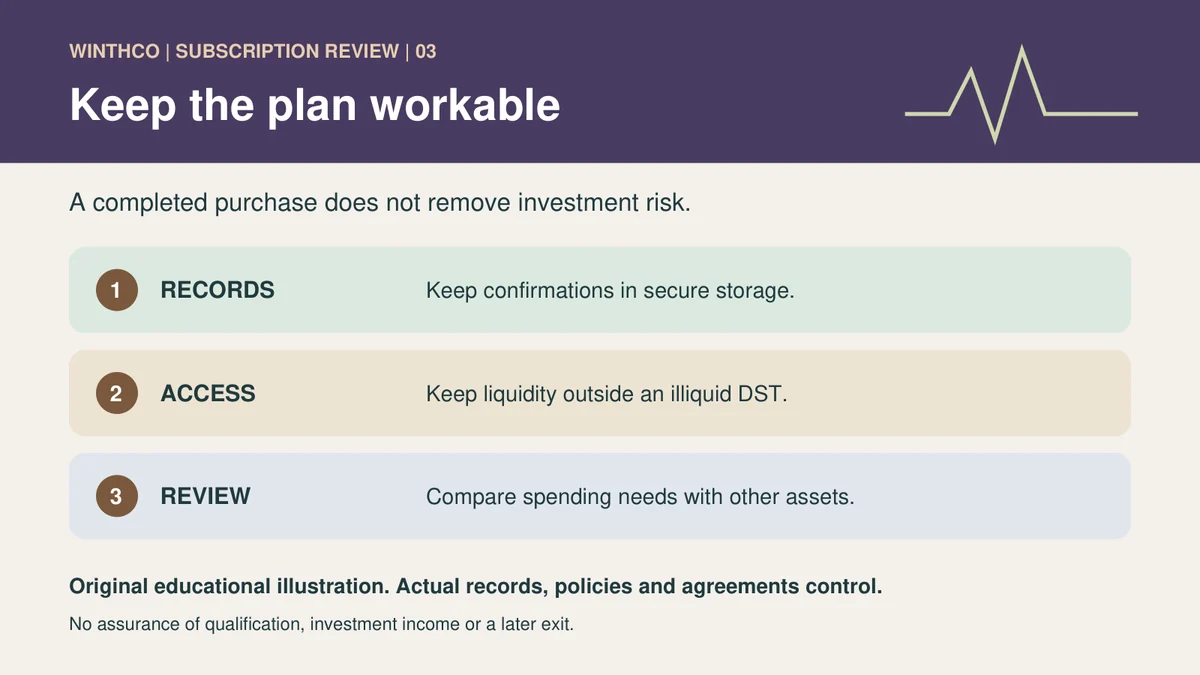
A completed purchase does not resolve investment risk. DST interests are generally available only to accredited investors and offered through a private placement memorandum. The SEC highlights private placements' illiquidity, limited disclosure and possible total loss. Financial eligibility does not establish that the investor can afford an extended holding period or interrupted income. An SEC Form D filing is not SEC approval of the investment.
Winthco's questions for evaluating DST investments can help organize the separate review of property, sponsor, financing and expenses. Consider tenant concentration, lease expirations, capital needs, debt maturity and the sponsor's ability to execute its plan. Read selling compensation, acquisition charges and ongoing fees together. Administrative acceptance does not validate projected cash flow or remove conflicts of interest.
Passive ownership can reduce direct landlord duties while limiting control over leasing, repairs and sale timing. Distributions can decline or stop, principal can be lost and tax rules can change. Ask whether any cancellation or withdrawal right exists before commitment and how it works under the actual agreement. Do not invent a cooling-off period or assume that reselling an accepted interest will be easy.
Keep a potential Section 721 UPREIT contribution outside the definition of today's completed DST purchase. It is a separate possible transaction, subject to its own proposal, conditions and review. Ask who would decide whether it occurs and how investors would learn about the terms. Do not evaluate the initial subscription as though a future contribution were already agreed or certain.
Ordinary REIT shares and partnership units are not direct Section 1031 replacement real estate. Have tax and legal advisers explain any proposed later structure and its consequences. A possible future change in ownership should not be treated as a promised liquidity date, redemption value or tax-free withdrawal method. The original investment needs to fit even if that later transaction never occurs.
Keep executed documents, applicable supplements, acceptance or closing evidence and QI records in secure storage. Ask which party supplies ongoing reports and tax information, how contact changes are handled and whom to contact about discrepancies. Do not send account numbers, identification documents or tax returns through a general marketing inquiry form. Use the secure process specified by the responsible professional.
Connect the property decision with accessible savings, other investments, 401(k)s, IRAs and retirement spending. Qualified retirement accounts are not exchange proceeds. Any rollover or transfer needs its own assessment of costs, services, protections and access. Budget for the possibility that DST distributions arrive later or at a lower level than expected, without depending on a projected exit to meet essential expenses.
Winthco's wealth-management conversation can put those decisions in a broader plan without assuming every asset should be transferred. Use either prospect form here or the dedicated contact page to describe general sale timing and your questions. Before considering the purchase complete, obtain a clear answer from the responsible parties about what closed, when it closed and what documentation supports that answer.
| Decision | Evidence to request | What to avoid assuming |
|---|---|---|
| Application | What was submitted? | Proof of completed ownership |
| Funding | Where were funds received? | Proof every condition was met |
| Acceptance | What do the agreements establish? | Assurance of tax qualification |
| Acquisition | What confirms the acquired interest? | Assurance of investment performance |
Do not assume so. Ask counsel and the issuer which conditions and documents establish completion under the actual agreement.
It confirms a payment-related event, not necessarily every closing requirement. Ask for the separate acquisition evidence.
Do not assume they do. Have the QI and tax advisers address the applicable federal deadline and any specifically available relief.
Cancellation rights depend on the actual agreements and applicable law. Ask counsel before assuming a right to withdraw or a refund timetable.
No. Review liquidity, costs and possible loss separately from the administrative completion of a purchase.
Sources checked November 21, 2026. This article explains general concepts; your facts and the applicable documents control.
Winthco DST services · Winthco evaluation overview · Editorial standards
1031 exchange planning
Learn what a qualified intermediary does in a DST 1031 exchange and how to review agreements, fund controls, deadlines and professional roles.
Read guide →DST investment due diligence
Selling a rental property? Learn how to review a DST private placement memorandum, compare fees and risks, and assess separate 721 UPREIT terms.
Read guide →Due Diligence
Learn how to verify DST funding instructions, coordinate with your QI and separate payment checks from investment due diligence.
Read guide →Explore Winthco’s main DST article collection
Share your timeline and investment range. A Winthco team member will follow up with you.