DST investment due diligence
DST Master Lease Risks: A Property Seller's Guide
Review who owes rent in a DST master lease, what supports payment, and how lease risks fit a property sale, 1031 exchange and retirement plan.
Read guide →
Home / Learning center / DST structure
DST structure
Winthco Wealth Management · Updated October 21, 2026
Revenue Ruling 2004-86 describes a Delaware statutory trust whose trustee has tightly limited authority over property, debt, leases, new assets, investor contributions and structural changes. Those limits support the ruling's federal tax analysis, but they can also constrain responses to property problems. Investors should review the actual trust agreement, not rely on a checklist label.
A rental-property owner preparing to sell may be trying to reduce repair calls, tenant decisions and day-to-day responsibility. Before listing, interview appropriately licensed realtors or commercial brokers about property-type experience, valuation, marketing, compensation, sale readiness and closing coordination. If a deferred exchange is being considered, involve the CPA, attorney and qualified intermediary before closing or receiving sale proceeds.
A DST may transfer many operating tasks to a sponsor and property manager, but it also gives the investor limited control. Winthco's DST requirements overview provides broader structural context. The more useful question for a seller is not simply whether management is delegated. It is what the trustee may do when a lease fails, debt matures, a repair grows or the property no longer fits the original plan.
Share your timeline and investment range. A Winthco team member will follow up with you.
Revenue Ruling 2004-86 analyzes one specified Delaware statutory trust that owns rental real property. The IRS concludes, under those facts and the governing arrangement, that the trust is classified as an investment trust and that acquiring an interest can qualify under Section 1031 when the other exchange requirements are satisfied. It is not blanket approval of every entity called a DST, every trust agreement or every investor's exchange.
Treasury Regulation 301.7701-4 says an investment trust will not be classified as a trust if the governing agreement gives power to vary the certificate holders' investment. The ruling emphasizes fixed financing and leasing arrangements and limited trustee activities. Industry materials sometimes compress these facts into a named list. The primary source is more precise: the actual powers and prohibitions in the governing documents must be reviewed together.
Delaware law provides broad flexibility for a statutory trust's governing instrument. That state-law flexibility does not replace the federal tax analysis in the ruling. It makes the document review more important because the title Delaware statutory trust, by itself, does not prove that an offered interest follows the specified arrangement or qualifies as real property for a particular exchange.
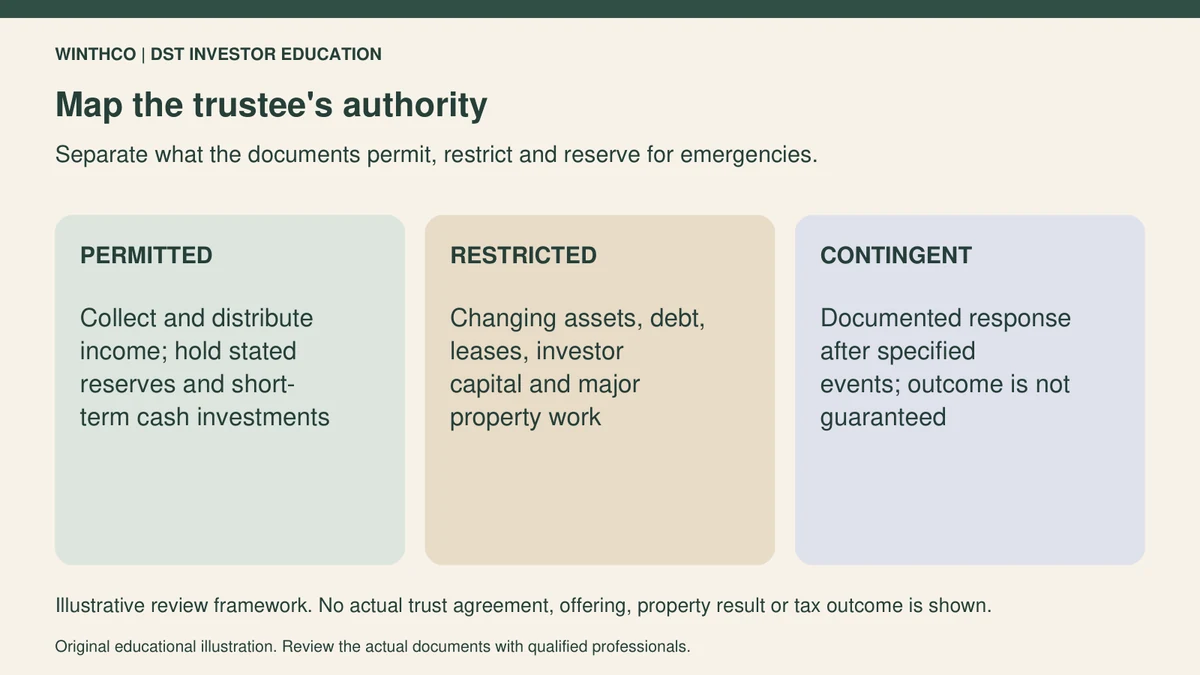
The ruling states that the trustee may not exchange the real property for other property, buy assets other than specified short-term investments or accept additional assets, including money. It also states that the trustee may not renegotiate the acquisition debt. These limits can affect how the structure responds to a funding gap, refinancing need or changing market conditions.
The trustee may not renegotiate the existing lease or enter a lease with a different tenant, except in the stated bankruptcy or insolvency circumstance. The trustee may make only minor nonstructural property modifications unless a change is required by law. Ministerial activities needed to maintain and operate the trust under local law are permitted. Read the exact offering provisions and tax analysis because a summary can hide exceptions, definitions and emergency mechanics.
The ruling also describes reasonable reserves, periodic cash distributions and narrow permitted investments for cash between distribution dates. None of those facts guarantees that reserves are sufficient, distributions continue or a property problem can be solved. Our capital-call and funding-shortfall guide explains why a limit on new investor money can increase the importance of initial reserves and contingency planning.
Discuss your DST questions with Winthco →
Limited authority helps explain why the described arrangement protects and conserves the property rather than operating like a business with broad discretion to change the investment. It may also make the investor's rights and the manager's ordinary role easier to map from the documents. That is a structural observation, not an assurance that the property or securities investment is safe.
The same limits can reduce flexibility. A conventional owner might refinance, sign a replacement tenant, add capital, reposition a building or acquire another asset. A qualifying DST structure may not permit those responses in the ordinary course. If property facts deteriorate, the sponsor may face a narrower set of actions, possible lender remedies, a sale or an emergency mechanism described in the documents. Each alternative can carry costs, timing risk and tax consequences.
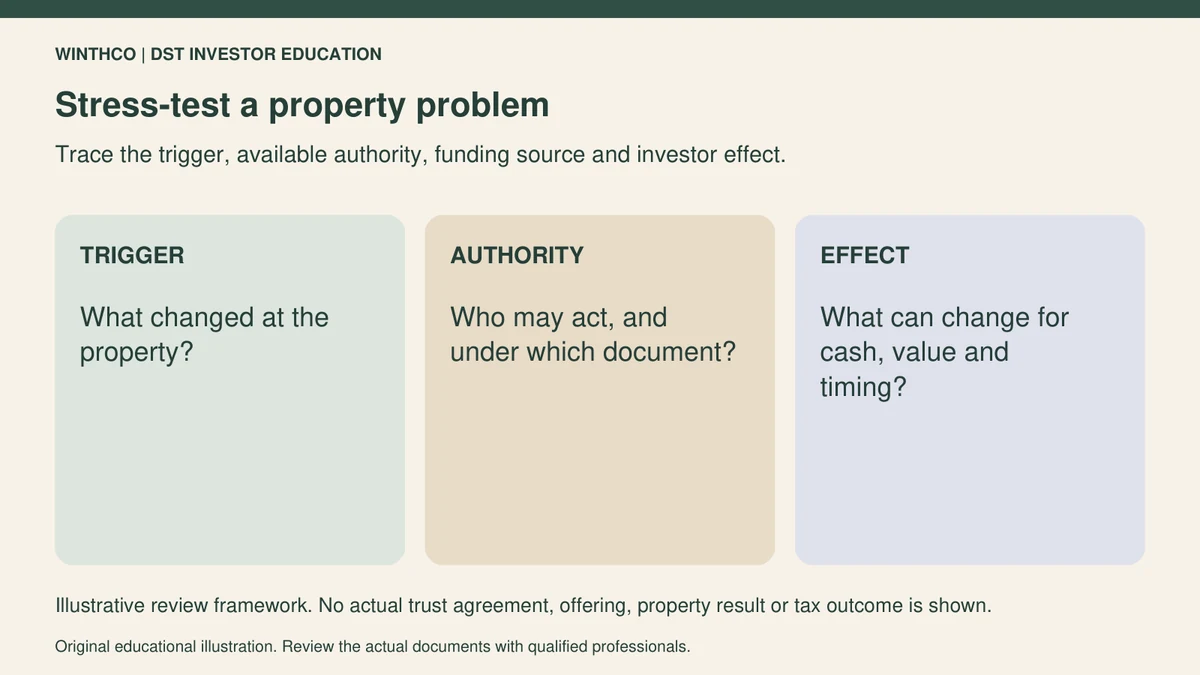
Use a scenario rather than a slogan. Suppose a major tenant fails while repairs and debt payments continue. This is hypothetical, not an actual offering. Ask which party controls the lease response, which reserves are available, whether insurance applies, what the lender can require and what event could trigger a different ownership or management structure. Then ask how each step could affect distributions, value and exit timing.
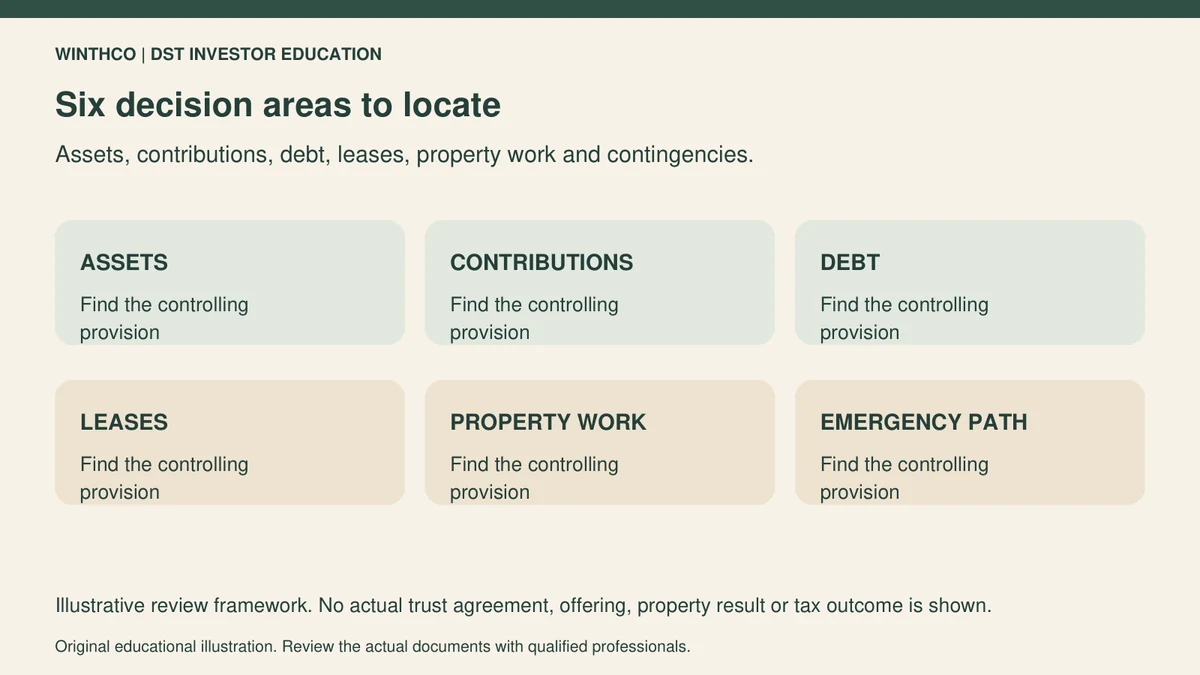
Read the private placement memorandum, trust agreement, property-management agreement, master lease if applicable, loan documents, tax opinion and subscription materials together. Locate the sections addressing additional contributions, leases, debt, property changes, reserves, sale authority and termination. Winthco's DST evaluation framework can organize the broader review, but the offered documents control.
If the materials describe a springing LLC or another emergency structure, ask what event activates it, who decides, which powers change and what tax reporting may follow. Do not assume a contingency creates money, avoids foreclosure, preserves Section 1031 treatment or prevents loss. Tax and legal professionals should review the actual mechanism rather than inferring consequences from its name.
Compare responsibility with capacity. A master tenant or affiliate may be assigned an expense or operating duty, but the assignment does not prove that party has unlimited resources. Ask about caps, termination rights, reimbursement, conflicts and available financial information. A sponsor's explanation can clarify a document; it should not substitute for the document or turn a projection into a guarantee.
WATCH & LEARN
Winthco Wealth Management provides general DST planning context. This video is not a legal interpretation of trustee powers, a review of any offering or a promise of exchange treatment or investment results. Original resource · Watch on YouTube ↗
Educational context only. The discussion does not establish the suitability, returns or tax treatment of an investment.
Trustee restrictions do not pause the exchange clock. Treasury regulations generally require written identification within 45 days and receipt of replacement property by the earlier of 180 days or the taxpayer's return due date, including extensions. Coordinate title, debt replacement, identification and funding with the qualified intermediary and tax adviser before any replacement closing. Cash retained or other boot can produce recognized gain.
A possible later Section 721 contribution is a separate partnership framework, not an exception to a DST trustee restriction and not an automatic next step. Ordinary REIT shares and operating-partnership units generally are not direct Section 1031 replacement real property. If offering materials discuss a future UPREIT transaction, review decision authority, conditions, valuation, unit rights, liquidity limits and tax consequences. A possibility is not a promise of conversion, cash access or a tax-free basis withdrawal.
Compare the choices at the seller level. Direct replacement property may offer more control and management responsibility. A DST may reduce direct duties but introduces sponsor, property, debt, fee, concentration and illiquidity risks. A separate 721 contribution may alter ownership and tax reporting under a partnership framework. None of these structures eliminates the need for legal, tax and investment review.
The sponsor should identify the controlling provisions and explain how property management, reserves, financing and emergency decisions work. The investment professional should help compare fees, conflicts, concentration, liquidity and fit with the investor's objectives. The attorney evaluates legal rights and documents, while the CPA assesses the investor's tax facts and reporting.
The qualified intermediary administers the exchange and safeguards exchange funds, but ordinarily does not underwrite the offered security or determine whether its property plan is sound. Keep those roles separate. A properly administered exchange does not establish that a DST is suitable, and an investment review does not extend an IRS deadline.
The SEC warns that private placements can provide less information than registered offerings, be highly illiquid and involve total loss. FINRA's concentration guidance also matters when the same property type, tenant, region or sponsor appears elsewhere in the household's holdings. Ask for missing evidence, but treat an unexplained restriction or contingency as unresolved rather than filling the gap with optimism.
DST interests are private, illiquid investments generally offered to accredited investors through a private placement memorandum. Distributions can change or stop, a property can lose value and investors can lose principal. Limited trustee authority does not remove sponsor execution, tenant, insurance, debt, market or tax-law risk.
Review the property transition alongside financial assets, 401(k)s, IRAs, retirement-income needs, accessible cash, beneficiary designations and estate coordination. If the DST cannot accept new money or quickly change strategy, household liquidity outside the investment becomes especially important. A hoped-for sale or future unit redemption should not be the only plan for an essential expense.
A Winthco wealth-management conversation can help organize those questions with the investor's tax, legal and exchange professionals. It should not assume that a rollover, transfer, DST or 721 transaction is appropriate. Compare services, costs and alternatives separately, and remember that retirement accounts are not themselves exchange proceeds. Use the prospect form to describe the property-sale stage and document question, not to transmit tax returns, account numbers or confidential offering files.
| Decision | Evidence to request | What to avoid assuming |
|---|---|---|
| Property exchange or new asset | Trust agreement and tax analysis | The trustee can freely reposition the portfolio |
| Additional investor money | Contribution prohibition and reserve plan | A funding need can always be solved with a capital call |
| Debt change | Loan terms, trustee authority and contingency provisions | Refinancing will be available when needed |
| Lease response | Lease, master-lease and insolvency provisions | A replacement tenant can be signed in every circumstance |
| Property modification | Permitted work, legal requirements and budgets | Any major repositioning can proceed |
| Emergency structure | Trigger, authority, funding and tax review | Activation prevents loss or preserves a tax result |
No. Revenue Ruling 2004-86 analyzes one specified arrangement. Review the offered trust agreement, tax opinion and other documents rather than assuming the name DST proves identical terms.
The ruling describes fixed financing and a trustee that cannot renegotiate the acquisition debt. The actual loan, trust and emergency provisions must be reviewed for the offered structure.
The ruling's trust cannot accept additional contributions, including money. That makes initial reserves, insurance, operating cash and documented contingencies important, but none is guaranteed to cover every cost.
The ruling restricts lease renegotiation and new tenants, with a stated exception tied to the tenant's bankruptcy or insolvency. Do not generalize beyond the actual documents and facts.
No. Limits can reduce flexibility and do not prevent property, tenant, debt, sponsor, fee, liquidity, tax or loss-of-principal risks.
No. A Section 721 contribution is a separate partnership framework with its own conditions, rights, restrictions and tax consequences. It is not automatic and does not guarantee liquidity.
Use qualified legal and tax professionals for the actual documents and transaction. The investment professional can help compare risks and fit, while the qualified intermediary administers the exchange rather than underwriting the DST.
Sources checked October 21, 2026. This article explains general concepts; your facts and the applicable documents control.
Winthco DST services · Winthco evaluation overview · Editorial standards
DST investment due diligence
Review who owes rent in a DST master lease, what supports payment, and how lease risks fit a property sale, 1031 exchange and retirement plan.
Read guide →DST due diligence
Review DST loan maturity, balloon payments and exit assumptions before exchanging a rental. Prepare questions about debt and household liquidity.
Read guide →DST due diligence
Learn why a 1031 DST may restrict capital calls, how a property funding shortfall can still affect investors, and what documents to review.
Read guide →Explore Winthco’s main DST article collection
Share your timeline and investment range. A Winthco team member will follow up with you.