Local real estate planning
Moorpark DST advisor and 1031 exchange guide
Plan a Moorpark property sale, compare DST and separate 721 options, and connect a potential 1031 exchange with retirement and household liquidity.
Read guide →
Home / Learning center / Local real estate planning
Local real estate planning
Winthco Wealth Management · Updated October 16, 2026
A Fillmore property owner considering a DST should start with sale preparation, a qualified real estate broker and early exchange planning. Evaluate a qualifying DST interest and any separate 721 UPREIT proposal against the actual documents, fees and risks. Keep the decision connected to accessible cash, retirement income and existing financial assets.
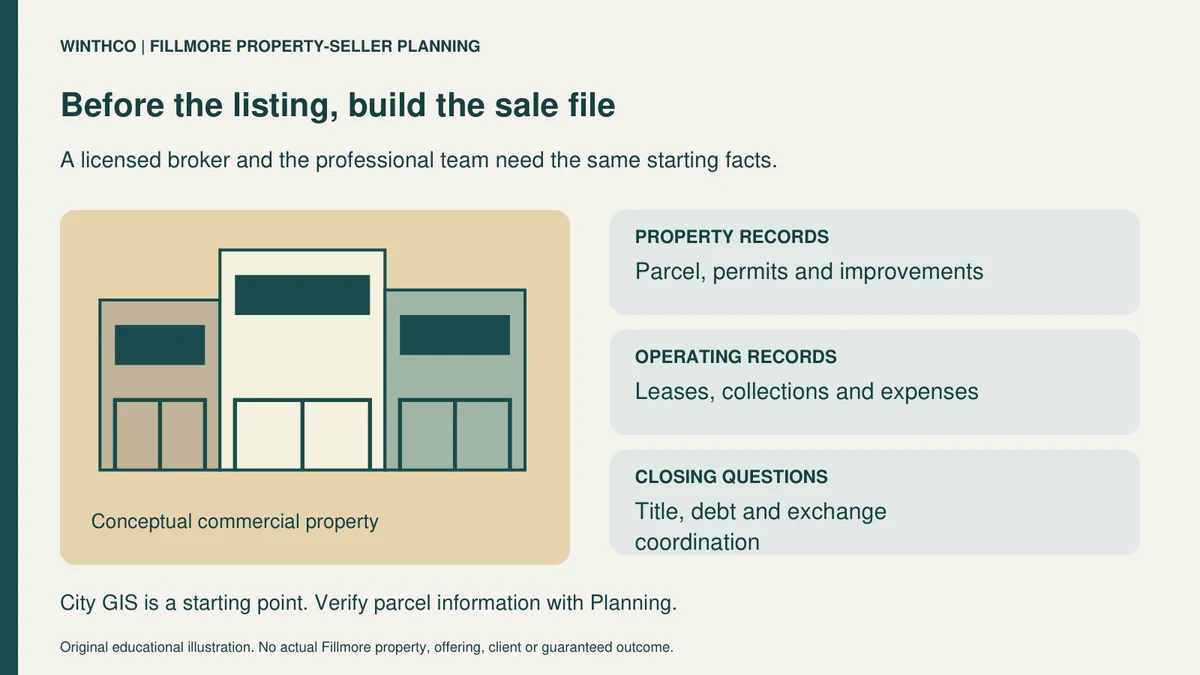
Begin by explaining why you want to sell: fewer management duties, a different property exposure, more accessible money or a simpler retirement plan. Those goals can lead to different decisions. Interview appropriately licensed realtors or commercial brokers about relevant property-type experience, valuation evidence, marketing, compensation and sale readiness. Verify the license through California's Department of Real Estate rather than treating a title or advertisement as proof.
Build a preliminary sale file with title, leases, collections, improvement records, loan information and insurance. Involve the CPA, attorney and qualified intermediary before closing or receiving proceeds if a deferred exchange is contemplated. Winthco's tax-professional questions for a DST sale plan can help organize the tax discussion. The broker handles the sale role; a DST advisor does not replace independent tax, legal or exchange advice.
Share your timeline and investment range. A Winthco team member will follow up with you.
Fillmore is an incorporated Ventura County city. Confirm the property's actual jurisdiction, not just its mailing address, before relying on city procedures. The city's GIS public viewer offers parcel, zoning and fire-hazard information for properties within city limits and explicitly asks users to verify information with Planning. Use it to identify questions for the broker and city staff, not as a parcel-specific approval or an insurance quotation.
For a downtown commercial building or a property marketed partly on redevelopment potential, ask which adopted plans actually apply. Fillmore publishes Downtown Specific Plan materials, a Business Park Master Plan and Ventura Street Design Guidelines. Their presence online does not establish that a particular use or alteration is allowed. Ask Building and Safety about the relevant permit record and unresolved work before promising a buyer a use, conversion or closing date.
Keep the local review practical: what is being sold, what records support the description, and who must resolve discrepancies? A storefront with an undocumented alteration presents different preparation questions from a rental with complete records. Assemble the evidence before setting a firm exchange schedule. This guide does not claim that every Fillmore sale requires a special municipal pre-sale inspection.
Section 1031 can defer eligible gain when qualifying business or investment real property is exchanged for qualifying replacement real property and applicable requirements are satisfied. It can allow an owner to retain real estate exposure while changing location, property type or management responsibility. Deferral is not tax elimination. Compare it with keeping the property, hiring management, a taxable sale or a partial exchange.
Under the standard deferred-exchange rules, identify replacement property within 45 days after transferring the relinquished property and receive it by the earlier of 180 days or the applicable return due date, including extensions. The qualified intermediary and attorney should address the written arrangements and restrictions on receiving proceeds under Treasury Regulation 1.1031(k)-1. Do not close first and assume an exchange can be reconstructed later.
Have the CPA reconcile ownership, basis, depreciation, liabilities, exchange expenses and any cash retained. Cash or nonqualifying property can create currently recognized gain. For California property exchanged for out-of-state replacement real property, the FTB generally requires Form 3840 reporting in the exchange year and annually until the California-source deferred gain or loss is recognized. Buying outside California does not by itself erase that reporting obligation.
Discuss your DST questions with Winthco →
A Delaware statutory trust is a legal structure, not a promise of a particular tax result. Revenue Ruling 2004-86 addresses a specified trust arrangement whose beneficial interests are treated as interests in the underlying real property for Section 1031 purposes. Ask tax counsel whether the actual offering and your transaction satisfy the relevant requirements. Not every trust interest qualifies merely because its name includes DST.
For a seller leaving a directly managed Fillmore rental or commercial building, a DST may reduce hands-on responsibility. Professional management does not mean the investor has eliminated property risk. You generally give up control over daily decisions, leasing and the timing of a property sale. Consider whether that trade is acceptable independently of any exchange deadline or projected distribution.
Use Winthco's steps for buying a DST interest to frame the acquisition conversation, then request the current private placement memorandum and supporting documents. Private DST offerings are generally limited to accredited investors. Review eligibility separately from suitability. Ask how subscription acceptance, funding and the actual replacement-property description will be coordinated with the QI; an expression of interest is not proof that an acquisition is complete.
Review property operations, tenant exposure, debt maturity, sponsor conflicts, reserves and each layer of compensation. Compare the sponsor's assumptions with available evidence. Ask how a rent interruption, major expense or delayed sale could affect distributions and principal. The SEC warns that private placements can involve limited information, resale restrictions and loss of the entire investment. Tax eligibility does not validate an offering's economics.
An UPREIT uses an operating partnership that can hold real estate. A proposed Section 721 contribution generally involves contributing property in exchange for partnership interests, subject to the actual structure and tax rules. IRS Publication 541 describes the general nonrecognition framework and exceptions. Have the CPA and attorney evaluate liabilities, cash movements and any related transactions rather than relying on the transaction's marketing label.
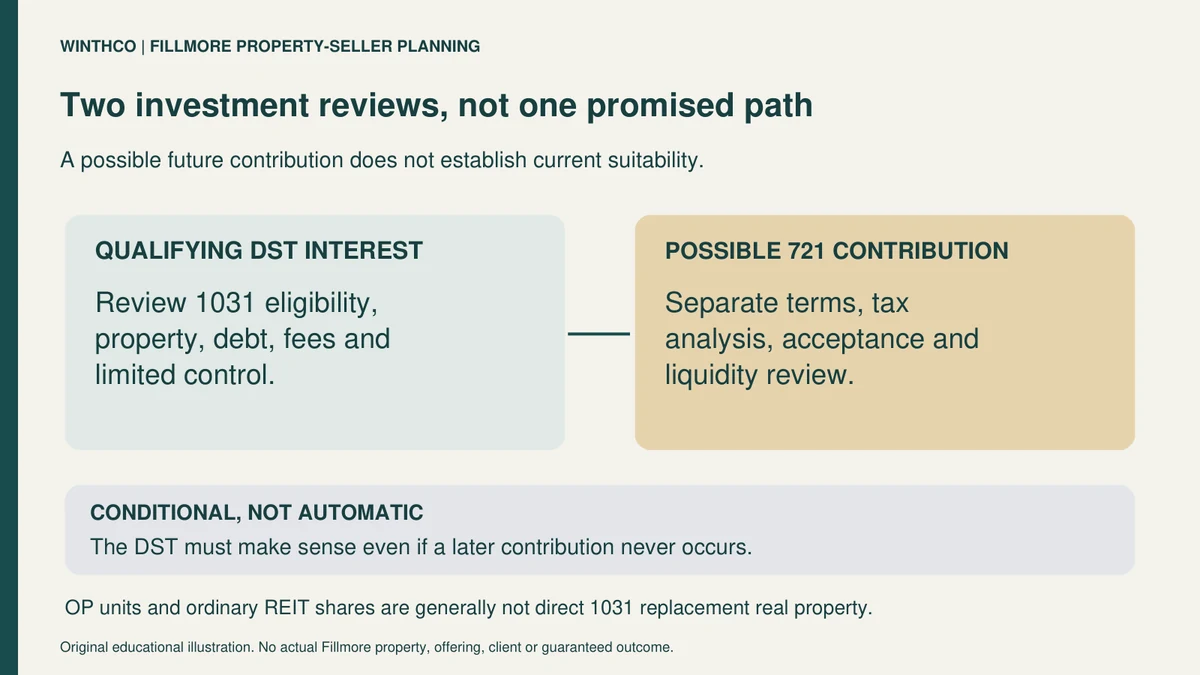
The differences between DST interests and REIT ownership matter because these are not interchangeable replacement assets. Operating-partnership units and ordinary REIT shares generally are not direct Section 1031 replacement real property. A possible later DST-to-UPREIT transaction needs a separate review and may never happen. Do not assume every DST contains that option or that a future counterparty must accept the property.
Ask whether any later contribution is optional, mandatory under specified circumstances or merely contemplated. Identify who controls the decision, what fees may apply and how the investor receives information. Then evaluate the current DST as though that later event does not occur. A strategy that only makes sense if an uncertain conversion happens needs further scrutiny before you commit.
If OP units may eventually be received, examine lockups, redemption conditions, issuer discretion, valuation and potential tax consequences. A broader portfolio does not remove leverage, concentration or liquidity risk. Later redemption or conversion may recognize gain; FIFO does not guarantee tax-free withdrawals of basis. Any tax-protection provisions should be explained by counsel, including their duration, exceptions and remedies.
WATCH & LEARN
Accruit explains DSTs as potential replacement property in a 1031 exchange. This is general background, not Fillmore municipal guidance or an assessment of any offering. Potential income and diversification are not guaranteed. Accruit is the third-party creator, not a Winthco representative. Original resource · Watch on YouTube ↗
Educational context only. The discussion does not establish the suitability, returns or tax treatment of an investment.
Consider a hypothetical owner preparing to sell a leased downtown building. The broker wants the lease file and permit history clarified before marketing. The owner wants fewer tenant calls but also needs accessible retirement reserves. These are invented planning facts, not a Winthco client story, local market forecast or current investment offering.
The first comparison is between retaining the building with management, selling and paying applicable tax, and pursuing a qualifying exchange. If a DST remains under consideration, compare the interest's fees, debt, control and holding-period uncertainty with the household plan. If a possible 721 proposal is presented, place it in a separate column with its own conditions. Do not combine all potential benefits into one assumed outcome.
Ask the professionals to document what would change the decision: unresolved property records, an unsuitable replacement, insufficient accessible cash or unacceptable partnership terms. Set a review date before closing and another before committing to replacement property. The useful result is a clear decision process, not a recommendation that every Fillmore owner sell or reinvest the same way.
DST distributions may change or stop, and principal can be lost. Review illiquidity, limited control, sponsor and property risk, debt, fees, exit uncertainty and tax-law changes. A projected holding period is not a guaranteed redemption date. Ask how all upfront and ongoing compensation affects the investment and whether the professional has relationships that create conflicts.
FINRA explains that concentration can arise across holdings with shared industries, geographic exposures or illiquidity. Several DST names do not necessarily create a diversified household portfolio. Review remaining property, business interests and financial accounts together. Diversification cannot prevent every loss. Verify the relevant professional registrations and ask for the scope of each engagement; a financial advisor is not automatically a CPA or attorney.
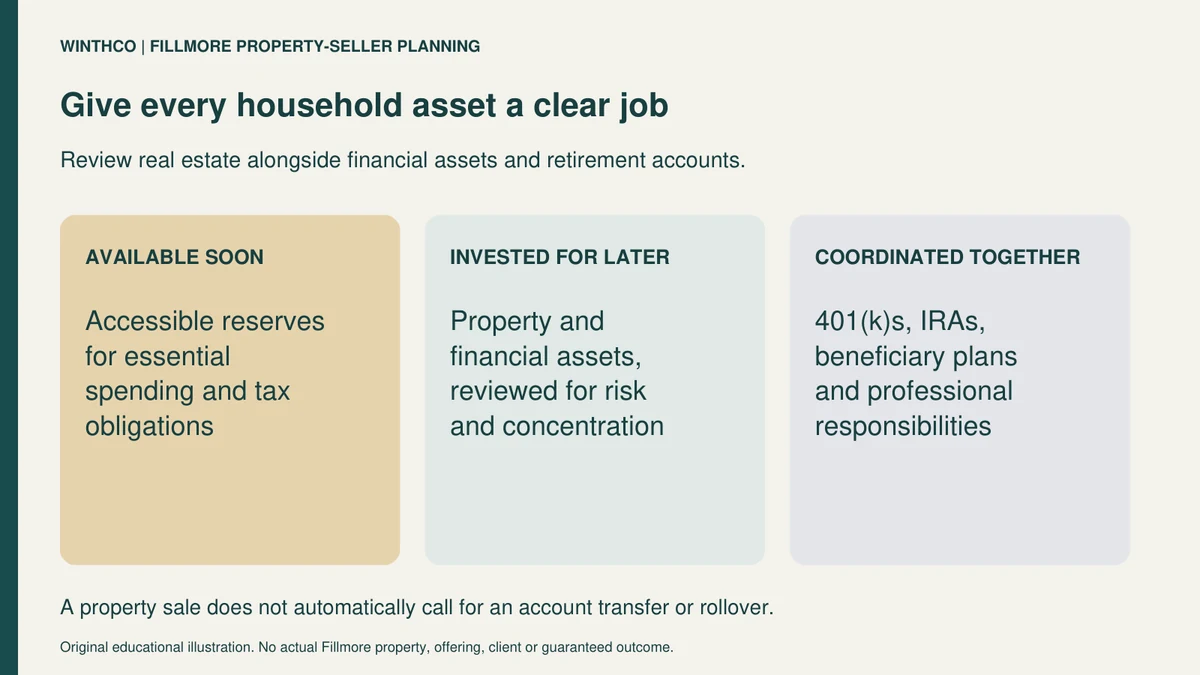
Bring the real estate choice into a discussion of existing financial assets, 401(k)s, IRAs, retirement-income needs and accessible cash. Winthco describes financial-advising, wealth-management and retirement-planning services on its main website. Review the proposed real estate exposure beside the rest of the household, including spending that cannot wait for a property sale or an uncertain distribution.
Coordinate beneficiary and estate questions with counsel and tax projections with the CPA. Retirement accounts are not 1031 exchange proceeds. A property sale does not automatically make a rollover, transfer or new advisory relationship appropriate; compare relevant account options, costs and services independently. Winthco lists its office at 1871 Tapo Street in Simi Valley, not Fillmore. Use the prospect form to discuss your sale timeline, and request a verified secure channel before sharing confidential records.
Map of Fillmore, California, for geographic context only. Not a Winthco office, property boundary, hazard determination or zoning approval. Confirm parcel jurisdiction and requirements with the relevant agencies.
| Decision | Evidence to request | What to avoid assuming |
|---|---|---|
| Licensed property broker | Valuation, marketing, sale readiness and closing coordination | Investment suitability or a tax opinion |
| Qualified intermediary | Exchange documentation, funds and acquisition coordination | A guarantee that the replacement is appropriate |
| CPA and attorney | Basis, liabilities, reporting, entity and legal questions | A promise that every proposed step is tax-free |
| DST / financial advisor | Offering review, compensation, portfolio fit and retirement planning | A substitute for independent legal or tax advice |
The verified office listed on Winthco’s contact page is in Simi Valley. This guide and its city map provide Fillmore planning context, not a claim of a Fillmore office.
Interview appropriately licensed agents or commercial brokers with relevant property-type experience. Ask about valuation evidence, marketing, fees and document preparation, and verify the license with California DRE.
Do not treat the viewer as an approval. The city asks users to verify GIS information with its Planning Department; parcel-specific plans and permit records require further review.
Potentially, when the relinquished and replacement property and transaction meet the applicable requirements. Coordinate before closing with the QI, CPA, attorney and investment professional.
Not necessarily. FTB Form 3840 generally tracks California-source deferred gain from California real property exchanged for out-of-state real property, including annual reporting until recognition.
No. Review the actual documents and conditions. OP units and ordinary REIT shares generally are not direct 1031 replacement property, and later redemptions can have tax consequences.
Sources checked October 16, 2026. This article explains general concepts; your facts and the applicable documents control.
Winthco DST services · Winthco evaluation overview · Editorial standards
Local real estate planning
Plan a Moorpark property sale, compare DST and separate 721 options, and connect a potential 1031 exchange with retirement and household liquidity.
Read guide →Property sale planning
Prepare a rental sale with broker questions, 1031 timing, DST and separate 721 review, and retirement planning before committing proceeds.
Read guide →1031 exchange planning
Can you keep cash and use a DST in a partial 1031 exchange? Review boot, debt, timing and retirement liquidity before selling your rental.
Read guide →Explore Winthco’s main DST article collection
Share your timeline and investment range. A Winthco team member will follow up with you.