1031 exchange planning
1031 exchange identification rules for DSTs
Understand the three-property, 200 percent and 95 percent identification rules before naming DST replacement property.
Read guide →
Home / Learning center / Local real estate planning
Local real estate planning
Winthco Wealth Management · Updated October 13, 2026
A Moorpark investment-property sale should begin with a licensed broker, a clear sale plan and early tax, legal and exchange coordination. A qualifying DST may reduce direct management while deferring eligible gain, but fees, liquidity, control and any separate 721 contribution must fit the household plan.
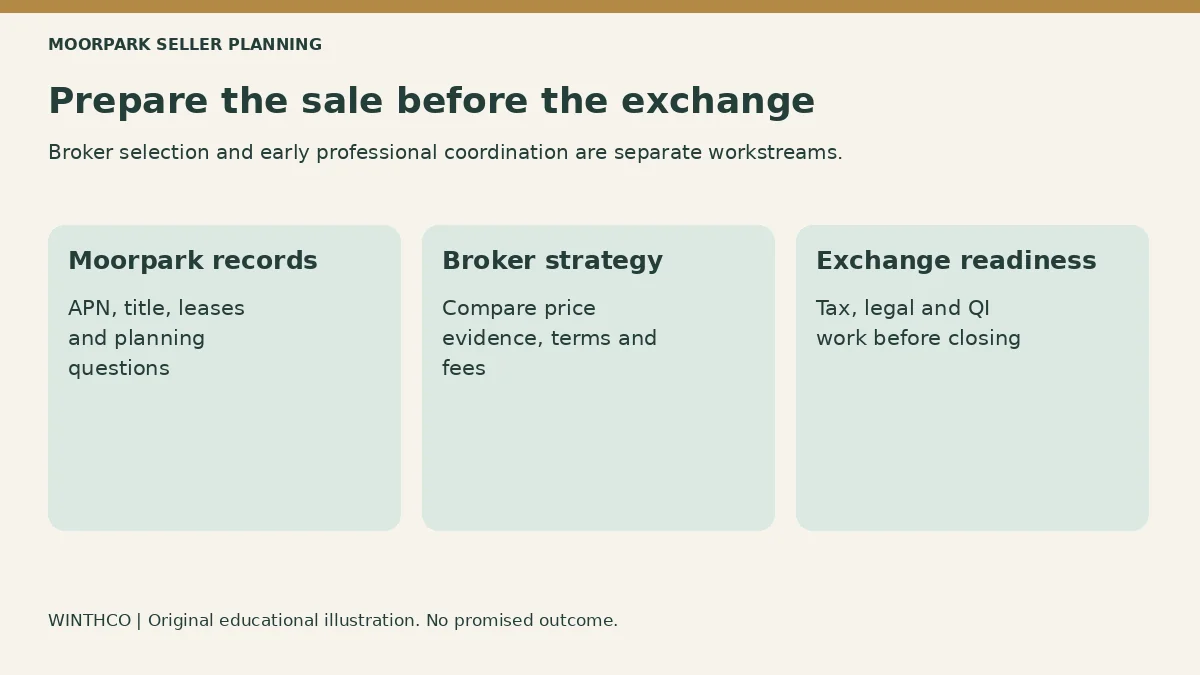
Interview a licensed realtor or commercial broker with relevant property-type experience. Ask how occupied rentals, tenant access, lease terms and deferred repairs affect valuation and marketing. Compare the proposed fee agreement, buyer screening and closing assumptions. Verify the license through California's Department of Real Estate. This guide does not claim that Winthco operates a real estate brokerage or maintains a verified Moorpark referral network.
Build a compact sale file with the APN, title, leases, operating statements, debt payoff and improvement records. Moorpark is an incorporated Ventura County city. Use the City's Planning resources for zoning and permit questions and the Ventura County Assessor for assessment records. Resolve discrepancies before promising a use or expansion to a buyer. The map below identifies the service area, not a Winthco office or an investment property.
Share your timeline and investment range. A Winthco team member will follow up with you.
Bring the CPA, attorney and qualified intermediary into the process before closing or receipt of sale proceeds. The CPA evaluates investment use, basis, depreciation, liabilities and potential recognized gain. The attorney reviews title, entity authority and agreements. The intermediary administers the deferred exchange. The listing broker and financial advisor do not automatically perform these other roles.
Section 1031 may defer eligible gain when its requirements are met, allowing reinvestment in qualifying replacement real estate. Deferral is not tax elimination. Signed written identification generally is due within 45 days after transfer; acquisition is due by the earlier of 180 days or the applicable federal return due date, including extensions. Both periods run concurrently. Confirm the dates, identification rules and fund restrictions with the professionals responsible.
Compare the taxable-sale and partial-exchange alternatives before allocating every dollar. Cash retained and net debt relief can affect recognized gain, so sale price alone is not an exchange budget. California Form 3840 may be required when California property is exchanged for qualifying out-of-state property and California-source gain is deferred. Have the CPA plan ongoing reporting rather than assume an out-of-state DST ends California obligations.
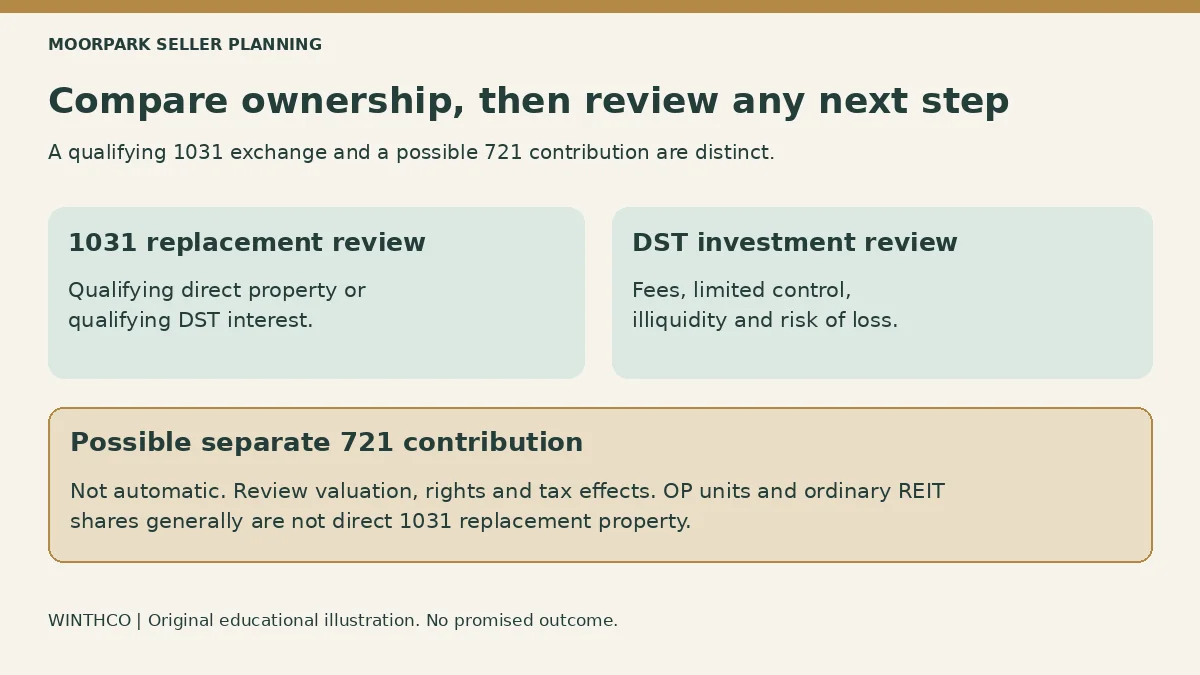
A DST may reduce the owner's direct responsibility for tenant calls and property operations. In return, an investor generally accepts limited control over management and exit decisions. Winthco's Delaware statutory trust advisor overview can frame the investment discussion, but the actual trust agreement, offering memorandum and subscription documents determine the rights being purchased. A marketing summary is not a substitute for those documents.
Revenue Ruling 2004-86 addresses a particular trust arrangement whose interests are treated as real property for federal tax purposes. Qualification requires review of the actual structure and facts. Many DST interests are privately offered securities generally limited to accredited investors. Eligibility and tax treatment do not establish that a particular investment is suitable for an owner seeking retirement income or less management work.
Start the property review with occupancy, tenant financial strength, lease expirations and capital needs. Ask how local supply, operating expenses and insurance could affect the property. The underlying real estate may be far from Moorpark, so familiarity with the sold property is not knowledge of the replacement market. Request evidence for important assumptions and record which questions remain unanswered.
Discuss your DST questions with Winthco →
Direct ownership can preserve meaningful authority over repairs, tenant selection and disposition, but it retains operational work or the cost of hired management. A DST shifts much of that authority to the sponsor and managers under the documents. A taxable sale may provide more flexibility in using cash, while producing current tax costs. None of these choices is automatically superior simply because the owner wants fewer obligations.
Create a comparison using capital committed, fees, remaining liquidity and decision rights. For a DST, separate gross property cash flow from distributions after expenses, debt service and reserves. Ask whether distributions may include sources other than current operating income. The amount or frequency of a projected payment should not be treated as an enforceable household paycheck. Distributions can decline or stop.
Request all compensation and related-party arrangements. Consider acquisition and selling costs, ongoing fees, financing expenses and disposition charges together. Ask who receives each payment and whether the fee continues when performance weakens. A proposal that emphasizes one low charge can still have meaningful costs elsewhere. Read how reserves may be used and what happens if property needs exceed the available resources.
Review leverage, loan maturity, rate structure and the consequences of a covenant breach. A property can face financing pressure even when rents are being collected. Understand the trustee's limits and any mechanisms described for unusual operating problems. Ask what the governing documents permit if market conditions change, rather than assuming management can refinance or alter the business plan whenever desirable.
Evaluate the sponsor's organization, reporting, financial resources and conflicts without interpreting past projects as a promise. Ask who selects service providers, whether affiliates participate in transactions and how investors learn about adverse events. Compare the property-level downside case with the sponsor's stated plan. A strong presentation cannot remove operating, debt, legal or market risks, including loss of principal.
Plan for a longer hold than the illustrated target. A DST investor may have no practical way to sell an interest promptly or force a property sale. An emergency medical expense, family obligation or move should not depend on a projected liquidation date. Review concentration across existing rentals and other investments, including shared sponsor, tenant and geographic exposures that multiple DST subscriptions might leave unchanged.
WATCH & LEARN
Accruit discusses the substantially-same-property issue when an exchanger acquires less than all of an identified fractional interest, including a DST interest. This third-party video is educational, not a Winthco endorsement; the Treasury regulation, actual identification and retained professionals control. Original resource · Watch on YouTube ↗
Educational context only. The discussion does not establish the suitability, returns or tax treatment of an investment.
A contemplated UPREIT transaction involves contributing property to an operating partnership for partnership interests, subject to a separate Section 721 analysis. Winthco's 721 UPREIT planning overview can introduce the concept. IRS Publication 541 explains general partnership contribution rules and exceptions. Neither source substitutes for review of contribution terms, liabilities, built-in gain and the owner's actual circumstances.
Ask who can initiate the transaction, whether an investor has an election, how contributed property is valued and which fees apply. Request the proposed partnership agreement, redemption restrictions, lockups and any tax-protection provisions. Evaluate what happens if the anticipated transaction never occurs. A DST should not be justified solely by an assumed next stage that is outside the investor's control.
Operating-partnership units and ordinary REIT shares generally do not qualify as direct Section 1031 replacement real property. Do not treat a possible later contribution as interchangeable with the initial exchange. A future redemption or conversion may trigger taxable consequences. Choosing the order in which units are redeemed does not itself guarantee tax-free withdrawals of basis or unrestricted access to cash.
Suppose a Moorpark owner is preparing to sell a small leased commercial property and wants fewer tenant responsibilities. A buyer asks about an older building alteration, while the owner also needs cash for retirement spending. The broker coordinates the property records and sale disclosures; planning staff, inspections and legal advice resolve use questions. The CPA calculates the tax alternatives before the owner commits the proceeds.
The investment review compares direct replacement property, a DST and a taxable sale using a reduced-distribution scenario. The owner keeps near-term spending separate from capital that could remain illiquid. If a future 721 path is mentioned, its rights and tax effects receive an independent review. This hypothetical illustrates a process; it describes no client, available offering, forecast or promised result.
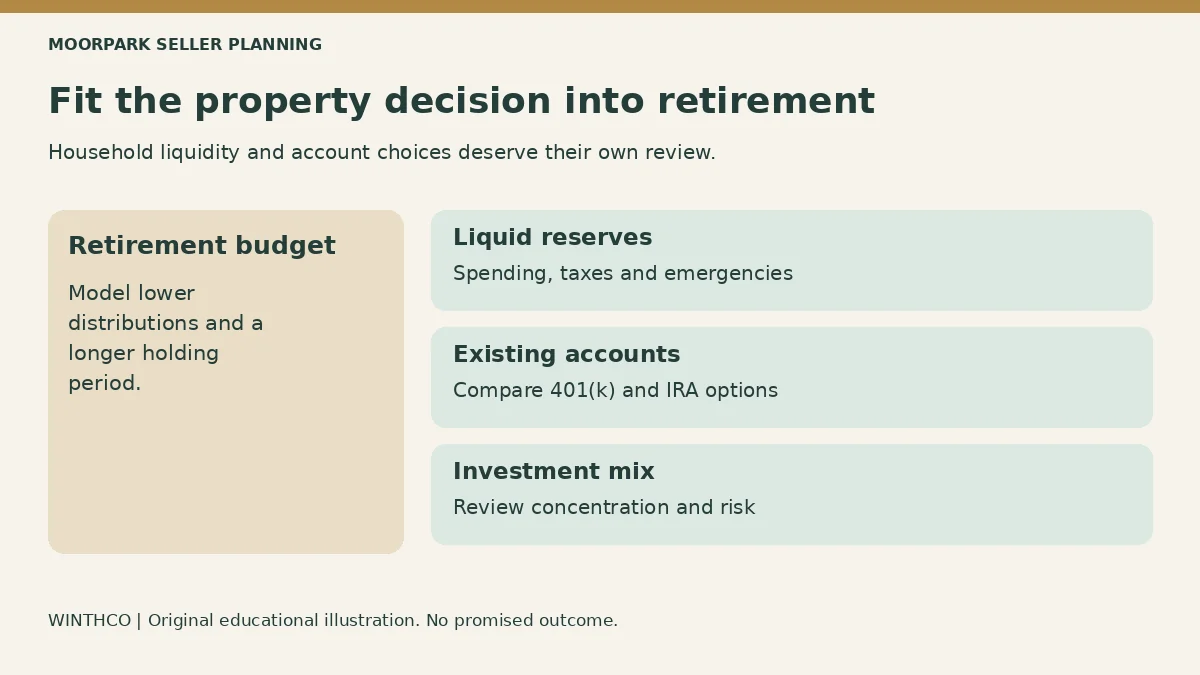
Winthco's published services include financial advising, wealth management and retirement planning. A discussion can inventory existing financial assets, 401(k)s, IRAs, expected income and future spending alongside the property decision. Review allocation and liquid reserves before selecting an investment. Retirement accounts have their own rules and are not interchangeable with personal exchange proceeds.
If a rollover is considered, compare retaining an eligible employer plan, another eligible plan when available and an IRA using actual costs, services, investment choices and protections. Do not assume a transfer to Winthco is appropriate. Coordinate beneficiary designations and estate documents with legal counsel and review tax reporting with the CPA. Winthco's DST tax reporting resource can help prepare questions for that separate professional work.
Bring a property summary and a list of goals to the initial conversation; keep sensitive financial documents out of a general contact message. The prospect form starts an inquiry, not an investment commitment, exchange agreement or guaranteed allocation. This guide uses AI-assisted drafting and Winthco organization attribution. Sources were reviewed October 13, 2026, and the only office claimed by this campaign remains the verified Simi Valley location.
This map identifies Moorpark as a service area only. It does not claim a Winthco office, client location, DST property or investment offering in the city.
| Decision | Evidence to request | What to avoid assuming |
|---|---|---|
| Listing strategy | Comparable sales, marketing plan and written fees | A high suggested price proves a better outcome |
| Exchange readiness | QI agreement, tax analysis and deadline calendar | The process can be added after receipt of proceeds |
| DST selection | Offering documents and downside cases | An identified investment is reserved or suitable |
| Possible 721 contribution | Valuation, rights, tax review and exit limits | Partnership units are direct 1031 replacement property |
| Retirement coordination | Account options, fees and household cash needs | Every account should be transferred |
No Moorpark office is claimed in this guide. Winthco's verified office is at 1871 Tapo Street in Simi Valley. The map identifies only the Moorpark service area.
No. Qualifying use, ownership, replacement property, timing and the exchange procedure all matter. Ask your tax and legal professionals to review the facts.
Request written explanations of compensation, alternatives, property and sponsor risks, debt, liquidity, control and exit rights. Verify registrations and separate tax and legal responsibilities.
Do not assume so. DST interests can be highly illiquid and subject to transfer restrictions, with no assured secondary market or investor-controlled exit.
No. Availability, timing, control and tax consequences depend on separate documents and facts. Operating-partnership units generally are not direct 1031 replacement property.
No. Compare eligible account options, costs, investments and services independently of the property transaction. A rollover is not an automatic part of an exchange.
Sources checked October 13, 2026. This article explains general concepts; your facts and the applicable documents control.
Winthco DST services · Winthco evaluation overview · Editorial standards
1031 exchange planning
Understand the three-property, 200 percent and 95 percent identification rules before naming DST replacement property.
Read guide →Local real estate planning
A practical Simi Valley guide to Delaware statutory trust advisors, 721 UPREIT planning, CPA coordination, California reporting and investment risks.
Read guide →Local real estate planning
A Thousand Oaks guide to DST, 1031 exchange and 721 UPREIT planning, with local records, professional roles, deadlines, fees and risks.
Read guide →Explore Winthco’s main DST article collection
Share your timeline and investment range. A Winthco team member will follow up with you.