Investor decision-making
How to choose a DST advisor: 12 questions to ask
Use practical questions about registration, compensation, due diligence, coordination and follow-up when evaluating a DST advisor.
Read guide →
Home / Learning center / Local real estate planning
Local real estate planning
Winthco Wealth Management · Updated October 10, 2026
A Thousand Oaks property owner considering a Delaware statutory trust should coordinate four separate jobs before selling: investment analysis, tax advice, legal review and qualified-intermediary administration. Local property records can improve the sale assumptions, while the DST offering documents, household liquidity needs and Section 1031 deadlines determine whether the strategy is workable.
A local rental, medical office, retail unit or small apartment building may carry years of tax history and deferred maintenance. Start by comparing continued ownership, professional property management, a taxable sale, a direct-property exchange and a DST replacement. The right comparison is based on your actual records and household plan, not on a general claim that one structure is easier.
Thousand Oaks is an incorporated California city in Ventura County, identified by Census GEOID 0678582. This guide discusses the city as a service area. Winthco has not claimed a Thousand Oaks office, and the map below does not identify a branch or investment property.
Share your timeline and investment range. A Winthco team member will follow up with you.
Before discussing investments, prepare a one-page property summary with title, current use, leases, debt, estimated closing date and cash you may need after the sale. That document helps each professional see the same facts and exposes questions that could affect timing.
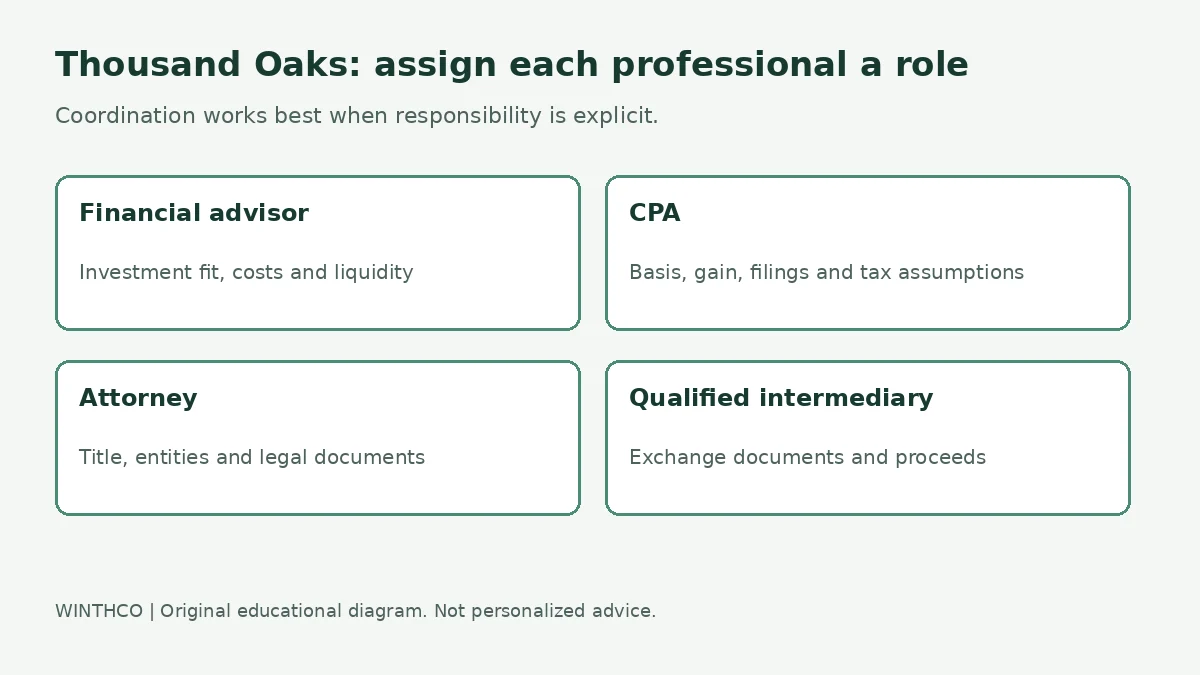
A financial advisor in Thousand Oaks should address investment fit, portfolio concentration, liquidity, compensation and reasonable alternatives. If a DST security is being considered, verify the professional and firm through FINRA BrokerCheck and ask for written disclosure of fees and conflicts. The Delaware statutory trust advisor overview offers questions to frame that discussion.
A CPA analyzes adjusted basis, depreciation, liabilities, possible taxable cash and federal or state reporting. A DST CPA search should lead to credential and engagement questions, not an assumption that an investment advisor supplies tax services. Winthco's DST tax reporting resource can help identify topics to discuss, but the person you retain must confirm the calculations for your transaction.
An attorney reviews title, entity documents, contracts and legal rights. A qualified intermediary follows its exchange agreement, receives exchange proceeds and administers the deferred-exchange process. Neither the intermediary nor the investment representative should be treated as a substitute for the other professionals.
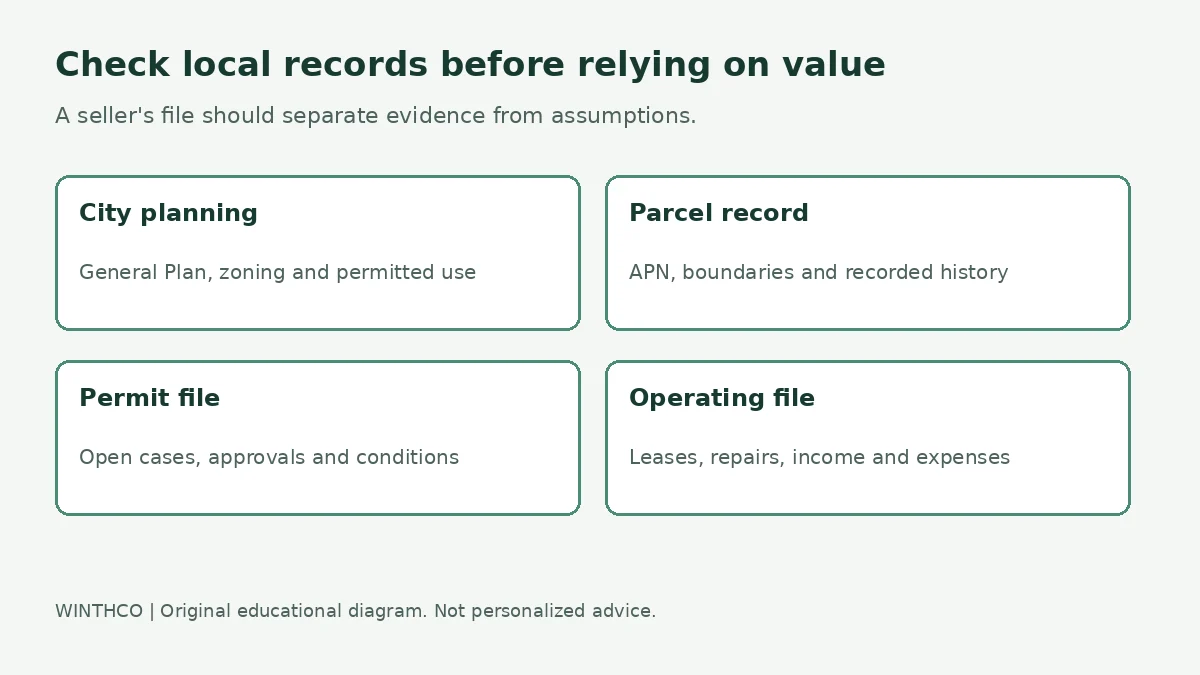
The City of Thousand Oaks adopted its 2045 General Plan in December 2023 and provides an interactive map for land-use designations. The city is also updating its zoning code and map to align with that plan. For a specific parcel, confirm the current zoning, overlays, specific-plan rules and permitted use with the Planning Division rather than relying on an old listing or a neighboring property.
The city's official GIS includes zoning and parcel layers. Ventura County Citizen Access provides public land-use permitting information, including case status and documents available through that system. These tools can reveal questions for the broker, attorney or city staff, but they do not replace a title report, survey, inspection or written planning determination.
Build a seller's file with the assessor parcel number, leases, rent roll, permits, major repairs and any code or entitlement questions. If the asking price assumes expansion, conversion or redevelopment, label that assumption and identify the evidence supporting it. A clean file can make the sale analysis more credible even when the ultimate answer is that additional review is needed.
Discuss your DST questions with Winthco →
Section 1031 generally applies to real property held for productive use in a trade or business or for investment. A main home and property held primarily for sale generally do not qualify under the same rules. Mixed use, a recent change in use and entity ownership require individual tax and legal analysis.
The IRS Form 8824 instructions state that replacement property must be identified within 45 days after the relinquished property transfers. Receipt must occur within 180 days or by the federal return due date, including extensions, whichever is earlier. These are outside limits, not targets, and the return-date rule can shorten the completion period.
Engage the qualified intermediary before the sale closes and before receiving proceeds. Confirm the taxpayer, title, written identification procedure and wire instructions independently. Have the CPA model debt relief and cash retained, since those items can affect recognized gain. Leave time for offering review and funding because naming a DST interest does not reserve capacity or complete an investment.
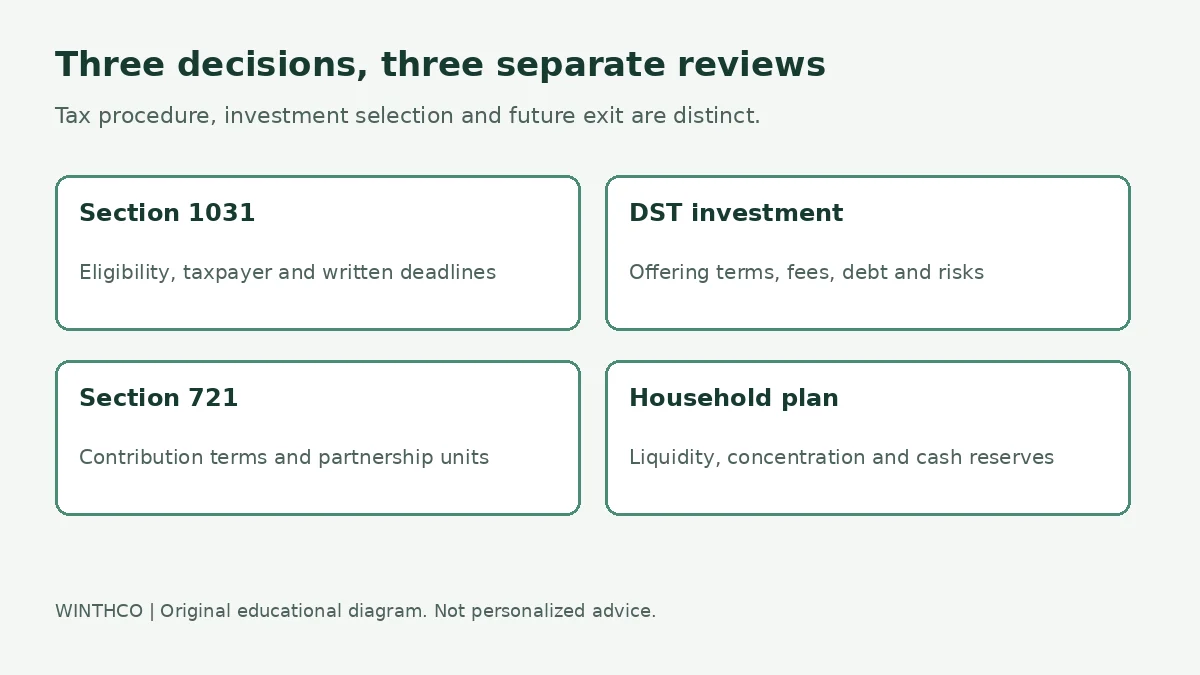
IRS Revenue Ruling 2004-86 describes a particular trust arrangement whose beneficial interests can be treated as interests in real property for Section 1031. The ruling does not approve every DST, establish investment quality or guarantee tax treatment for a purchaser. Compare the actual trust agreement and private placement memorandum with the ruling and your facts.
A DST investor generally gives up direct control in exchange for passive beneficial ownership under the trust documents. Review the sponsor, property, tenants, debt, reserves, fees, conflicts, distribution assumptions and exit provisions. Ask how decisions are made if occupancy falls, financing becomes costly or a sale takes longer than projected.
A 721 UPREIT contribution is a separate partnership transaction. A 721 UPREIT planning overview can provide background, but the contribution agreement determines valuation, lockups, conversion rights and redemption limits. Ask a 721 UPREIT advisor to explain who can initiate a contribution and what choices remain afterward. Do not assume partnership units can later be exchanged for another property under Section 1031.
WATCH & LEARN
Origin Investments' Mike O'Shea explains the DST structure and its use as replacement property. This third-party video is educational background, not a Winthco endorsement; current IRS guidance, offering documents and the investor's advisers control. Original resource · Watch on YouTube ↗
Educational context only. The discussion does not establish the suitability, returns or tax treatment of an investment.
California Franchise Tax Board Form 3840 applies when California real property is exchanged for qualifying replacement property outside California. The 2025 instructions say the form is generally filed for the exchange year and each later year until the California-source deferred gain or loss is recognized. A DST holding property in another state can therefore create continuing recordkeeping for a Thousand Oaks seller.
Ask the CPA to identify the location of each underlying property, allocate the California deferred gain as required and preserve prior Forms 8824 and 3840. State income filing may also depend on where DST properties operate. Neither moving away from California nor using an out-of-state replacement automatically erases California-source deferred gain.
DST interests are commonly offered through private placements and may be available only to accredited investors. The SEC warns that private placements can provide limited disclosure, be difficult to resell and result in total loss. Accreditation is an eligibility standard, not evidence that an offering is suitable or that projected distributions will occur.
Request a complete use-of-proceeds and compensation schedule. Identify selling compensation, organizational and offering expenses, financing costs, reserves, property-level fees and any related-party arrangements. Compare projected distributions with expected property cash flow and ask whether reserves, borrowed funds or other sources could support payments. Fees reduce the capital working in the investment.
FINRA's concentration guidance notes that holdings can share the same real estate, geographic, tenant, sponsor or illiquidity risks even when they have different names. Include existing rentals, private real estate and future spending in the analysis. Keep adequate accessible assets for taxes, repairs, health costs and other needs because a DST interest may not provide a practical early exit.
Consider a hypothetical owner of a Thousand Oaks rental duplex who wants less tenant responsibility and expects a sale later this year. The property has a mortgage, several improvements and one unit with incomplete permit records. The first step is not choosing a DST. The owner should verify the local file, reconstruct basis and clarify the expected closing sequence.
The CPA compares a taxable sale, a full exchange and a partial exchange using the actual basis and debt. The attorney reviews title and the permit issue. The intermediary confirms the exchange setup and dates. The investment professional separates near-term cash needs from funds that could remain illiquid, then compares direct replacement property, a qualifying DST and continued ownership.
If a later UPREIT contribution is mentioned, it receives its own document review rather than being treated as automatic. The owner asks about valuation, timing, control, fees, unit liquidity and future tax choices. This scenario is educational and does not describe a client, a promised outcome or a recommendation.
Bring the property summary, title information, debt statement, leases, estimated sale proceeds, basis records and target closing date. List required cash reserves separately from funds available for a long-term investment. Ask each professional to write down open questions, deadlines and the person responsible for answering them.
Before authorizing a transaction, understand the offering documents, all compensation, debt terms, concentration, liquidity limits and plausible downside outcomes. A contact-form submission begins a conversation; it does not reserve an offering, create a tax or legal engagement, or complete an exchange. Use secure channels for returns, account statements and identification documents. This guide uses AI-assisted research and drafting with Winthco Wealth Management organization attribution.
This map identifies the City of Thousand Oaks as the subject of this guide. It does not claim a Winthco office, client location, DST property or investment offering in Thousand Oaks.
| Decision | Evidence to request | What to avoid assuming |
|---|---|---|
| Local property review | Current city GIS, permit records, title and operating documents | A nearby parcel proves your property's permitted use |
| Exchange procedure | Intermediary agreement, taxpayer identity and written deadlines | An identified DST interest is automatically available |
| Investment review | Offering memorandum, fee schedule, debt, tenants and exit terms | Accredited-investor status establishes suitability |
| California reporting | Basis history, Forms 8824 and 3840, underlying property locations | Out-of-state replacement property ends California obligations |
This guide does not claim a Thousand Oaks office. Winthco's verified office is at 1871 Tapo Street in Simi Valley. The map on this page identifies the Thousand Oaks service area only.
Real property held for business or investment use may qualify when all Section 1031 requirements are met. Personal use, dealer property, ownership changes and mixed use require fact-specific advice.
No. Revenue Ruling 2004-86 addresses the trust arrangement described in that ruling. Your CPA, attorney, intermediary and investment professional should review the actual structure and transaction.
Ask about registration, compensation, alternatives, sponsor review, property risks, debt, liquidity and exit provisions. Request written disclosures and verify the professional through FINRA BrokerCheck.
A CPA is not the qualified intermediary or investment advisor. A tax professional can analyze basis, depreciation, debt, recognized gain and federal and state reporting for your facts.
Some programs may contemplate a later contribution, but it is not automatic. The trust, contribution and partnership documents determine whether a transaction is offered and what rights, restrictions and tax consequences apply.
Sources checked October 10, 2026. This article explains general concepts; your facts and the applicable documents control.
Winthco DST services · Winthco evaluation overview · Editorial standards
Investor decision-making
Use practical questions about registration, compensation, due diligence, coordination and follow-up when evaluating a DST advisor.
Read guide →1031 replacement property
Compare DST and 721 UPREIT paths, tax rules, ownership, liquidity, control and risks before a property sale or exchange.
Read guide →California 1031 planning
Learn how California owners can evaluate a DST replacement, federal deadlines, Form FTB 3840 reporting, liquidity and investment risks.
Read guide →Explore Winthco’s main DST article collection
Share your timeline and investment range. A Winthco team member will follow up with you.