Investor decision-making
How to choose a DST advisor: 12 questions to ask
Use practical questions about registration, compensation, due diligence, coordination and follow-up when evaluating a DST advisor.
Read guide →
Home / Learning center / Local real estate planning
Local real estate planning
Winthco Wealth Management · Updated October 9, 2026
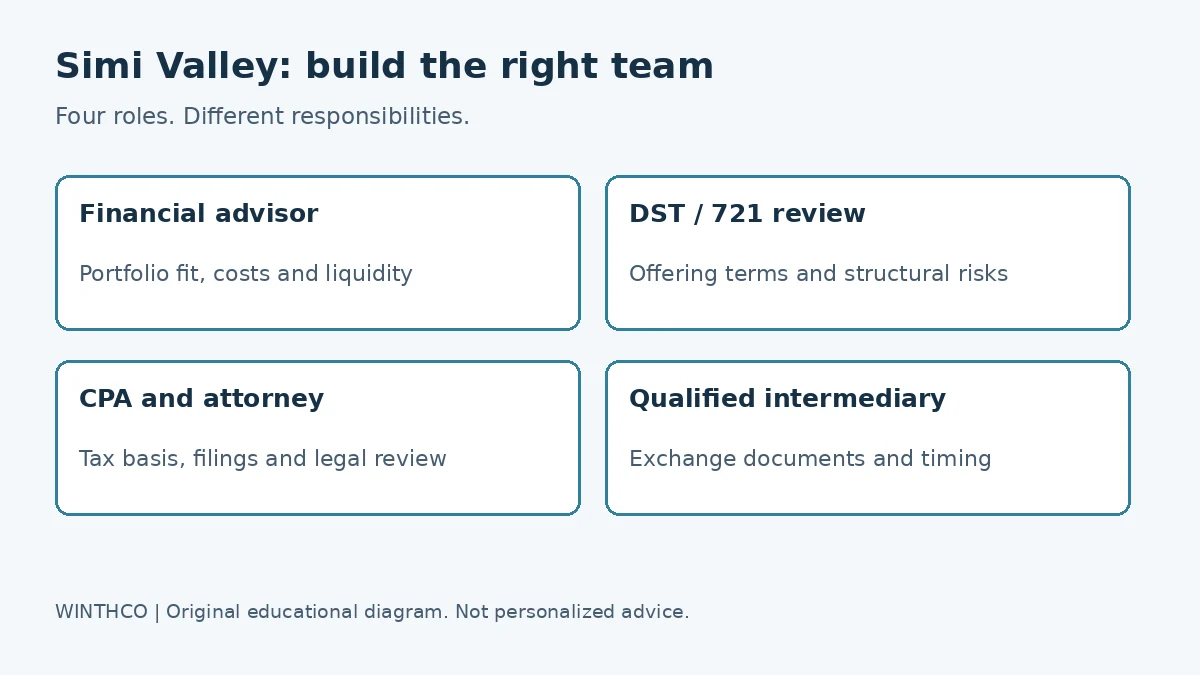
A Simi Valley property owner considering a Delaware statutory trust should coordinate investment advice, tax analysis and exchange execution before selling. A financial advisor evaluates portfolio fit; a CPA analyzes tax consequences; and a qualified intermediary administers an eligible deferred exchange. A 721 UPREIT requires a separate review of ownership and exit rights.
Perhaps you own a rental house, a small apartment building or a commercial property and want fewer management responsibilities. First compare keeping it, hiring a manager, selling in a taxable transaction and pursuing an eligible exchange. Each choice changes your workload, available cash and future decisions. An exchange should earn its place in the plan after those alternatives are considered.
Winthco lists its Simi Valley office at 1871 Tapo Street, Simi Valley, CA 93063, with the office number 805-583-2720. Use the Simi Valley office contact page to arrange a conversation and confirm appointment details. A nearby office can make coordination easier, but the investment's underlying properties may be elsewhere. Evaluate those markets separately from your familiarity with Simi Valley.
Share your timeline and investment range. A Winthco team member will follow up with you.
When interviewing a Delaware statutory trust advisor in Simi Valley, ask how the proposed investment fits your household's assets, spending and capacity for loss. Request an explanation of compensation, sponsor relationships, available alternatives and ongoing service. Winthco's Delaware statutory trust advisor overview describes its educational and coordination role. Ask which professional will be responsible for each part of your transaction.
A search for a DST CPA in Simi Valley should lead to questions about actual tax experience: Who will reconcile basis and depreciation, calculate possible taxable gain, and prepare federal and state filings? Confirm the individual's qualifications and engagement scope. A financial advisor's participation does not establish a CPA engagement.
The qualified intermediary manages the exchange arrangements within its agreement. Your attorney addresses title, entity documents and legal rights. Put these responsibilities in writing so a missing document or disputed assumption has a clear owner.
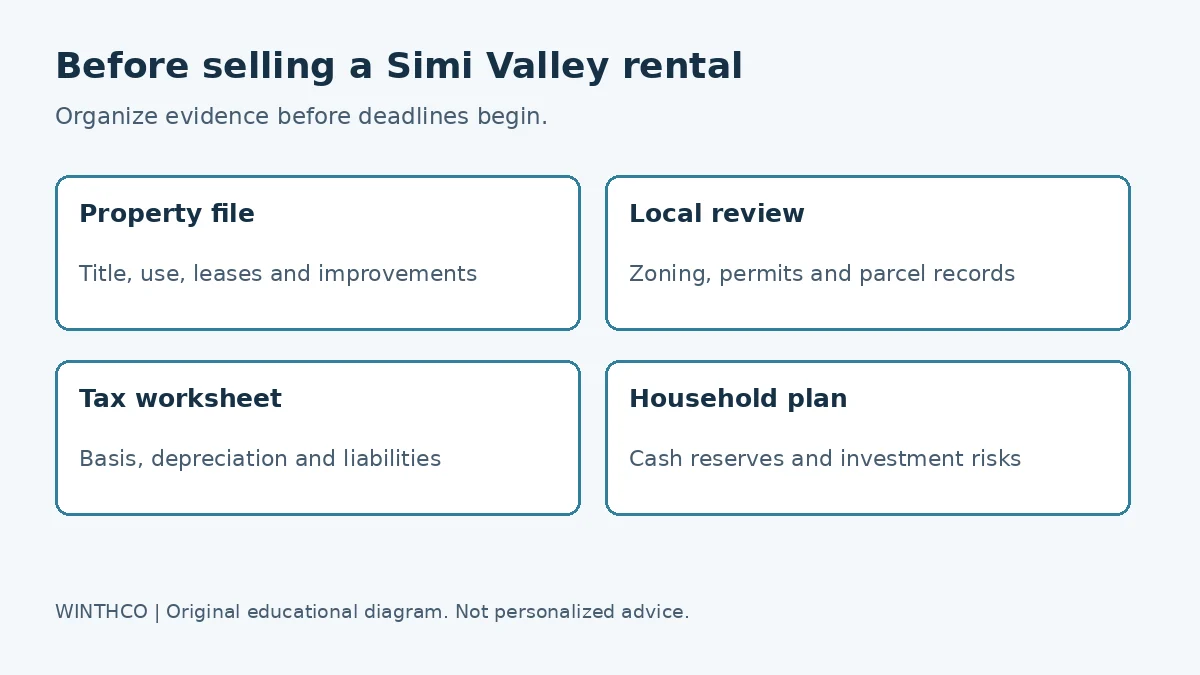
The City of Simi Valley provides a zoning map and links to its GIS Public Planning Viewer. Its zoning guidance distinguishes residential, commercial, industrial, specific-plan and overlay areas. For your parcel, verify permitted use and applicable restrictions with Planning rather than assuming a nearby property establishes what you may do. This is particularly useful when a sale estimate depends on expansion, a change of use or additional units.
The city's General Plan page also provides its land-use map and chapters addressing community development, housing, mobility, and safety. These are starting points for property-specific questions, not promises of approvals or appreciation.
Create a short seller's file containing the parcel identification, leases, rent roll, major repair history and questions about permits. Ask your broker and relevant city staff to resolve material issues early. Uncertain property assumptions can disrupt the sale timetable and the replacement-investment search.
Discuss your DST questions with Winthco →
IRS guidance limits Section 1031 to qualifying real property held for investment or business use. A personal residence or property held primarily for sale generally does not qualify under those rules. Mixed use, changes of use and entity ownership need individualized tax review. Avoid transferring title or changing ownership solely because someone describes a shortcut.
For a typical deferred exchange, the IRS Form 8824 instructions require identification within 45 days after the relinquished property transfers. Receipt of replacement property must occur by the earlier of 180 days or the applicable federal return due date, including extensions. Ask the intermediary to confirm the dates and written identification requirements.
Arrange the intermediary and handling of proceeds before closing. Have the CPA model debt relief, cash retained and other potential taxable amounts. A late-year Simi Valley sale deserves particular attention to the return deadline. Allow time for offering review, eligibility checks and funding; identifying an interest does not reserve it.
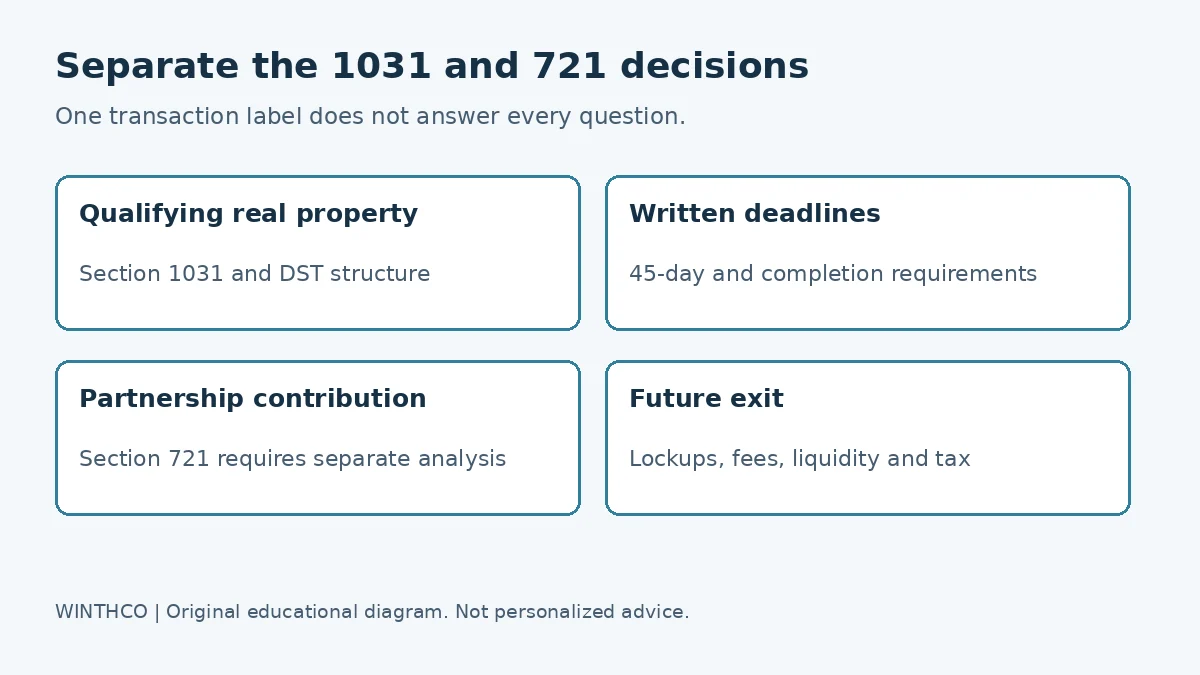
IRS Revenue Ruling 2004-86 describes a trust arrangement whose beneficial interests can qualify for a Section 1031 exchange when the other requirements are satisfied. This is the foundation for evaluating qualifying real estate DST interests. It does not approve every DST, certify an offering's quality or guarantee tax deferral for your transaction. Review the particular trust and offering documents with your advisers.
A 721 UPREIT arrangement generally involves contributing property to a REIT's operating partnership in return for partnership units. IRS Publication 541 explains the general nonrecognition rule for property contributions to partnerships, alongside exceptions and complications. Debt changes, cash transfers and disguised-sale rules require tax analysis.
When consulting a 721 UPREIT advisor in Simi Valley, ask who controls a proposed contribution, whether it is optional, how units are valued and what redemption restrictions apply. Some DST programs contemplate a later contribution, but the documents determine the rights. Do not assume partnership units can be exchanged back into another property under Section 1031. Winthco's 721 UPREIT resource provides additional background for that discussion.
WATCH & LEARN
Jeff Peterson discusses DSTs and 1031 exchange property identification rules. This third-party educational video provides background; the current IRS rules and your advisers determine the requirements for your transaction. The speaker is not presented as a Winthco representative. Original resource · Watch on YouTube ↗
Educational context only. The discussion does not establish the suitability, returns or tax treatment of an investment.
The Franchise Tax Board's Form 3840 instructions require reporting when California real property is exchanged for qualifying property outside California. Filing generally continues each year until the California-source deferred gain or loss is recognized. The requirement can apply even when the taxpayer no longer lives in California or otherwise has no California return to file.
For a Simi Valley owner acquiring a DST interest with out-of-state real estate, ask the CPA to identify the underlying locations, allocate the California deferred gain as required and maintain the reporting history. Moving the investment elsewhere does not automatically erase California's claim to that deferred gain.
Agree who will keep the original basis records, prior exchange forms and annual sponsor statements. If you later change tax preparers, transfer that complete history. Review the instructions for the filing year involved rather than assuming an older form or deadline remains current.
A private DST can be difficult or impossible to resell when you need cash. The SEC's private-placement guidance highlights illiquidity, limited disclosures and the possibility of total loss. Eligibility to buy an offering does not establish that it fits your circumstances.
FINRA's concentration-risk guidance also warns that several investments may share exposure to the same region, industry or illiquid asset type. Count existing rentals and other real estate investments when evaluating a new allocation. Multiple DST interests do not automatically create adequate diversification.
Request the full fee schedule, debt terms, tenant information, reserves and exit provisions. Ask what happens if occupancy falls, financing becomes expensive, distributions decline or a sale takes longer than projected. Compare actual operating cash flow with proposed distributions and ask whether reserves or other sources support payments. Keep enough accessible assets for the expenses you cannot postpone. Tax deferral does not compensate for an investment you cannot afford to hold.
Consider a hypothetical owner of a Simi Valley rental home who wants less hands-on management but needs accessible money for family expenses. The meeting should not begin with choosing a distribution rate. First establish investment use, title, tax basis and the expected sale timetable. Then separate the cash that must remain liquid from funds that could tolerate a restricted investment.
The CPA models a taxable sale, a full exchange and a partial exchange using actual records. The investment professional compares a qualifying DST with direct replacement property and continued ownership with a manager. A proposed later UPREIT contribution adds another document review. This scenario illustrates a process, not a client result or a recommendation. No route is automatically preferable because the property is in Simi Valley.
Bring a summary of the property, ownership arrangement, estimated sale proceeds, mortgage balance and anticipated closing date. Separately identify near-term spending, emergency reserves and how much management responsibility you want to retain. Your financial advisor in Simi Valley can use those facts to frame the investment discussion while your CPA verifies the tax calculations.
Ask for a written list of unresolved questions and the professional handling each one. Before authorizing a transaction, understand the investment rights, total costs, tax assumptions and plausible adverse outcomes. An introductory conversation or contact-form submission does not reserve an offering, complete an exchange or commit you to invest. Use a verified secure channel for tax returns, identification and account documents.
This guide uses AI-assisted research and drafting, with Winthco Wealth Management organization attribution. It provides general education, not individualized investment, tax or legal advice. Sources and offering documents should be checked against your circumstances before you act.
Winthco Wealth Management lists its office at 1871 Tapo Street, Simi Valley, CA 93063. Call 805-583-2720 to confirm appointment arrangements. This map identifies that office, not the location of a DST investment or another branch.
| Decision | Evidence to request | What to avoid assuming |
|---|---|---|
| Advisor selection | Compensation, registration, alternatives and written service scope | A local address establishes investment suitability |
| Tax and exchange execution | CPA calculations, intermediary agreement and confirmed deadlines | The investment advisor performs every professional role |
| DST or 721 route | Trust or partnership documents, decision rights and exit restrictions | Both structures preserve identical future choices |
| California reporting | Property locations, deferred-gain records and applicable FTB forms | An out-of-state investment ends California obligations |
Its contact page lists 1871 Tapo Street, Simi Valley, CA 93063, and 805-583-2720. Contact the office to confirm appointment arrangements.
Section 1031 generally concerns business or investment real property. A personal residence ordinarily does not qualify. Ask your tax adviser about any mixed-use or rental history before proceeding.
Do not assume so. Confirm who is engaged for tax analysis and return preparation, their qualifications, fees and responsibilities. An investment-advice engagement alone does not establish those services.
Arrange an eligible deferred exchange and the handling of proceeds before the sale closes. Receiving or controlling the proceeds can jeopardize the intended treatment. Seek immediate professional advice if closing is near.
Do not count on it. Partnership agreements can impose holding periods, redemption limits and other restrictions. A later redemption or conversion may have tax consequences. Review the actual terms.
Moving does not automatically end Form 3840 reporting for deferred California-source gain from an exchange into out-of-state property. Your CPA should determine continuing filing obligations.
Sources checked October 9, 2026. This article explains general concepts; your facts and the applicable documents control.
Winthco DST services · Winthco evaluation overview · Editorial standards
Investor decision-making
Use practical questions about registration, compensation, due diligence, coordination and follow-up when evaluating a DST advisor.
Read guide →1031 replacement property
Compare DST and 721 UPREIT paths, tax rules, ownership, liquidity, control and risks before a property sale or exchange.
Read guide →California 1031 planning
Learn how California owners can evaluate a DST replacement, federal deadlines, Form FTB 3840 reporting, liquidity and investment risks.
Read guide →Explore Winthco’s main DST article collection
Share your timeline and investment range. A Winthco team member will follow up with you.