Local real estate planning
Simi Valley DST and 721 UPREIT Seller Planning
A practical Simi Valley guide to Delaware statutory trust advisors, 721 UPREIT planning, CPA coordination, California reporting and investment risks.
Read guide →
Home / Learning center / Local real estate planning
Local real estate planning
Winthco Wealth Management · Updated October 14, 2026
A Hidden Hills property sale can lead to a DST discussion only after investment use, sale readiness and household goals are established. Coordinate your broker, CPA, attorney and qualified intermediary before closing. Then compare qualifying DST ownership and any separate 721 UPREIT proposal with liquidity needs, retirement assets and alternatives.
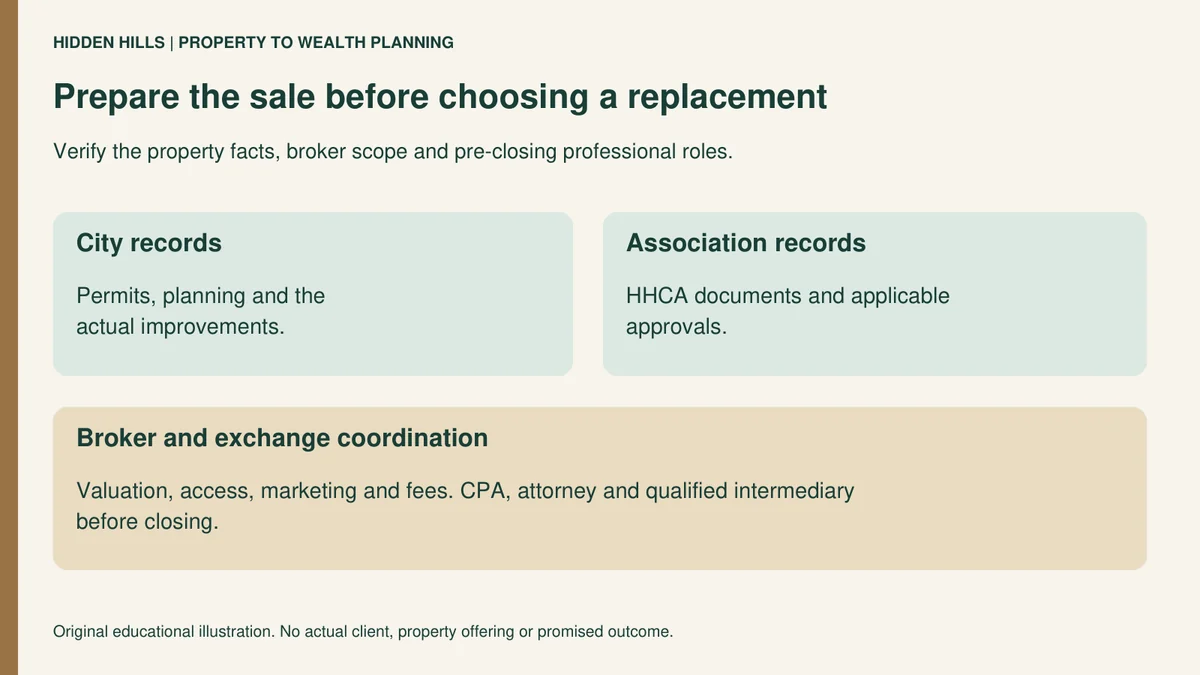
Begin by identifying what is being sold and why. A residence you occupy is not automatically eligible for a 1031 exchange because it has substantial equity. Document rental and personal use, title, leases, improvements and debt. Interview appropriately licensed realtors or commercial brokers with relevant property-type experience. Ask how they support valuation, handle showing access, market the property, explain fees and coordinate closing. Verify licenses and claimed expertise through the California Department of Real Estate.
Hidden Hills is an incorporated Los Angeles County city, identified in Census records as GEOID 0633518. This guide and its map describe the service area, not a Winthco office there. Engage tax, legal and exchange professionals before closing or receiving proceeds. Winthco's DST advisor selection questions can frame the investment discussion, but do not replace the listing broker's engagement or establish a brokerage referral relationship.
Share your timeline and investment range. A Winthco team member will follow up with you.
The city's City Hall or HHCA resource distinguishes municipal responsibilities from those of the Hidden Hills Community Association. The city handles building and grading permits and planning, while HHCA oversees architectural standards and gate access. The city's Permit Center lists association approval documents among application materials. For sale preparation, ask which city records and association documents apply to the actual improvements; do not assume one approval proves the other.
Keep this review practical: reconcile the physical property with permits, disclosures and the title file, then identify unresolved issues that could affect price or closing. Separately provide the CPA with the history of investment and personal use. A broker's description of a guest area, rental potential or future improvement does not establish tax qualification, a permitted use or an association approval. Obtain parcel-specific answers before relying on those assumptions.
Section 1031 can defer eligible gain when qualifying business or investment real property is exchanged for qualifying replacement real property and the requirements are met. That may permit continued real-estate exposure while changing management responsibility or property allocation. It is deferral, not elimination of tax, and it does not make a poor investment suitable. Compare keeping the property, hiring management, a taxable sale and a partial or full exchange.
Under the IRS Form 8824 instructions and Treasury Regulation 1.1031(k)-1, a deferred exchange generally requires written identification within 45 days after transfer. Replacement property must be received by the earlier of 180 days or the federal return due date, including extensions. Arrange the qualified intermediary before closing and before receiving proceeds. Have the CPA model retained cash, debt relief, expenses and possible taxable boot rather than equating the sale price with exchangeable equity.
Discuss your DST questions with Winthco →
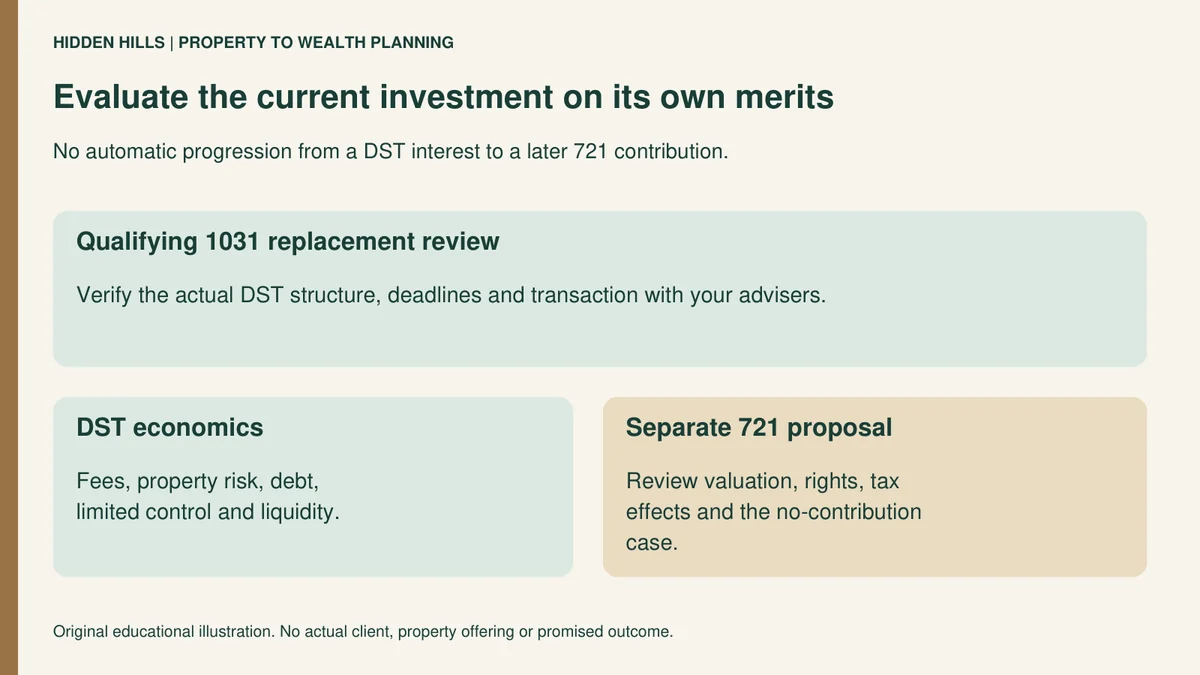
Revenue Ruling 2004-86 addresses a specific Delaware statutory trust arrangement whose beneficial interests receive real-property treatment for Section 1031. It is not a blanket approval of every trust or an assessment of investment quality. Ask the CPA, attorney, intermediary and investment professional to review the actual structure and transaction. Investor eligibility, tax qualification and investment suitability are three different questions.
A qualifying DST can reduce direct management work because operations are handled under the trust and property-management arrangements. The tradeoff is limited control. You generally cannot personally change the tenant mix, commission a renovation or choose the date of a property sale. Read the trust agreement to understand decision rights and restrictions rather than assuming passive ownership means no further monitoring.
The Hidden Hills seller should evaluate the replacement properties on their own merits. Familiarity with the neighborhood being sold says little about a different property's tenants, market or condition. Ask for the rent roll, lease expirations, operating assumptions, physical-condition information and reserve policy. Identify which assumptions are documented and which are projections. A tax deadline should not turn unanswered investment questions into accepted facts.
Request the complete use-of-proceeds and compensation schedules. Separate selling compensation, organizational costs, acquisition expenses, financing charges, reserves, ongoing property-management fees and exit costs. Determine who receives each payment and whether related parties are involved. A quoted distribution percentage is not a substitute for understanding how much capital reaches the property and what costs remain over the holding period.
For a leveraged DST, review loan maturity, rate terms, covenants and refinancing assumptions. Fixed-rate financing does not remove maturity or property-value risk. Debt-free ownership avoids some borrowing risks but still faces property expenses, tenant problems, fees and illiquidity. Ask the tax professional to review allocated debt for exchange purposes separately from the investment professional's assessment of the financing risk.
Trace anticipated distributions to their sources and ask who may reduce them. Payments supported by reserves or other nonoperating sources tell a different story from recurring property cash flow. Distributions can decline or stop, and receiving cash does not prevent a loss of principal. Stress-test higher expenses, weaker occupancy and a delayed sale against the household's actual spending obligations.
WATCH & LEARN
Accruit explains the DST structure as a passive replacement-property option. This third-party overview is general education, not a Winthco endorsement or an assurance of income, diversification or tax treatment. Current guidance and actual documents control. Original resource · Watch on YouTube ↗
Educational context only. The discussion does not establish the suitability, returns or tax treatment of an investment.
A Section 721 contribution generally involves transferring property to a partnership for an ownership interest, subject to exceptions and fact-specific tax analysis. In an UPREIT structure, the relevant entity is the REIT's operating partnership. The separate 721 UPREIT decision framework supplies background, but contribution and partnership documents control the terms. Ordinary REIT shares and operating-partnership units generally are not direct Section 1031 replacement real property.
Some DST programs may contemplate a later contribution, but the transaction is not automatic. Ask who can initiate it, whether investors can decline, how valuation is established, what conflicts exist and what happens if it never occurs. Compare the current DST investment without assuming the future transaction will provide an attractive exit. An expected transition date is not a personal liquidity commitment.
If a contribution becomes available, examine the assets supporting the partnership units, distribution policy, fees, lockups and redemption or conversion rights. A later redemption can have tax consequences. IRS Publication 541 discusses partnership contributions and complications including liabilities and disguised sales. Do not assume a FIFO redemption election guarantees tax-free withdrawals of basis or that units can later be exchanged directly into a personally selected building.
Private DST offerings are generally limited to accredited investors and made through the applicable private placement memorandum. The SEC warns that private placements can have limited disclosure, resale restrictions and the potential for total loss. Accreditation does not establish suitability. Review sponsor experience, conflicts, property risks, debt, fees and the possibility of a longer holding period than expected.
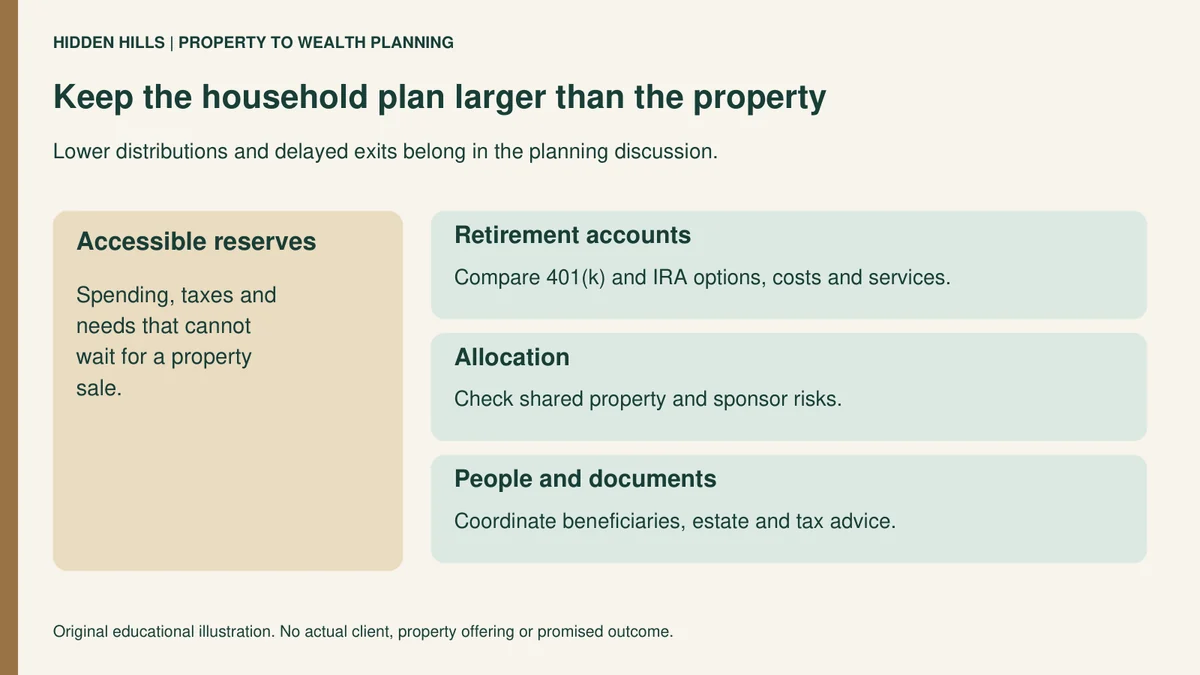
FINRA's concentration guidance is relevant even when a household owns several properties or DSTs. Different names can conceal shared exposure to a sponsor, geography, property sector, tenant or lending environment. Include other rentals and private investments in the review. Keep accessible resources for expenses that cannot wait for a sale, and consider how changes in tax law or household circumstances could affect the plan.
California reporting can continue after an exchange into out-of-state property. FTB Form 3840 generally must be filed for the exchange year and subsequent years until the deferred California-source gain or loss is recognized. A DST tax reporting discussion should identify the responsible CPA, underlying property locations, basis records and continuing filings. The investment advisor is not automatically engaged as the tax preparer.
Consider a hypothetical owner with a rented Hidden Hills property, an older remodel and a history that includes personal use. The owner wants less management and expects retirement spending to rise. Before committing to an exchange, the broker evaluates sale readiness and access arrangements, the attorney reviews title and relevant approvals, and the CPA reconstructs the use and basis history. No particular tax treatment is assumed.
If the facts support an exchange, the team compares direct replacement property and qualifying DST interests with a taxable sale or partial exchange. Money needed soon is identified separately from long-term capital. A possible later UPREIT proposal gets its own review. Unresolved remodel documentation, an insufficient liquidity reserve or unsuitable investment terms could change the decision. This scenario is illustrative, not an actual client, offering or promised outcome.
Use the sale as a reason to review the whole household balance sheet with Winthco's financial advising and wealth-management team. Consider existing financial assets, 401(k)s, IRAs, retirement-income needs, asset allocation and accessible reserves. Qualified retirement accounts are not themselves Section 1031 exchange proceeds. Compare relevant account options, costs, services and restrictions before considering a rollover or transfer; moving accounts is not an assumed next step.
Coordinate beneficiary designations and estate documents with legal counsel, and tax estimates and reporting with the CPA. Bring a property summary, anticipated closing date and spending priorities to the initial conversation. Use a verified secure channel for statements, returns and identification documents, not the public prospect form. An inquiry does not reserve an investment, establish suitability or create an intermediary, tax or legal engagement.
This map identifies the City of Hidden Hills, California, as the subject of this guide. It does not identify a Winthco branch, client property or DST offering.
| Decision | Evidence to request | What to avoid assuming |
|---|---|---|
| Sale preparation | Use history, permits, association documents and broker proposal | A listing description proves tax or permit status |
| 1031 execution | Intermediary agreement, taxpayer identity and written deadlines | The exchange can be arranged after receipt of proceeds |
| DST investment | Trust terms, fees, property assumptions and financing | A projected distribution equals dependable spending money |
| Possible 721 contribution | Valuation, decision rights, restrictions and tax review | A future transition guarantees liquidity |
No Hidden Hills office is claimed here. Winthco lists its office at 1871 Tapo Street in Simi Valley; the map shows only the Hidden Hills service area.
Section 1031 generally concerns business or investment real property, not a personal residence. Mixed-use or changing-use history requires individual tax analysis rather than an assumption based on the address.
The city and HHCA have separate responsibilities. Confirm which municipal and association documents apply to your particular improvements and transaction.
Ask about compensation, alternatives, sponsor review, property assumptions, debt, fees and liquidity. Verify the professional and request written disclosures.
No. Some programs contemplate a later contribution, but the documents and circumstances determine whether it happens and on what terms.
No automatic rollover follows from the conversation. Review retirement-account alternatives, fees, services and restrictions independently.
Sources checked October 14, 2026. This article explains general concepts; your facts and the applicable documents control.
Winthco DST services · Winthco evaluation overview · Editorial standards
Local real estate planning
A practical Simi Valley guide to Delaware statutory trust advisors, 721 UPREIT planning, CPA coordination, California reporting and investment risks.
Read guide →Local real estate planning
An Agoura Hills guide to DST, 1031 exchange and 721 UPREIT planning, with local records, professional roles, fees and risks.
Read guide →Alternatives and comparisons
Compare DST distributions with rental cash flow, fees, tax reporting and retirement spending before selling an investment property.
Read guide →Explore Winthco’s main DST article collection
Share your timeline and investment range. A Winthco team member will follow up with you.