Local real estate planning
Simi Valley DST and 721 UPREIT Seller Planning
A practical Simi Valley guide to Delaware statutory trust advisors, 721 UPREIT planning, CPA coordination, California reporting and investment risks.
Read guide →
Home / Learning center / Local real estate planning
Local real estate planning
Winthco Wealth Management · Updated October 13, 2026
A Agoura Hills investment-property sale should connect broker selection, pre-closing tax and exchange planning, and careful review of DST or separate 721 UPREIT options. Start with the property facts, then evaluate fees, liquidity and downside risks against retirement spending and the rest of your financial assets before committing to a replacement.
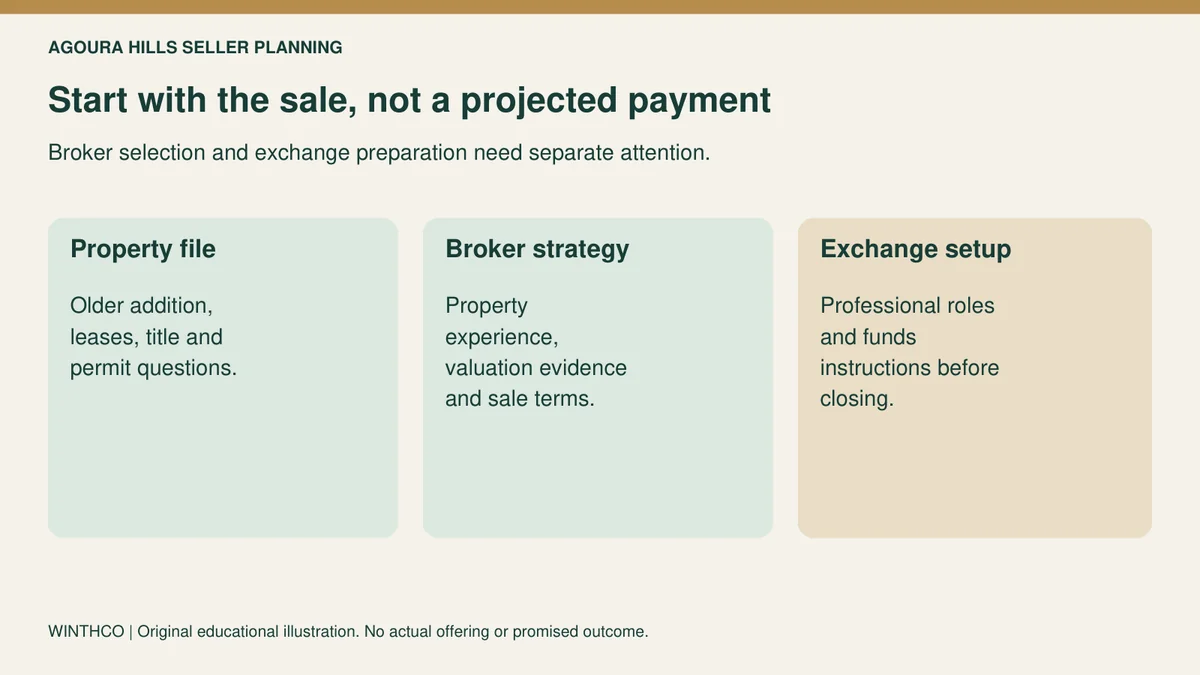
Selling an Agoura Hills rental with an older addition starts with a credible property file and an appropriate sale strategy. Interview licensed real estate agents or commercial brokers with experience in the property's actual use. Ask how they support valuation, handle tenant access, market the asset, disclose fees and coordinate closing. Compare written proposals rather than treating an ambitious asking price as evidence of net proceeds.
Agoura Hills is an incorporated city in Los Angeles County, not a claimed Winthco branch. Prepare leases, title, debt and improvement records, and involve the CPA, attorney and qualified intermediary before closing or receipt of proceeds. Winthco's Delaware statutory trust advisor overview helps frame the investment role, which is distinct from the listing broker's work. Neither this guide nor its service-area map asserts a brokerage or referral relationship.
Share your timeline and investment range. A Winthco team member will follow up with you.
Keep local due diligence focused on facts that affect the sale. Agoura Hills Community Development provides planning, zoning, building and permit resources. Reconcile an older addition with the permit file, inspections and seller disclosures. The Los Angeles County Assessor's address or AIN search helps identify the parcel; title and legal questions still require the appropriate professionals. If valuation assumes added units or a use change, request parcel-specific confirmation rather than inferring permission from a nearby property.
Nearby Hidden Hills investment-property planning highlights a different local issue: coordinating municipal and community-association documentation without confusing either with tax qualification.
IRS guidance states that Section 1031 applies to exchanges of real property held for business or investment use. Property held primarily for sale does not qualify, and a main home follows different rules. Mixed use, a recent conversion from personal use and ownership through an entity require fact-specific tax and legal review.
The 2025 Form 8824 instructions state that replacement property must be identified no later than 45 days after the relinquished property transfers. Receipt must occur by the earlier of 180 days after the transfer or the applicable federal return due date, including extensions. These are outside limits, not planning targets.
Engage the qualified intermediary before closing and before the seller receives proceeds. Confirm the taxpayer, title, written identification procedure, exchange-account instructions and closing sequence. Have the CPA model debt relief and cash retained. A named DST interest can become unavailable, and identification does not reserve capacity, approve a security or complete a subscription.
A qualifying exchange can defer eligible gain while changing the form of real-estate ownership, but deferral is not tax elimination. The CPA should compare a taxable sale, full exchange and partial exchange, including costs, retained cash and potential boot. Use the DST tax reporting resource to organize questions, not to replace an engagement with a qualified tax professional.
Discuss your DST questions with Winthco →
IRS Revenue Ruling 2004-86 addresses a specific trust arrangement whose beneficial interests are treated as interests in real property for federal tax purposes. The ruling does not approve every DST, determine suitability or guarantee a purchaser's tax treatment. Review the actual trust agreement, private placement memorandum and transaction with the appropriate professionals.
A DST investor generally accepts limited control and relies on the sponsor and property managers under the governing documents. Review the real estate, tenants, debt, reserves, fees, conflicts, distribution assumptions and exit provisions. Ask what happens if occupancy declines, expenses rise, financing becomes costly or a planned sale is delayed.
A 721 UPREIT contribution is a separate partnership transaction. The 721 UPREIT planning overview provides general background, but contribution documents control valuation, timing, lockups, conversion rights and redemption limits. A 721 UPREIT advisor should explain who may initiate a contribution and what choices remain afterward. Do not assume partnership units can later be exchanged for other real estate under Section 1031.
For an Agoura Hills seller, less day-to-day management can be meaningful, but it comes with less ability to direct property decisions. You generally cannot choose an individual tenant, authorize a renovation or demand a sale as you could as a direct owner. Read the trust's restrictions alongside the property's operating plan. Ask who resolves conflicts when investor preferences and the sponsor's preferred timing differ.
Study the entire use-of-proceeds schedule before comparing investments. Separate selling and organizational costs, property acquisition expenses, financing charges, reserves, ongoing management costs and exit compensation. Determine which amounts are paid to related parties and whether any quoted payment assumes fee waivers. The useful question is not whether a fee sounds ordinary, but what service it buys and how it affects capital and future cash available to investors.
Review tenant quality and lease expirations, physical condition, insurance assumptions and geographic exposure. Stress-test weaker collections and higher costs. If distributions are supported partly by reserves or other nonoperating sources, identify that explicitly. A regular payment does not establish that the property is earning an equivalent economic return, and a forecast cannot resolve a household's need for dependable accessible funds.
Before treating projected payments as a replacement for rent, compare DST distributions with rental cash flow using consistent expense, reserve and tax definitions.
WATCH & LEARN
Origin Investments' Mike O'Shea explains the DST structure and its use as replacement property. This third-party video is general education, not a Winthco endorsement; IRS guidance, offering documents and the investor's advisers control. Original resource · Watch on YouTube ↗
Educational context only. The discussion does not establish the suitability, returns or tax treatment of an investment.
A possible UPREIT transaction deserves a separate decision memo. Ask how the property would be valued, whether outside appraisal or other safeguards apply, what conflicts exist and whether investors can decline. Identify lockups, distribution policies, redemption rights and the consequences if a planned contribution is postponed or abandoned. The promise of a future alternative should not substitute for acceptable current DST economics.
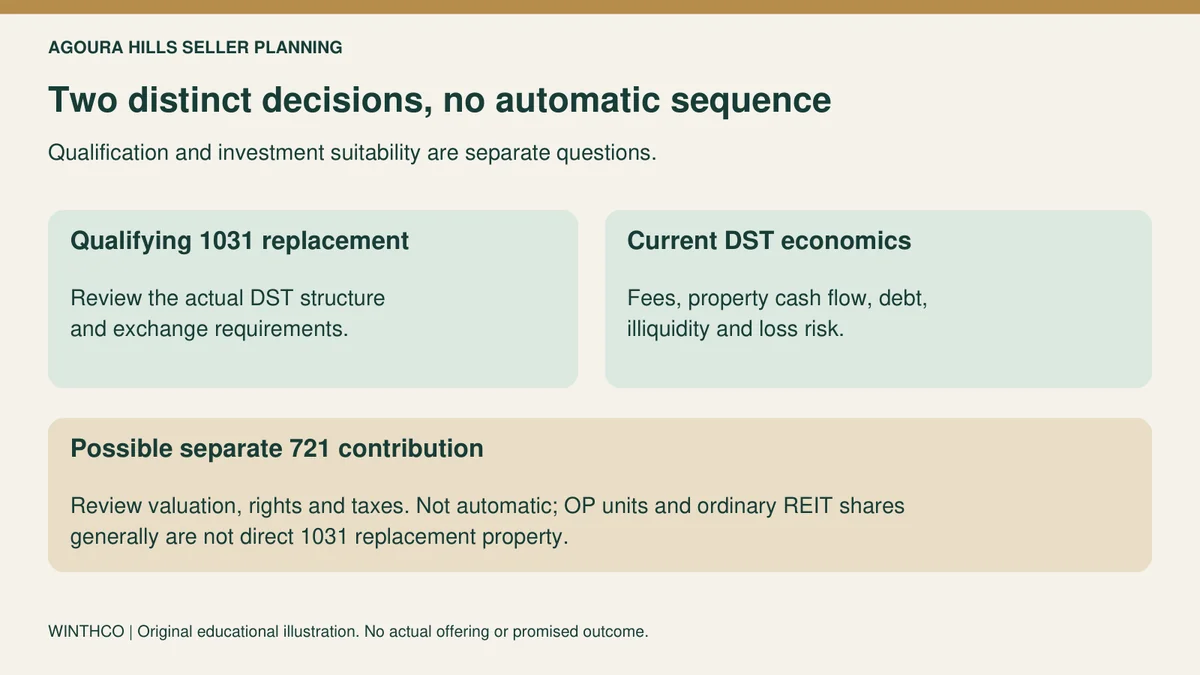
Section 721 generally concerns property contributions to partnerships, subject to exceptions and transaction-specific analysis. It is not another name for Section 1031. Operating-partnership units and ordinary REIT shares generally do not qualify as direct 1031 replacement real property. Conversions, redemptions and liability changes may produce tax consequences; no FIFO convention guarantees tax-free recovery of basis. Review the contribution and partnership agreements with legal and tax counsel.
DST interests are commonly offered through private placements and may be limited to accredited investors. The SEC warns that private placements can provide less information than registered offerings, impose transfer restrictions, be highly illiquid and involve total loss. Accredited status is an eligibility standard, not proof of suitability or investment quality.
Request a complete use-of-proceeds and compensation schedule. Identify selling compensation, organizational and offering costs, financing expenses, reserves, property-level fees and related-party arrangements. Test whether projected distributions rely on current property operations, reserves, borrowed money or another source. Distributions can change or stop, and fees reduce the capital exposed to the investment.
FINRA explains that concentration can arise from correlated asset classes, markets, regions and illiquid investments. Several DST interests can still share real estate, sponsor, tenant, financing or geographic risks. Measure the proposed allocation alongside existing rentals and private investments, and keep adequate liquid resources for taxes, repairs, health costs and other needs.
California Franchise Tax Board instructions for Form 3840 apply when California real property is exchanged for qualifying replacement property outside California and California-source gain is deferred. The 2025 instructions generally require the form for the exchange year and later years until the deferred California-source gain or loss is recognized.
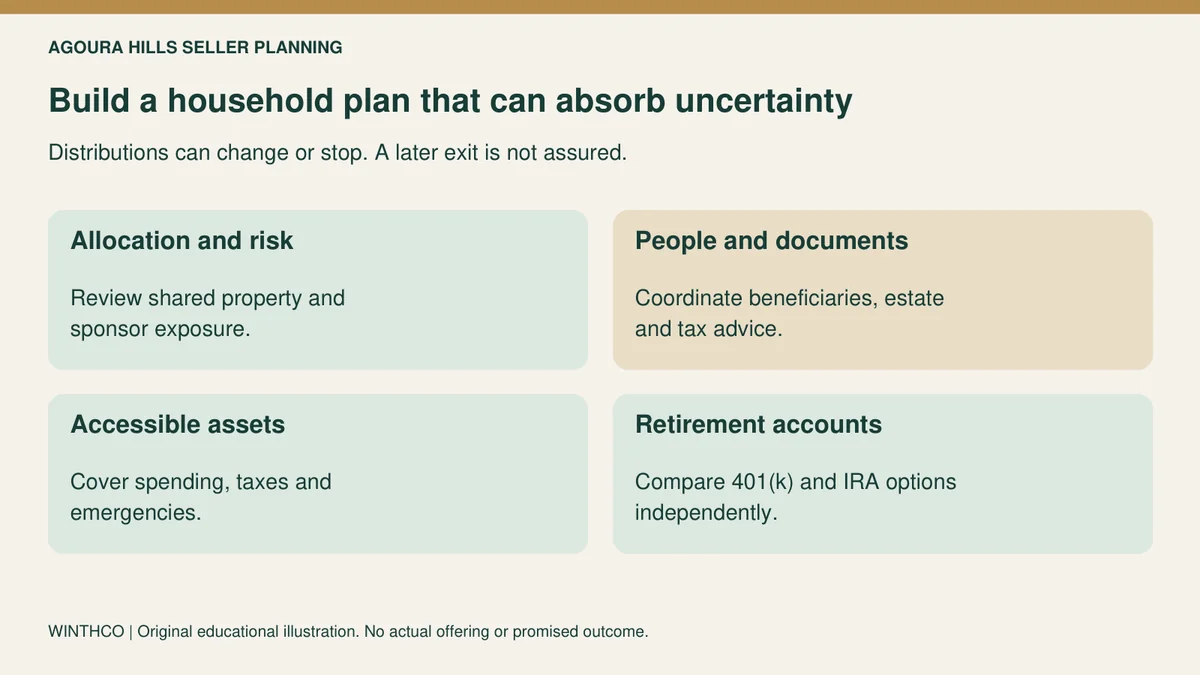
Return to the Agoura Hills seller's broader household plan before choosing an allocation. Winthco's financial advising and wealth-management discussion can connect the property decision with existing financial assets, retirement-income needs, 401(k)s, IRAs, liquidity and portfolio concentration. A rental sale is not an instruction to move every account. Compare available retirement-account choices, costs, services and restrictions independently; retirement assets are not themselves Section 1031 proceeds.
Coordinate beneficiary designations and estate documents with the attorney, and tax estimates and reporting with the CPA. In the hypothetical older-addition case, the owner could decide to reserve more cash, accept a partial exchange's tax consequences, use professional management or postpone a sale. The illustration describes no actual client or promised outcome. The planning result depends on verified property records, offering documents and household priorities.
Use the prospect form to request a conversation, not to upload tax returns or financial statements. Bring the sale estimate, basis questions and spending priorities to an agreed secure channel. A contact request does not establish investment eligibility, reserve a DST or appoint a tax adviser or intermediary.
This map identifies the City of Agoura Hills as the subject of this guide. It does not claim a Winthco office, client location, DST property or investment offering in Agoura Hills.
| Decision | Evidence to request | What to avoid assuming |
|---|---|---|
| Local property review | Address, AIN, zoning, permits, title and operating records | An old listing proves current permitted use |
| Exchange procedure | Intermediary agreement, taxpayer identity and written deadlines | The exchange can be added after the sale |
| DST investment | Offering documents, fees, debt, liquidity and downside cases | Accredited status establishes suitability |
| Possible 721 path | Contribution agreement, valuation, lockups and redemption rights | A later contribution is automatic |
No Agoura Hills office is claimed in this guide. Winthco's verified office is at 1871 Tapo Street in Simi Valley. The map identifies only the Agoura Hills service area.
Real property held for business or investment use may qualify if every applicable requirement is met. Personal use, dealer property, mixed use and ownership changes require fact-specific advice.
Ask about registration, compensation, alternatives, sponsor review, property risks, debt, liquidity and exit provisions. Request written disclosures and verify the professional through FINRA BrokerCheck.
The qualified intermediary and investment advisor do not replace a tax professional. A CPA or tax attorney can analyze basis, depreciation, debt, recognized gain and federal and state reporting for the transaction.
No. Revenue Ruling 2004-86 addresses the trust arrangement described in that ruling. The actual structure, offering documents and transaction facts must be reviewed.
Some programs may contemplate a later contribution, but it is not automatic. The trust, contribution and partnership documents determine whether a transaction is offered and what rights, limits and tax consequences apply.
Sources checked October 13, 2026. This article explains general concepts; your facts and the applicable documents control.
Winthco DST services · Winthco evaluation overview · Editorial standards
Local real estate planning
A practical Simi Valley guide to Delaware statutory trust advisors, 721 UPREIT planning, CPA coordination, California reporting and investment risks.
Read guide →Local real estate planning
A Thousand Oaks guide to DST, 1031 exchange and 721 UPREIT planning, with local records, professional roles, deadlines, fees and risks.
Read guide →Alternatives and comparisons
Compare DST distributions with rental cash flow, fees, tax reporting and retirement spending before selling an investment property.
Read guide →Explore Winthco’s main DST article collection
Share your timeline and investment range. A Winthco team member will follow up with you.