DST investment due diligence
DST Master Lease Risks: A Property Seller's Guide
Review who owes rent in a DST master lease, what supports payment, and how lease risks fit a property sale, 1031 exchange and retirement plan.
Read guide →
Home / Learning center / Local DST guides
Local DST guides
Winthco Wealth Management · Updated November 12, 2026
Before selling an Inglewood rental and considering a Delaware statutory trust, reconcile the signed leases, rent collections and applicable city registry records. That helps separate income a buyer can verify from future rent assumptions. Arrange any deferred 1031 exchange before closing, then apply the same scrutiny to the replacement DST's leases, debt and reserves.
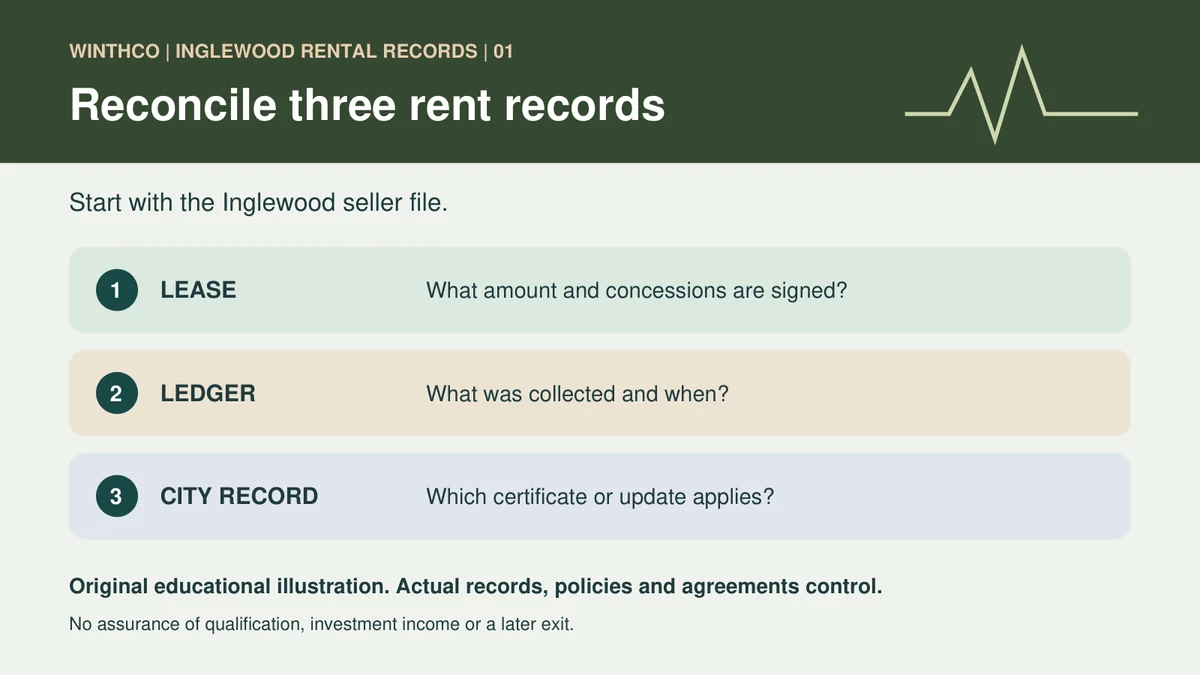
Ask a licensed broker for closed sales of comparable occupied properties, an explanation of how buyers underwrote those rents, and a written description of fees, marketing and closing coordination. Bring signed leases, concessions, the rent ledger, deposits, expense statements and maintenance records. Request two income views: one based on documented current operations and another that clearly labels assumptions about vacancy or turnover. The price a buyer might pay after a hypothetical rent change is not the price supported by the existing lease file. Limit access to tenant details to people who need them for a legitimate review. A public listing is not the place to circulate a tenant ledger.
The City of Inglewood's Residential Registry describes annual registration for owners subject to its requirements, distinguishes regulated and exempt certificates, and identifies change of ownership among the transactions recorded in its system. Ask Housing Protection and your attorney what applies to your parcel and units, including who handles ownership updates and when. Collect the applicable certificates and compare the registered information with the leases and payment ledger. A certificate does not explain every discrepancy or resolve a disputed increase. If the records disagree, document the gap, give your advisers the supporting dates and avoid treating an unsupported rent amount as collectible income.
Share your timeline and investment range. A Winthco team member will follow up with you.
Consider a hypothetical Inglewood owner whose broker discovers that the rent roll shows a higher monthly amount than the leases and collection history support. A buyer may revise its offer, request additional documents or need more time to finalize financing. Compare the revised net proceeds and the likelihood of closing, not just the headline price. Involve the CPA, attorney and qualified intermediary before closing or receiving proceeds if a deferred exchange is under consideration. Section 1031 can defer eligible gain when requirements are met; it does not eliminate the tax. Winthco's explanation of DST replacement property outlines one possible replacement route.
Discuss your DST questions with Winthco →
A deferred exchange generally requires written identification of replacement property within 45 days after transfer, and receipt by the earlier of 180 days after transfer or the federal return due date for the year of transfer, including extensions. Confirm the deadlines with the qualified intermediary and CPA using the actual transfer date. Bring adjusted basis records, depreciation, mortgage payoff and the draft settlement statement so the CPA can compare a taxable sale, partial exchange and qualifying exchange. Cash or other non-like-kind property received and the treatment of liabilities can affect gain recognition. If exchanging California property for out-of-state property, ask the CPA about initial and continuing California Form 3840 reporting.
A qualifying Delaware statutory trust may reduce the day-to-day work of direct ownership, but it does not make projected income collectible. Start with the specific assets, leases and actual payment obligations. Revenue Ruling 2004-86 addressed the trust and transaction described in that ruling, not every DST. Ask your legal and tax advisers to confirm how the proposed interest and exchange are structured. Use Winthco's guide to reviewing a DST offering while reading the private placement memorandum, trust agreement and relevant financial documents. Separate current income under executed leases from sponsor estimates about future occupancy, rent increases or a higher price at sale.
WATCH & LEARN
Tina Colson-Jones of Equity Advantage 1031 Exchange explains the role of a qualified intermediary. This third-party video is general education, not a determination of rental compliance or exchange eligibility. Original resource · Watch on YouTube ↗
Educational context only. The discussion does not establish the suitability, returns or tax treatment of an investment.
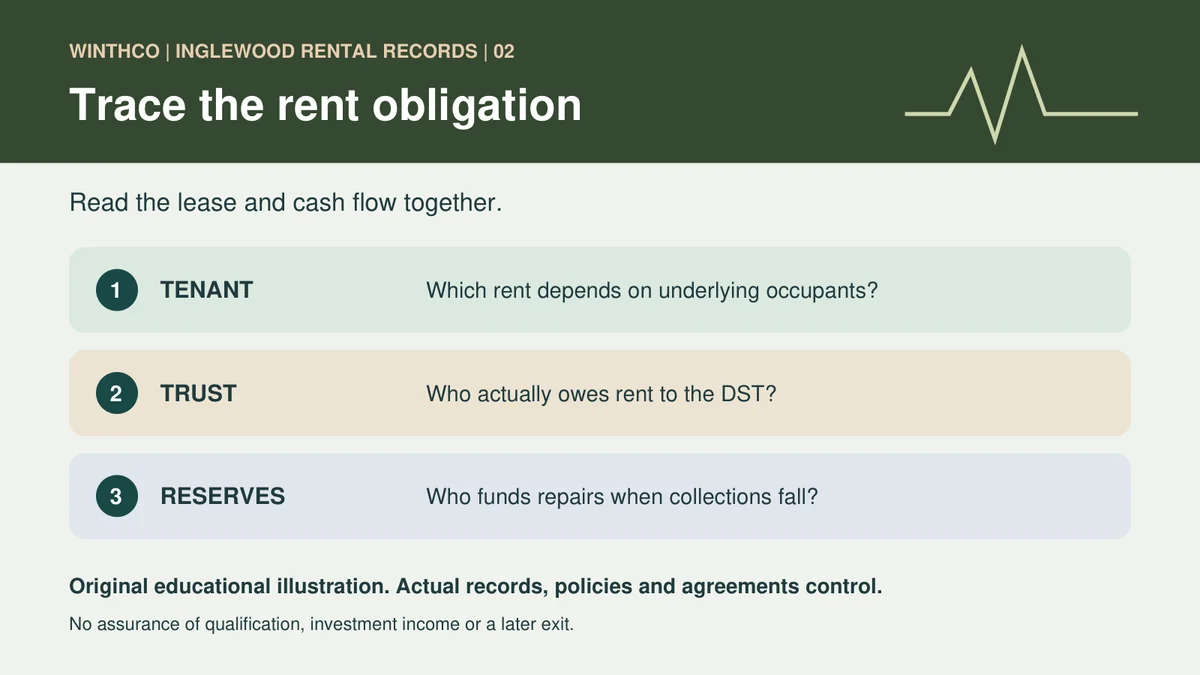
When there is a master lease, distinguish the rent payable to the trust from income the master tenant receives from underlying occupants. Ask whether and how the master tenant can sustain payments if tenants leave or collections slow. Compare lease expiry dates, counterparty strength and how much revenue depends on a single occupant, operator or market. A distribution projection may be based on renewals or occupancy that have not happened. Ask what property taxes, insurance and major repairs could cost under a downside case and which obligations stay with the trust. The DST master lease risk guide explains how contractual rent and property collections can diverge.
Review what money is already reserved, who controls it, and what documents allow when a repair costs more than expected. Read the loan maturity date, debt service and any conditions for an extension before assuming financing will be available. An illustrative case might combine a tenant departure, a new leasing cost and an unexpected repair in the same year. Ask the sponsor to identify the sources and timing of cash under that case, rather than supplying a single best-case distribution schedule. Compare the acquisition, operating and exit costs, including affiliate compensation, with the control and management responsibilities of buying a replacement outright.
Private DST offerings are generally directed to accredited investors. The offering documents should explain transfer restrictions, fees and who makes property decisions. An interest can be hard to price or sell, and limited control may prevent an investor from choosing when to refinance or exit. Sponsor execution, debt, property condition, tenant credit and overlapping exposures across several holdings can all affect outcomes. Distributions can change or stop and investors can lose principal. Do not treat a proposed hold period as an exit date. Compare a DST, direct replacement and a taxable sale on after-tax cash needs and investment risk, not on an assumption that deferral always makes one better.
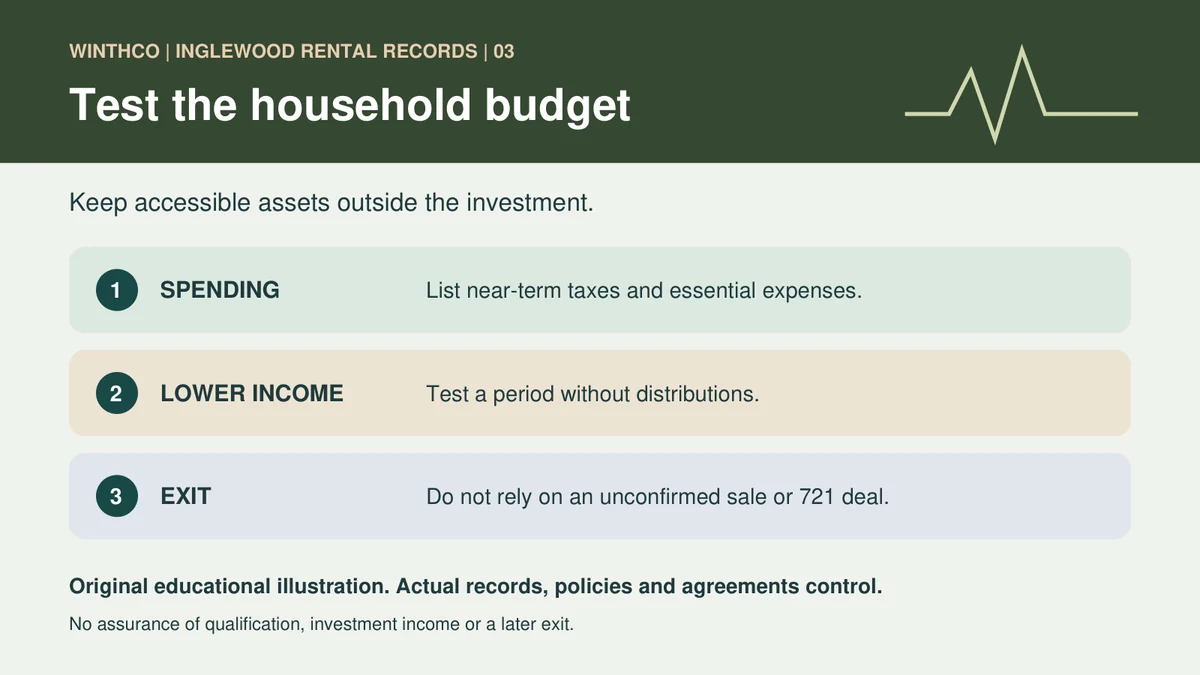
A later Section 721 contribution to a real estate operating partnership is separate from a Section 1031 exchange and may never occur. Ordinary REIT shares and operating partnership units are not direct replacement real property for Section 1031. Evaluate the DST without assuming it will convert. If a transaction is proposed later, have counsel and your CPA review the valuation, debt, fees, potential tax consequences, transfer terms and any limits on conversion or redemption. An operating partnership interest is not the same as immediately accessible cash. Compare what you can actually sell or redeem under the documents with your expected need for money.
Estimate household spending, near-term taxes and cash reserves before allocating proceeds to illiquid property. Test a scenario with a smaller sale amount and a period without DST distributions. Review taxable investments, existing IRAs and 401(k)s, account costs, services, asset allocation and beneficiary arrangements alongside the property decision. Retirement accounts are not 1031 exchange proceeds and no rollover is assumed. Winthco Wealth Management can help put the sale and replacement choices in the context of your broader income and liquidity needs. Ask your legal and tax advisers to coordinate estate and tax decisions separately. If the projected budget requires an unconfirmed exit, revisit the allocation before closing.
Use one page to record each unresolved rent or registry question, who will answer it and the deadline for doing so. Ask the broker to document which price assumptions depend on future changes. Ask counsel to review the relevant leases and closing obligations, the CPA to model tax alternatives, and the intermediary to confirm identification and funds handling. For each replacement, note which revenues are contractual, who owes them, and how major expenses would be funded if collections fall. Record how much cash remains available for essential spending under the downside case. This makes it easier to decline an investment that does not fit even if it could close quickly.
City-area context only. This is not a parcel map or a Winthco office.
| Decision | Evidence to request | What to avoid assuming |
|---|---|---|
| Inglewood sale file | Leases, collections and relevant registry certificates | Advertised rent proves collectible income |
| 1031 preparation | Written identification and actual transfer dates | A delayed replacement restarts the clock |
| DST review | Contractual rent, funded reserves, debt and costs | A distribution estimate is a promise |
| Retirement plan | Accessible assets and essential spending | A future 721 transaction provides cash on demand |
No. Confirm coverage, certificates and ownership updates for your specific parcel with Housing Protection and counsel.
No. Compare leases, applicable rules, collections and actual expenses before using an income figure.
A qualifying interest may be considered if the trust and exchange meet applicable requirements. Have tax and legal advisers review the documents.
Do not assume so. Confirm each professional's role and arrange the intermediary before closing.
No. A later contribution is separate and may not happen, and redemption can be restricted.
Sources checked November 12, 2026. This article explains general concepts; your facts and the applicable documents control.
Winthco DST services · Winthco evaluation overview · Editorial standards
DST investment due diligence
Review who owes rent in a DST master lease, what supports payment, and how lease risks fit a property sale, 1031 exchange and retirement plan.
Read guide →DST due diligence
Before exchanging a rental into a DST, review repair budgets, restricted reserves and funding limits. Know which questions to ask before committing.
Read guide →Local DST guides
Selling an occupied Glendale rental? Verify tenant obligations before setting a closing date and comparing a 1031 exchange, DST and retirement cash needs.
Read guide →Explore Winthco’s main DST article collection
Share your timeline and investment range. A Winthco team member will follow up with you.