DST ownership and exits
DST holding period and exit timing
Understand DST holding periods, sponsor sale timing, early-exit limits and the tax decisions that may follow a trust's disposition.
Read guide →
Home / Learning center / DST ownership and estate planning
DST ownership and estate planning
Winthco Wealth Management · Updated October 21, 2026
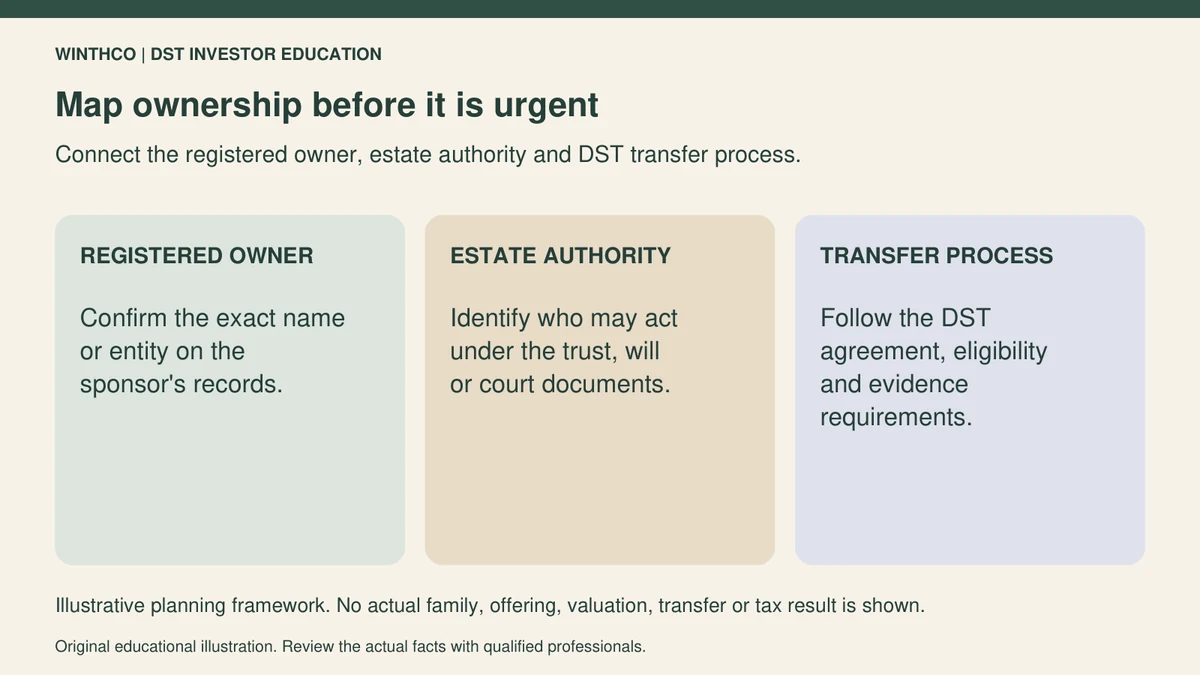
A DST interest does not necessarily liquidate when an investor dies. The estate, trust, beneficiary documents and DST governing agreement may determine who can receive or control the interest and which records are required. Inherited-basis rules may apply, but valuation, transfer restrictions, income reporting and any later sale require qualified tax and legal review.
A rental-property owner preparing to sell should interview appropriately licensed realtors or commercial brokers about property-type experience, valuation, marketing, compensation, sale readiness and closing coordination. If a deferred exchange is being considered, involve the CPA, attorney and qualified intermediary before closing or receiving proceeds. Estate planning belongs in the same early conversation when age, health, family responsibilities or beneficiary goals may affect the ownership decision.
A DST may reduce direct management duties, but it can replace a property the family understands with a private security governed by subscription and trust documents. Winthco's DST estate-planning overview provides broader questions to discuss. Before investing, identify who would locate the records, receive sponsor notices, coordinate tax forms and communicate with the transfer agent if the investor became incapacitated or died.
Share your timeline and investment range. A Winthco team member will follow up with you.
No general federal rule cited here requires a DST property or beneficial interest to be sold at an investor's death. The Delaware Statutory Trust Act states that a beneficial interest is personal property and, unless the governing instrument provides otherwise, is freely transferable. The same statute gives the governing instrument broad power to create restrictions, classes and procedures. The actual trust agreement, subscription agreement and offering memorandum therefore matter.
The estate plan determines a different layer: who has authority to act for the deceased owner and who may ultimately receive the interest. Ownership in an individual name, revocable trust, entity, community-property arrangement or retirement account can produce different documents and processes. A will, trust or beneficiary designation does not rewrite the DST agreement. Likewise, sponsor paperwork does not replace probate, trust or account law.
Revenue Ruling 2004-86 describes beneficial interests that are freely transferable, yet also says there is no established securities market on which they are traded. That distinction is important. A legal transfer to an estate or beneficiary is not the same as a ready cash redemption. Death should not be presented as a guaranteed exit, a sponsor buyback or a sale of the underlying property.
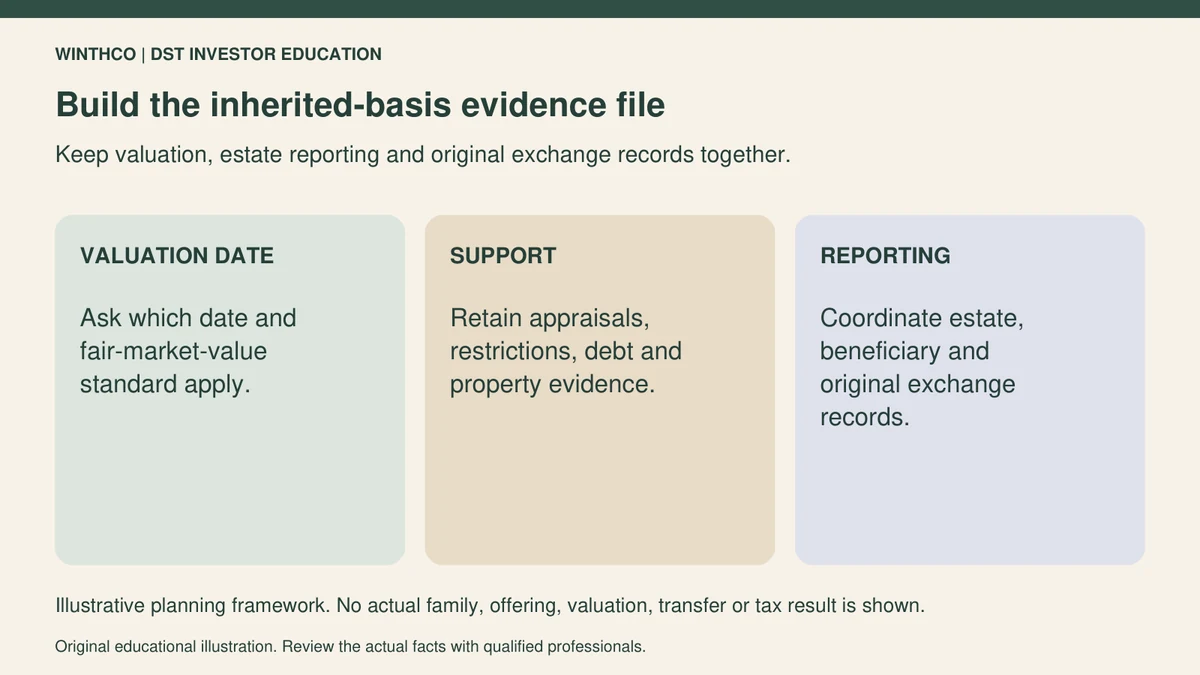
Create a secure ownership file before a problem occurs. It should identify the registered owner, subscription agreement, private placement memorandum, trust agreement, tax opinion, latest sponsor statement, cost and exchange-basis records, recent tax forms and the contact process for the sponsor or transfer agent. Keep account numbers and confidential offering material out of an ordinary prospect form.
Coordinate that file with the estate-planning attorney's documents. Ask which power of attorney, trust certification, death certificate, court appointment or other evidence would be needed for an authorized person to act. Confirm where originals are stored and who can access them. Do not assume an adviser, qualified intermediary or family member automatically has authority merely because that person helped with the original exchange.
The DST investor-reporting guide explains the operating information an owner may receive after closing. A successor may need to distinguish property reports, cash distributions, tax documents and transfer notices. Recordkeeping also matters because the IRS generally requires Form 8824 for the original exchange year, and later tax reporting may depend on documents that predate the successor's ownership.
Discuss your DST questions with Winthco →
IRS Publication 559 states that the basis of property inherited from a decedent is generally fair market value on the date of death, the alternate valuation date if properly elected, or another applicable statutory value. Publication 551 describes the same general framework and notes special rules and consistency requirements. Those are general inherited-property rules, not a promise that every DST interest receives a simple step-up to an easily observed number.
Valuation can be difficult because a private DST interest may have no active market, may be subject to transfer restrictions and may reflect property debt, reserves, fees and other rights in the governing documents. The estate's valuation process and any Form 706 or Form 8971 reporting can affect the records a beneficiary receives. The IRS defines fair market value using a willing buyer and willing seller standard, not merely the original subscription price or a forced-sale value.
Ask the CPA and estate attorney to identify possible exceptions, income in respect of a decedent, community-property issues, estate-tax reporting, state-law consequences and the correct valuation date. Preserve any appraisal and the facts used. This article cannot determine basis, estate inclusion, depreciation or later gain for a particular owner.
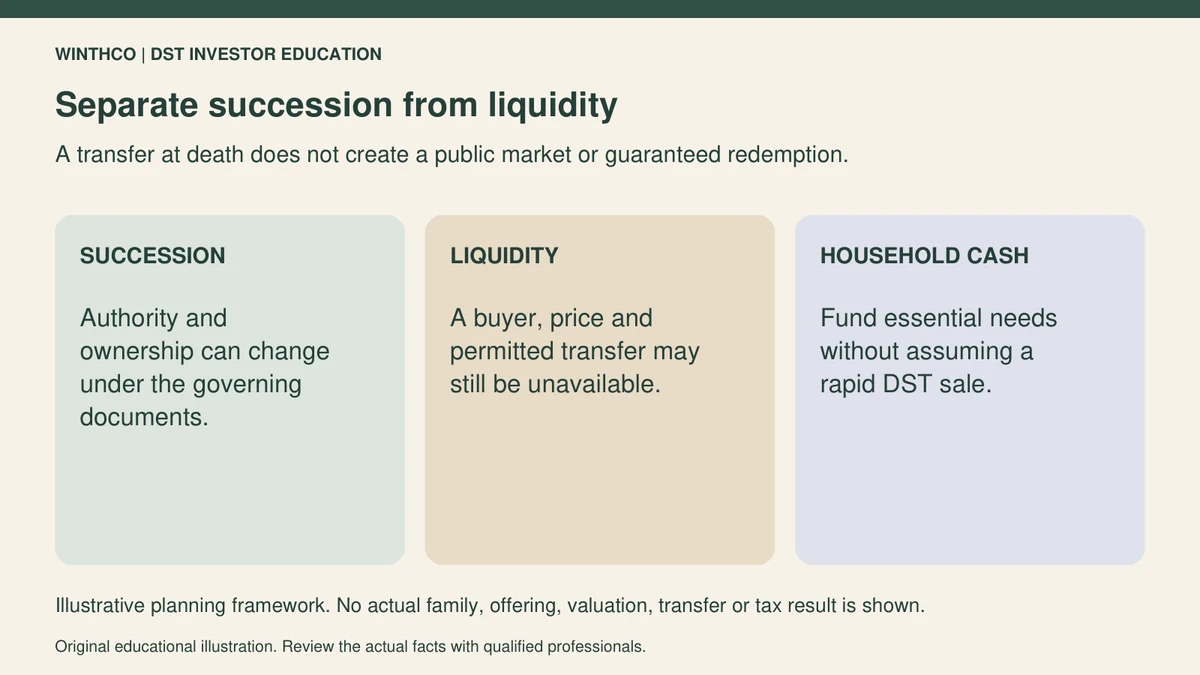
Do not assume so. The SEC warns that private placements can be highly illiquid, provide less information than registered offerings and involve total loss. Rule 144 and other securities-law issues may restrict resale, while the trust agreement may require notice, consent, purchaser eligibility, legal opinions or other transfer steps. An inheritance does not create a national exchange or guarantee a willing buyer.
Review whether the documents distinguish a transfer at death from a voluntary sale. Ask who decides whether the proposed successor is admitted or merely receives an economic interest, whether a minimum ownership amount applies, and who bears legal, valuation or administrative costs. If a redemption program or sponsor accommodation is described, verify whether it is binding, discretionary, funded and available to an estate.
Household planning should assume that essential expenses cannot be paid by an immediate DST sale. FINRA's concentration guidance notes that private placements and other illiquid holdings can be difficult to sell quickly. Maintain accessible cash outside the DST for administration, taxes, health costs and family needs. Neither accredited-investor status nor inherited ownership protects principal.
WATCH & LEARN
Equity Advantage discusses DSTs as one possible response to the time and energy demands of direct property ownership. This third-party video is general education, not estate, tax or legal advice and not an endorsement of any offering. Original resource · Watch on YouTube ↗
Educational context only. The discussion does not establish the suitability, returns or tax treatment of an investment.
The estate or successor may receive distributions, tax reporting and eventual sale proceeds after death. The correct taxpayer, reporting period and character of each item depend on the ownership structure and facts. Publication 559 explains that estates and beneficiaries can have separate filing responsibilities. A distribution received after death is not automatically principal, and a tax form should not be interpreted without the supporting records.
If the DST property or interest is later sold, another Section 1031 exchange may be considered only if the owner, property, purpose and transaction then satisfy the rules. The qualified intermediary must be involved before the taxpayer receives sale proceeds. Treasury regulations generally require identification within 45 days and receipt by the earlier of 180 days or the return due date, including extensions. Death itself is not a new 45-day deadline and does not cure a prior exchange defect.
A possible Section 721 contribution is a separate partnership framework. It is not an automatic estate-planning feature, and operating-partnership units or ordinary REIT shares are not direct Section 1031 replacement real property. If documents discuss a future UPREIT transaction, review who controls it, valuation, unit rights, transfer and redemption limits, tax reporting and beneficiary consequences. Winthco's 721 UPREIT planning guide is background only; the actual documents and professional advice control.
The estate-planning attorney should align ownership, incapacity authority and transfer documents with state law and the investor's plan. The CPA should address final returns, estate or trust returns, basis, valuation reporting and later income or gain. The sponsor or transfer agent should explain its documentary requirements and update the registered ownership only after satisfactory evidence is received.
The investment professional can help the authorized decision-maker understand fees, risks, concentration, sponsor reporting and how the interest fits with other assets. The qualified intermediary administers a contemplated exchange, but ordinarily does not settle the estate, value the DST or determine securities suitability. A realtor or commercial broker handles the original property sale within the broker's role, not the later administration of a private security.
Keep a written responsibility map. Note who can sign, who receives mail, where sensitive documents are stored and which questions remain unresolved. Confirm advice in writing where appropriate. A smooth administrative transfer does not prove the investment is liquid, suitable or likely to preserve value.
DST interests are generally private, illiquid investments offered to accredited investors through a private placement memorandum. Property, tenant, debt, sponsor, fee, valuation, concentration and tax-law risks remain. Distributions can change or stop, and investors or successors can lose principal. The DST evaluation checklist should include the household's death and incapacity plan, not only the property's projected operations.
Review financial assets, 401(k)s, IRAs, insurance, retirement-income needs, accessible reserves, beneficiary designations and estate documents together. The person inheriting an illiquid DST may have different income needs, experience and risk capacity than the original owner. A family should not depend on a hoped-for sponsor sale, secondary transfer or future redemption to pay a fixed expense.
A Winthco wealth-management conversation can help organize the property transition alongside retirement, liquidity and beneficiary questions while coordinating with tax and legal professionals. It should not assume that a rollover, account transfer, DST purchase or 721 transaction is appropriate. Qualified retirement accounts are not themselves Section 1031 proceeds. Use the prospect form to describe the sale stage and planning question, not to send confidential estate, tax or offering documents.
| Decision | Evidence to request | What to avoid assuming |
|---|---|---|
| Registered ownership | Subscription, trust and transfer records | A family member can act without authority |
| Estate authority | Will, trust, beneficiary and court documents | The DST agreement settles every estate issue |
| Inherited basis | IRS rules, valuation and estate reporting | Original subscription price always becomes basis |
| Liquidity | Transfer limits, buyer eligibility and actual market | Death triggers a cash redemption |
| Later tax action | Current owner, timing and professional coordination | A new 1031 or 721 result is automatic |
Not necessarily. The governing documents determine the trust's duration and transfer procedures. An investor's death does not itself guarantee liquidation of the property or redemption of the interest.
It may be possible, but title, subscription records and the DST transfer provisions must align with the estate plan. Ask the estate attorney and sponsor or transfer agent which documents and approvals are required.
IRS publications state a general fair-market-value basis rule for inherited property, subject to exceptions and reporting rules. A CPA and estate attorney should determine whether and how it applies to the specific interest and valuation.
Valuation should follow applicable tax standards and consider the actual rights, restrictions, debt and available evidence. The original investment amount or a sponsor statement may not by itself establish fair market value.
A transfer or sale may be limited by securities law, the trust agreement, consent requirements, buyer qualifications and the absence of a market. Do not assume a quick or full-price sale.
Potentially, but only if the taxpayer and transaction then satisfy the applicable requirements and are structured before receipt of proceeds. Coordinate the qualified intermediary, CPA and attorney early.
Not automatically. Section 721 is a separate partnership framework with different rights, valuation, reporting and liquidity questions. A possible future transaction is not a guaranteed conversion or redemption plan.
Sources checked October 21, 2026. This article explains general concepts; your facts and the applicable documents control.
Winthco DST services · Winthco evaluation overview · Editorial standards
DST ownership and exits
Understand DST holding periods, sponsor sale timing, early-exit limits and the tax decisions that may follow a trust's disposition.
Read guide →DST tax reporting
Learn how DST tax reporting can involve Form 8824, owner statements, basis, depreciation, state filings and private-placement risks.
Read guide →DST due diligence
Learn how to review DST investor reports, reconcile distributions and operating updates, and organize questions about reserves, debt and retirement needs.
Read guide →Explore Winthco’s main DST article collection
Share your timeline and investment range. A Winthco team member will follow up with you.