DST due diligence
DST Loan Maturity: Balloon Payments and Exit Risk
Review DST loan maturity, balloon payments and exit assumptions before exchanging a rental. Prepare questions about debt and household liquidity.
Read guide →
Home / Learning center / DST due diligence
DST due diligence
Winthco Wealth Management · Updated October 20, 2026
DST investor reports should help you understand what changed after closing, not simply confirm that a distribution arrived. Compare the reporting period, property operations, cash sources, reserves and financing updates with the actual offering documents. Record unanswered questions and coordinate follow-up with the sponsor, investment professional and tax preparer within their respective roles.
A property owner preparing to sell often wants fewer repair calls and tenant decisions. Interview appropriately licensed realtors or commercial brokers about property-type experience, valuation, marketing and compensation. At the same time, involve the CPA, attorney and qualified intermediary before closing or receiving proceeds if a deferred exchange is contemplated. The replacement investment's reporting arrangements deserve attention while there is still time to compare alternatives.
Winthco's DST purchase-process overview introduces the transition from sale planning to acquisition. Add another question to that conversation: what information will you receive after investing, from whom and through which verified channel? Ask for a sample report where available and identify the applicable document provisions. A professional-looking sample illustrates format, not a promise that future reports will be equally detailed or that the investment will perform as projected.
Share your timeline and investment range. A Winthco team member will follow up with you.
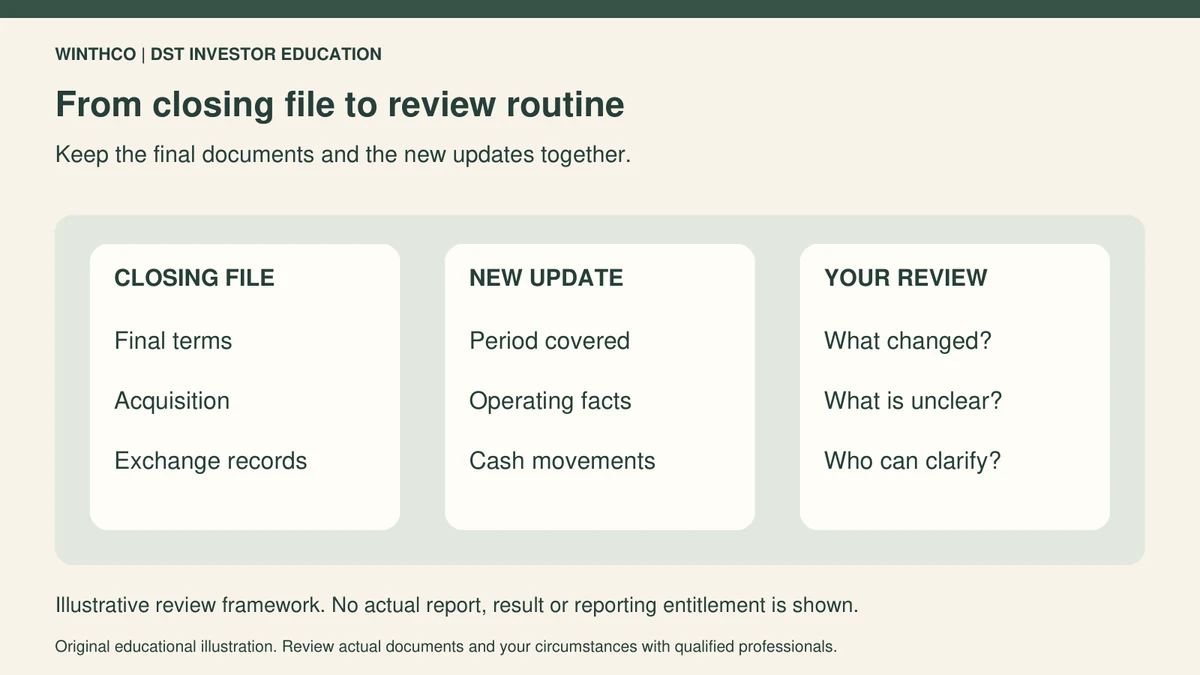
Keep the final private placement memorandum, supplements, trust agreement, accepted subscription, acquisition confirmation and relevant exchange records together. Record the version and date of each document. A preliminary presentation may differ from the terms ultimately accepted. Comparing a later operating update with an outdated slide deck can produce a misleading impression that the investment is ahead of or behind the actual plan.
Ask the sponsor or servicing contact which reports are expected, their usual timing, the period covered and how material notices will be delivered. Distinguish a contractual reporting commitment from a voluntary marketing update. The SEC explains that private placements do not provide the same disclosure as registered offerings. Do not assume every DST must provide identical quarterly statements, audited accounts or a particular list of metrics; the actual arrangement and applicable requirements need review.
Create a simple information log with the document date, period covered, issuer, questions and responses. Keep originals as well as your summary. If a report is missing, first check the expected schedule and the verified delivery channel. Then request it or an explanation. Lack of a report is a reason for follow-up, but by itself it does not establish misconduct, insolvency or an investor right that the documents do not provide.
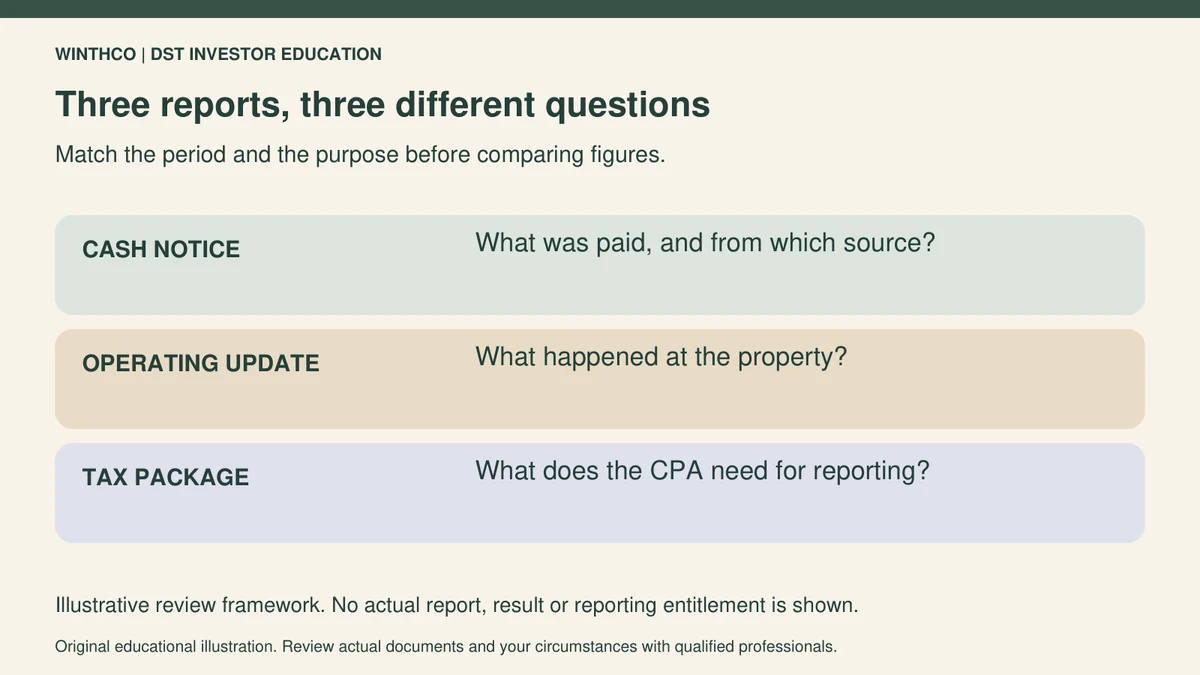
Start with the period. A monthly payment, a calendar-quarter operating report and a year-to-date summary can describe different windows. Match the actual cash received to the distribution notice before comparing either with property results. Confirm whether an amount is shown for the entire trust, a property or your interest. Do not multiply a partial-period payment into an annual income assumption without understanding what it represents.
Ask what funded the distribution and whether the report explains operating cash, reserve movements or other sources separately. A stable payment does not prove that revenue, expenses and reserves were unchanged. Conversely, a reduced payment may reflect several different circumstances that require explanation. Our distribution and rental-cash-flow comparison separates the cash arriving in an investor's account from property earnings and overall investment return.
Read the narrative alongside the numbers. If expenses increased, ask which costs changed, whether the explanation concerns a one-time event or an ongoing issue, and what remains uncertain. If the report compares actual results with a budget, check that the budget period and accounting definitions match. Request clarification of an unexplained difference rather than assuming that a single favorable headline describes the entire investment.
Discuss your DST questions with Winthco →
For a property-level update, ask what the reported occupancy figure measures and whether rent collection, concessions or significant lease expirations are discussed. Physical occupancy is not automatically the same as cash collected. The right questions depend on the property type and actual report. Avoid treating a metric with a familiar label as comparable across every sponsor or building without checking its definition.
Review reserve information together with completed and planned work. Ask which expenses have been paid, which remain estimated and whether the report identifies restricted versus available funds. Our DST reserve-review guide provides a starting point for those questions. The existence of a reserve balance does not establish that every future repair, insurance claim or operating shortfall can be funded without affecting investors.
When property debt exists, look for changes in interest expense, maturity, lender requirements or the financing plan. Ask what has actually been agreed and what remains a proposal. A sponsor's intention to refinance is different from a binding loan commitment, and a proposed sale is different from a completed closing. Do not assume that nonrecourse financing removes the economic effect of debt on distributions or principal.
Winthco's discussion of DST failure risks can frame downside questions, but this guide makes no allegation about a particular sponsor or property. A change deserves a documented explanation that connects the facts, possible consequences and unresolved items. Request written clarification and involve the relevant professional when the response changes your understanding of the investment or conflicts with other documents.
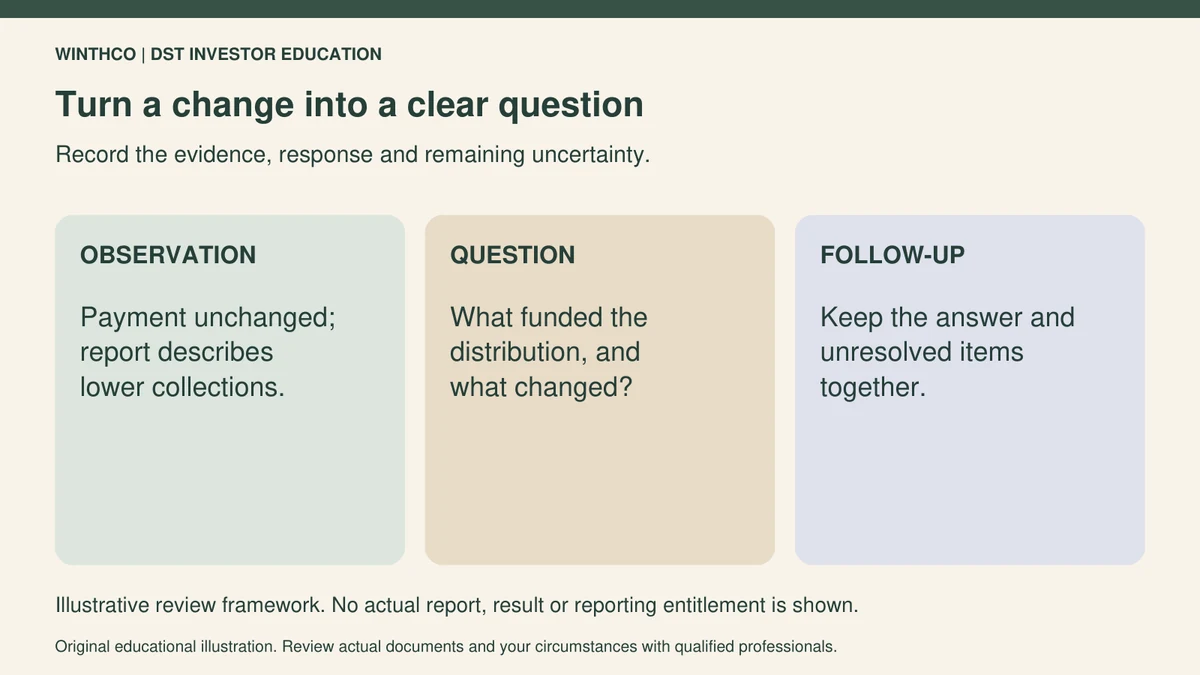
Consider a hypothetical investor receiving the same distribution while an operating update describes lower rent collections and planned capital work. No actual offering or financial outcome is implied. The investor should not conclude that the payment proves conditions are unchanged. A useful question is: which sources funded this period's distribution, and how do the planned expenses affect the available reserves described in the report?
The answer might identify timing differences, previously funded reserves or other facts. Record the answer and any remaining uncertainty without assuming a reassuring explanation proves future payments are sustainable. Assign a follow-up date based on the issuer's stated next update, not an invented deadline. If the information is insufficient for the household's planning, discuss that limitation with the investment professional and, where appropriate, qualified legal counsel.
WATCH & LEARN
Equity Advantage's David Moore and guest Robert Zink discuss reducing day-to-day management work. This third-party background explains why ongoing information matters, not a reporting standard or an offering recommendation. Simplified debt language does not remove economic risk: property debt can affect distributions and principal. Original resource · Watch on YouTube ↗
Educational context only. The discussion does not establish the suitability, returns or tax treatment of an investment.
An operating report, distribution notice and tax package answer different questions. Do not infer taxable income or the correct return treatment solely from cash payments. Winthco's DST tax-reporting background can help prepare questions, but your CPA needs the actual transaction and year-end documents. Ask what information will be issued, when it is expected and how corrections or missing items should be handled.
For an exchange, retain the relinquished and replacement closing evidence, QI records and basis information. The IRS directs taxpayers to file Form 8824 for the year the relinquished property was transferred. Ordinary identification is within 45 days, and completion is by the earlier of 180 days or the return due date including extensions. Those closing rules do not disappear because a later investor statement arrives, and cash retained or other boot can create recognized gain.
Revenue Ruling 2004-86 concerns a specified DST structure; it is not blanket approval of every trust or its reporting practices. Ask the CPA how the actual arrangement is treated and which records should be retained. Use secure channels for tax returns and account documents. An ordinary prospect message is a place to describe the planning question, not to upload confidential financial records.
Separate an announced possibility from an approved or completed transaction. If an update discusses a potential contribution to an UPREIT operating partnership, ask what conditions remain, who controls the decision, whether investor participation is optional and how value and unit rights would be determined. Do not treat a target date as confirmation that a transaction will occur or that investors will receive cash.
Section 721 partnership contributions are a separate framework described generally in IRS Publication 541. Ordinary REIT shares and operating-partnership units generally are not direct Section 1031 replacement real property. Have tax and legal professionals review the proposed structure, liabilities and subsequent redemption consequences. A possible conversion does not itself guarantee liquidity, and FIFO selection does not guarantee tax-free withdrawals of basis.
Private DST offerings are generally limited to accredited investors and made through a private placement memorandum. The SEC highlights limited information, severe illiquidity and potential total loss. Sponsor, property, tenant, financing, fee and tax-law risks remain after acquisition. Reports can improve understanding, but they do not eliminate those risks, give investors day-to-day control or ensure that distributions continue.
Use the review to revisit household assumptions rather than to chase every short-term change. FINRA's concentration guidance emphasizes correlated exposures and illiquid holdings. Consider remaining property, financial assets, 401(k)s and IRAs alongside accessible reserves and retirement spending. A hoped-for DST sale or future unit redemption should not become the only funding plan for an essential expense.
Winthco's wealth-management discussion can connect the property transition with retirement income, asset allocation, beneficiaries and coordination with tax and estate professionals. A sale does not automatically justify a rollover or transferring other accounts; compare options, services and costs separately. Retirement accounts are not themselves exchange proceeds. Use the prospect form to discuss your sale stage or the reporting questions you want clarified before committing.
| Decision | Evidence to request | What to avoid assuming |
|---|---|---|
| Distribution notice | Amount, period and stated cash source | An unchanged payment proves unchanged operations |
| Operating update | Definitions, actual results and explanations | Different sponsors calculate every metric identically |
| Reserve and debt update | Available funds, obligations and confirmed commitments | An intention to refinance is a completed financing |
| Tax package | Actual taxpayer and transaction information | Cash received equals taxable income |
| Possible 721 notice | Conditions, rights, valuation and tax review | A target date creates a cash withdrawal right |
Do not assume that. Review the actual document provisions and ask the issuer to clarify the expected reporting schedule, content and applicable requirements.
Not necessarily. Compare the stated cash source, operating period and reserve information. A payment alone does not explain the underlying results.
No. Confirm the expected schedule and contact the verified servicing channel. Persistent gaps or conflicting information warrant further professional review.
Do not assume they are the same. Provide the actual tax package and transaction records to the CPA for the applicable treatment.
No. Review conditions, approval status, unit rights, restrictions and taxes. A proposal is not a completed transaction or liquidity guarantee.
Describe your sale stage and the question you want to discuss. Request a secure channel before sharing account numbers, tax returns or other confidential records.
Sources checked October 20, 2026. This article explains general concepts; your facts and the applicable documents control.
Winthco DST services · Winthco evaluation overview · Editorial standards
DST due diligence
Review DST loan maturity, balloon payments and exit assumptions before exchanging a rental. Prepare questions about debt and household liquidity.
Read guide →DST due diligence
Review DST affiliated-party transactions, compensation, valuation and possible 721 conflicts before committing property-sale proceeds.
Read guide →1031 exchange planning
Planning a late-year property sale? Review how a return extension, DST closing requirements and household liquidity affect your exchange plan.
Read guide →Explore Winthco’s main DST article collection
Share your timeline and investment range. A Winthco team member will follow up with you.