DST investment due diligence
DST Private Placement Memorandum: What to Review
Selling a rental property? Learn how to review a DST private placement memorandum, compare fees and risks, and assess separate 721 UPREIT terms.
Read guide →
Home / Learning center / Local Guides
Local Guides
Winthco Wealth Management · Updated November 14, 2026
Before selling a Lawndale rental, compare the advertised unit count and square footage with city permit records, approved plans and final inspections. Ask your broker to price any uncertainty separately. If you are considering a 1031 exchange, arrange the qualified intermediary before the sale transfers and evaluate any replacement DST on its own merits.
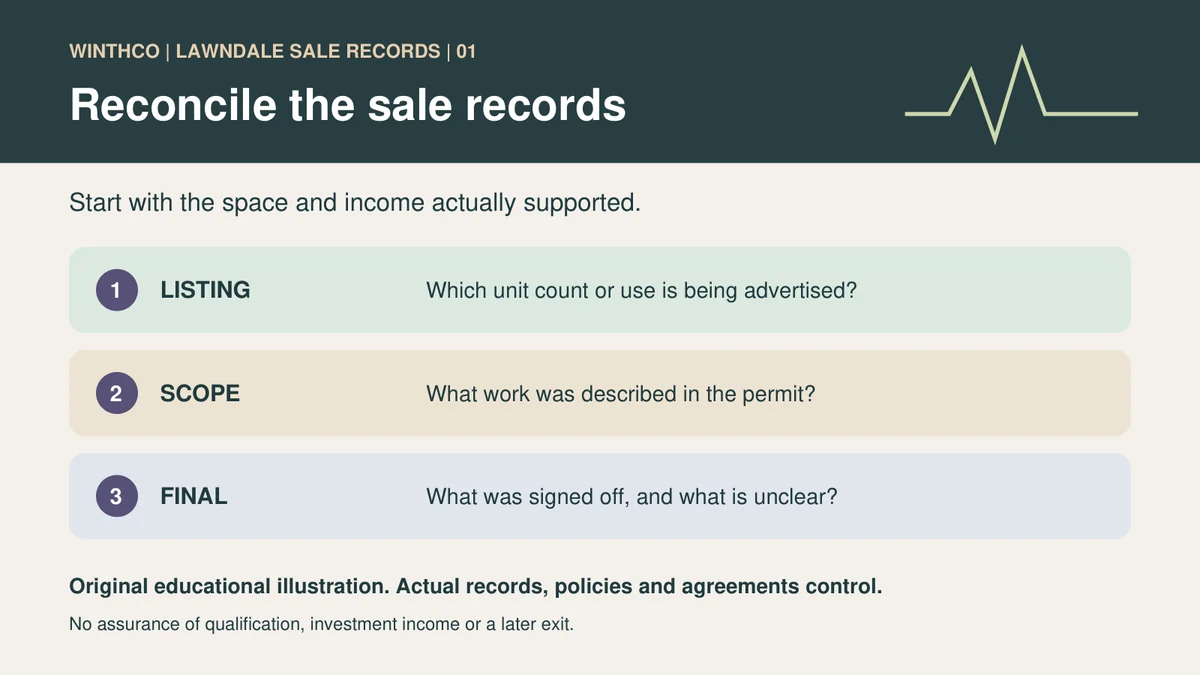
Interview an appropriately licensed broker who has sold small income properties in the South Bay. Ask how they select comparable sales, what fees you will pay, and how they would market an occupied property with an addition whose permit history is unclear. Request separate estimates for the property as documented and for any additional space with evidence of lawful use. Gather leases, rent records, disclosures, and plans before the broker relies on a particular unit count or income figure.
Lawndale's Online Permit Archive describes access to historical and current building permit records and says finalized, canceled, and expired permits are uploaded. A permit entry is not by itself a final inspection or current approval to rent the space. Compare the work description, address, permit status and any available final sign-off. If a file is missing or inconsistent, ask the city's Permit Center how to obtain further records and whether the Residential Property Report applies to your sale. Do not treat silence in an online archive as proof of either compliance or a violation.
Share your timeline and investment range. A Winthco team member will follow up with you.
Before transfer or receipt of proceeds, have a qualified intermediary set up the deferred exchange and ask your CPA and attorney to review ownership and closing terms. The broker can update marketing, price and credits; escrow can confirm transfer and disbursement details; your tax adviser can model gain, basis and potential taxable amounts. A late change in sale terms is a reason to update the comparison with replacement options, not to rely on the original proceeds estimate.
For qualifying real property held for investment or productive use in a trade or business, Section 1031 may defer eligible gain. In an ordinary deferred exchange, written identification is due within 45 days of transfer, and the replacement must be received by the earlier of 180 days or the federal return due date, including extensions. A price adjustment after negotiation does not give a second clock after transfer. Cash received or other non-like-kind consideration can result in recognized gain, and the treatment of debt or settlement costs depends on the facts. Review Winthco's overview of DST interests in a 1031 exchange and ask your CPA whether California's reporting rules apply if the replacement is outside the state.
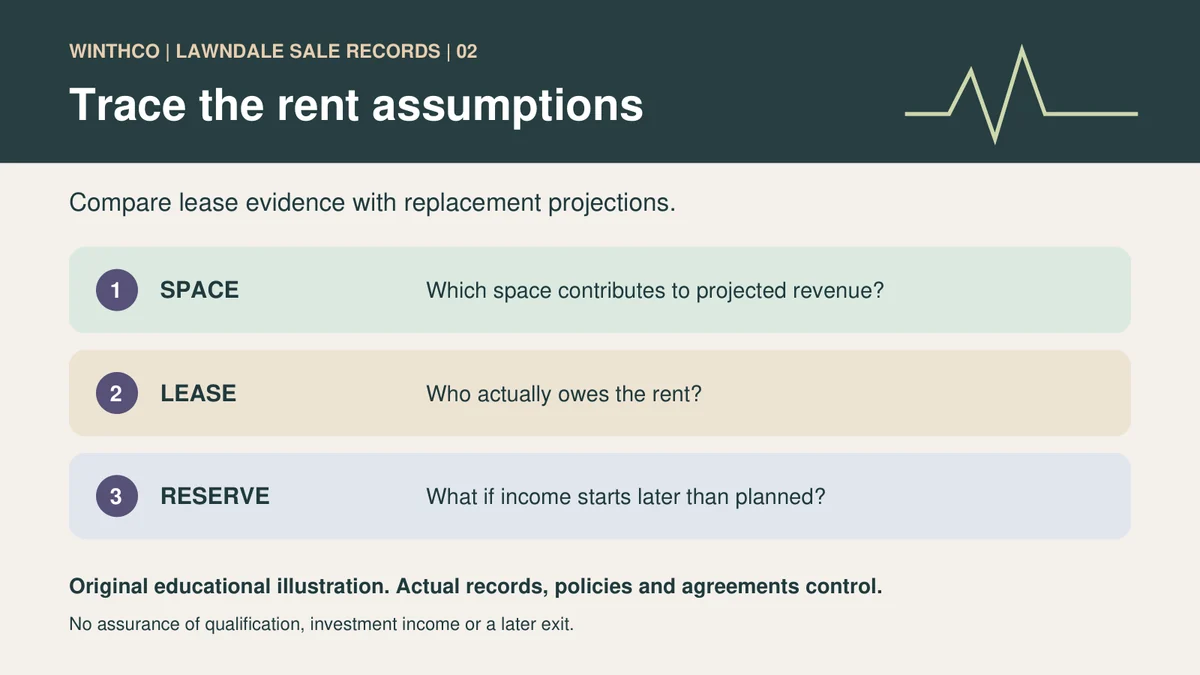
The same question that matters to a Lawndale buyer matters to a DST investor: what space supports the income in the underwriting, and what evidence shows it can be used as assumed? A qualifying DST interest may reduce direct landlord work, but investors have limited control over the property. IRS Revenue Ruling 2004-86 analyzes one particular trust structure, not every DST. Review the actual private placement memorandum and trust documents with your advisers before assuming the interest is eligible.
Compare the sponsor's rent roll and leasing assumptions with the property condition assessment, known permit issues, and executed leases or master lease. Ask how much revenue depends on space under renovation, a change in use, or occupancy that has not yet occurred. If rent is credited through a master lease, identify the tenant that owes rent to the trust and examine whether that party can cover its obligation if assumptions disappoint. Check which repairs are the tenant's responsibility, which costs fall to the trust, and how a delay would affect reserve use and debt payments. Winthco's guide to evaluating a DST offering provides a framework for reviewing the supporting records.
Ask for a downside case that removes or delays the rent in question without assuming expenses fall at the same time. Review what reserves are funded, what is subject to lender approval, and whether the loan matures before the projected property sale. A large projected reserve is not equivalent to cash available for the next repair. Ask who can approve changes, what the trust documents allow, and where the shortfall would show up first: property operations, debt compliance or investor distributions. Ask for the date of each source document as well as its label. A rent roll prepared before a renovation can disagree with a later inspection report without explaining why. Make a short list of discrepancies, the documents needed to resolve them and who is responsible for getting each answer. If nobody can reconcile a material income assumption before closing, compare the investment without that income instead of silently treating the projection as established.
Discuss your DST questions with Winthco →
Hypothetical: A Lawndale owner plans to list a duplex and describes a converted garage as a third rental. The archive shows a permit for earlier work, but the seller does not see a final approval for that use. The broker values the documented duplex and treats the extra income as unresolved. The seller's attorney advises on disclosures and the CPA reruns the expected proceeds. Instead of racing to match the original exchange budget, the seller compares a smaller directly owned replacement, a qualifying DST if available, and a taxable sale.
For an offering, compare the amount actually invested in real estate after upfront costs, compensation to parties and affiliates, recurring property costs, and fees or debt costs at sale. Ask how long the sponsor expects to hold the property and whether you have any say over timing. Private placements can have limited disclosure, significant transfer restrictions, little resale market and loss of principal. Distributions can be reduced or suspended. Many DST offerings limit participation to accredited investors, and accreditation does not establish that the investment fits the household. Direct ownership may offer more control but leaves more of the leasing, borrowing and repair decisions to you.
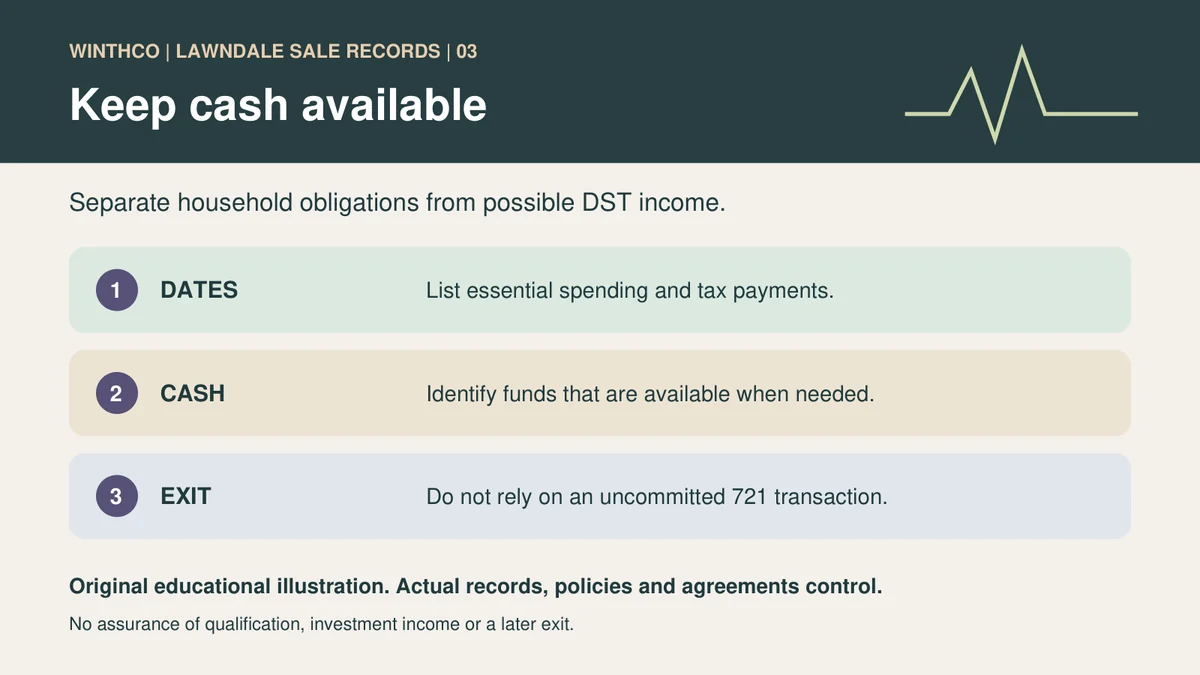
A later contribution to a partnership in exchange for an interest in that partnership is a separate decision under Section 721, not a second step every DST completes. In an UPREIT structure the partnership interest may take the form of operating partnership units. Those units and ordinary REIT shares are not direct replacement real estate under Section 1031. Ask who can approve any property contribution and what happens if it is never offered. If an option does arise, have counsel and your CPA review transfer restrictions, when redemption is allowed, and what tax consequences could follow from a redemption or sale. Do not use an uncommitted transaction as the exit assumption.
WATCH & LEARN
Accruit introduces DST interests as possible 1031 replacement property. This third-party overview does not verify a property's use, lease income or suitability. Original resource · Watch on YouTube ↗
Educational context only. The discussion does not establish the suitability, returns or tax treatment of an investment.
Set out essential expenses, known tax payments and major family commitments on a calendar. Compare them with assets you can access even if a replacement pays nothing for a period. Ask whether the real estate you would retain is concentrated by region, tenant, sponsor or type. Review taxable investments, 401(k)s and IRAs separately with your advisers, including costs, services and beneficiary arrangements. A retirement account is not a place to park exchange proceeds, and a rollover need not be part of the decision.
Bring a one-page comparison of net proceeds, accessible cash and who will handle property decisions under each route. If the documented sale value is lower than expected, decide which obligations need funding before setting a reinvestment amount. A planning conversation with Winthco can start there. Use the prospect form on this guide or the dedicated contact page, and keep tenant files and personal tax records out of the form.
City-area context only. This is not a parcel map or a Winthco office.
| Decision | Evidence to request | What to avoid assuming |
|---|---|---|
| Lawndale sale | Scope, status and final inspection records | An archived permit approves the marketed use |
| 1031 exchange | Actual transfer date, identification and funds | An amended deal restarts the clock |
| DST purchase | Leases, reserve requirements, fees and loan terms | Every projected rent item is currently collectible |
| Retirement and exit | Accessible assets and documented redemption terms | A future 721 contribution supplies cash on demand |
No. Compare the authorized scope and status with available records, and confirm unresolved use questions with the city.
No. In an ordinary deferred exchange the actual transfer date starts the calendar, not the negotiated amount.
It can remove day-to-day landlord duties, but the sponsor's decisions and property risks still affect investors.
Do not assume so. Review the governing transfer and exit terms and plan for a limited resale market.
Use the relevant city office and legal advisers for the property file, and a qualified CPA for tax analysis. A QI and an investment adviser have different roles.
Sources checked November 14, 2026. This article explains general concepts; your facts and the applicable documents control.
Winthco DST services · Winthco evaluation overview · Editorial standards
DST investment due diligence
Selling a rental property? Learn how to review a DST private placement memorandum, compare fees and risks, and assess separate 721 UPREIT terms.
Read guide →DST due diligence
Learn how DST lease expirations, renewal assumptions, downtime and re-leasing costs can affect cash flow. Prepare a document-based review.
Read guide →Local DST guides
Selling a Hawthorne rental? Reconcile unit records, plan the 1031 before closing, and compare DST risks with your retirement cash needs.
Read guide →Explore Winthco’s main DST article collection
Share your timeline and investment range. A Winthco team member will follow up with you.