Property sale planning
Before Listing a Rental: DST and 1031 Planning
Prepare a rental sale with broker questions, 1031 timing, DST and separate 721 review, and retirement planning before committing proceeds.
Read guide →
Home / Learning center / Local DST guides
Local DST guides
Winthco Wealth Management · Updated November 8, 2026
Before selling a Hawthorne rental and comparing a Delaware statutory trust, reconcile how many units the broker plans to market with the leases and the city's records. A discrepancy can change the buyer's underwriting or closing timeline. Plan any 1031 exchange before closing, then test a DST against your liquidity needs.
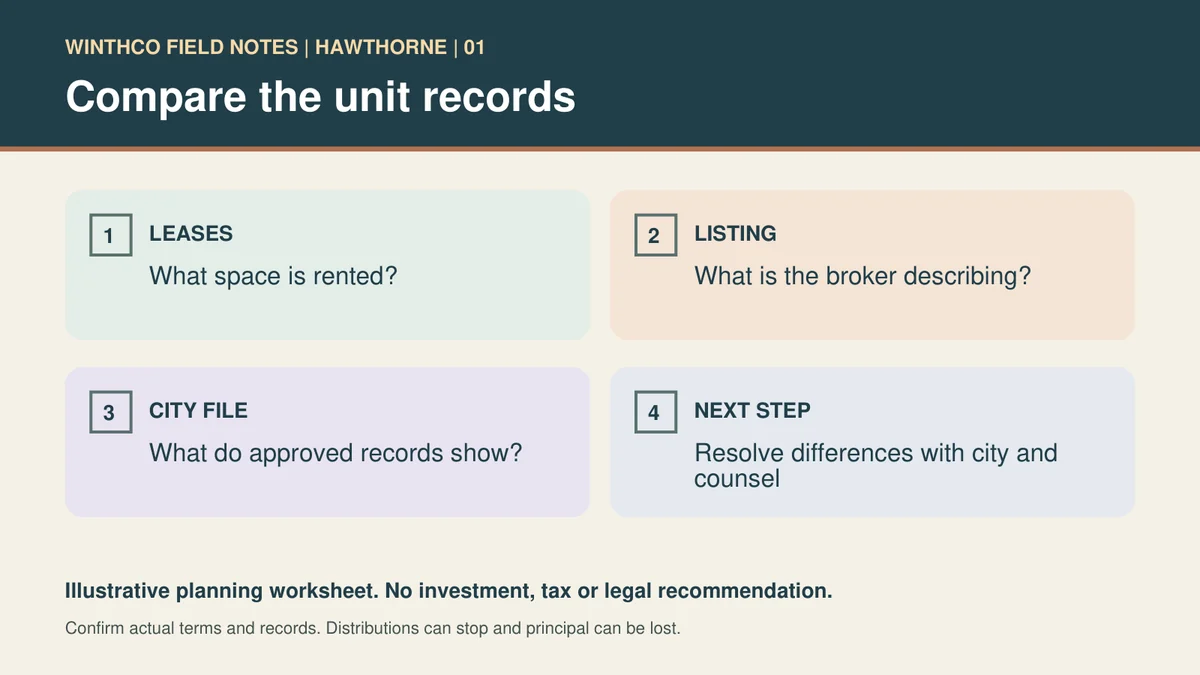
Start with a broker who has handled sales of similar rentals in Hawthorne or nearby markets. Ask for comparable closed sales with similar unit mixes and occupancy, an estimate of selling costs, and two views of likely buyer underwriting: one based on documented units and one showing how unresolved space might be discounted. Have the broker explain how a buyer's appraiser and lender might treat the difference, and what happens to price or timing if a buyer will not count that income. Request a marketing and disclosure plan, rather than assuming that a higher advertised unit count will bring a better result. The Lawndale permit-scope checklist offers a related example of distinguishing advertised use from documented work.
Suppose, hypothetically, a four-unit building has a separately leased rear room that the rent roll labels as a fifth unit. Gather lease descriptions, payment history, available permits, approved plans and inspection or occupancy records. Ask Hawthorne Building and Safety and Planning how the particular space is documented. Hawthorne Municipal Code Chapter 15.75 addresses enforcement for projects including alterations and changes of use; Chapter 17.04 incorporates the official zoning map. Neither provision tells you, on its own, what is approved for a particular parcel. Do not treat a lease, a separate meter or an assessor entry as approval. Ask counsel about disclosure and tenancy issues before changing a listing or contacting a tenant about their occupancy.
Share your timeline and investment range. A Winthco team member will follow up with you.
Put the buyer's diligence deadline, financing conditions and expected transfer date on one calendar. Bring a CPA, real estate attorney and qualified intermediary into the discussion before closing or receiving sale proceeds. If the transaction is structured as a deferred Section 1031 exchange, the IRS generally requires identification within 45 days after transfer of the relinquished property and receipt by the earlier of 180 days after transfer or the return due date, including extensions, for the year of transfer. A later closing can move those dates, but a replacement seller's delay after your own sale generally does not reset them. Use the Winthco overview of 1031 timing rules as background and confirm your actual dates with your exchange and tax professionals.
Discuss your DST questions with Winthco →
Ask your CPA to reconcile estimated net cash with the potential gain calculation. Sale price, proceeds, adjusted basis and taxable gain are different figures. Bring acquisition and improvement records, depreciation schedules, loan payoff details and a draft closing statement. Cash or other non-like-kind property received, or net debt relief that is not appropriately offset, can affect recognized gain. Ask for an exchange scenario, a partial exchange scenario and a taxable sale scenario. If replacement property would be outside California, have the CPA check applicable California reporting, including whether Form FTB 3840 applies. Get a revised estimate if the sale price, concessions or debt figures change.
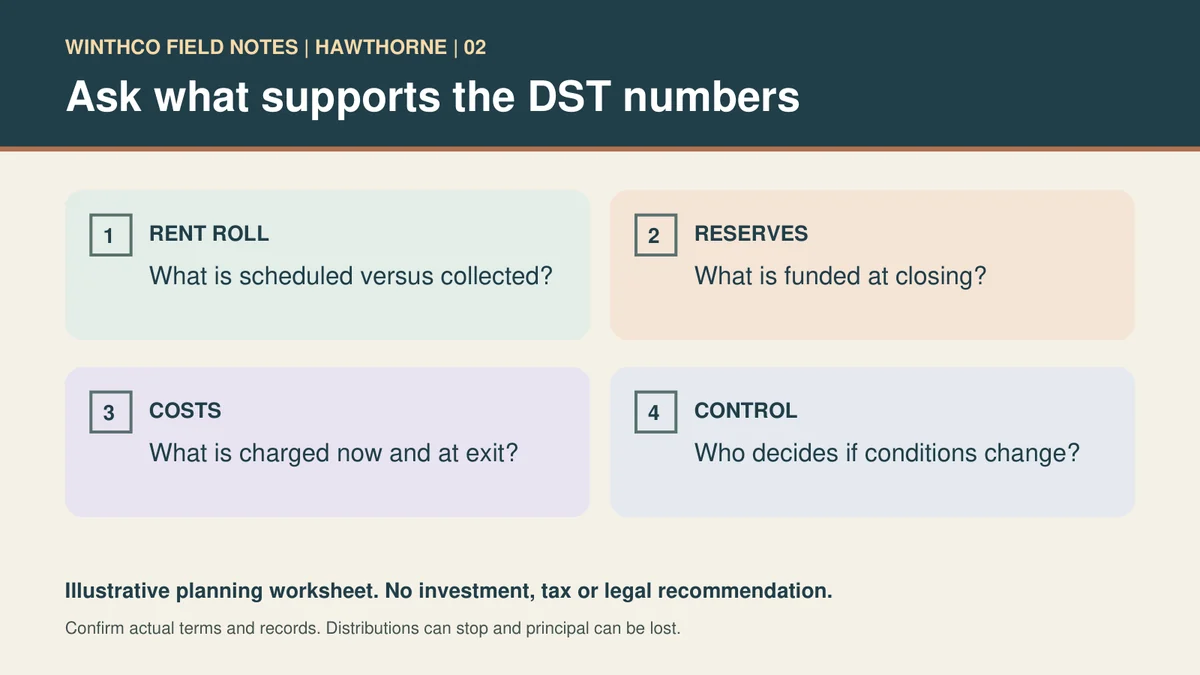
The same discipline used to reconcile the Hawthorne rental applies on the buying side. IRS Revenue Ruling 2004-86 discusses a particular trust whose qualifying interests were treated as ownership interests in real property for the ruling's facts; the DST label alone is not enough. Read the private placement memorandum, trust agreement and financial materials with your advisers. Ask for the date of the underlying rent roll, how concessions and delinquent accounts are handled, and whether income shown to investors is collected or merely scheduled. If a master lease is involved, review the master tenant's obligations and financial capacity separately from what occupants pay. The Winthco checklist for evaluating a DST offering provides a starting point for those questions.
WATCH & LEARN
David and Tom Moore of Equity Advantage 1031 Exchange explain written identification and the exchange calendar. This third-party video is general education, not Hawthorne permit guidance or investment advice. Original resource · Watch on YouTube ↗
Educational context only. The discussion does not establish the suitability, returns or tax treatment of an investment.
Separate acquisition and offering costs, recurring management or administration charges, financing costs and expenses that could apply at exit. Identify which reserves are funded at closing, what they are intended to cover and what may happen if they prove insufficient. A sponsor's projected distribution is not the same as rental receipts or net cash available to investors. Compare the base case with a slower lease-up, a large repair, a tenant default or a higher cost of debt when relevant. Ask what the documents allow the trustee to do and what choices individual investors do not control. A lender's appraisal or a sponsor's valuation does not settle the question of what an investor might receive at disposition.
Assume, hypothetically, the Hawthorne seller wants to stop managing tenants. A directly owned replacement property could preserve more control over repairs, borrowing and the eventual sale, but someone still has to manage it and carry the operating risk. A qualifying DST may reduce direct management, but the owner accepts decisions made under the trust documents and may have few options to sell the interest. Compare the choices using the same measures: near-term cash needed, total expenses, exposure to a major tenant or sponsor, downside cash flow and a realistic holding period. A taxable sale is also a comparison point, especially when the exchange choices do not fit the seller's goals.
Imagine that the seller identifies a qualifying DST interest and then learns that a significant tenant has given notice. Ask for updated operating materials and whether the assumptions used at identification still hold. Separately, ask the intermediary what the existing identification actually permits and which alternatives remain available. Do not assume an option that was discussed, reserved or underwritten but not properly identified can simply be substituted after the identification period. Let the investment and tax decisions stand on their own evidence.
Private placement interests can be difficult to value and sell. DST offerings are generally directed to accredited investors, and offering documents govern eligibility and terms. Limited control can matter when distributions fall, a tenant fails, the property requires work or a sale takes longer than expected. A portfolio with several DSTs can still concentrate exposure in the same sector, market, financing structure or sponsor. Check whether you could meet spending needs without distributions or an early exit. Fees reduce the money available to invest or distribute, tax law may change and investors can lose principal. No identification deadline makes an unsuitable investment more suitable.
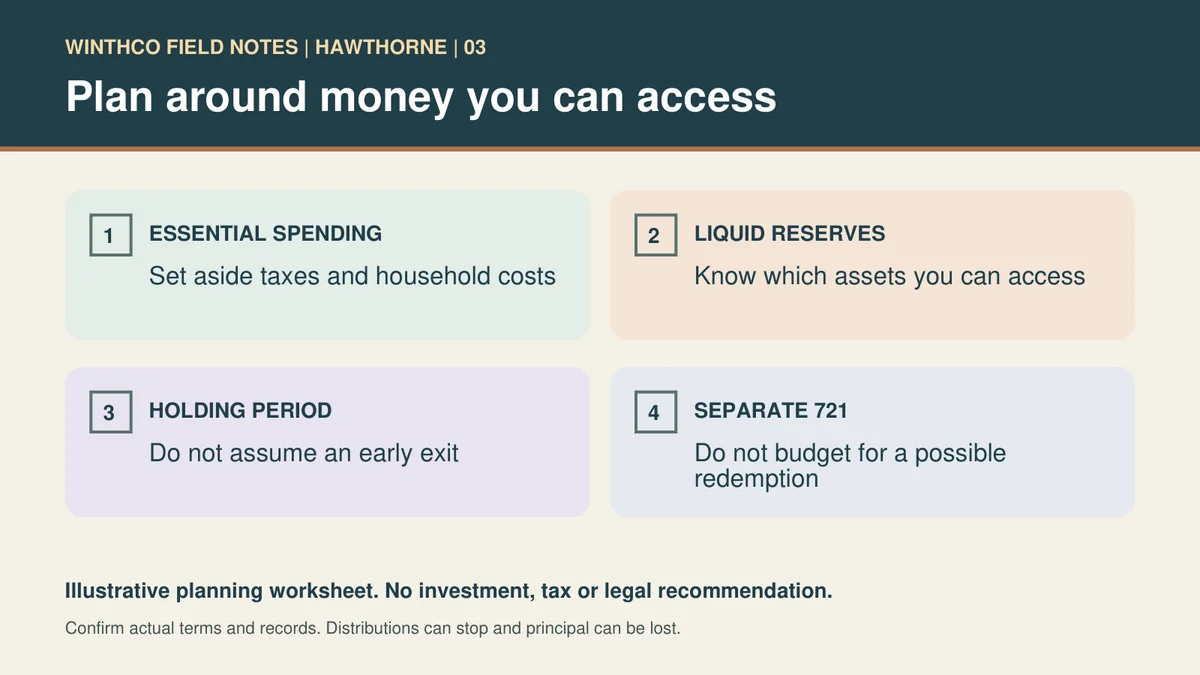
No. A possible contribution of eligible property to an operating partnership in an UPREIT is a separate transaction with its own terms and tax analysis. It may never be offered or completed. Operating partnership units and ordinary REIT shares are not direct replacement real property in a Section 1031 exchange. If a later transaction is proposed, ask who controls it, what consideration you would receive and what holding restrictions, redemption limits, valuation terms and tax consequences apply. Have counsel and your CPA review the actual documents. Do not count a potential contribution or redemption as money available on a date you need it.
Start with spending that cannot wait, such as taxes, household expenses and emergency reserves. Then compare that need with resources already available outside the property, including taxable assets, retirement accounts and any other dependable income. Review existing IRA and 401(k) investments, fees and services without assuming a transfer or rollover is appropriate. Coordinate beneficiary and estate questions separately with counsel. Winthco Wealth Management can help compare your property choices with your overall allocation and retirement-income needs. The rental seller's pre-listing checklist can help organize a first conversation with your broker and advisers. Keep sensitive documents out of the prospect message field.
Geographic context only. Not a Winthco office or parcel zoning determination.
| Decision | Evidence to request | What to avoid assuming |
|---|---|---|
| Rent roll | Leases, receipts and dates | That every listed space is approved as a unit |
| City file | Plans, permits and status for the parcel | That a generic map or permit settles the unit question |
| Replacement DST | Offering documents, operations, fees and control | That projections or appraisals equal exit proceeds |
| Retirement budget | Liquid assets, essential spending and reserves | That distributions or redemptions will cover spending |
No. It describes rental arrangements or income. Confirm how the specific property and spaces are documented with the city and obtain legal advice on discrepancies.
Generally it begins on the date you transfer the relinquished property. Ask the intermediary to confirm the date and identification procedure for your transaction.
A CPA and counsel can evaluate the tax treatment of the actual trust and your exchange. The intermediary handles the exchange arrangements; an investment adviser can help review offering risks and portfolio fit.
Do not rely on it. A contribution might not happen, and any later redemption would be subject to its own terms, restrictions and tax consequences.
No. It shows the city area for geographic reference and is not a parcel or zoning map. The campaign's verified Winthco office is in Simi Valley.
Sources checked November 8, 2026. This article explains general concepts; your facts and the applicable documents control.
Winthco DST services · Winthco evaluation overview · Editorial standards
Property sale planning
Prepare a rental sale with broker questions, 1031 timing, DST and separate 721 review, and retirement planning before committing proceeds.
Read guide →DST due diligence
Learn how to review DST appraisals, compare acquisition costs and separate property value from investor proceeds before a 1031 exchange.
Read guide →DST due diligence
Review DST downside scenarios, cash-flow assumptions and exit risks before investing. Learn what a stress test can reveal and what it cannot promise.
Read guide →Explore Winthco’s main DST article collection
Share your timeline and investment range. A Winthco team member will follow up with you.