1031 replacement property
DST vs 721 UPREIT after a property sale
Compare DST and 721 UPREIT paths, tax rules, ownership, liquidity, control and risks before a property sale or exchange.
Read guide →
Home / Learning center / California advisor guides
California advisor guides
Winthco Wealth Management · Updated October 30, 2026
A Malibu owner considering a DST advisor should organize the coastal property's use, permits and operating records before listing, while the CPA, attorney and qualified intermediary review sale alternatives before closing. Compare reduced management with DST fees, limited control and illiquidity, and evaluate any possible 721 contribution separately within the household's retirement plan.
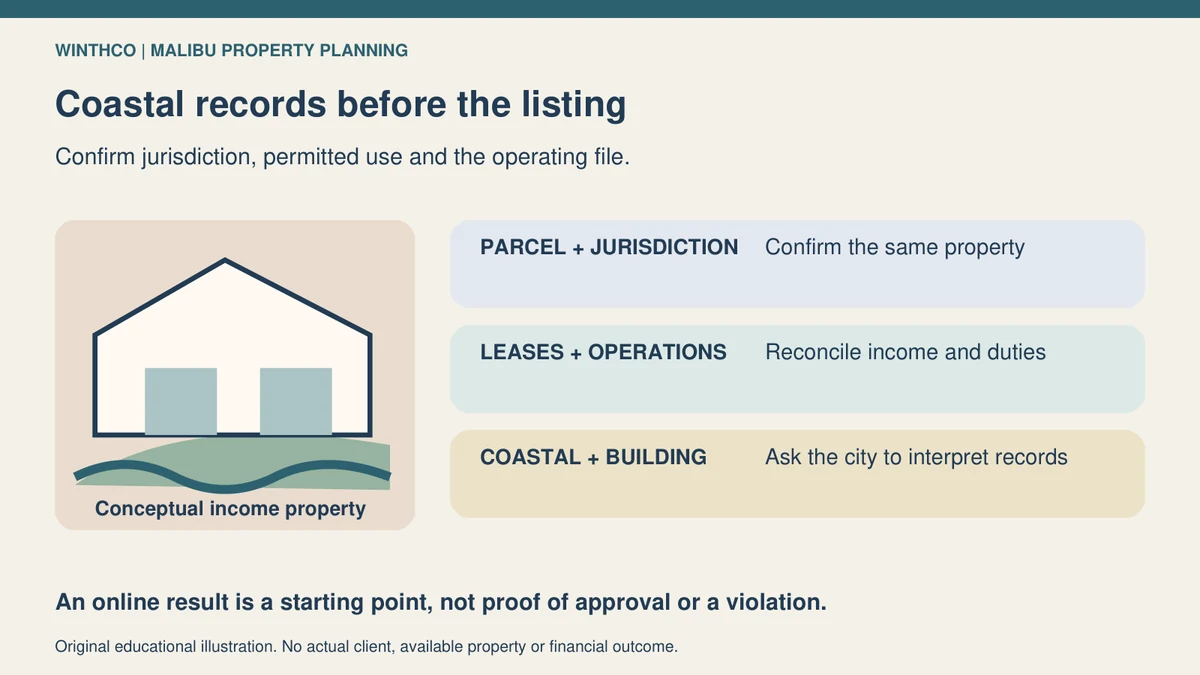
Start with what the sale needs to accomplish. Interview appropriately licensed realtors or commercial brokers about the actual property type, relevant sale evidence, tenant occupancy, marketing, compensation and contingencies. Ask how they would separate documented rental operations from assumptions about future use or improvements. Verify the California license and written scope. A securities adviser does not automatically provide brokerage, legal, tax or exchange-administration services.
Build a sale file with deeds, leases, rent records, operating expenses, insurance, debt payoff terms, improvement history and permits. Explain known cash needs and any unresolved property questions. If a deferred exchange is contemplated, involve the CPA, attorney and QI before closing or receiving proceeds. The replacement-investment conversation should begin while alternatives remain available, not only after a buyer sets a closing date.
Share your timeline and investment range. A Winthco team member will follow up with you.
The City of Malibu states that the entire city is within California's coastal zone and describes its Local Coastal Program as the framework for coastal land use and development, subject to applicable exemptions. For a seller, the practical question is what the property's actual approvals and conditions establish. Do not infer a permitted use, expansion right or approval from a coastal address, marketing description or neighboring property. Ask city staff and qualified counsel to interpret the relevant file.
Malibu's public-records page describes OnBase access to building permits, geology reports and septic approvals, along with NextRequest for public-records requests. Match the address and assessor's parcel number to the records, then identify gaps or inconsistencies with the sale team. The city's permit-search page also directs owners to confirm city limits, because some Malibu-addressed properties are in unincorporated Los Angeles County. The map below shows the city area, not a Winthco office or parcel boundary. These resources support diligence; they do not establish a particular property's compliance.
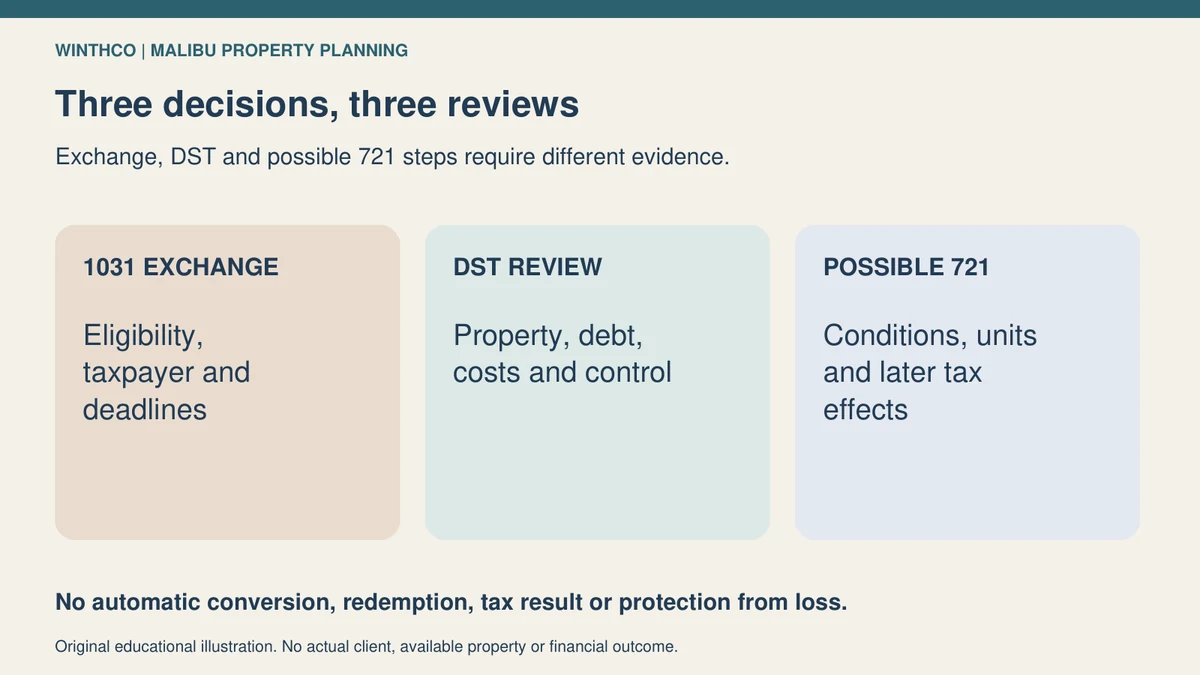
Section 1031 can defer eligible gain on an exchange of qualifying business or investment real property when its requirements are satisfied. Deferral does not eliminate tax, establish investment suitability or make personal-use property eligible. The CPA should review the taxpayer, ownership, use history, basis, depreciation and liabilities. Mixed personal and rental use calls for specific analysis rather than a conclusion based solely on the property's listing category.
In an ordinary deferred exchange, replacement property generally must be identified within 45 days after transfer of the relinquished property and received by the earlier of 180 days or the applicable return due date, including extensions. Confirm the actual dates and receipt restrictions with the QI and tax preparer. The 1031 replacement alternatives are discussion starting points, not assurance that any specific replacement will qualify or remain available. Compare a taxable sale, partial exchange and full exchange before committing the household's liquidity.
Discuss your DST questions with Winthco →
A Delaware statutory trust may hold identified real estate while investors own beneficial interests. Under the particular facts of IRS Revenue Ruling 2004-86, the interests were treated as direct real-property interests for federal tax purposes. The ruling is not blanket approval of every trust carrying a DST label. Have qualified professionals review the offered interest and the actual exchange requirements.
A DST can reduce the owner's direct involvement in leasing, tenant calls and repair coordination. That potential convenience has a corresponding cost in control: investors generally do not make the same operating decisions as direct owners. Ask who manages the property, uses reserves, administers debt and determines a sale. An expected holding period is not a personal cash-withdrawal right or a guaranteed exit date.
Read the private placement memorandum, trust agreement, subscription documents and amendments before comparing projections. DST interests are generally offered through private placements to accredited investors; eligibility does not prove suitability. A Malibu property's large sale value does not determine how much of the household's wealth should enter one illiquid investment. Use the DST ownership overview to frame questions, then examine the actual property, sponsor and governing documents.
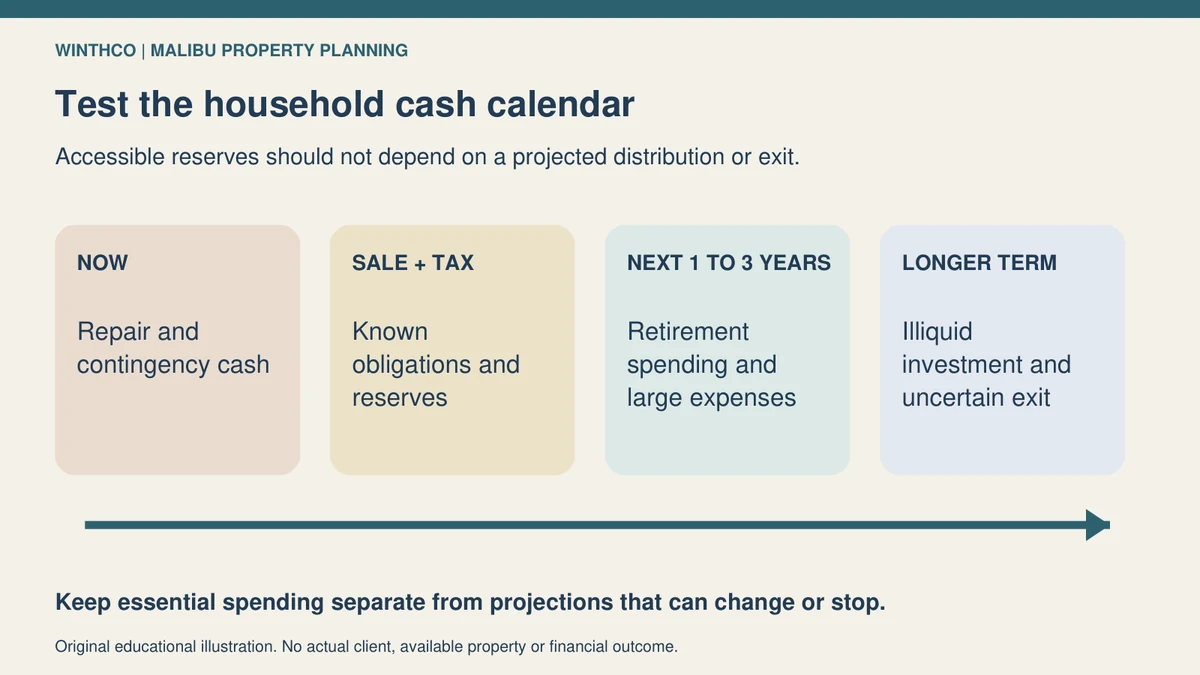
Reconcile net cash flow rather than comparing gross Malibu rent with a DST distribution target. Account for vacancy, concessions, management, insurance, taxes, maintenance, debt service and capital needs. If the sale file contains uncertain use, improvement or permit assumptions, ask the broker and counsel how those uncertainties affect buyer diligence. Carry that same evidence-first approach into the replacement review.
A DST distribution can change or stop. Ask how projected payments relate to current property operations, reserves and other sources, and what expenses are excluded. Review acquisition, financing, organization, property-management, asset-management and disposition costs, including affiliate compensation. A quoted distribution percentage is not total return, and past payments do not establish the eventual sale value or protect invested principal.
Stress-test tenant losses, rising expenses, property damage, reserve shortfalls, loan maturity and delayed exits. Replacing one coastal property with multiple DST names does not necessarily diversify shared sponsors, lenders, tenants, property sectors or regions. FINRA's concentration guidance supports reviewing the whole portfolio, including holdings that are difficult to sell. The property insurance diligence guide adds questions about coverage assumptions without substituting for the actual policy or an insurance professional's advice.
WATCH & LEARN
Winthco Wealth Management introduces its DST educational resources. This is general background, not Malibu coastal-permit guidance, an offering recommendation or a promise of income, liquidity or tax treatment. Original resource · Watch on YouTube ↗
Educational context only. The discussion does not establish the suitability, returns or tax treatment of an investment.
Section 721 generally concerns contributions of property to a partnership in exchange for partnership interests, subject to exceptions and the transaction's facts. An UPREIT commonly owns real estate through an operating partnership associated with a REIT. This framework is different from Section 1031. Ordinary REIT shares and operating-partnership units generally are not direct 1031 replacement real property.
Some DST materials discuss a potential later operating-partnership contribution. Ask who controls timing, which conditions remain, how value and debt would be measured and what happens if the event never occurs. Evaluate the initial DST without depending on that possibility. Reduced management duties today do not establish a right to choose a later conversion or obtain cash on a particular date.
If a real proposal arises, the CPA and attorney should examine the separate documents, unit rights, debt allocations, distributions and redemption consequences. Transfer restrictions and taxes can remain relevant after a contribution. A stated holding period or FIFO selection does not guarantee conversion, cash or tax-free basis withdrawals. The DST and 721 distinction can help organize the two reviews without depicting them as an automatic sequence.
Consider a hypothetical owner of a Malibu rental who wants less repair coordination and more time for retirement. The owner also expects a major household expense within several years. This illustration represents no actual client, property or investment result. Before listing, the broker helps reconcile the operating file, while city records and professional review clarify the property's approved configuration and any unanswered coastal or improvement questions.
The CPA and QI compare sale alternatives before closing. The investment review considers a direct replacement, qualifying DST interests and retaining accessible cash through a taxable or partial-exchange approach. It does not assume a future distribution, property sale or 721 event. The household separates known spending dates from uncertain investment dates. That can reveal a liquidity mismatch before the owner signs subscription documents, when the proposed commitment can still be reconsidered.
Private placements may provide limited disclosure and be highly illiquid, and the SEC cautions that investors can lose their entire investment. DST risks include property, tenant, sponsor, leverage, valuation, fees, conflicts, concentration and tax-law changes. Distributions may decline or stop and principal can be lost. Exchange eligibility and accreditation are not protections against these risks.
California reporting also needs an assigned owner. The FTB describes Form 3840 reporting when California real property is exchanged for out-of-state property and California-source gain or loss remains deferred. Reporting can continue in later years. Keep the sale, exchange, basis and subsequent-transaction records together and have the CPA confirm the actual federal and state filings. This guide does not determine property-specific disaster relief or insurance-proceeds tax treatment.
Winthco's wealth-management conversation can connect the decision with retirement-income needs, existing financial assets, 401(k)s, IRAs, liquidity, asset allocation and beneficiary or estate coordination. The DST estate-planning questions support that broader review. A property sale does not automatically justify a retirement-account rollover, securities transfer or advisory relationship; compare options, costs and services separately. Retirement accounts are not themselves 1031 proceeds. Use the prospect form for the planning question, and request a secure process before sending confidential records.
Malibu, California, for geographic context, not a Winthco office or parcel-boundary determination.
| Decision | Evidence to request | What to avoid assuming |
|---|---|---|
| Keep with hired management | Net operations, duties and control | Delegation removes property risk |
| Taxable or partial sale | Tax cost and accessible cash | Every dollar must enter an exchange |
| Qualifying DST replacement | Documents, sponsor, property, fees and debt | Tax eligibility proves suitability |
| Possible later 721 | Conditions, valuation, unit rights and taxes | A target holding period guarantees cash |
This guide does not claim one. The verified main contact page lists Simi Valley. The Malibu map provides city-area context only.
Not necessarily. The city directs owners to check city limits before requesting permits. Confirm the parcel's responsible jurisdiction before relying on a records source.
No. A record search helps organize evidence but does not establish a complete file or legal conclusion. Ask city staff and qualified professionals to interpret approvals and gaps.
No. Section 1031 concerns qualifying business or investment real property. The CPA should examine actual use and any personal/rental allocation.
Not necessarily. Verify credentials, engagement and scope. Tax analysis, legal advice, securities services and exchange administration have different responsibilities.
No. It may not occur, and unit rights can limit transfer or redemption. Review the actual conditions and tax consequences separately.
Sources checked October 30, 2026. This article explains general concepts; your facts and the applicable documents control.
Winthco DST services · Winthco evaluation overview · Editorial standards
1031 replacement property
Compare DST and 721 UPREIT paths, tax rules, ownership, liquidity, control and risks before a property sale or exchange.
Read guide →Property sale planning
Prepare a rental sale with broker questions, 1031 timing, DST and separate 721 review, and retirement planning before committing proceeds.
Read guide →DST due diligence
Review DST property insurance, exclusions, deductibles and rent-loss coverage before exchanging a rental. Prepare questions about cash flow and reserves.
Read guide →Explore Winthco’s main DST article collection
Share your timeline and investment range. A Winthco team member will follow up with you.