1031 replacement property
DST vs 721 UPREIT after a property sale
Compare DST and 721 UPREIT paths, tax rules, ownership, liquidity, control and risks before a property sale or exchange.
Read guide →
Home / Learning center / Local DST guides
Local DST guides
Winthco Wealth Management · Updated November 5, 2026
Before selling a Manhattan Beach residential investment property, address the city’s residential building-report process and involve your exchange team before closing. A Delaware statutory trust may reduce hands-on management, but it needs a separate review of eligibility, costs, property risks and liquidity. A city report does not establish whether a DST fits your retirement plan.
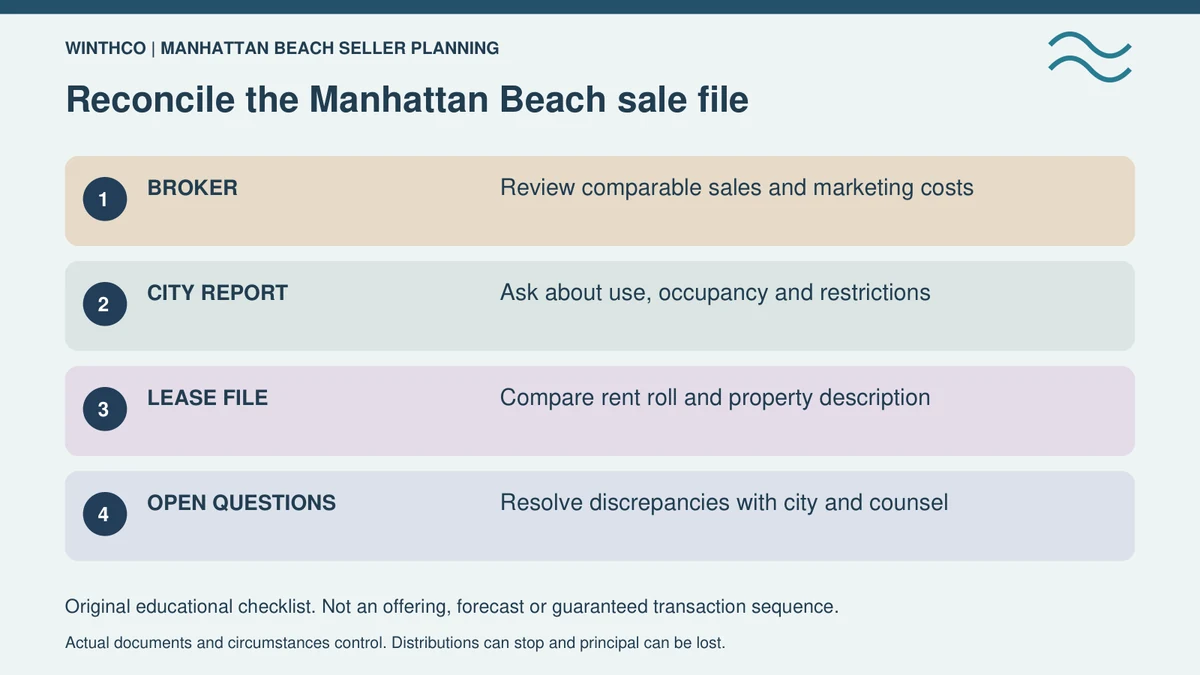
Interview an appropriately licensed broker who has sold your type of rental property. Ask for comparable transactions, the reasoning behind the proposed valuation, marketing expenses, compensation and a realistic diligence schedule. Explain whether you want to stop managing tenants, reduce property concentration or raise accessible cash. Those objectives can point to different choices. Ask the broker to flag records a buyer is likely to request before you commit to a closing date, rather than building the sale file only after accepting an offer.
Ask Community Development and your attorney about the residential building-record report before signing a sale agreement. The city’s Ordinance 22-0008 amended Section 9.24.040 to specify report contents, including the recorded zoning and authorized use, occupancy indicated by permits, variances and restrictions where information is available. That makes the report a useful early question, not an item to leave until the closing calendar is already tight. Confirm current applicability, procedure and timing directly with the city. Do not assume a buyer’s inspection, appraisal or an exchange agreement replaces the local report process.
Share your timeline and investment range. A Winthco team member will follow up with you.
Compare the report and available permit records with the property description, leases and rent roll you intend to present to buyers. If the number of units or described use appears inconsistent, ask the city and counsel what further research is needed. Request the relevant permits and ask what additional records can clarify an old alteration. Keep the address, parcel reference and dates together so the broker and advisers review the same property. An online search can help frame a question; a blank search result alone does not prove work was unauthorized or that a use is permitted.
Discuss your DST questions with Winthco →
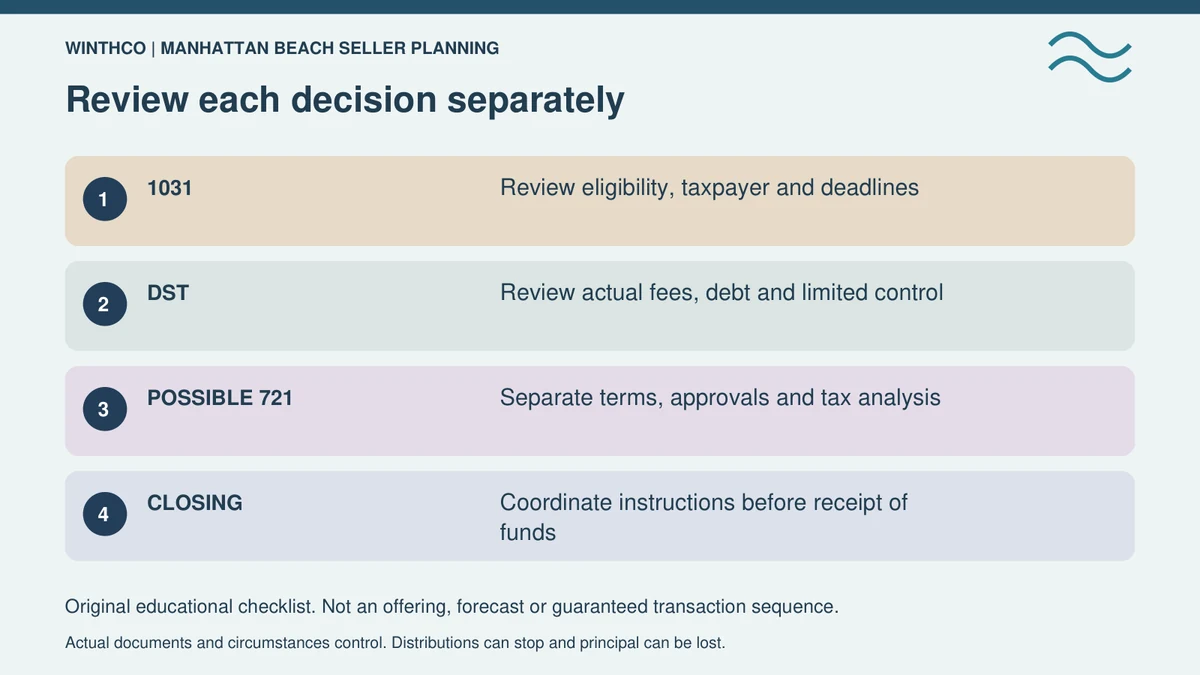
Involve a CPA, attorney and qualified intermediary before closing or taking control of the proceeds if you are considering a deferred exchange. Preferably they should review the proposed contract and ownership before you sign. Section 1031 can defer eligible gain on qualifying real property held for business or investment, not eliminate tax. Generally identify replacement property within 45 days and receive it by the earlier of 180 days after transfer or the applicable federal return due date, including extensions. Winthco’s 1031 exchange timing and rules overview can help you prepare questions about the taxpayer, deadlines and closing instructions.
The city report concerns records of the property being sold. It does not review a sponsor’s finances, decide whether a replacement interest qualifies under Section 1031 or assess your ability to tolerate loss. Keep a separate replacement-property file. Review the actual offering memorandum, trust agreement, leases, financing, valuation and operating assumptions. Revenue Ruling 2004-86 addresses a particular trust with limited powers. Ask your tax adviser to confirm how the proposed structure relates to that guidance rather than assuming every product called a DST qualifies.
WATCH & LEARN
Winthco Wealth Management introduces general DST educational resources. This video is not Manhattan Beach building-report guidance, an offering recommendation or a promise of income, liquidity or tax treatment. Original resource · Watch on YouTube ↗
Educational context only. The discussion does not establish the suitability, returns or tax treatment of an investment.
A qualifying DST interest can reduce the need to handle rent collection, repair calls and vendor decisions yourself. But giving up direct management usually also means giving up control over those decisions. Ask who approves budgets, manages leases, maintains reserves and decides when to sell. If a property needs more work than expected, ask what contractual and financial options exist. Use Winthco’s DST replacement-property opportunities overview as educational context, not evidence that an offering is available or appropriate. Request the actual documents and current information through the appropriate professional process.
Separate acquisition and placement costs from recurring management, property and financing expenses. Ask what portion of the purchase supports the property and what portion pays transaction costs. Compare actual leases with projected rent, scheduled expirations, tenant credit exposure and concessions. Review reserve assumptions, insurance deductibles and debt maturity. Ask what happens if rent falls or a large repair occurs before a lease renews. A distribution projection should not be treated as a household spending commitment or a substitute for reviewing the underlying source of cash.
Suppose a Manhattan Beach rental owner has buyers interested in a property described as having two separately rented living areas. The city report and lease file raise a question about the recorded use. The owner wants to promise a rapid closing and select a DST afterward. A more deliberate sequence is to ask the city and counsel to resolve the records question, ask the broker how it affects marketing and contract terms, and give the intermediary and CPA the actual expected closing schedule. The example is hypothetical, not a claim that a particular local property has a violation or that a records question always delays settlement.
Keep a written list of replacement alternatives and the date each was reviewed. Ask which information may become stale, such as property availability, funding deadlines, financing or financial statements. A city-record issue does not mean you should loosen your investment standards to finish the exchange later. Compare the costs, management responsibilities and liquidity of direct replacement property, a qualifying DST and a taxable sale with your advisers. The before-listing planning checklist can help you keep contract preparation separate from replacement selection. Do not assume that another opportunity will remain available until your sale closes.
A later contribution to an operating partnership is a separate, conditional transaction. Section 721 generally addresses property contributed in exchange for a partnership interest, subject to exceptions and the actual facts. A DST purchase does not assure an UPREIT transaction. Ordinary REIT shares and operating partnership units are not direct Section 1031 replacement real property. Ask a prospective 721 UPREIT advisor and your attorney who controls a contribution decision, what liabilities and costs matter, and what transfer or redemption restrictions apply. A later redemption may be taxable or delayed, and should not be counted on to meet a near-term expense.
A CPA familiar with real estate and DST reporting can review basis, debt relief, potential boot, filing deadlines and applicable state reporting. That role is distinct from the broker’s pricing work, counsel’s legal review and the intermediary’s exchange coordination. California’s Franchise Tax Board explains that exchanges of California property for out-of-state property with deferred California-source gain or loss generally require FTB 3840 reporting in the exchange year and subsequent years until recognition. Ask your CPA how the actual interest and transaction should be reported. Moving your residence or selecting property elsewhere does not by itself resolve that question.
DST interests are generally private placements offered to accredited investors through offering documents. They may have limited disclosures, transfer restrictions and no readily available resale market. You can lose principal, distributions can decrease or stop, and the holding period can exceed your expectations. Compare sponsor, tenant, lender, property-type and geographic concentration across your portfolio. Even if your sale file is complete and exchange requirements are met, investment risk remains. Ask how you would cover expenses if the DST paid less while another illiquid asset also became difficult to sell.
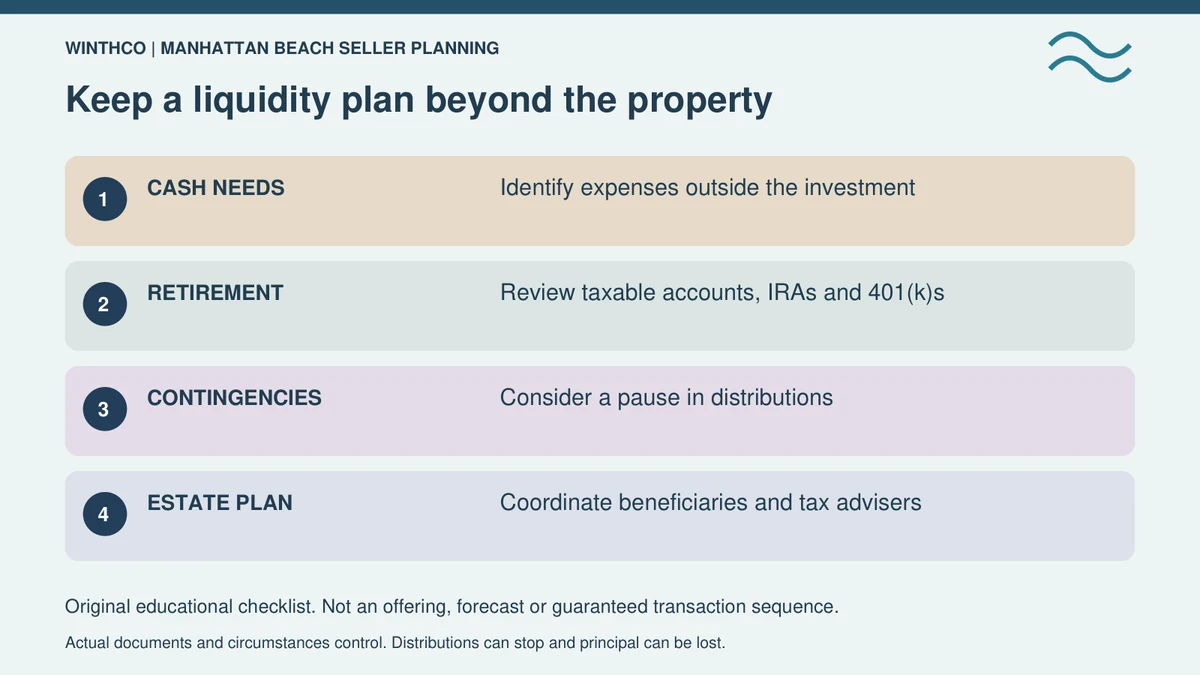
Start with the money you need outside the replacement investment: estimated taxes, near-term expenses, emergency reserves and retirement spending. Review your taxable investments, 401(k)s, IRAs, beneficiary arrangements and estate coordination with your financial adviser, CPA and attorney. Retirement accounts are separate from exchange proceeds. Compare costs, services and liquidity before any rollover or transfer; neither an account move nor a DST purchase is a condition of having a conversation. Use the prospect forms here or the dedicated contact page to discuss the property transition and broader financial planning with Winthco Wealth Management.
Geographic context, not a Winthco office, parcel boundary or approval determination.
| Decision | Evidence to request | What to avoid assuming |
|---|---|---|
| City report | Authorized use, occupancy and zoning shown in the city’s records | It establishes exchange eligibility or property condition. |
| Sale file | Leases, rent roll, permits and unresolved questions | Marketing language settles a discrepancy. |
| DST review | Offering terms, debt, fees and operating downside | A completed sale makes any replacement suitable. |
| Retirement plan | Accessible cash, spending needs and other assets | A possible 721 event assures timely liquidity. |
Ask Community Development and counsel about applicability, current requirements and timing before signing. The city’s ordinance specifies records the report should contain where available.
It is a report based on city records, not a substitute for evaluating physical condition. Ask your broker and attorney what additional diligence is appropriate.
It can reduce direct involvement in operations. Property risk and the consequences of limited control still remain.
No. Verify each professional’s credentials and scope; investment advice does not replace tax or legal advice.
No. It is a Manhattan Beach city reference. The verified office for this campaign is in Simi Valley, California.
Sources checked November 5, 2026. This article explains general concepts; your facts and the applicable documents control.
Winthco DST services · Winthco evaluation overview · Editorial standards
1031 replacement property
Compare DST and 721 UPREIT paths, tax rules, ownership, liquidity, control and risks before a property sale or exchange.
Read guide →Property sale planning
Prepare a rental sale with broker questions, 1031 timing, DST and separate 721 review, and retirement planning before committing proceeds.
Read guide →DST investment due diligence
Selling a rental property? Learn how to review a DST private placement memorandum, compare fees and risks, and assess separate 721 UPREIT terms.
Read guide →Explore Winthco’s main DST article collection
Share your timeline and investment range. A Winthco team member will follow up with you.