California 1031 planning
California 1031 exchange into a DST
Learn how California owners can evaluate a DST replacement, federal deadlines, Form FTB 3840 reporting, liquidity and investment risks.
Read guide →
Home / Learning center / Local DST guides
Local DST guides
Winthco Wealth Management · Updated November 4, 2026
If you are selling an Oxnard investment property and considering a Delaware statutory trust, review the parcel’s flood and insurance records with your broker before marketing it. Involve your exchange and tax team before closing, then compare the DST’s property risks, fees and liquidity with the responsibilities you want to leave behind.
Interview a licensed real estate broker with relevant experience selling your type of rental or commercial property. Ask for comparable sales, assumptions behind the proposed price range, a marketing plan, proposed fees and a realistic schedule for buyer diligence. Share actual rents, expenses, repair invoices and insurance information. Ask which gaps would keep a buyer from underwriting the property. Your broker can help assemble the facts; counsel can address disclosure questions and interpret the sale agreement.
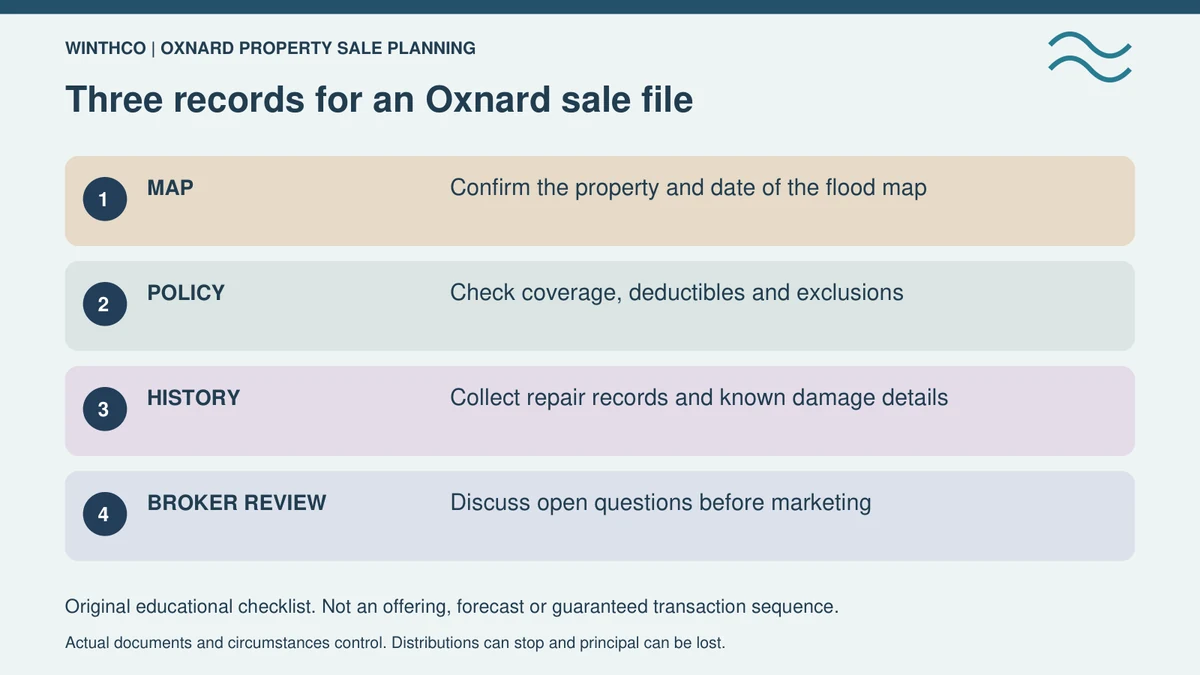
The City of Oxnard’s Floodplain Administration page points owners to flood mapping and insurance resources. Match the address and parcel to the applicable map and record the date you checked it. Keep the map result, actual policy terms and any known damage or repairs in separate parts of your sale file. A map is not an insurance quote or a complete property history. If the result is unclear, ask the city about its records and your insurer about the coverage, deductible and exclusions that apply to the property.
Share your timeline and investment range. A Winthco team member will follow up with you.
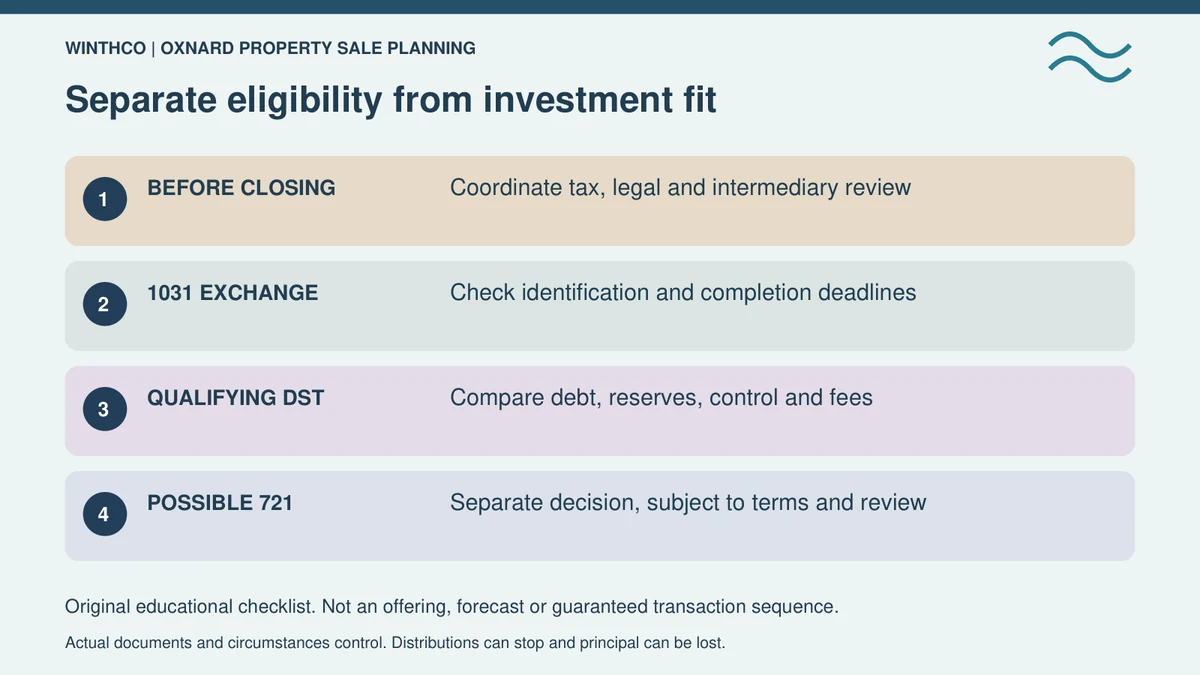
If you are considering a deferred exchange, consult your CPA, attorney and qualified intermediary before closing or taking control of the proceeds. Have them review ownership, basis, debt payoff, expected net proceeds and the exchange agreement. Section 1031 can defer eligible gain on qualifying real property held for business or investment. Generally you must identify replacement property within 45 days and receive it by the earlier of 180 days after transfer or the federal return due date, including extensions. Deferral is not elimination, and cash or other non-like-kind property can trigger recognized gain.
Discuss your DST questions with Winthco →
Ask your CPA to evaluate California reporting separately from the federal exchange. The Franchise Tax Board explains that a qualifying exchange of California property for out-of-state property with deferred California-source gain or loss generally requires FTB 3840 for the exchange year and subsequent years until recognition. Have your CPA assess how that applies to your actual replacement interest and ownership. Do not assume leaving California or acquiring a property elsewhere ends the reporting question.
A qualifying DST interest can provide exposure to replacement real estate without requiring you to supervise tenants, repairs and rent collection personally. Review Winthco’s overview of Delaware statutory trusts alongside the actual offering documents. IRS Revenue Ruling 2004-86 discusses a specific trust and its restricted powers. It does not say that every trust qualifies. Confirm the proposed interest with tax counsel and distinguish eligibility from investment fit. Ask who makes decisions when operating results fall short, what rights investors retain and whether the structure has practical options if a major property expense arises.
WATCH & LEARN
Winthco Wealth Management introduces general DST educational resources. This is not Oxnard flood or insurance guidance, an offering recommendation or a promise of income or tax treatment. Original resource · Watch on YouTube ↗
Educational context only. The discussion does not establish the suitability, returns or tax treatment of an investment.
Ask for a summary of coverage and the relevant policy terms, including exclusions, limits and deductibles, rather than relying on a one-line insurance expense in a projection. Where flood exposure is relevant, ask whether the property has separate coverage, what it covers and who bears uncovered costs. Check whether the trust, an operating entity or a master tenant is responsible for premiums and claims under the agreements. For example, a higher deductible can leave the property with more expense after a loss even if the policy pays part of the claim. Compare those questions across every location in the offering, not just the property featured in the marketing material.
Start with the purchase price and the actual cash available after offering costs. Separate one-time charges from recurring property, management and financing expenses. Review lease rollover, tenant concentration, reserve balances and any balloon payment. Ask whether a scenario with lower rent, more repairs or higher renewal premiums reduces or interrupts distributions. Winthco’s DST offering-document evaluation guide can help you organize the documents. Check who is paid at acquisition and sale, and whether affiliates receive fees even when investors receive less cash than projected.
Ask for beginning reserves, the expenses they were intended to cover and the conditions under which they can be used. Then compare that information with the sponsor’s model and the most recent property and insurance documents available for review. A budget may show money set aside for routine work but not tell you what happens if an uninsured repair and a vacancy occur together. Ask who can authorize reserve spending and how a shortfall could affect investors. The DST property insurance risk guide explains how to separate insurance obligations from the cash that would actually be available after a loss. Bring unresolved questions to your advisers before identifying a replacement, not after the deadline has narrowed your alternatives.
Suppose an owner wants to sell a small rental and stop handling repairs. Their broker asks for the flood map result and a recent insurance renewal before circulating the sale package. The owner’s CPA estimates potential tax exposure and the qualified intermediary explains the exchange timetable. One possible replacement is a directly owned rental with a hired manager; another is a qualifying DST. The first may give the owner more say over repairs and insurance but leaves ownership decisions with them. The second may require less daily involvement but provides less control and may be hard to sell. If the owner needs cash for a planned expense next year, neither option should be counted on to deliver a timely exit.
Treat it as a separate, conditional decision. Section 721 generally concerns a contribution of property in exchange for a partnership interest, subject to exceptions and transaction-specific analysis. A later UPREIT contribution is not assured because you acquire a DST. Ordinary REIT shares and operating partnership units are not direct replacement real property for Section 1031. Ask who can authorize a later contribution, what liabilities and costs are involved, and what restrictions apply to operating partnership units. A redemption right may be limited, delayed or taxable. Have counsel and your CPA assess the actual terms before assuming a second transaction makes the first one more attractive.
Good records make questions easier to answer, but they do not prevent property damage, vacancies, rising expenses or sponsor problems. DST interests are generally private placements for accredited investors. They may be difficult to transfer, have limited disclosures and hold your money longer than you expect. Distributions may fall or stop, and you can lose principal. Consider your combined exposure to the same geography, property type, operator and lender across investments. A new property address does not necessarily mean you have diversified the risks that matter to your household.
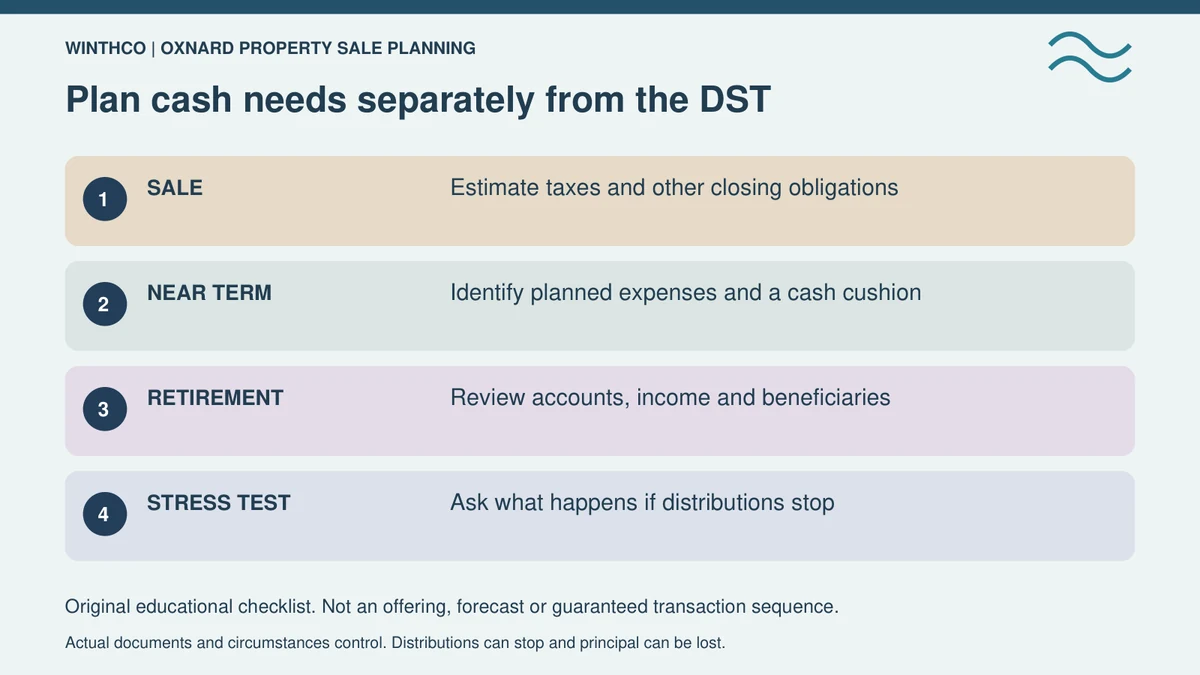
Review what you need the sale to accomplish before deciding whether to exchange. Separate money for estimated taxes, near-term expenses and emergencies from any income you hope the replacement investment will provide. Review your taxable assets, 401(k)s, IRAs, retirement spending and beneficiary arrangements with your financial adviser, CPA and attorney. Those accounts are separate from exchange proceeds. Compare the cost, services and liquidity of leaving assets where they are with any proposed changes; neither a rollover nor a DST purchase is required to have a planning conversation. Use the prospect forms on this guide or the dedicated contact page to discuss your timing with Winthco Wealth Management.
Oxnard geographic context only. Not a Winthco office, parcel map or flood-zone determination.
| Decision | Evidence to request | What to avoid assuming |
|---|---|---|
| Sale readiness | Parcel, flood map date, policy terms and repair history | A mapped zone describes every loss or coverage question. |
| Exchange planning | Ownership, deadlines and written closing instructions | Receiving proceeds first preserves the same options. |
| DST evaluation | Insurance obligations, debt, reserves and offering terms | Delegating operations removes property risk. |
| Possible later 721 | Approvals, terms, liabilities and liquidity limits | An UPREIT contribution or redemption is automatic. |
A qualifying DST interest may serve as replacement property if your exchange meets the applicable requirements. Set up deferred exchange arrangements before closing; consult your CPA, attorney and qualified intermediary about your facts.
No. A flood map and the actual policy or quote answer different questions. Ask an insurer for the applicable terms, costs and exclusions.
No. The operator may manage the insurance, but the owner’s investment can still be affected by uninsured losses, deductibles and premiums. Review the responsible party and how costs are funded.
No. It is a separate possible partnership contribution with its own conditions, costs and tax consequences.
The verified office for this campaign is in Simi Valley, California. The Oxnard map is a city reference, not an office location.
Sources checked November 4, 2026. This article explains general concepts; your facts and the applicable documents control.
Winthco DST services · Winthco evaluation overview · Editorial standards
California 1031 planning
Learn how California owners can evaluate a DST replacement, federal deadlines, Form FTB 3840 reporting, liquidity and investment risks.
Read guide →Property sale planning
Prepare a rental sale with broker questions, 1031 timing, DST and separate 721 review, and retirement planning before committing proceeds.
Read guide →DST due diligence
Review DST property insurance, exclusions, deductibles and rent-loss coverage before exchanging a rental. Prepare questions about cash flow and reserves.
Read guide →Explore Winthco’s main DST article collection
Share your timeline and investment range. A Winthco team member will follow up with you.