Property sale planning
Before Listing a Rental: DST and 1031 Planning
Prepare a rental sale with broker questions, 1031 timing, DST and separate 721 review, and retirement planning before committing proceeds.
Read guide →
Home / Learning center / Local DST guides
Local DST guides
Winthco Wealth Management · Updated November 7, 2026
Before selling a Port Hueneme rental and considering a Delaware statutory trust, ask your broker to separate the property’s current use and income from value that depends on future approvals. Coordinate the exchange before closing, then review a DST’s actual operations, costs and liquidity without counting on a renovation, distribution or later exit.
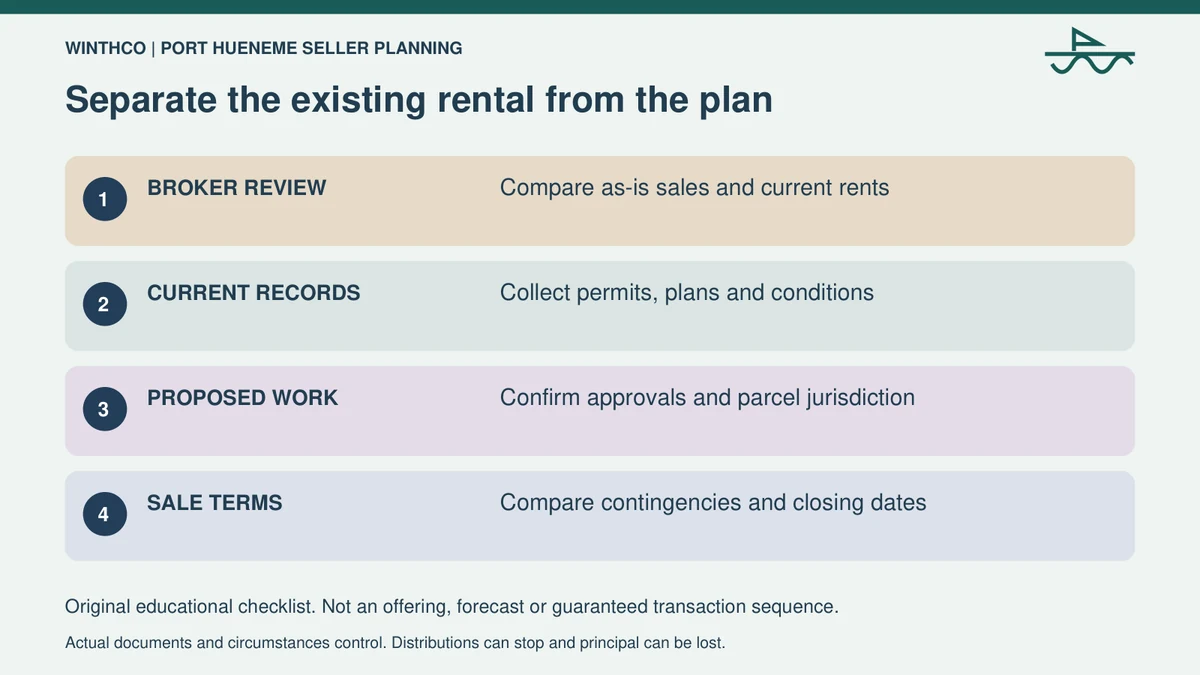
Interview a licensed broker with experience selling your type of rental. Ask which comparable sales support the valuation, how the broker would market the property, what the fees cover and how long buyer diligence might take. Have the broker distinguish actual rents and expenses from what a new owner might earn after a renovation. If the sale pitch depends on adding space or changing how a building is used, ask for a valuation based on current conditions as well. A proposed project and an approved project should not be described as the same thing.
Port Hueneme’s Planning and Zoning Division administers local coastal planning and land-use review. The California Coastal Commission explains that development in the coastal zone generally requires a coastal development permit unless an exception applies, and that some changes in use can matter even without construction. Confirm the parcel, proposed work, relevant approvals and the responsible agency with Planning and counsel. Do not infer permit jurisdiction from a city map or a nearby address. A sale alone is not presented here as a development permit trigger; the issue is how existing conditions and proposed work are documented.
Share your timeline and investment range. A Winthco team member will follow up with you.
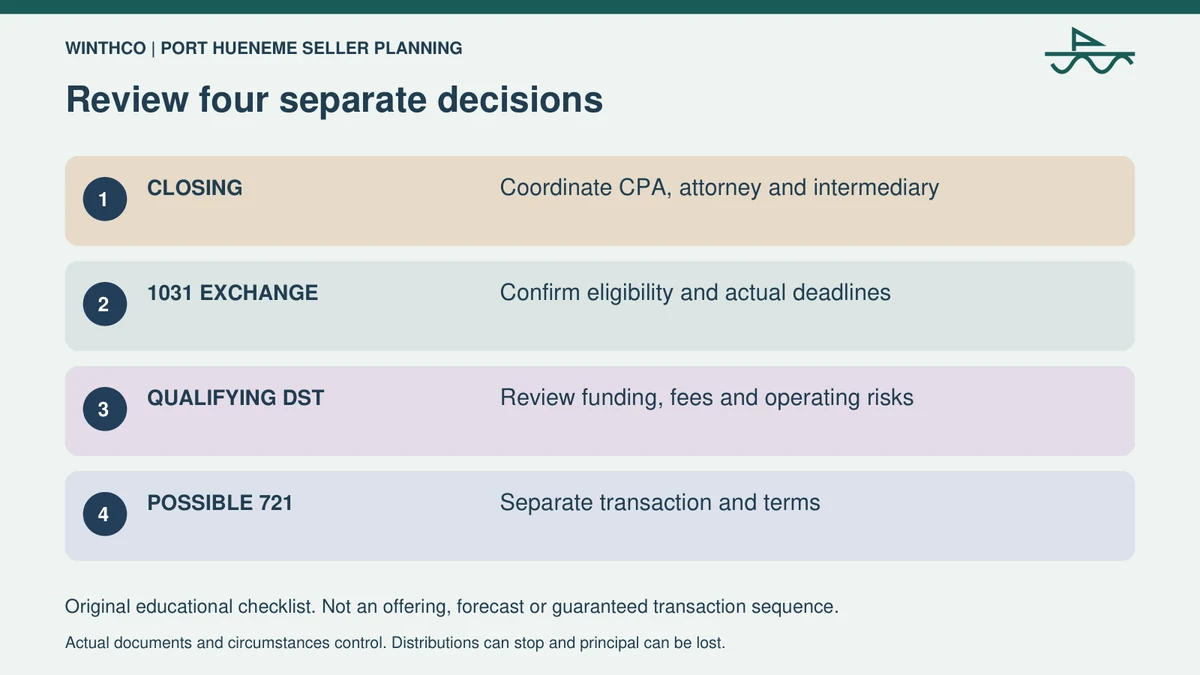
Collect permits, approved plans, conditions and available inspection records for prior work. Put unapproved concepts in a separate file, with the assumptions that support them. Ask what a buyer could verify before making an offer, and whether an approval, lender condition or other issue could change the contract or timing. If a record is missing, ask the city how to investigate rather than treating the gap as proof of compliance or noncompliance. The rental sale preparation guide offers a broader checklist for organizing these conversations.
Discuss your DST questions with Winthco →
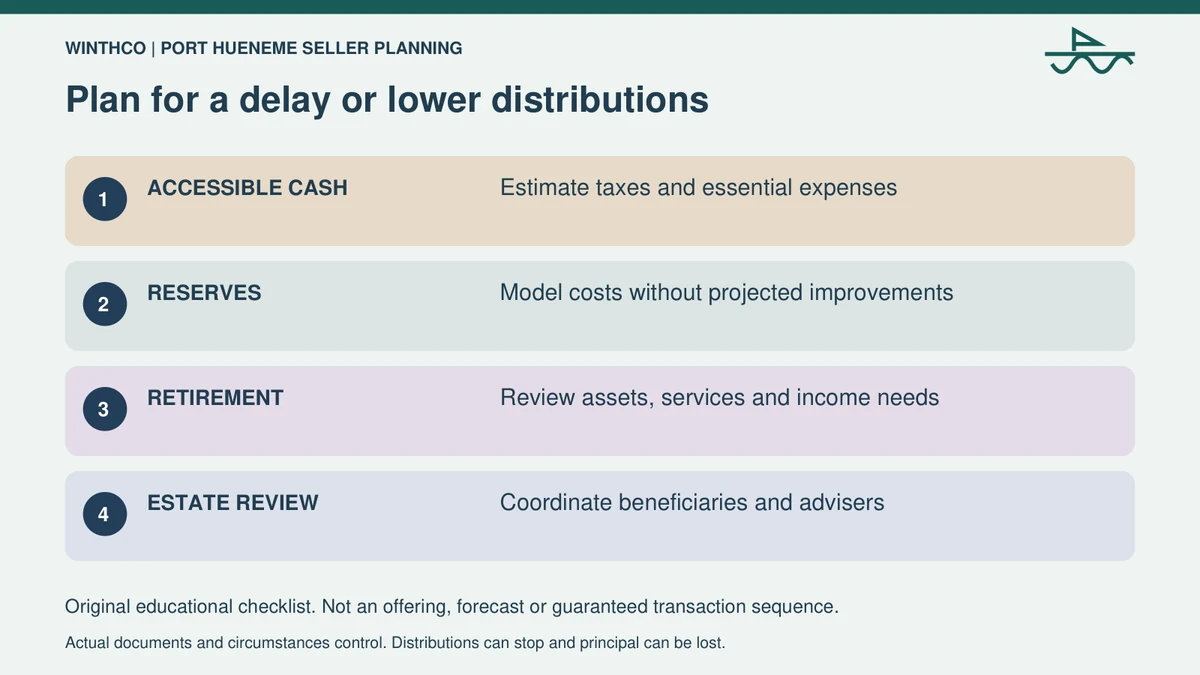
If a deferred exchange is under consideration, coordinate your CPA, attorney and qualified intermediary before closing or taking control of the proceeds. Ask them to review who owns the property, the proposed closing statement, debt payoff and written instructions. Section 1031 can defer eligible gain on qualifying business or investment real property, not eliminate tax. Generally, identify replacement property within 45 days and receive it by the earlier of 180 days after transfer or the federal return due date, including extensions. Cash or other non-like-kind consideration can affect recognized gain. If a permit or buyer contingency changes your timing, have your advisers update the exchange plan.
Suppose a seller has an occupied rental and is weighing whether to market an addition that has been sketched but not approved. One buyer prices the property on existing rent; another ties a higher offer to confirmation that an expansion can proceed. The broker can compare price, financing, contingencies and expected net cash. Counsel can review how the proposed project is described and when the contract could close. The seller can compare replacement options without committing on the assumption that the higher offer or earlier close will materialize. This is a hypothetical, not a claim about any actual parcel or approval.
WATCH & LEARN
Equity Advantage 1031 Exchange discusses the time and effort of direct property ownership. This third-party video is general context, not coastal permit guidance or advice on a specific investment. Original resource · Watch on YouTube ↗
Educational context only. The discussion does not establish the suitability, returns or tax treatment of an investment.
A qualifying DST interest can provide exposure to replacement real estate while reducing direct work such as arranging repairs and dealing with tenant calls. Review Winthco’s guide to using a DST as replacement property, then ask tax counsel to review the actual structure. IRS Revenue Ruling 2004-86 addresses a specific trust with restricted powers, not a blanket approval of every DST. With direct ownership you may retain more authority over operations, while still bearing the costs and obligations. With a DST, ask what decisions investors can make and which ones belong to the trustee, sponsor or operator.
Distinguish what the replacement property can do today from changes assumed in an offering’s forecast. Ask whether current income reflects signed leases, collections or projected renewals. Identify any proposed work or changes in use and ask what approvals, contracts, funding and governing-document authority would support them. A planned project is not necessarily part of the current property income. Use Winthco’s DST offering evaluation guide to organize questions about the private placement memorandum, then request the specific lease, financing and operating evidence that matters to your decision.
Give each important assumption a date, an evidence source and a person who can confirm it. For example, compare a signed tenant renewal with a broker’s estimate for a lease that has not been negotiated. Ask whether any rent increase depends on work that is not funded or on a use that still needs review. Then compare the cost of waiting with the cost of a taxable sale or a different replacement. An unresolved assumption should remain visible when you compare options.
Ask for a scenario where the property continues operating without the projected improvement. Review the expenses it would still owe, debt service, reserves, tenant rollover and which party can authorize work. Ask who bears any uninsured or unfunded expense and whether fees are paid even when investors receive less cash. Do not assume an investor can authorize new capital or compel a sale. Read the trust and loan terms with your advisers, and compare what happens if the exit occurs later or at a lower price than the sponsor projects.
DST interests are generally offered in private placements to accredited investors and may have limited disclosure and transfer restrictions. You may be unable to sell when you want, distributions can fall or stop, and principal can be lost. Consider fees, sponsor and operator incentives, lender terms and exposure to the same tenants or property types across investments. Compare the risk of owning another property directly with the loss of control and liquidity you would accept in a DST. Meeting the exchange deadline does not establish that an investment fits your portfolio.
A future contribution to an operating partnership is separate and conditional. Section 721 generally concerns property contributed in exchange for a partnership interest, subject to exceptions and actual terms. Buying a DST does not assure a later contribution, redemption or tax outcome. Ordinary REIT shares and operating partnership units are not direct Section 1031 replacement property. Ask a 721 UPREIT adviser, CPA and attorney who can approve any contribution, what restrictions apply and when a redemption might be possible. Do not count on the transaction for cash you need near term.
Have a CPA familiar with real estate and DST reporting review adjusted basis, debt, potential boot, depreciation-related gain and filing requirements. California’s Franchise Tax Board explains that exchanges of California property for out-of-state property with deferred California-source gain or loss generally require FTB 3840 reporting in the exchange year and later years until recognition. Ask how that guidance applies to the proposed ownership and replacement. Keep the CPA’s analysis separate from the broker’s valuation, the attorney’s legal review and the intermediary’s coordination of the exchange.
Before deciding what to reinvest, identify accessible money needed for estimated taxes, major expenses and essential retirement spending. Review your existing taxable holdings, 401(k)s, IRAs, beneficiary designations and estate arrangements separately from exchange proceeds. Compare what happens if the replacement pays less than expected or remains illiquid for longer. An investment adviser can help compare costs, services and allocation choices without assuming a rollover, transfer or DST purchase. Use the prospect forms here or the dedicated contact page to discuss the sale and your broader financial plan with Winthco Wealth Management.
Geographic context, not a Winthco office, parcel boundary or coastal jurisdiction determination.
| Decision | Evidence to request | What to avoid assuming |
|---|---|---|
| Existing rental | Current leases, income, use and permit records | Projected renovation value is current value. |
| Proposed change | Scope, jurisdiction and applicable approvals | A concept or map establishes permission. |
| Qualifying DST | Trust terms, costs, funded reserves and operating evidence | Less daily work removes the investment risk. |
| Retirement liquidity | Available cash and essential spending | Projected distributions or a 721 event will cover near-term needs. |
Do not assume a sale itself triggers a development permit. Ask Planning and counsel about the specific parcel, proposed work and applicable process.
A qualifying interest may be eligible if the exchange requirements are met. Ask your tax and exchange advisers before closing.
Separate current operations from forecasts. Ask what must happen for the projected changes to occur.
No. Any contribution is separate, conditional and subject to its actual terms, costs and restrictions.
No. It shows Port Hueneme geographic context. The campaign’s verified office is in Simi Valley.
Sources checked November 7, 2026. This article explains general concepts; your facts and the applicable documents control.
Winthco DST services · Winthco evaluation overview · Editorial standards
Property sale planning
Prepare a rental sale with broker questions, 1031 timing, DST and separate 721 review, and retirement planning before committing proceeds.
Read guide →DST due diligence
Learn how to review DST appraisals, compare acquisition costs and separate property value from investor proceeds before a 1031 exchange.
Read guide →DST due diligence
Review DST downside scenarios, cash-flow assumptions and exit risks before investing. Learn what a stress test can reveal and what it cannot promise.
Read guide →Explore Winthco’s main DST article collection
Share your timeline and investment range. A Winthco team member will follow up with you.