Local real estate planning
Santa Clarita DST advisor and 1031 guide
Prepare a Santa Clarita rental sale, compare DST and separate 721 decisions, and coordinate a potential exchange with retirement accounts and liquidity.
Read guide →
Home / Learning center / Local real estate planning
Local real estate planning
Winthco Wealth Management · Updated October 15, 2026
A San Fernando investment-property sale should begin with a qualified broker, a documented sale file and early tax and exchange coordination. A DST advisor then helps evaluate replacement-property economics and any separate 721 UPREIT proposal. The decision should fit household liquidity and retirement needs, not simply a deadline or projected distribution.
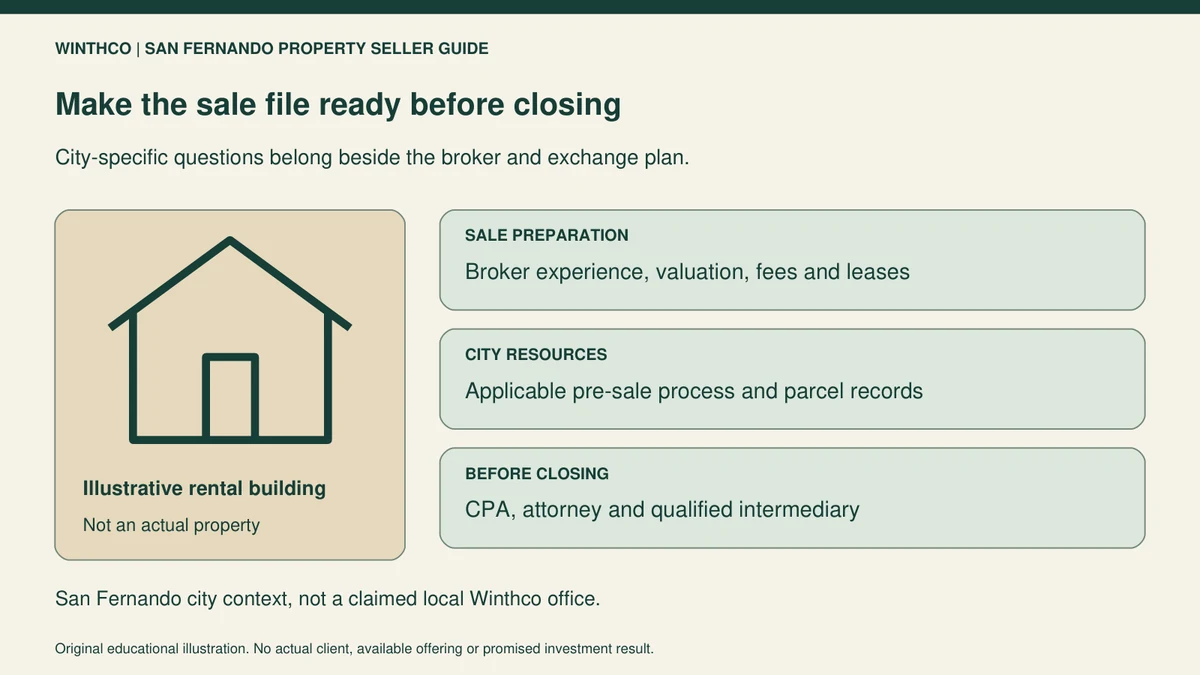
Start with the parcel, leases and reason for selling. San Fernando is an incorporated city, not a synonym for the entire San Fernando Valley. Confirm the property's jurisdiction before applying municipal requirements. Interview appropriately licensed realtors or commercial brokers about comparable sales, property-type experience, marketing, fees and closing coordination. Check licensing with California's Department of Real Estate. No brokerage referral relationship is implied here.
Build a sale file containing title information, leases, rent collections, improvements, insurance and debt details. Ask the broker which unresolved issues could affect value or buyer financing. If a deferred exchange is contemplated, involve the CPA, attorney and qualified intermediary before closing or receiving proceeds. Winthco's questions to ask a DST advisor can frame the investment discussion without replacing the broker's sale responsibilities.
Share your timeline and investment range. A Winthco team member will follow up with you.
The City of San Fernando lists a Residential Property Pre-Sale Inspection service. Ask the city's Community Development staff and your closing team what applies to the actual property, including current procedures, documents and timing. Do not assume a buyer's private inspection replaces a municipal process. Identify responsibility for resolving findings before setting expectations about when the sale can close.
The city's zoning resources distinguish the citywide zoning map, General Plan land-use map and San Fernando Corridors Specific Plan maps. If marketing a commercial or rental property partly on redevelopment potential, have the broker verify the applicable parcel designation with planning staff. A broad corridor concept is not an approval for a particular project. Keep these checks focused on sale readiness rather than assuming future development value.
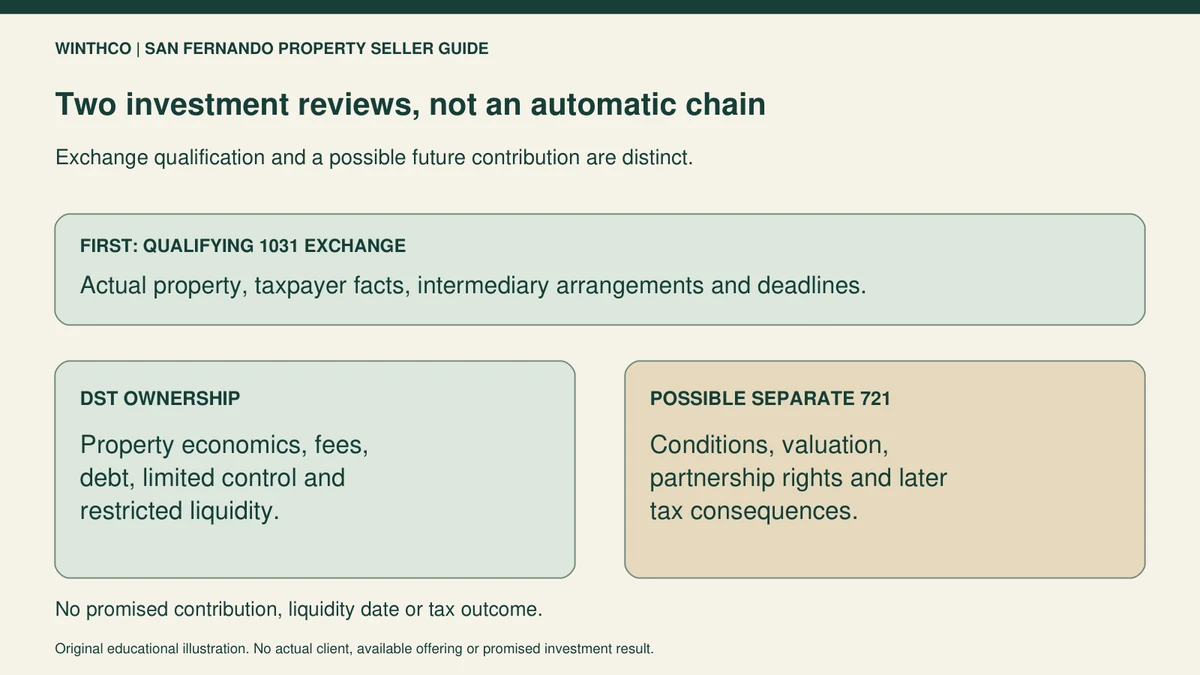
Section 1031 can defer eligible gain when qualifying business or investment real property is exchanged for qualifying replacement real property and the requirements are met. A seller may maintain real-estate exposure while changing location, property type or management responsibility. The benefits and limits of a 1031 exchange belong alongside a comparison of keeping the property, hiring management, a taxable sale and a partial exchange.
Deferral is not tax elimination. Have the CPA review ownership, basis, depreciation, investment use, liabilities and cash retained. A residence does not become exchange-eligible merely because its sale produces a gain. Debt relief, nonqualifying property and cash can affect recognized gain. Brokerage and closing expenses also need classification rather than assuming every charge reduces taxable boot in the same way.
IRS Form 8824 instructions and Treasury Regulation 1.1031(k)-1 generally require identification within 45 days after transfer and receipt by the earlier of 180 days or the applicable federal return due date, including extensions. Plan the qualified intermediary before closing. Local sale-preparation work and exchange planning run alongside each other; unresolved property documents should not force a rushed replacement decision after transfer.
Discuss your DST questions with Winthco →
IRS Revenue Ruling 2004-86 addresses a specified Delaware statutory trust arrangement whose beneficial interests receive real-property treatment for Section 1031. It does not approve every DST or certify investment quality. Ask the tax and legal professionals to analyze the actual structure. An investor's eligibility, the transaction's tax treatment and the investment's fit are separate determinations.
A qualifying DST interest may reduce direct landlord work because property operations are handled through the offering's management arrangements. That can appeal to someone who no longer wants tenant calls, maintenance coordination or lease negotiations. The tradeoff is limited control: investors generally do not choose individual repairs, tenants or the sale date. Read the trust agreement for decision rights instead of equating passive ownership with a deposit account.
Evaluate the replacement independently of the San Fernando property. A familiar local rental may be exchanged for interests supported by different tenants, markets and property sectors. Request operating history, lease expirations, property-condition information and reserve assumptions. Identify what is verified, what is forecast and what remains unknown. A lower personal workload does not remove the need to monitor reports and investment risks.
Ask the investment professional to explain the sponsor review and any conflicts. Separate sponsor experience from the performance assumptions for the particular property. Obtain the current private placement memorandum, supplements, trust agreement and subscription materials. A presentation or projected distribution rate is not the complete offering. Keep a question log so missing documents do not quietly become favorable assumptions.
Reconcile all disclosed costs: selling compensation, organization and acquisition costs, financing expenses, ongoing management charges and exit fees. Identify who receives each payment and whether affiliates are involved. Ask how fees affect investable capital and future proceeds. Compare options on a consistent basis rather than assuming the lowest stated commission means the lowest total cost or the most suitable investment.
For a financed DST, examine interest terms, maturity, covenants and the repayment plan. Debt-free ownership removes some borrowing exposure, not tenant, expense, valuation or liquidity risk. Separately ask the CPA how allocated debt and additional cash affect exchange calculations. The financing structure should be assessed for investment suitability, not selected solely to match a tax worksheet.
Trace distributions to recurring operations and any other disclosed sources. Ask who can reduce payments, how reserves are used and how weaker occupancy or unexpected repairs could change cash available. Distributions can fall or stop. Receiving payments does not prevent loss of principal, and an estimated holding period is not a right to sell on a particular date.
WATCH & LEARN
Winthco Wealth Management presents its 1031 DST Welcome Video as introductory background. This is not a review of San Fernando municipal requirements or a specific offering, and it does not establish suitability, tax treatment or investment results. Original resource · Watch on YouTube ↗
Educational context only. The discussion does not establish the suitability, returns or tax treatment of an investment.
A Section 721 contribution generally involves transferring property to a partnership for a partnership interest, subject to exceptions and transaction-specific analysis. In an UPREIT arrangement, the relevant partnership is the REIT's operating partnership. The 721 UPREIT planning overview supplies background. Ordinary REIT shares and operating-partnership units generally are not direct Section 1031 replacement real property, so distinguish the initial exchange from a potential later contribution.
Some DST programs contemplate a later contribution, but that outcome is not automatic. Read who decides whether it occurs, whether investors have choices, how property value is determined and which conflicts exist. Ask what happens if the proposed transaction is delayed or never happens. The current DST must be evaluated on its own terms rather than justified only by an anticipated transition.
If a contribution becomes available, review the partnership's assets, fees, distribution policy, lockups and redemption or conversion conditions. A broader portfolio may still have concentration or liquidity risks. IRS Publication 541 discusses partnership contributions and complications such as liabilities and related transfers. Have the CPA and attorney analyze the proposed documents rather than assuming that the words tax deferred settle the result.
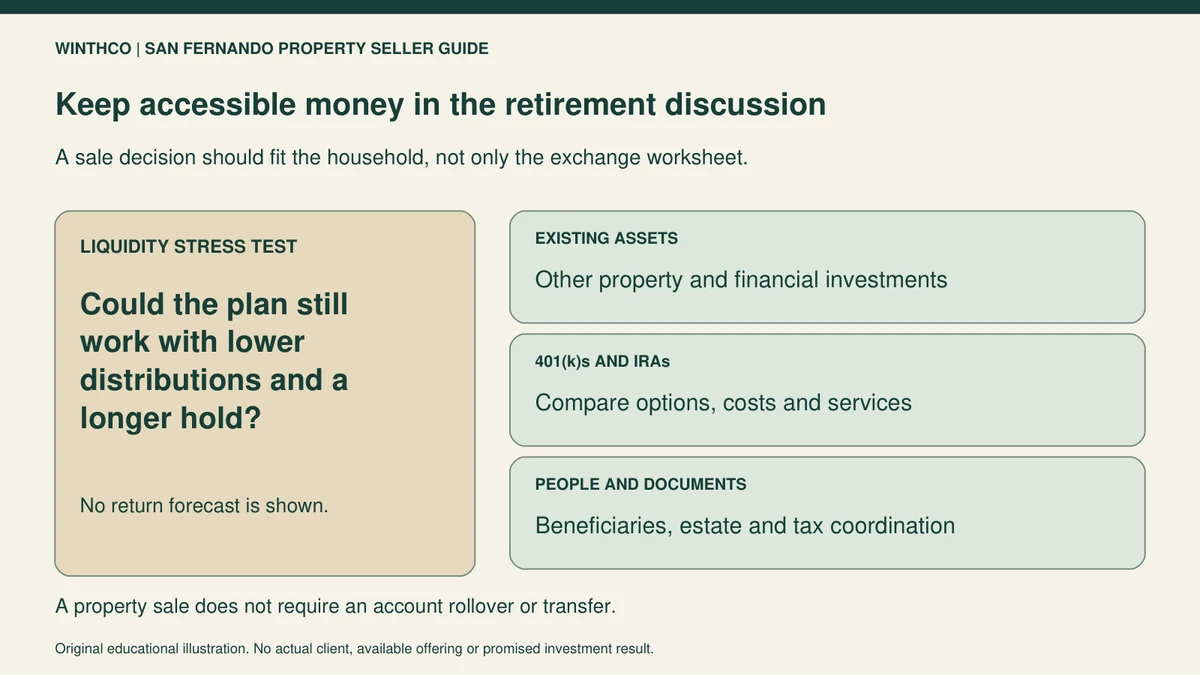
Later redemptions or conversions can have tax consequences. FIFO selection is not a guarantee of tax-free withdrawals of basis, and an expected conversion date is not a cash-access promise. Compare the proposed long-term ownership with family spending needs and estate plans. A seller who needs accessible money soon should not treat an uncertain future contribution as the liquidity reserve.
Private DST offerings are generally limited to accredited investors and offered through the applicable private placement memorandum. The SEC warns that private placements can involve limited disclosure, restricted resale and substantial loss. Neither a PPM nor a Form D filing is regulatory approval. Review sponsor conflicts, property and debt risks, fees, limited control, tax-law changes and the possibility of losing principal.
FINRA's concentration guidance matters when the household already owns other rentals or private real-estate investments. Several investment names may share a tenant, market, sponsor or economic exposure. Test a longer holding period and lower distributions against actual spending commitments. Diversification does not ensure profit or prevent loss, and funds needed for near-term expenses should not depend on finding a buyer for a restricted interest.
A California property exchange can also leave continuing state reporting obligations. FTB Form 3840 generally applies when California property is exchanged for out-of-state property with deferred California-source gain or loss; filings continue until that amount is recognized. Ask the CPA who will track the underlying property locations, basis and subsequent transactions. A DST advisor is not automatically the engaged tax preparer.
Consider a hypothetical owner of a small rented residential property who wants to step back from management. The broker flags municipal pre-sale questions and a mismatch between the owner's improvement records and the sale file. Before closing, the team resolves documentation, confirms investment-use facts and compares net proceeds under taxable-sale and exchange scenarios. This is not an actual client or an assumed tax result.
The owner then compares qualifying DST interests with direct replacement property and retaining some taxable cash. A potential 721 proposal receives a separate review. If the replacement's restricted liquidity does not fit the household's needs, the owner revisits the plan instead of accepting unsuitable terms to meet a deadline. Neither completing the sale nor choosing a tax-deferral strategy establishes that every dollar should remain in real estate.
Use the property decision to review existing financial assets, 401(k)s, IRAs, retirement-income needs, asset allocation and accessible reserves with Winthco's financial-advising and wealth-management team. Qualified retirement accounts are not themselves Section 1031 proceeds. Compare account options, costs, services and restrictions before any rollover or transfer. An initial conversation does not assume that moving accounts or engaging an advisor is appropriate.
Coordinate beneficiaries and estate documents with legal counsel and tax estimates with the CPA. Winthco lists its office at 1871 Tapo Street in Simi Valley; this article and map do not claim a San Fernando office. Bring a property summary, anticipated timing and household priorities to the conversation. Use the prospect form for basic contact information, then arrange a verified secure channel for statements and confidential documents.
Map of the City of San Fernando, California, for geographic context only. This is not a Winthco office location or a parcel-level zoning determination. Winthco lists its office in Simi Valley.
| Decision | Evidence to request | What to avoid assuming |
|---|---|---|
| Sale readiness | Broker proposal, leases, records and applicable city process | A private inspection replaces municipal requirements |
| 1031 execution | Taxpayer facts, intermediary arrangements and deadlines | Tax deferral means every replacement is suitable |
| DST selection | Offering documents, fees, debt and downside assumptions | A projected payment is dependable retirement income |
| Possible 721 contribution | Decision rights, valuation, lockups and tax review | Conversion or cash access will happen automatically |
No San Fernando office is claimed here. Winthco lists a Simi Valley office, and the map identifies the city service area only.
The city lists a residential pre-sale inspection service. Confirm applicability, current procedures and timing for the actual property with city staff and the closing team.
A contemplated deferred exchange should be coordinated with the qualified intermediary, CPA and attorney before closing or receipt of proceeds. Timing and control of funds matter.
Ask about compensation, alternatives, sponsor and property review, fees, debt, control and liquidity. Eligibility to invest does not establish suitability.
No. Review the actual decision rights, conditions and proposed partnership terms, and evaluate the DST if no later contribution occurs.
No. Retirement-account alternatives, costs, services and restrictions should be reviewed independently; moving an account is not an automatic consequence of selling property.
Sources checked October 15, 2026. This article explains general concepts; your facts and the applicable documents control.
Winthco DST services · Winthco evaluation overview · Editorial standards
Local real estate planning
Prepare a Santa Clarita rental sale, compare DST and separate 721 decisions, and coordinate a potential exchange with retirement accounts and liquidity.
Read guide →Property sale planning
Prepare a rental sale with broker questions, 1031 timing, DST and separate 721 review, and retirement planning before committing proceeds.
Read guide →DST investment due diligence
Selling a rental property? Learn how to review a DST private placement memorandum, compare fees and risks, and assess separate 721 UPREIT terms.
Read guide →Explore Winthco’s main DST article collection
Share your timeline and investment range. A Winthco team member will follow up with you.