Local real estate planning
Simi Valley DST and 721 UPREIT Seller Planning
A practical Simi Valley guide to Delaware statutory trust advisors, 721 UPREIT planning, CPA coordination, California reporting and investment risks.
Read guide →
Home / Learning center / Local real estate planning
Local real estate planning
Winthco Wealth Management · Updated October 13, 2026
A Santa Clarita investor preparing to sell should coordinate a licensed broker, CPA, attorney and qualified intermediary before closing. Evaluate qualifying DST replacement property separately from any later 721 contribution. Less direct management can come with illiquidity, fees and limited control, so the sale must support the wider retirement plan.
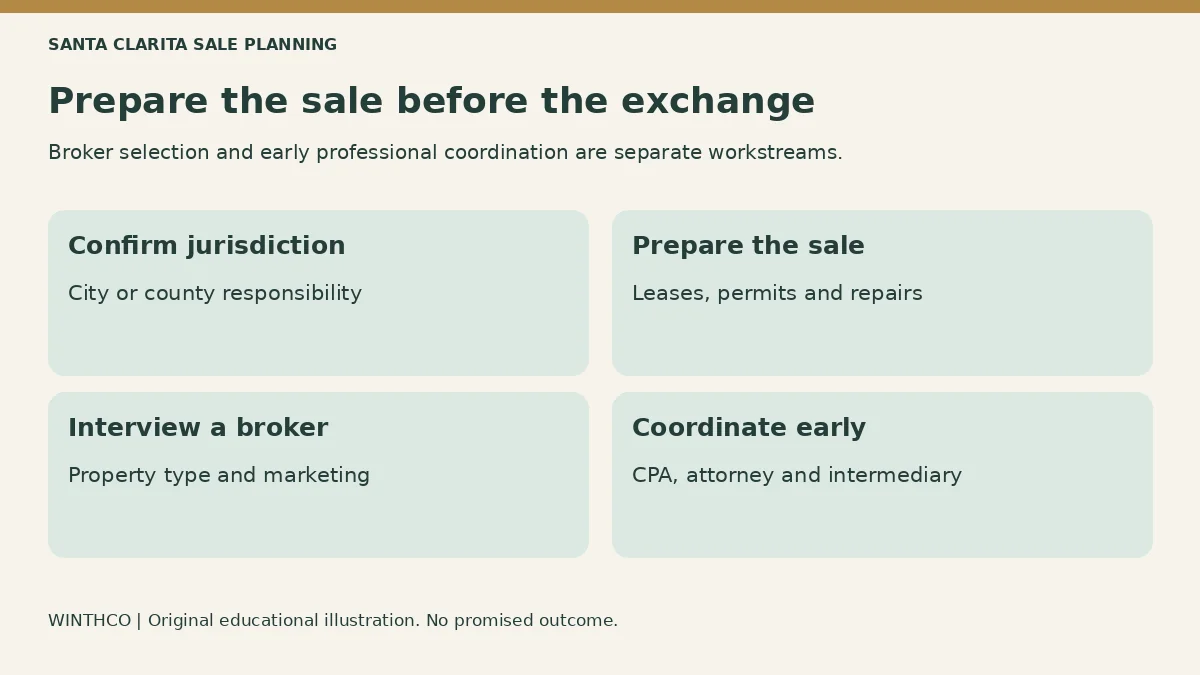
For a Santa Clarita rental or commercial property, interview an appropriately licensed realtor or commercial broker about relevant transactions, valuation evidence, marketing, fees and closing coordination. Ask how lease terms, tenant access and a buyer's financing could affect the process. Check the California real estate license rather than relying on a professional title. No Winthco brokerage service or local referral relationship is claimed here.
Prepare leases, operating expenses, title, debt and repair records before setting the marketing timetable. Santa Clarita is an incorporated Los Angeles County city, but a mailing address alone does not establish city jurisdiction. The City's Planning FAQ and mapping tools help identify the responsible authority and zoning. Confirm permit and occupancy questions with the appropriate agency. The city map is a service-area reference, not a Santa Clarita Winthco office.
Share your timeline and investment range. A Winthco team member will follow up with you.
Engage the qualified intermediary before closing when a deferred exchange is contemplated. The CPA should analyze qualifying use, basis, depreciation, liabilities and cash needs; the attorney should review ownership and agreements. Give the closing agent a coordinated plan. A listing contract or investment discussion does not by itself establish an exchange, and the seller's receipt of proceeds can jeopardize the intended treatment.
The potential benefit of Section 1031 is deferral of eligible gain through qualifying replacement real property when all requirements are met. The identification period generally ends 45 days after the relinquished transfer. Completion is due by the earlier of 180 days after transfer or the applicable federal return due date, including extensions. Have the CPA and intermediary confirm the actual calendar and identification procedure. These are outside limits, not targets for starting diligence.
Ask the CPA to compare a full exchange, a partial exchange and a taxable sale. Cash or other non-like-kind property received and debt adjustments may cause recognized gain. California's Form 3840 rules can require continuing reporting when California-source gain is deferred into qualifying property outside the state. Preserve settlement statements and basis schedules; moving investment exposure elsewhere does not automatically eliminate the California reporting issue.
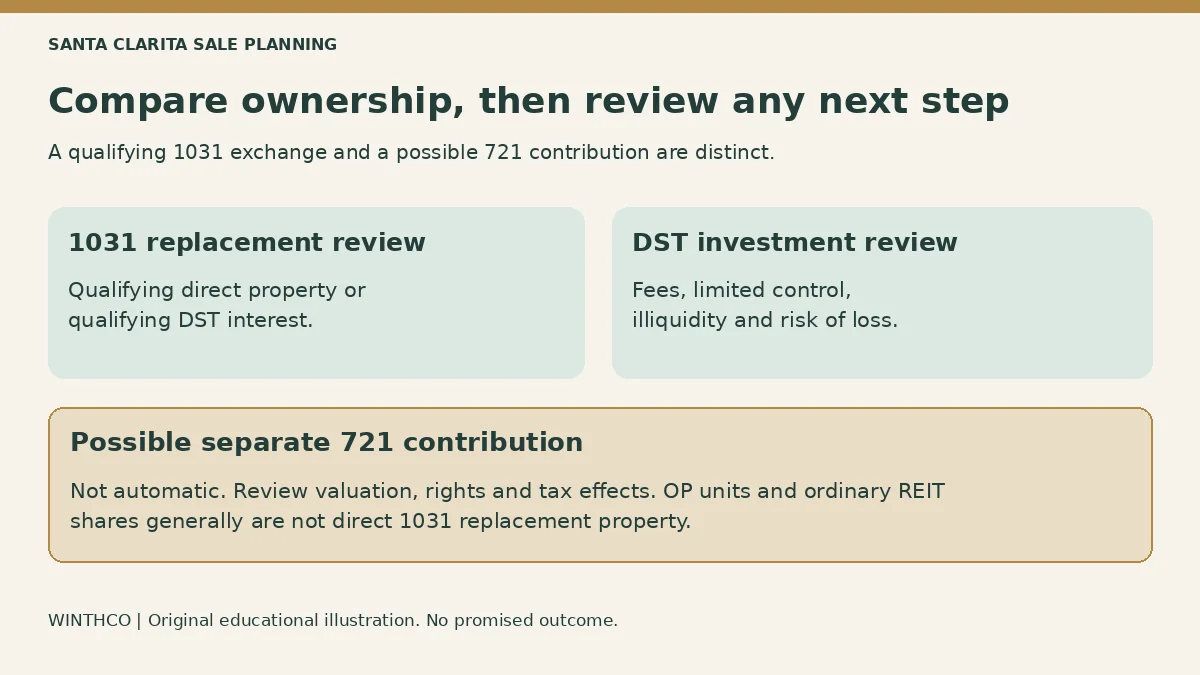
A Santa Clarita owner may want to stop arranging repairs and communicating with tenants. DST ownership can shift those tasks to professional management under the governing documents, but generally also shifts control away from the investor. Winthco's Delaware statutory trust advisor overview is a starting point for identifying which decisions an investor retains and which belong to the sponsor or trustee.
Review the structure before treating an interest as replacement real estate. Revenue Ruling 2004-86 addresses the particular DST arrangement described in the ruling, not every trust bearing the label. The investment professional, tax adviser and attorney should examine the actual offering and transaction within their separate scopes. A qualifying structure still may be unsuitable for the household's risk tolerance or cash needs.
Many DST securities are private placements generally offered to accredited investors through a private placement memorandum. Read that memorandum, the trust agreement and subscription materials. The SEC highlights illiquidity, limited disclosures and the possibility of total loss in private placements. Accreditation does not mean that a regulator has approved an offering or that the investor can afford its risks.
Discuss your DST questions with Winthco →
Begin with the leases, tenants and expected capital work. How much revenue depends on one tenant or a few renewals? Which operating expenses could rise faster than rents? What evidence supports occupancy and expense assumptions? Compare the property manager's budget with engineering and condition reports where supplied. A geographically distant replacement requires its own market analysis, not assumptions drawn from a Santa Clarita rental.
Examine financing and reserves together. Identify loan maturity, interest-rate exposure, covenants and any constraints on changing financing. Ask how a tenant departure, insurance increase or major repair would affect debt service and distributable cash. Clarify which parties bear obligations under the actual documents. An investor should understand the scenario in which the property operates but produces little or no distributable income.
Separate a stated distribution rate from total economic performance. Ask whether payments are funded by current operations, reserves or other sources, and how fees affect the result. Distributions can change or stop, and capital value can decline. A forecast is useful for testing assumptions, but it does not establish an amount the household can safely spend every month.
Request a consolidated compensation schedule covering selling costs, organizational charges, property acquisition, management, financing and disposition. Ask about affiliate arrangements and conflicts. Discuss which costs are paid immediately and which continue throughout ownership. Compare complete structures instead of selecting the proposal with the smallest prominently displayed fee or the most appealing cash-flow illustration.
Look at the household portfolio before adding another real estate interest. Existing rentals, employer stock, private investments and retirement holdings may create overlapping exposures. Several DSTs can still share a sponsor, tenant, lender, region or property sector. FINRA's concentration guidance supports looking through labels to correlated assets and the amount that cannot readily be sold when cash is needed.
Assume an exit could take longer than the sponsor's target. Ask about transfer restrictions, investor voting rights and whether any secondary market actually exists. A hoped-for property sale is not the same as a contractual redemption right. Maintain liquid resources for foreseeable spending and emergencies independently of the expected exit. Limited control and an uncertain hold are central tradeoffs of reducing direct management.
WATCH & LEARN
Accruit provides a general introduction to DSTs as possible replacement property in a 1031 exchange. This third-party video is educational, not a Winthco endorsement; Revenue Ruling 2004-86, current offering documents and the investor's advisers control. Original resource · Watch on YouTube ↗
Educational context only. The discussion does not establish the suitability, returns or tax treatment of an investment.
A Section 721 contribution generally concerns an exchange of property for a partnership interest, subject to exceptions and fact-specific tax analysis. An UPREIT operating partnership is a different ownership arrangement from the qualifying DST replacement interest. Winthco's 721 UPREIT planning overview introduces the distinction. IRS Publication 541 addresses contributions, basis, liabilities and other partnership tax issues that retained professionals must apply.
Determine whether a contemplated contribution is required under particular circumstances, optional for the investor or simply part of a sponsor's plan. Who controls timing and valuation? What fees and conflicts arise? Which lockups, redemption limits and tax-protection terms survive afterward? Request the documents and compare the consequences of proceeding, declining if permitted, or never receiving an offer.
Operating-partnership units and ordinary REIT shares generally are not direct 1031 replacement real property. A later conversion or redemption may have tax consequences, and there is no general rule promising tax-free basis withdrawals through a particular unit-selection order. Evaluate the investment without assuming a later 721 transaction will solve a near-term liquidity problem or permit continued real-property exchanges on the same terms.
Consider an owner selling a small apartment building who wants fewer operating duties and expects to retire in two years. Before listing, the broker reviews leases and the marketing plan while the owner resolves a permit-record question with the responsible city or county agency. The CPA reviews basis and debt, and the attorney confirms authority to sell. The intermediary is engaged before the exchange closing.
The household compares a direct replacement, one or more DSTs and retaining taxable-sale cash. The financial plan tests reduced distributions and a longer hold while preserving funds for health costs and retirement spending. A possible 721 contribution receives a separate valuation, rights and tax review. The example is hypothetical and does not describe a client, available security or expected outcome.
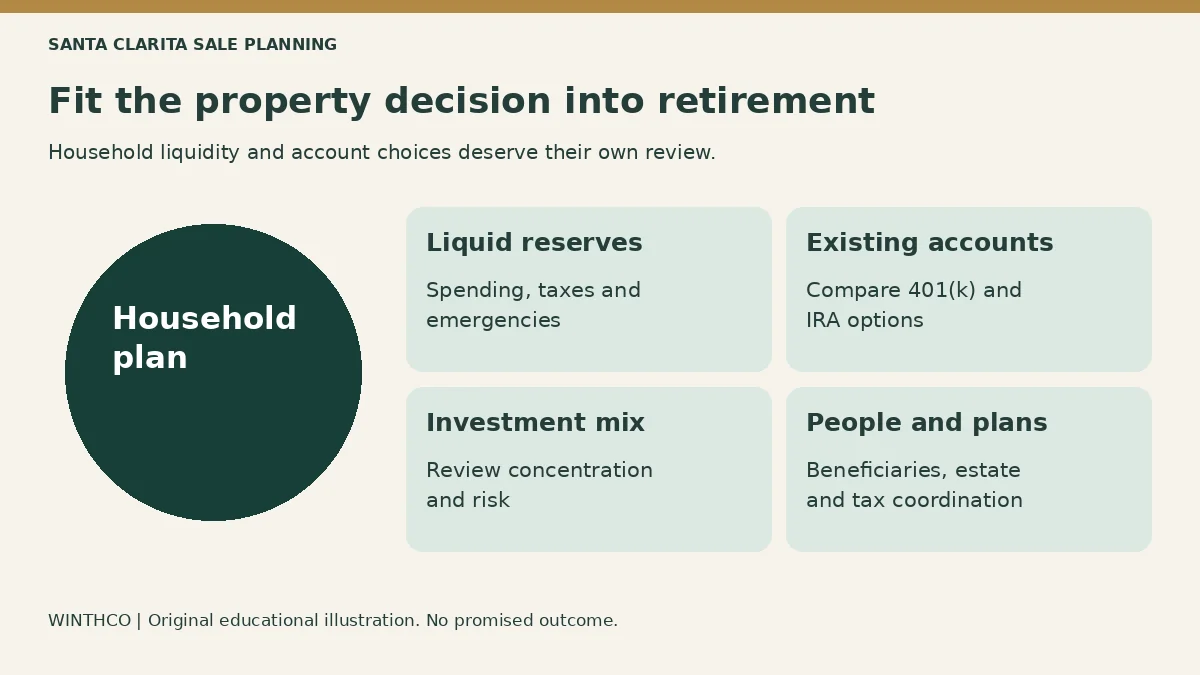
Winthco describes wealth management and retirement-planning services on its main site. A conversation can examine the sale alongside existing financial assets, 401(k)s, IRAs, liabilities, spending needs and beneficiaries. Review allocation and liquidity across the household rather than treating replacement real estate as a separate budget. Qualified retirement accounts are not themselves personal 1031 exchange proceeds.
Compare retirement-account options before making any rollover decision. Where eligible, retaining the current plan, using another employer plan or choosing an IRA can involve different costs, services, investment choices and protections. An account transfer or advisory engagement should not be presumed appropriate. Coordinate estate documents with an attorney and federal, California and other state filings with the CPA; Winthco's DST tax reporting resource can organize questions.
Use the prospect contact forms to request a planning conversation and identify the property-sale stage. Do not submit tax returns or identity documents in a general message. An inquiry does not create an exchange, reserve an investment or establish suitability. This guide uses AI-assisted research and drafting with Winthco organization attribution and primary-source review dated October 13, 2026.
This map identifies Santa Clarita as a service area only. It does not claim a Winthco office, client location, DST property or investment offering in the city.
| Decision | Evidence to request | What to avoid assuming |
|---|---|---|
| Listing strategy | Comparable sales, marketing plan and written fees | A high suggested price proves a better outcome |
| Exchange readiness | QI agreement, tax analysis and deadline calendar | The process can be added after receipt of proceeds |
| DST selection | Offering documents and downside cases | An identified investment is reserved or suitable |
| Possible 721 contribution | Valuation, rights, tax review and exit limits | Partnership units are direct 1031 replacement property |
| Retirement coordination | Account options, fees and household cash needs | Every account should be transferred |
No Santa Clarita office is claimed in this guide. Winthco's verified office is at 1871 Tapo Street in Simi Valley. The map identifies only the Santa Clarita service area.
No. Qualifying use, ownership, replacement property, timing and the exchange procedure all matter. Ask your tax and legal professionals to review the facts.
Request written explanations of compensation, alternatives, property and sponsor risks, debt, liquidity, control and exit rights. Verify registrations and separate tax and legal responsibilities.
Do not assume so. DST interests can be highly illiquid and subject to transfer restrictions, with no assured secondary market or investor-controlled exit.
No. Availability, timing, control and tax consequences depend on separate documents and facts. Operating-partnership units generally are not direct 1031 replacement property.
No. Compare eligible account options, costs, investments and services independently of the property transaction. A rollover is not an automatic part of an exchange.
Sources checked October 13, 2026. This article explains general concepts; your facts and the applicable documents control.
Winthco DST services · Winthco evaluation overview · Editorial standards
Local real estate planning
A practical Simi Valley guide to Delaware statutory trust advisors, 721 UPREIT planning, CPA coordination, California reporting and investment risks.
Read guide →Local real estate planning
A Thousand Oaks guide to DST, 1031 exchange and 721 UPREIT planning, with local records, professional roles, deadlines, fees and risks.
Read guide →1031 exchange planning
Learn what a qualified intermediary does in a DST 1031 exchange and how to review agreements, fund controls, deadlines and professional roles.
Read guide →Explore Winthco’s main DST article collection
Share your timeline and investment range. A Winthco team member will follow up with you.