1031 exchange planning
Qualified intermediary for a DST 1031 exchange
Learn what a qualified intermediary does in a DST 1031 exchange and how to review agreements, fund controls, deadlines and professional roles.
Read guide →
Home / Learning center / 1031 exchange planning
1031 exchange planning
Winthco Wealth Management · Updated November 4, 2026
A buyer’s promise to pay later is not the same as cash available to buy a Delaware statutory trust interest. If you are selling investment real estate and considering both seller financing and a 1031 exchange, have your advisers review the note, the closing instructions and the cash needed for replacement property before you commit.
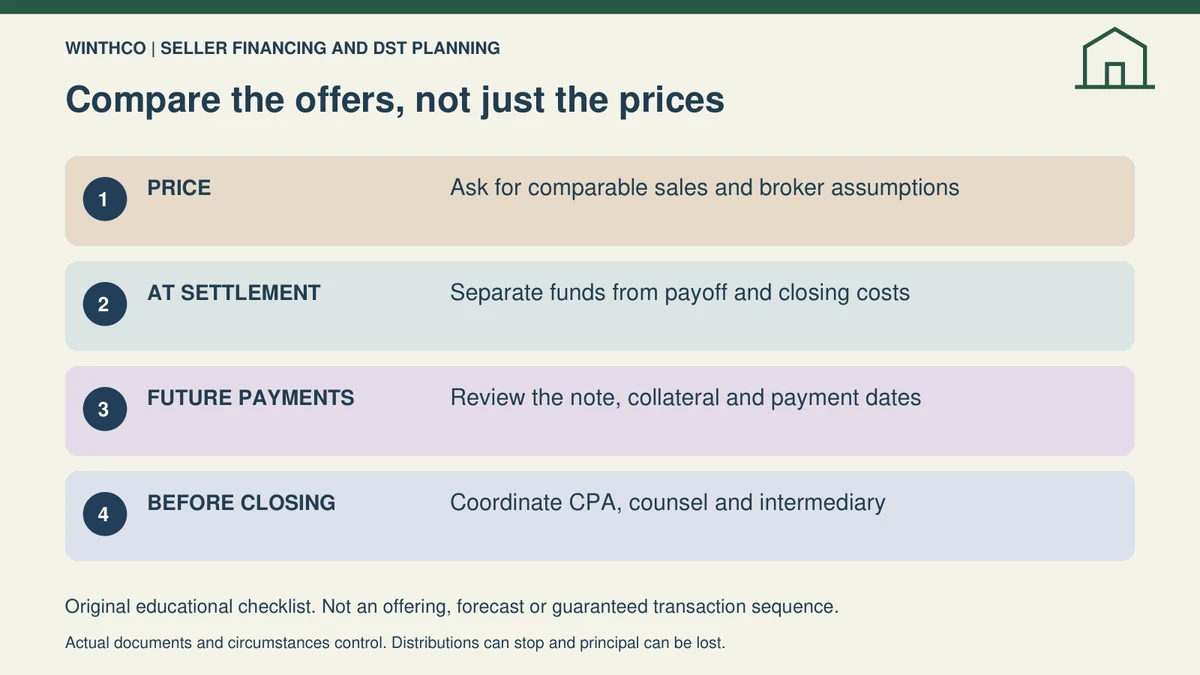
Interview a licensed broker with recent sales of comparable investment properties. Ask how they reached the valuation, what marketing and fees they propose, and how a buyer would document funds and financing. Compare offers by the cash due at closing, obligations you would retain and what must happen for the deal to close. A higher price with a substantial seller note is not necessarily a better offer than a lower price paid at closing. Ask your broker to show the timing and cash assumptions side by side.
If you are considering a deferred exchange, involve your CPA, attorney and qualified intermediary before closing or taking control of proceeds. Ideally they should review the proposed terms before you sign. Section 1031 can defer eligible gain on qualifying business or investment real property, not erase tax. Generally you have 45 days to identify replacement property and until the earlier of 180 days after transfer or your federal return due date, including extensions, to receive it. Winthco’s overview of 1031 exchange rules provides context for the questions your team will need to answer.
Share your timeline and investment range. A Winthco team member will follow up with you.
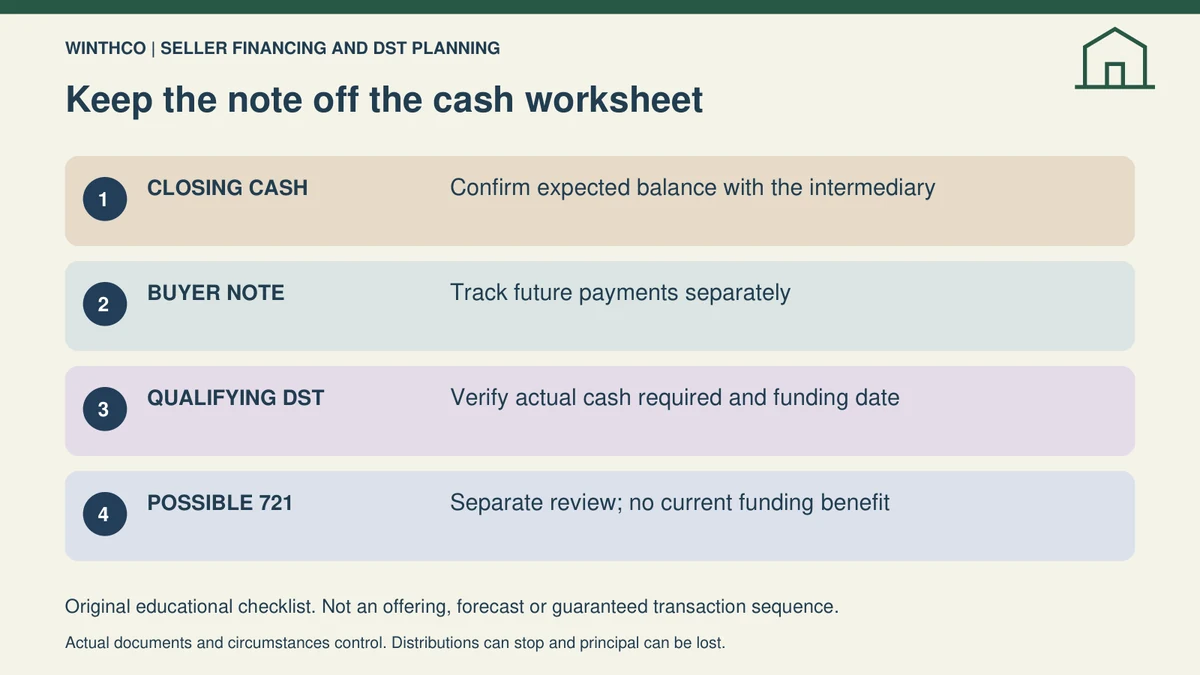
Closing cash is money delivered at settlement and allocated under the approved closing instructions. A buyer’s note is an obligation to make future payments. It can have value, and it may be secured by real estate, but that does not make the note itself replacement real property. Ask for a closing worksheet showing cash, the proposed note, any loan payoff, costs and the amount expected to be available to fund a replacement. Then ask who will hold each item and when you or the intermediary can access it.
Discuss your DST questions with Winthco →
IRS Publication 537 discusses exchanges in which the seller receives both like-kind property and an installment obligation. It describes adjustments to contract price and gross profit for computing installment income when the rules apply. That is not the same as treating the note as like-kind property or deferring everything under Section 1031. Have your CPA analyze the actual note, other non-like-kind consideration, any applicable depreciation recapture, interest and the timing of payments. Interest and principal should be tracked separately; not every dollar received has the same tax treatment.
Do not rely on that. The deferred-exchange rules consider when a taxpayer actually or constructively receives money or other property. An intermediary arrangement must satisfy applicable requirements, including limits on access to proceeds. Merely labeling an account as escrow does not settle the question. Counsel and the intermediary should review the purchase agreement, note, payee, escrow instructions and any rights to pledge or receive funds together. If a buyer changes financing just before closing, get updated written instructions rather than assuming the original analysis still applies.
WATCH & LEARN
Equity Advantage 1031 Exchange discusses the time and effort of direct property ownership. This third-party video provides general context, not seller-financing or installment-tax advice. Original resource · Watch on YouTube ↗
Educational context only. The discussion does not establish the suitability, returns or tax treatment of an investment.
Suppose a hypothetical rental sale is priced at $900,000, with $650,000 in closing cash and a $250,000 buyer note. If $150,000 of the cash goes to a loan payoff and closing costs, $500,000 is left on this simplified worksheet before any other adjustments. That is a funding illustration, not a tax calculation. If the seller is reviewing a DST interest requiring $600,000 in cash, the note does not fill the $100,000 gap. Compare alternatives with the exchange team before identification rather than counting on an early note payoff or a last-minute change to the documents.
Ask whether the interest has a minimum purchase amount, whether a closing slot is available and what funding must arrive by the proposed date. Separately confirm that the structure and interest qualify for your exchange. Revenue Ruling 2004-86 addresses a specific trust with limited powers, not every DST. Read Winthco’s DST offering memorandum review guide before asking for actual offering documents, debt terms, sponsor and affiliate compensation, reserves, operating assumptions and investor rights. A DST may reduce daily management without giving investors control over repairs, financing or exit timing.
Use one row for each source of cash, one for each required payment and a separate column for dates and conditions. Ask the intermediary to confirm the balance expected under the actual closing instructions, and ask the DST offering team to confirm the purchase amount and funding date in writing. Leave the buyer’s note on a separate schedule unless your advisers confirm a permissible, documented alternative that can actually be completed in time. Ask which amounts could change before settlement, such as the payoff or closing costs. Do not assume all expenses reduce taxable gain or are treated the same for exchange purposes.
A buyer might miss note payments at the same time a DST reduces distributions. Review the buyer’s ability to pay, the lien position and what enforcement would involve with counsel. For the DST, test tenant vacancies, higher expenses, refinancing or a delayed sale. Private placements can have limited disclosures and be difficult to resell; DST offerings are generally for accredited investors. Consider fees, sponsor risk, property and debt concentration, uncertain distributions and potential loss of principal. Holding a note backed by one property plus an interest in another does not automatically diversify your cash-flow risks.
Set decision points before signing: the minimum closing cash the household needs, the latest date a replacement can reasonably close, and any note terms your attorney flags as unacceptable. If an offer misses one of those thresholds, compare a revised cash and note split, a different replacement or a taxable sale. Ask your advisers to explain the consequences of each choice, rather than assuming the exchange must happen at any cost.
Treat it as a different transaction. Section 721 generally addresses contributing property to a partnership in exchange for an interest, subject to exceptions and the actual terms. A DST purchase does not assure an UPREIT contribution, a redemption date or a particular tax result. Ordinary REIT shares and operating partnership units are not direct 1031 replacement real property. A possible future contribution does not increase the cash available at today’s closing. Ask who controls any later decision, what liabilities or restrictions apply and what happens if a contribution is never offered.
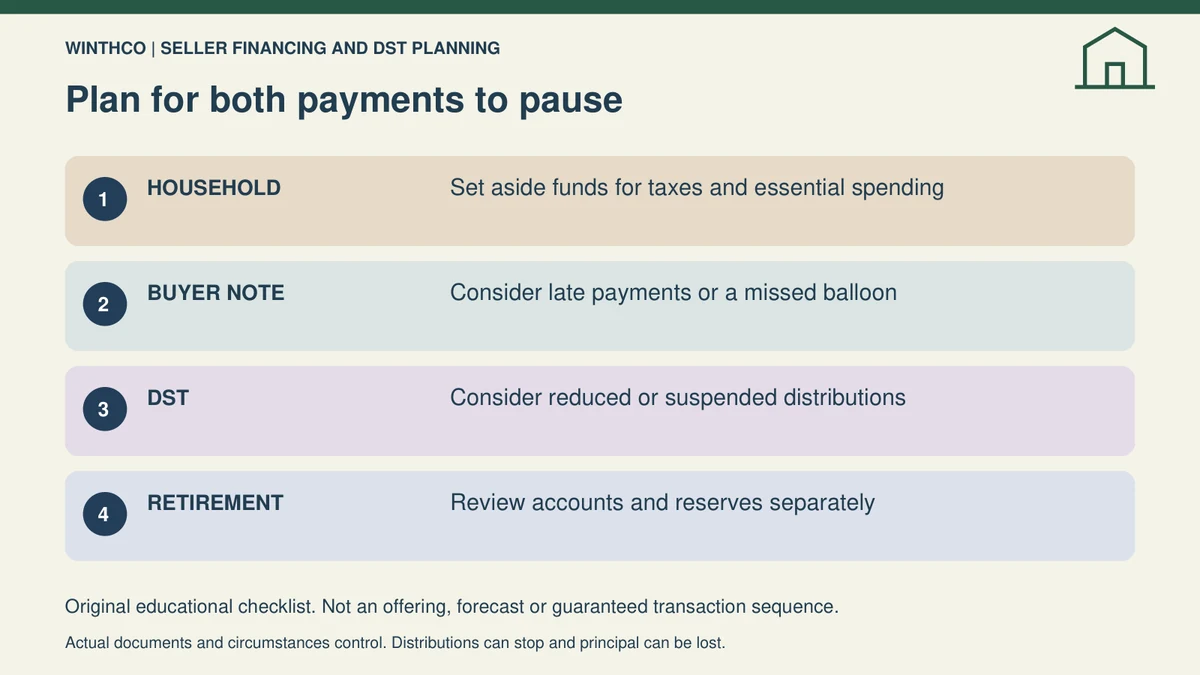
Model a delay in the first note payment, a missed balloon payment and a pause in DST distributions as separate events. Then consider them together. Compare the monthly spending you can cover without either source with the expenses you cannot defer. Ask the CPA to distinguish estimated taxes from cash available for living expenses, and ask counsel to explain the time and cost of enforcing the note. If the decision depends on selling the DST quickly, a buyer refinancing on schedule or borrowing against the note, identify those dependencies before the sale contract commits you.
Keep accessible reserves, known expenses and estimated taxes separate from uncertain note or DST cash flow. Compare a cash sale, an eligible exchange with a different replacement and seller financing with your advisers. Review your taxable assets, 401(k)s, IRAs, retirement-income needs and beneficiary or estate arrangements separately from the sale proceeds. Consider the costs and services of any proposed account change without assuming a rollover or transfer. Use the prospect forms here or the dedicated contact page to discuss the property transition and broader financial planning with Winthco Wealth Management.
| Decision | Evidence to request | What to avoid assuming |
|---|---|---|
| Buyer’s note | Payee, principal, terms, collateral and payment dates | The note can be wired to close a DST. |
| Closing cash | Settlement worksheet, payoff and exchange instructions | Contract price equals reinvestable cash. |
| DST | Funding deadline, fees, controls and downside scenarios | Exchange eligibility means investment suitability. |
| Household liquidity | Cash available if payments and distributions pause | Two illiquid positions provide reliable spending money. |
No. A buyer’s debt obligation is distinct from an interest in qualifying replacement real property.
Yes. It can affect available cash, the nature of consideration and timing of gain recognition. Ask your exchange and tax team to review the actual agreements before closing.
Taking a note does not by itself extend the identification period. Confirm the actual exchange deadlines with your intermediary and CPA.
No. Eligibility and timing depend on the facts; for example, applicable depreciation recapture generally is not deferred under the installment method.
No. A possible separate partnership contribution does not change the buyer’s payment obligation under the note.
Sources checked November 4, 2026. This article explains general concepts; your facts and the applicable documents control.
Winthco DST services · Winthco evaluation overview · Editorial standards
1031 exchange planning
Learn what a qualified intermediary does in a DST 1031 exchange and how to review agreements, fund controls, deadlines and professional roles.
Read guide →DST investment due diligence
Selling a rental property? Learn how to review a DST private placement memorandum, compare fees and risks, and assess separate 721 UPREIT terms.
Read guide →1031 exchange planning
Can you keep cash and use a DST in a partial 1031 exchange? Review boot, debt, timing and retirement liquidity before selling your rental.
Read guide →Explore Winthco’s main DST article collection
Share your timeline and investment range. A Winthco team member will follow up with you.