DST ownership and exits
DST holding period and exit timing
Understand DST holding periods, sponsor sale timing, early-exit limits and the tax decisions that may follow a trust's disposition.
Read guide →
Home / Learning center / DST due diligence
DST due diligence
Winthco Wealth Management · Updated October 29, 2026
Selling a DST interest before the underlying property sells may require a legally permitted resale, compliance with the trust's transfer provisions, an eligible buyer and completed closing documents. None of those steps guarantees the others. Review the actual offering and governing documents with securities counsel before treating a secondary sale as available cash.
Begin with the investment-property sale you are considering. Interview an appropriately licensed realtor or commercial broker about valuation evidence, marketing, occupied-property diligence, fees and realistic closing conditions. Assemble leases, operating statements, debt information and improvement records. Explain whether the household wants less management, different property exposure or money for known expenses. That distinction matters before deciding how much sale equity can reasonably become illiquid.
If a deferred exchange may be used, involve the CPA, attorney and qualified intermediary before closing or receiving proceeds. Replacement property generally must be identified within 45 days after transfer of the relinquished property and received by the earlier of 180 days or the applicable tax-return due date, including extensions. Deferral is not tax elimination. A tight exchange calendar should not turn an uncertain future DST resale into the household's plan for near-term cash.
Share your timeline and investment range. A Winthco team member will follow up with you.
Separate a sale of the investor's beneficial interest from a sale of the DST's underlying real estate. In an interest transfer, the property may remain in the trust while the registered owner of the interest changes. A sponsor's expected property holding period answers a different question from whether an individual investor can find and close with a buyer today. The DST holding-period overview is useful background, but it is not a personal withdrawal schedule.
Obtain the private placement memorandum, trust agreement, subscription documents and subsequent amendments. Confirm the legal entity, ownership registration and amount being considered for transfer. Ask the authorized administrator which provisions govern a sale, gift, estate transfer or change in registration; they need not follow identical procedures. An account statement showing a value does not itself establish that a transfer is permitted or that someone will pay that amount.
IRS Revenue Ruling 2004-86 addressed a specified arrangement in which beneficial interests were treated as direct real-property interests for federal tax purposes. That classification does not establish a public trading market or erase securities-law restrictions. The actual structure, documents and transaction facts still control. Have the CPA review the proposed transfer's tax treatment rather than extrapolating from the original exchange.
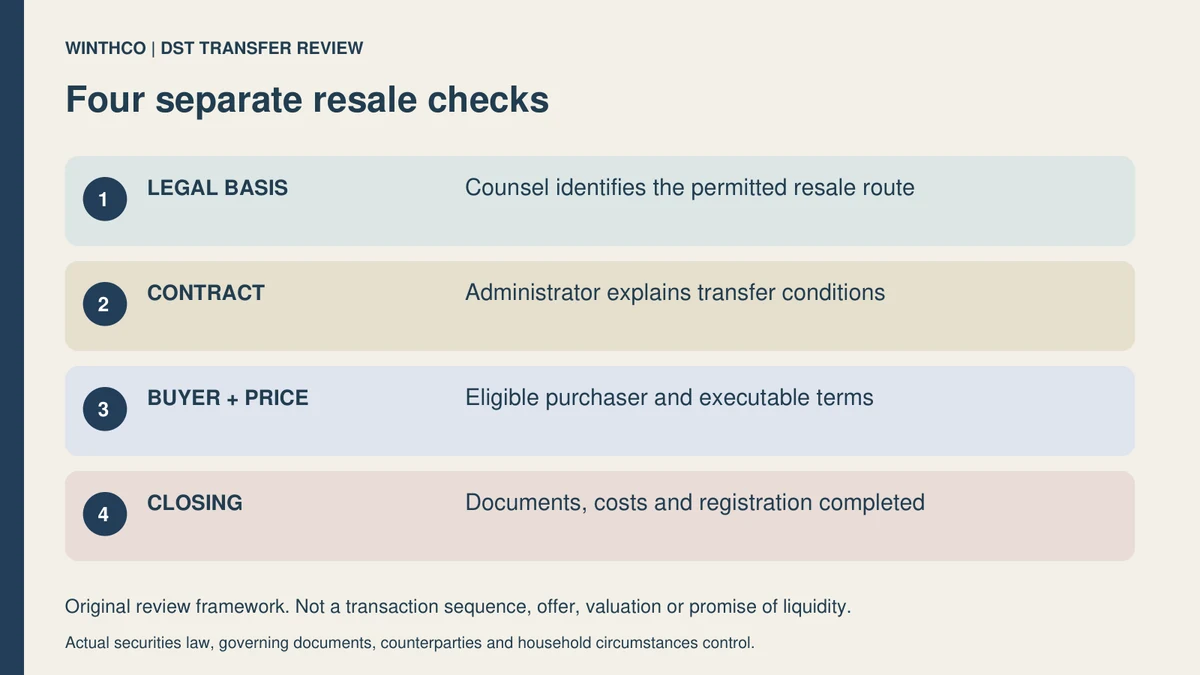
DST interests are commonly offered as private-placement securities. The SEC explains that resale of restricted securities requires registration or an applicable exemption. Securities counsel should identify the legal basis for the actual proposed sale, the seller's status, available information and required representations. Do not assume that every DST transfer follows one standard exemption or becomes freely tradable after an anniversary.
Rule 144 is a commonly used resale exemption with conditions, not a promise of a market or automatic permission to complete every transaction. Its applicability can depend on facts beyond elapsed time. Counsel should explain the appropriate route and any required opinion or legend procedures. Avoid turning a general online holding-period description into instructions to publicly advertise an interest.
Separately, the governing agreements may restrict transfers or require consent and documentation. Ask who has authority to approve the transaction, which conditions apply and whether the proposed buyer and ownership form are acceptable. Securities-law compliance does not cancel contractual conditions. Administrative consent does not by itself establish a securities-law exemption. Obtain a written explanation of both, rather than allowing one approval to stand in for the whole review.
Discuss your DST questions with Winthco →
Ask the administering party and counsel what eligibility information the proposed buyer must provide. Accreditation may be relevant, but it is not the only question and does not establish suitability. Confirm the actual offering and transfer provisions instead of presuming that the rules for an original subscription automatically answer every resale question. The accredited-investor background helps frame eligibility discussions, not approve a particular purchaser.
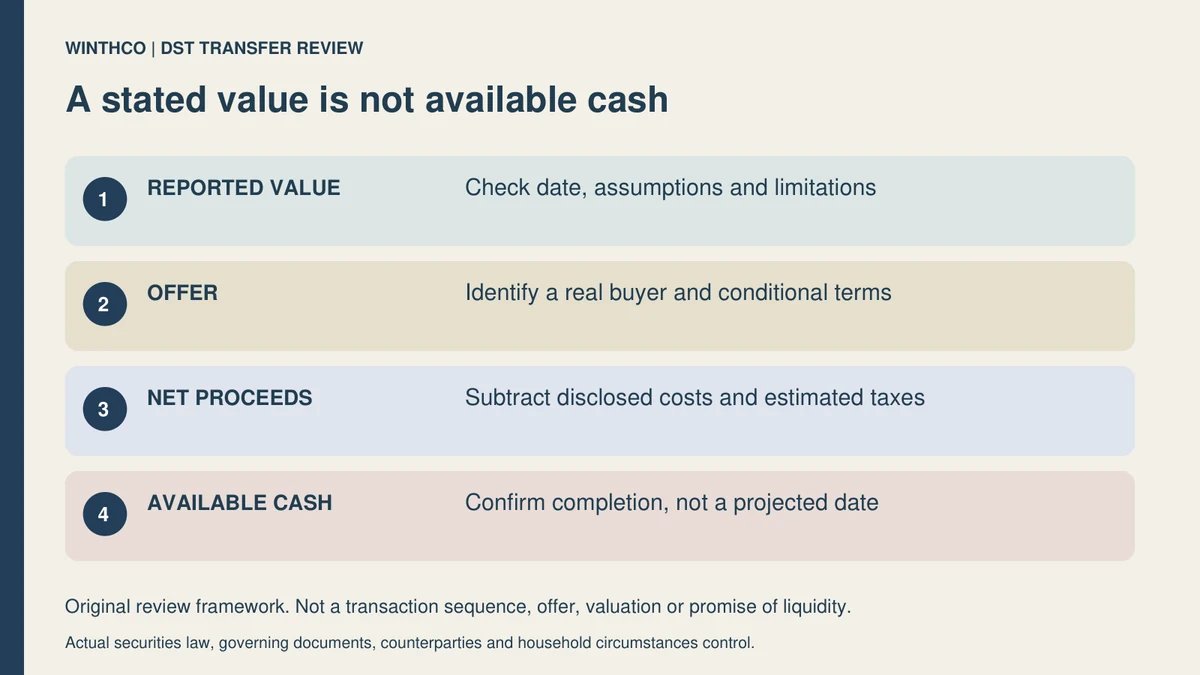
A willing buyer and an acceptable price remain separate hurdles. Private real estate interests may have limited available information and few potential buyers. A stated asset value, original purchase amount or projected exit value is not an executable bid. Request the date, assumptions and limitations of valuation information, and ask whether the prospective buyer can review current property performance, debt, reserves, distributions and material changes through an authorized process.
Compare the proposed gross price with the cash expected after disclosed brokerage, legal, administrative and other transaction costs, plus estimated taxes. Confirm who pays each charge and when. A discount may be economically significant, and a quick-sale request does not guarantee a quick closing. This article does not identify a trading venue, recommend a buyer or claim that a secondary market exists for your interest.
Request a written checklist from the authorized administrator before promising a closing date. It should identify the controlling documents, required seller and buyer information, approval sequence, legal-review responsibilities, estimated fees and method for confirming completion. Ask what remains conditional and how a rejected, incomplete or withdrawn transfer would be handled. Keep copies of the correspondence and final documents.
Have independent professionals verify the transaction counterparties and the permitted funds-handling process. Confirm important instructions through independently verified contact details; do not treat an unsolicited email as proof of authority. A prospect contact form is not a transfer instruction, subscription agreement or secure channel for account records. Ask for the firm's approved secure process before transmitting confidential information.
At completion, ask how ownership registration, future distributions and tax reporting will reflect the transfer and its effective date. Clarify who receives notices during the transition and how any amounts spanning the closing date are handled under the documents. The DST evaluation questions remain useful after purchase: evidence, responsibility and written terms matter more than an informal assurance that paperwork is routine. Review the DST documents to review before purchase alongside the administrator's current transfer checklist.
WATCH & LEARN
Equity Advantage 1031 Exchange discusses the time and energy demands of direct property ownership and DSTs as one possible alternative. This third-party video is general background, not resale legal advice, a promise of liquidity or endorsement of an offering. Original resource · Watch on YouTube ↗
Educational context only. The discussion does not establish the suitability, returns or tax treatment of an investment.
Consider a hypothetical investor who bought a DST interest after selling a rental and later needs cash for a family expense. This is not an actual client or investment outcome. The investor initially compares an account value with the expense, but counsel and the administrator identify unanswered transfer conditions. A potential buyer has not yet made a firm offer, and the net cash and completion date remain unknown.
The planning team separates five questions: can the proposed transaction legally proceed, do the documents permit it, is the buyer eligible, is the net price acceptable and can closing finish in time? A positive answer to only one does not fund the expense. The household reviews accessible assets and spending alternatives without assuming a DST redemption, borrowing arrangement or resale will be available. This exercise is most useful before committing capital, when liquidity needs can still influence the allocation.
Section 721 generally concerns property contributed to a partnership for partnership interests, subject to exceptions and transaction-specific facts. An UPREIT commonly holds property through an operating partnership associated with a REIT. It is a different framework from Section 1031; ordinary REIT shares and operating-partnership units generally are not direct 1031 replacement real property.
Some DST materials describe a possible later operating-partnership contribution. Do not treat that proposal as an individual investor's immediate cash exit. Ask who controls timing, what conditions remain, how value and debt are measured and which unit rights would apply. The event may not occur. If it does, transfer limits, redemption procedures and tax consequences may still matter. A minimum holding period or FIFO description does not promise conversion, cash or tax-free basis withdrawals. Review a real proposal with the CPA and attorney separately.
A DST may reduce direct property-management duties, but that convenience comes with limited control and potentially prolonged illiquidity. Property, tenant, sponsor, leverage, valuation, fee, conflict, concentration and tax-law risks remain. Distributions can change or stop and principal can be lost. Neither accreditation, original exchange eligibility nor an allowed transfer provision establishes safety or guarantees investment performance.
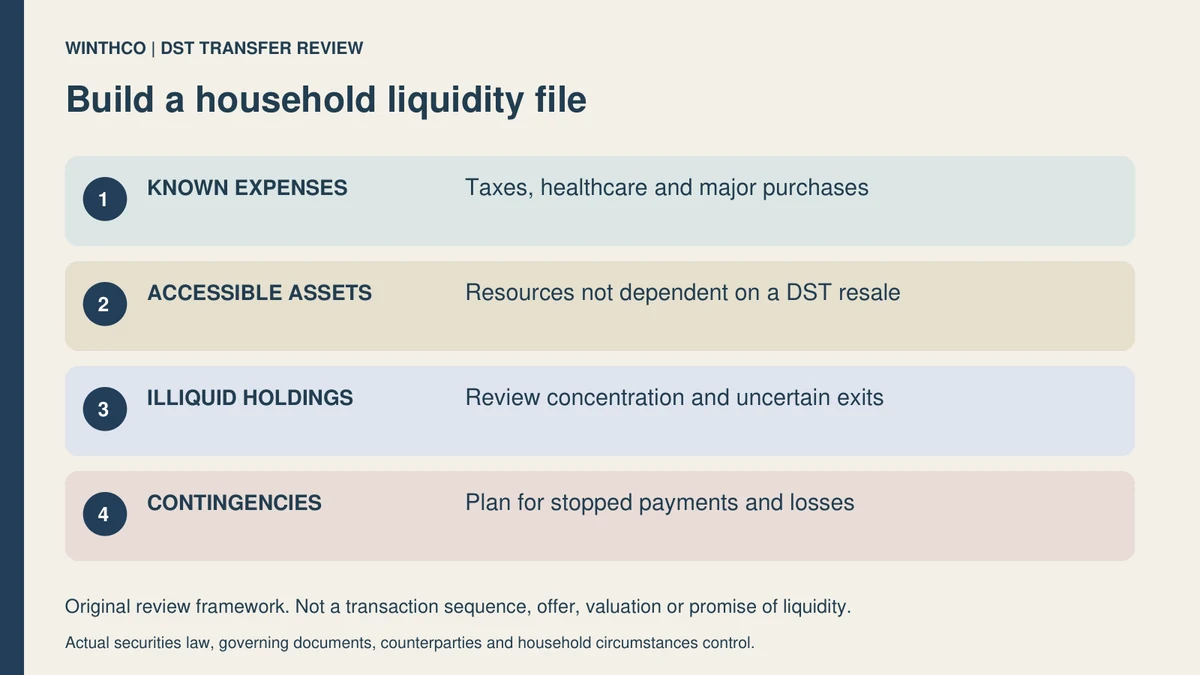
FINRA highlights the problem of holding too much wealth in securities that cannot readily be sold. Review accessible cash alongside existing financial assets, 401(k)s, IRAs, other real estate and the household's income needs. Include emergency expenses, taxes, healthcare, major purchases and beneficiary or estate administration. Several DST holdings can share risks even if their names differ. A projected property sale date is not a substitute for a household liquidity reserve.
Winthco's wealth-management conversation can connect these questions with retirement income, asset allocation, tax-professional coordination and estate objectives. A property sale does not automatically justify moving securities, rolling over retirement accounts or starting an advisory relationship. Compare the choices, costs and services separately. Use the prospect form to explain the planning question without account numbers or confidential documents, and obtain a secure process for any later records. The guide to household liquidity before a partial exchange addresses the earlier allocation decision, before capital becomes difficult to access.
| Decision | Evidence to request | What to avoid assuming |
|---|---|---|
| Legal resale basis | Counsel's transaction-specific analysis | Elapsed time alone authorizes resale |
| Contract terms | Trust provisions and authorized approvals | Legal eligibility overrides agreements |
| Buyer and value | Eligible purchaser and executable terms | An account value is a bid |
| Closing and cash | Completed documents, costs and effective date | Consent means money is available now |
Possibly, but do not assume an available buyer or an unrestricted transfer. The legal basis, governing documents, buyer eligibility and closing conditions all require review.
No. An exemption addresses securities-law requirements when applicable, not buyer demand or price. Counsel should assess the actual facts and any other conditions.
Not necessarily. A reported or estimated value is different from a buyer's executable offer, and costs and taxes can change net proceeds.
No. Contractual consent, securities-law compliance, buyer eligibility and completed closing documents answer different questions.
Ask about the actual gift, estate or registration-change provisions. Do not assume those procedures or tax consequences are identical to a sale.
Not necessarily. The event may not occur, and resulting unit rights can restrict transfers or redemption. Tax consequences and conditions require separate review.
Sources checked October 29, 2026. This article explains general concepts; your facts and the applicable documents control.
Winthco DST services · Winthco evaluation overview · Editorial standards
DST ownership and exits
Understand DST holding periods, sponsor sale timing, early-exit limits and the tax decisions that may follow a trust's disposition.
Read guide →DST investment due diligence
Selling a rental property? Learn how to review a DST private placement memorandum, compare fees and risks, and assess separate 721 UPREIT terms.
Read guide →1031 exchange planning
Can you keep cash and use a DST in a partial 1031 exchange? Review boot, debt, timing and retirement liquidity before selling your rental.
Read guide →Explore Winthco’s main DST article collection
Share your timeline and investment range. A Winthco team member will follow up with you.