Local real estate planning
Thousand Oaks DST advisor and 1031 exchange guide
A Thousand Oaks guide to DST, 1031 exchange and 721 UPREIT planning, with local records, professional roles, deadlines, fees and risks.
Read guide →
Home / Learning center / Local real estate planning
Local real estate planning
Winthco Wealth Management · Updated October 17, 2026
A Westlake Village property seller evaluating a DST should first confirm the property jurisdiction, prepare sale records and coordinate the broker, CPA, attorney and qualified intermediary. Compare the actual DST documents and any separate 721 UPREIT proposal with your need for control, accessible cash and retirement income, not just a projected distribution.
Start with the decision the sale is meant to solve. Are management demands increasing, does the property dominate household wealth, or will retirement require more accessible money? Interview licensed realtors or commercial brokers about the actual property type, recent valuation evidence, marketing, compensation and likely buyer questions. Verify the real estate license through California DRE. A broker's sale estimate is not an investment or tax recommendation.
Give the professional team a consistent file: ownership documents, leases, operating expenses, loan payoff information and improvements. Include the CPA, attorney and qualified intermediary before closing or receiving proceeds if an exchange is under consideration. Winthco's California DST planning background introduces the broader discussion, but no general guide can determine your eligibility or the appropriate replacement investment. Do not let a proposed closing date substitute for a coordinated plan.
Share your timeline and investment range. A Winthco team member will follow up with you.
The incorporated City of Westlake Village is in Los Angeles County and borders Thousand Oaks and Ventura County. Confirm the parcel's governing jurisdiction rather than relying on a familiar community name or mailing address. The city provides a Zoning and Neighborhood Finder through its official planning resources. Use it to frame questions for staff; a map is not a legal opinion about a property or permission for a proposed use.
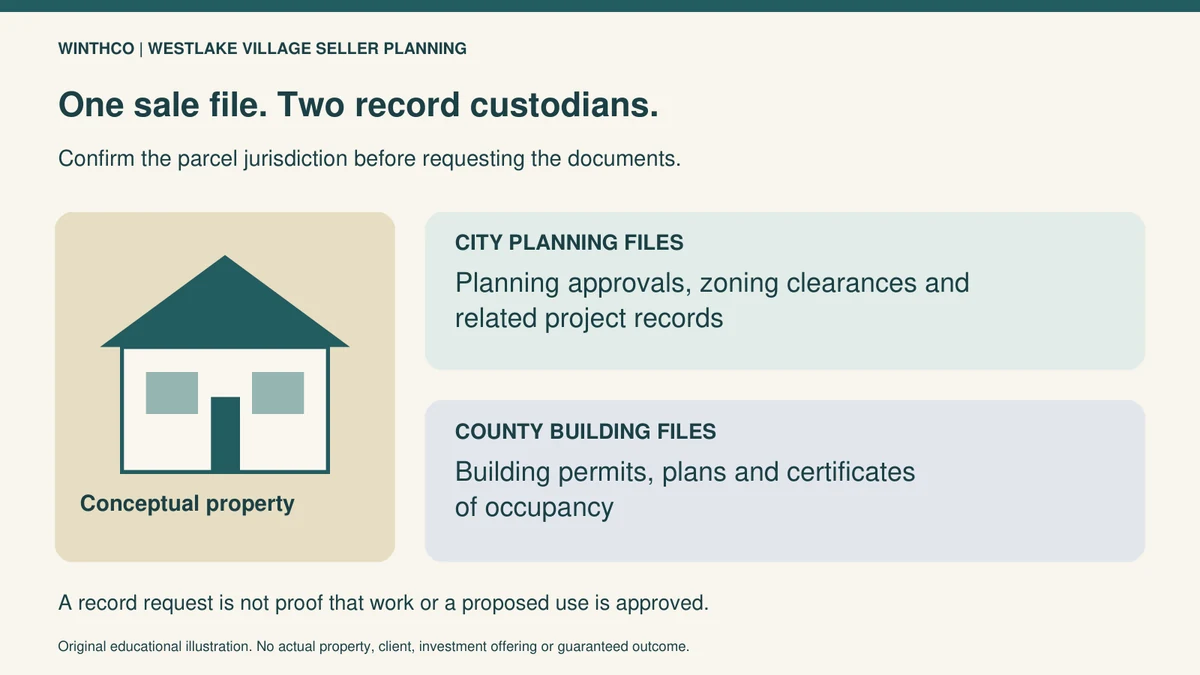
For property inside the city, planning approvals and building records have different custodians. The city directs requests for planning approvals, such as conditional-use permits and zoning clearances, to City Hall. It states that Los Angeles County holds building permits, plans and certificates of occupancy, which are not available at City Hall. Some permit records are accessible through the county's viewer. Request missing records early rather than expecting one office to supply everything immediately.
This distinction matters when a buyer asks whether a tenant alteration or earlier renovation was approved. The broker can identify the question, while the appropriate agency supplies records and qualified professionals interpret them. Also gather applicable association documents if the property is subject to them. These are sale-preparation questions, not a claim that every Westlake Village transaction requires a special city inspection or has the same approval history.
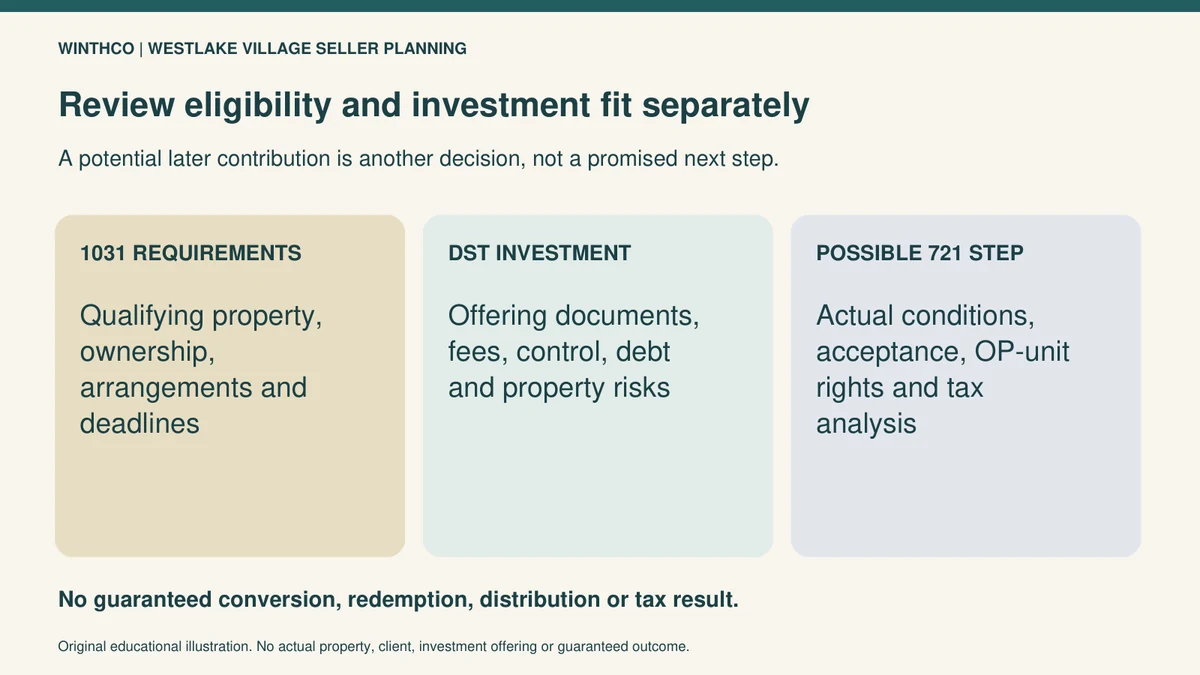
Section 1031 can defer eligible gain when qualifying business or investment real property is exchanged for qualifying replacement real property and the transaction meets the rules. It is not tax elimination. Compare a full exchange with retaining the property, changing management, a taxable sale or a partial exchange that preserves some cash. The useful question is which structure fits the owner's objectives after costs, taxes and risks.
In a standard deferred exchange, replacement property must be identified within 45 days after transfer of the relinquished property. Receipt must occur by the earlier of 180 days or the applicable tax-return due date, including extensions. The QI and counsel should address the written exchange arrangements and restrictions on receiving proceeds under Treasury Regulation 1.1031(k)-1. The CPA should review basis, depreciation, liabilities and cash or other nonqualifying property that may produce recognized gain.
California reporting can continue after an investment moves elsewhere. FTB generally requires Form 3840 when California real property is exchanged for out-of-state real property and California-source gain or loss remains deferred. Reporting generally continues annually until recognition. Ask the CPA who will maintain the schedule and report subsequent transactions; an out-of-state address does not end the obligation.
Discuss your DST questions with Winthco →
A Delaware statutory trust can hold real estate for beneficial owners. Revenue Ruling 2004-86 addresses a particular arrangement in which an acquired beneficial interest represents an interest in the underlying real property for federal tax purposes. Other Section 1031 requirements still apply. Ask tax counsel to examine the actual structure rather than assuming that the letters DST establish qualification.
For an owner leaving direct property management, less responsibility for tenants and repairs may be appealing. The other side is reduced control. You generally cannot direct leasing decisions, choose when the property is sold or demand that your interest be redeemed when a household expense appears. Evaluate that change in decision-making authority separately from projected cash flow. Would the investment still fit if distributions were reduced or an exit took longer?
Ask for the current private placement memorandum, financial information and relevant property, loan and management documents. Review tenant exposure, lease expirations, reserves, debt maturity, expenses and the assumptions behind distributions. Ask which fees are paid upfront, during ownership and at disposition, and how the seller or advisor is compensated. A quoted distribution rate is not a complete measure of economic return or total cost.
Winthco's DST advisor discussion topics provide a starting point for that conversation. Verify registrations and the actual scope of the engagement. Private DST offerings are generally limited to accredited investors, but eligibility does not establish suitability. Ask what happens if a subscription is not accepted, an allocation changes or documents arrive too late for review. Neither investment approval nor a replacement acquisition should be presumed from an initial inquiry.
An UPREIT uses an operating partnership associated with a real estate investment trust. A Section 721 contribution generally concerns property contributed to a partnership in exchange for a partnership interest, with exceptions and transaction-specific tax consequences. This is a different analysis from acquiring qualifying replacement real property in a 1031 exchange. Winthco's introduction to 721 UPREIT discussions is background, not confirmation that a particular contribution will occur.
Some DST documents contemplate a later operating-partnership transaction; others do not. Ask whether any proposed step is optional or mandatory under the documents, who controls acceptance, how value is determined, and which conditions could delay or prevent it. Assess the DST on its own terms before assigning value to a possible later event. A projected date is not an enforceable promise of liquidity.
OP units are partnership interests, and ordinary REIT shares are securities; they generally are not direct Section 1031 replacement real property. Review redemption restrictions, fees, tax reporting and consequences of a later sale or redemption with counsel and the CPA. FIFO selection alone does not guarantee tax-free withdrawals of basis. The household should not depend on a specific future conversion or redemption to fund a known expense.
WATCH & LEARN
Winthco Wealth Management introduces general DST and property-sale planning. This is educational background, not Westlake Village permitting guidance, an offering recommendation or a promise of distributions, liquidity or tax results. Review actual documents with qualified professionals. Original resource · Watch on YouTube ↗
Educational context only. The discussion does not establish the suitability, returns or tax treatment of an investment.
Consider a hypothetical owner selling a leased Westlake Village commercial property to reduce management responsibilities. The owner also expects to help a family member financially in two years. No sale price, return or tax result is assumed. Before listing, the broker requests records about an earlier tenant alteration; the owner seeks planning approvals from the city and building records through the county.
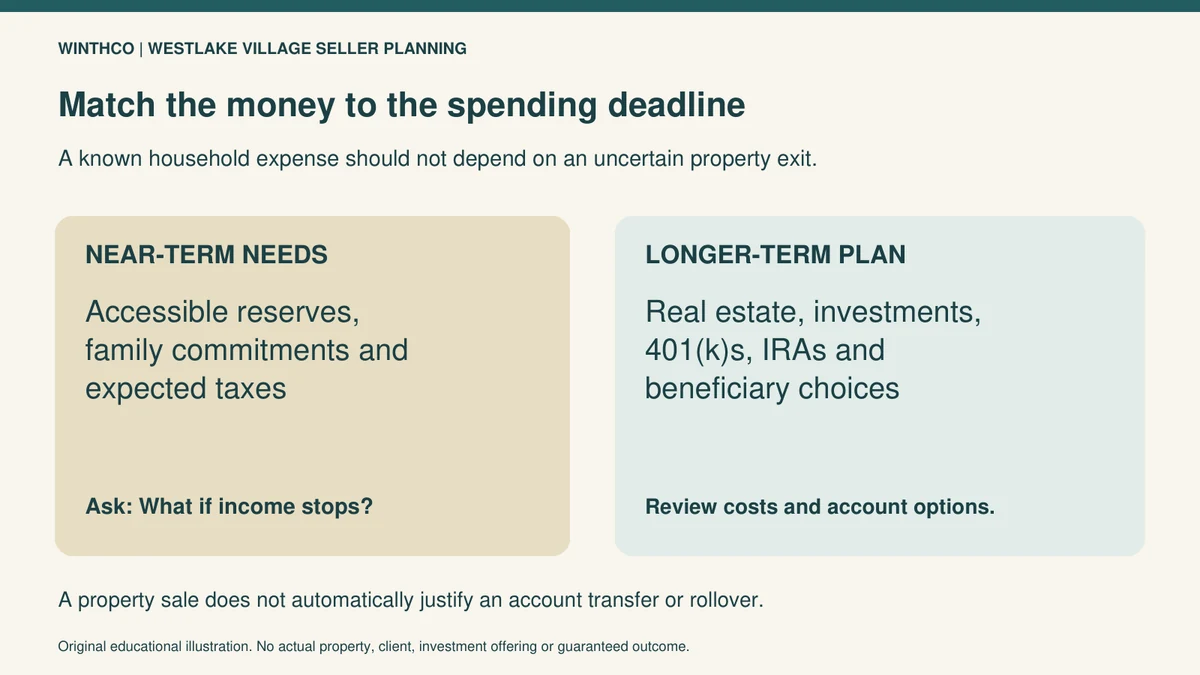
Separately, the CPA models a taxable sale, a partial exchange and a full exchange. The QI explains implementation and deadlines, while the investment professional reviews any proposed DST. A potential later 721 contribution is evaluated as a conditional option, not the source of the family payment. If accessible reserves are insufficient, that is a planning problem to resolve before committing more money to illiquid assets. It is not solved by choosing the largest projected distribution.
The SEC warns that private placements may involve limited disclosure, severe illiquidity and the possibility of total loss. For a DST, also examine sponsor execution, property conditions, tenant concentration, leverage, fees and tax-law changes. Distributions can change or stop. A stated holding period does not give the investor a right to receive cash on that date, and professional management does not remove investment risk.
FINRA notes that concentration can occur through shared exposures and holdings that are difficult to sell. Owning several differently named investments may still leave substantial exposure to the same property sector, region or liquidity constraint. Check registrations and disciplinary information using the relevant official tools. A person described as a DST CPA should have verified tax credentials; the investment advisor, broker, CPA, attorney and QI have different responsibilities.
Place the proposed real estate position beside existing financial assets, 401(k)s, IRAs and the household spending plan. Winthco describes wealth-management and retirement-planning services on its main website. A useful conversation identifies which resources can meet near-term expenses, how much illiquidity is acceptable, and how changes in distributions would affect retirement income. Review remaining property exposure as well as the new investment.
Coordinate beneficiary designations and estate documents with qualified professionals. Retirement accounts are not 1031 exchange proceeds, and a property sale does not automatically justify a rollover, account transfer or new advisory engagement. Compare relevant account choices, services and costs separately. Winthco's verified contact page lists 1871 Tapo Street in Simi Valley; the map below is a city-area reference, not a Winthco office. Use the prospect form to begin a planning discussion, and request a secure channel before sharing sensitive documents.
Map of Westlake Village, California, for geographic context only. Not a Winthco office, a parcel-boundary determination or a zoning approval. Confirm the property jurisdiction and record requirements with the relevant agencies.
| Decision | Evidence to request | What to avoid assuming |
|---|---|---|
| Property-sale readiness | Jurisdiction, planning approvals, building records, leases and broker valuation | One municipal office holds every record |
| 1031 eligibility | Ownership, basis, liabilities, QI arrangements and written deadlines | The exchange can be reconstructed after receiving proceeds |
| DST investment fit | Offering documents, compensation, property risks and liquidity needs | Accreditation or tax eligibility means suitability |
| Possible 721 contribution | Actual conditions, valuation, OP-unit rights and tax analysis | Conversion or later redemption is guaranteed |
No. The verified main contact page lists the Simi Valley office. The map provides city-area context and is not an office-location claim.
For property within the city, its official guidance directs building-record requests to Los Angeles County. City planning approvals are a separate category; confirm the jurisdiction and record type before submitting a request.
No. Section 1031 generally applies to qualifying business or investment real property, not a home merely because it has appreciated. Ask the CPA about actual use and any mixed-use or other rules.
No. Confirm each professional’s credentials, scope and compensation. Investment review, tax analysis, legal work and exchange implementation are separate responsibilities.
No. The actual offering documents determine whether a potential contribution is contemplated and what conditions apply. Evaluate the DST without assuming a later transaction or redemption.
Projected distributions can change or stop. Review accessible resources and the consequences of a shortfall before committing funds, rather than assuming distributions will meet every expense.
Sources checked October 17, 2026. This article explains general concepts; your facts and the applicable documents control.
Winthco DST services · Winthco evaluation overview · Editorial standards
Local real estate planning
A Thousand Oaks guide to DST, 1031 exchange and 721 UPREIT planning, with local records, professional roles, deadlines, fees and risks.
Read guide →1031 exchange planning
Can you keep cash and use a DST in a partial 1031 exchange? Review boot, debt, timing and retirement liquidity before selling your rental.
Read guide →DST due diligence
Review DST loan maturity, balloon payments and exit assumptions before exchanging a rental. Prepare questions about debt and household liquidity.
Read guide →Explore Winthco’s main DST article collection
Share your timeline and investment range. A Winthco team member will follow up with you.