DST due diligence
DST Reserves and Capital Repairs: What to Review
Before exchanging a rental into a DST, review repair budgets, restricted reserves and funding limits. Know which questions to ask before committing.
Read guide →
Home / Learning center / California advisor guides
California advisor guides
Winthco Wealth Management · Updated October 21, 2026
A Calabasas property owner considering a DST should prepare the rental sale and the replacement decision together. Interview a licensed sale professional, involve the CPA and qualified intermediary before closing, and compare control, costs and liquidity. A possible later 721 contribution needs separate review, alongside the household's broader retirement and wealth plan.
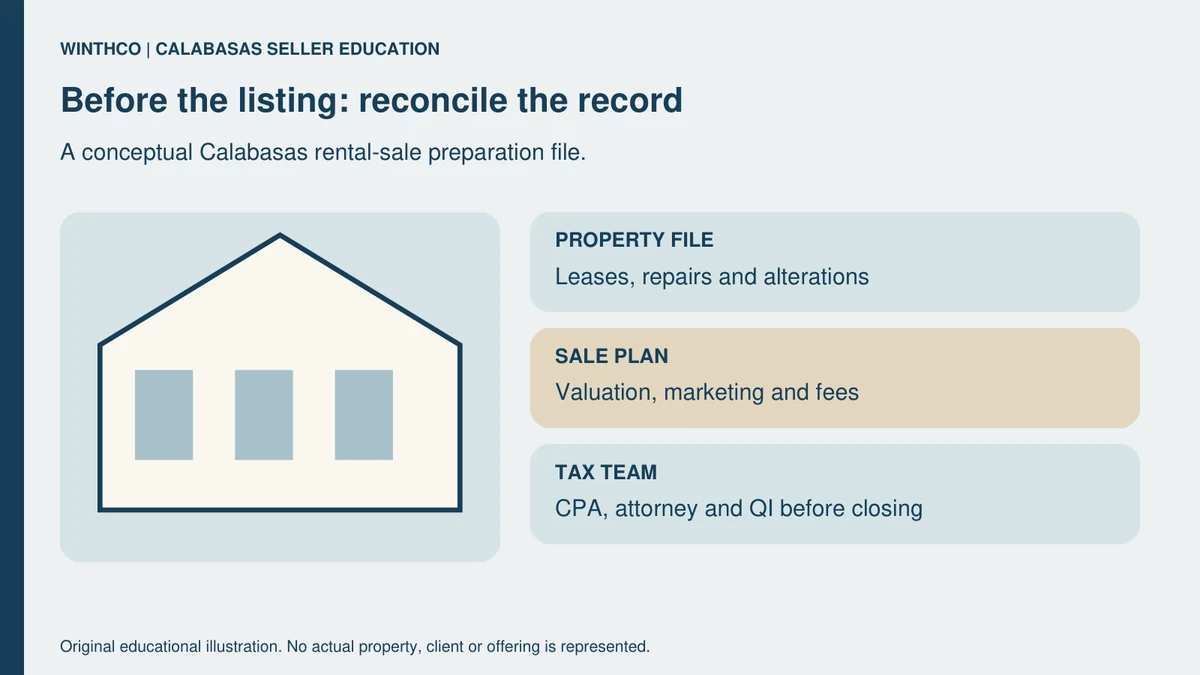
Start with the reason for selling, not an investment brochure. Is the problem maintenance, tenant administration, concentrated wealth or a coming retirement date? Interview appropriately licensed realtors or commercial brokers familiar with your property type. Ask for comparable-sale evidence, a marketing plan, proposed compensation and an explanation of how occupied-property access will be handled. Verify California licensing through the Department of Real Estate.
Give the sale team a practical file: leases, deposits, operating statements, debt information, repair history and documents for alterations. Ask what could affect buyer financing or the closing schedule. Before closing or receiving proceeds, involve the CPA, attorney and qualified intermediary if a deferred exchange is contemplated. A broker's sale plan and a tax professional's exchange analysis answer different questions; neither should substitute for the other.
Share your timeline and investment range. A Winthco team member will follow up with you.
Calabasas is an incorporated California city. The Census Bureau's current incorporated-place record identifies Calabasas separately, while the Los Angeles County Assessor maintains assessment records about land and buildings. A mailing address, assessor entry and city permit history answer different questions, so confirm the property's actual jurisdiction before relying on any one record.
Ask the relevant city staff how to obtain and interpret permit records, and ask the sale professional which gaps need resolution before marketing. A missing online entry does not itself prove that work was unlawful or approved. For occupied rentals, have counsel review applicable lease, notice and tenant protections; this guide does not determine whether any particular local or statewide rule applies. The map identifies Calabasas for geographic context, not a Winthco office or a parcel boundary.
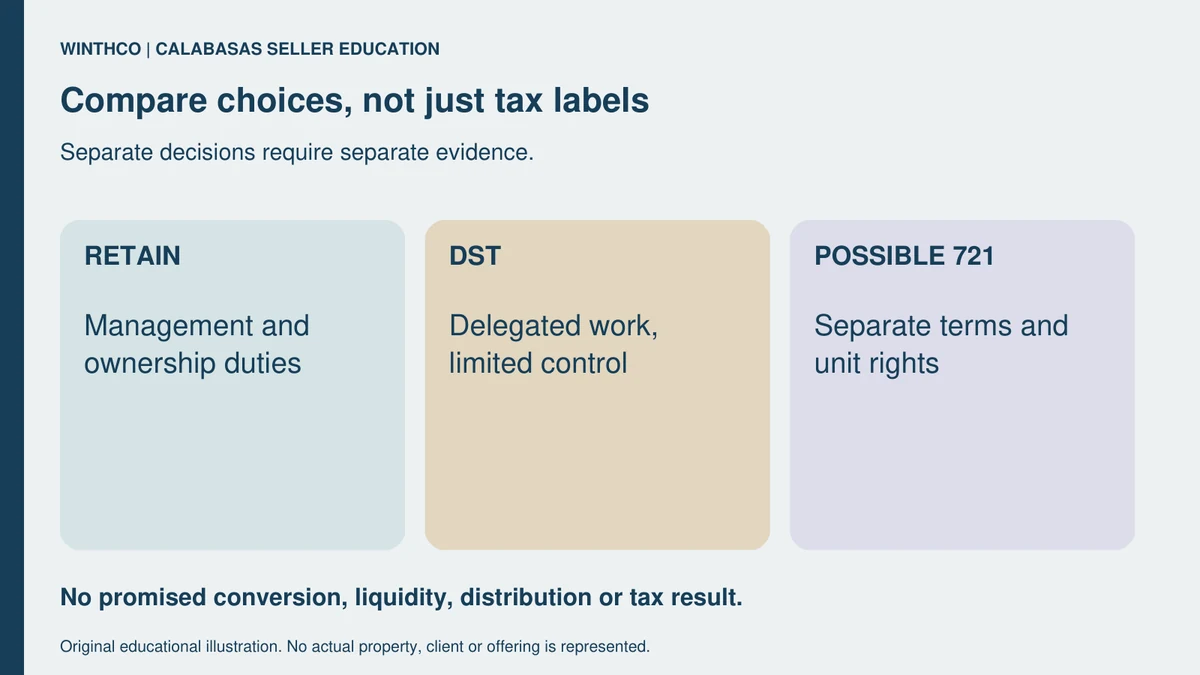
Section 1031 can defer eligible gain when qualifying business or investment real property is exchanged under the applicable requirements. Deferral is not tax elimination. Compare retaining the property with hired management, a taxable sale, a partial exchange and a full exchange before committing. The CPA should evaluate the actual taxpayer, ownership, basis, liabilities and any personal-use history; a valuable house is not automatically an eligible investment property.
Under the ordinary deferred-exchange rules, replacement property must be identified within 45 days after the relinquished transfer. Completion is due by the earlier of 180 days or the applicable return due date, including extensions. The QI and tax preparer should document those dates and required actions. Cash retained, nonqualifying property or liability changes can produce taxable boot. The precise amount requires transaction-specific analysis, not a shortcut based on the property's sales price.
Discuss your DST questions with Winthco →
A Delaware statutory trust can provide an interest in real estate without the investor personally arranging every repair or lease negotiation. IRS Revenue Ruling 2004-86 addresses a particular trust structure whose interests can qualify as replacement real property. It does not approve every product carrying the DST label. Review the actual trust and offering documents with qualified professionals, and use Winthco's California DST planning background as an introduction rather than an eligibility determination.
Reduced daily work comes with less direct authority. Ask who controls leasing, property management, reserves, financing decisions and sale timing, and what rights the investor actually retains. A former landlord may be comfortable delegating tenant calls but uncomfortable being unable to choose when to sell. Identify that difference before subscribing. The trust's expected holding period is a planning assumption, not a personal withdrawal right.
Private DST interests are generally offered to accredited investors through a private placement memorandum. Qualification does not establish suitability. Read the full documents and request clarification of unanswered questions. Winthco's DST offering-review framework can help organize the discussion, but no brochure or review checklist replaces the documents governing a particular investment. Do not assume that an available allocation is appropriate merely because an exchange deadline is approaching.
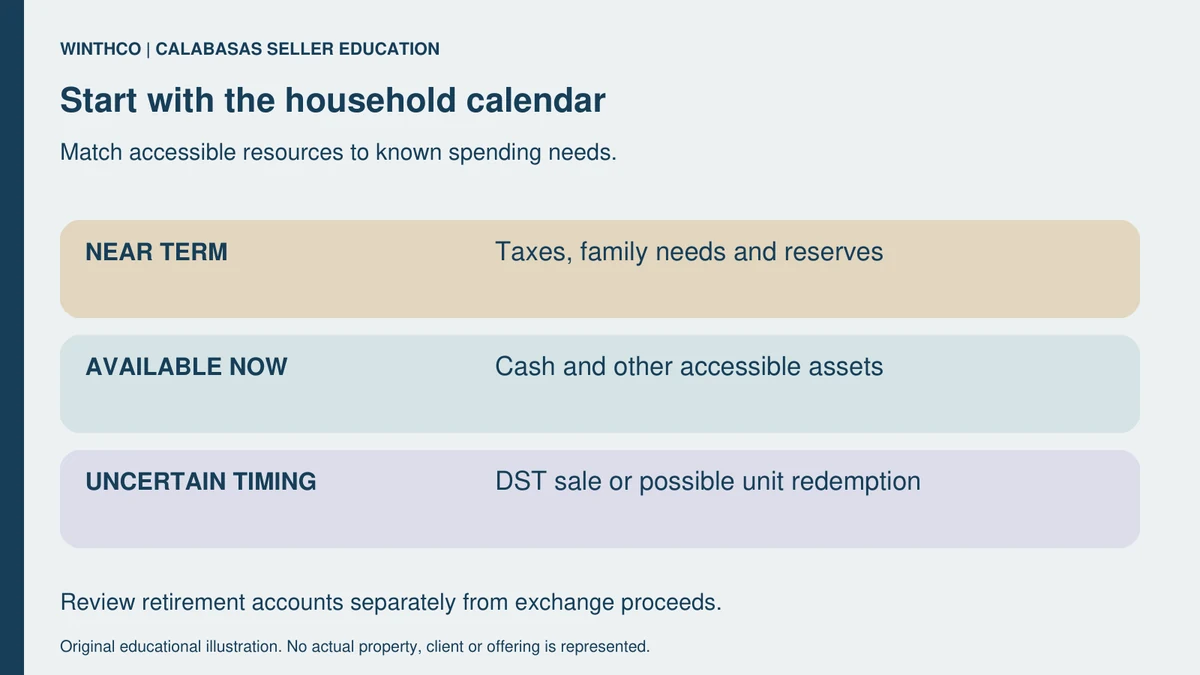
Compare the economics of the existing rental and the proposed DST on consistent terms. Rental receipts before repairs, management expenses and debt service are not comparable to a distribution after some expenses have already been deducted. Ask where distributions would come from, which costs are excluded and how vacancies or unexpected work could affect cash available to investors. A distribution percentage is not the same thing as total return.
Request a clear accounting of acquisition expenses, ongoing management charges, financing costs, disposition fees and professional compensation. Identify affiliates involved in buying, operating or selling the property. The recent DST conflicts-of-interest guide explains questions about related-party arrangements and incentives. Disclosure identifies a relationship; it does not by itself establish that pricing is favorable or that every participant's interests are aligned.
Review tenant concentration, lease expirations, reserves, insurance limitations and any loan maturity. Ask what happens if distributions fall, financing becomes more expensive or a sale takes longer than expected. Owning several interests may still leave exposure to similar tenants, sponsors or regional conditions. FINRA's concentration guidance supports looking across the whole portfolio, including holdings that would be difficult to sell when household needs change.
WATCH & LEARN
Equity Advantage discusses time and management demands when considering a DST. This third-party background is not Calabasas permitting advice, an offering recommendation or a promise of income, diversification or tax treatment. Equity Advantage is the creator, not a Winthco representative. Original resource · Watch on YouTube ↗
Educational context only. The discussion does not establish the suitability, returns or tax treatment of an investment.
An UPREIT generally holds real estate through an operating partnership associated with a real estate investment trust. Section 721 concerns partnership contributions, a separate tax framework from a Section 1031 exchange. IRS Publication 541 describes the general contribution rule and exceptions. Ordinary REIT shares and operating-partnership units generally are not direct 1031 replacement real property. Review the proposed transaction with the CPA and attorney before treating its tax label as an outcome.
Some DST programs contemplate a later operating-partnership contribution; others do not. Ask whether participation is optional, who decides timing, how valuation works, what conditions remain and what happens if the transaction never occurs. Winthco's 721 UPREIT structure overview provides background for those questions. The initial DST still needs to fit the household without relying on an uncompleted future event.
Review the rights attached to any prospective units, transfer restrictions, redemption provisions and potential tax consequences. A stated minimum holding period does not guarantee a cash exit at its end. FIFO selection does not itself guarantee tax-free basis withdrawals. Liabilities, later distributions and the transaction structure may matter. A seller seeking predictable access to principal should not confuse an illustrative conversion timeline with an enforceable liquidity right.
Consider a hypothetical Calabasas owner with an occupied rental and a previously remodeled room. The owner wants less maintenance responsibility but also expects a significant family expense within the next few years. No actual client, property or financial result is represented. The sale team investigates the alteration records and lease obligations, while the tax team compares keeping, selling and exchanging before the closing process advances.
The owner then evaluates a DST without assuming that a possible later 721 transaction will fund the family expense. The financial advisor identifies what resources would remain accessible if distributions stopped or the property could not be sold on the expected schedule. A taxable sale, partial exchange or different allocation might be discussed. The point is to make the liquidity conflict explicit, not to prescribe one transaction for all Calabasas sellers.
The SEC warns that private placements may involve limited information, severe illiquidity and total loss. DST investors also face property, tenant, sponsor, debt, fee and tax-law risks. Distributions can decline or stop. A qualifying exchange does not remove these risks, and an investment's tax treatment should not overwhelm the assessment of whether the underlying property and restrictions fit the household.
Ask a CPA with relevant DST and exchange-reporting experience about California follow-up obligations. The FTB describes Form 3840 requirements when California property is exchanged for out-of-state property and California-source gain or loss remains deferred. Reporting can continue in later years. Moving replacement real estate outside California is not a reliable basis for assuming the state's deferred-gain reporting disappears. Coordinate responsibility for federal and state records before they become scattered.
Winthco's wealth-management services can connect the property discussion with retirement-income needs, financial assets, 401(k)s, IRAs, asset allocation and beneficiary or estate coordination. A property sale does not automatically make an account transfer or rollover appropriate; compare available options, costs and services separately. Qualified retirement accounts are not themselves exchange proceeds. Use the prospect form to describe your sale stage and planning questions, and request a secure channel before providing confidential documents.
Calabasas, California, for geographic context. This is not a Winthco office or a parcel-boundary determination.
| Decision | Evidence to request | What to avoid assuming |
|---|---|---|
| Keep with management | Management costs and retained decisions | Delegating work removes ownership risk |
| Taxable or partial sale | Taxes, spending needs and flexibility | Every seller should exchange everything |
| Qualifying DST exchange | Structure, documents, costs and liquidity | Tax eligibility proves suitability |
| Possible later 721 | Conditions, valuation, unit rights and taxes | A proposed date guarantees conversion or cash |
This guide does not claim one. The verified contact page lists Simi Valley; the Calabasas map is geographic context only.
No. Section 1031 concerns qualifying business or investment real property, not a property used solely as a personal residence. Ask the CPA to assess mixed or changed use.
No. Confirm the property's jurisdiction and ask the sale team which assessment, permit and alteration records should be reviewed before marketing. A missing online entry does not by itself prove approval or a violation.
No. Confirm each professional's credentials, engagement and responsibilities. Relevant tax experience does not replace investment advice, and investment advice does not replace tax preparation.
Not necessarily. The transaction may not occur, and unit restrictions and tax consequences require separate review. A target timeline is not a withdrawal guarantee.
Not automatically. The FTB describes continuing Form 3840 obligations for qualifying exchanges of California property into out-of-state property with deferred California-source gain or loss. Confirm your requirements with the CPA.
Sources checked October 21, 2026. This article explains general concepts; your facts and the applicable documents control.
Winthco DST services · Winthco evaluation overview · Editorial standards
DST due diligence
Before exchanging a rental into a DST, review repair budgets, restricted reserves and funding limits. Know which questions to ask before committing.
Read guide →DST due diligence
Review DST property insurance, exclusions, deductibles and rent-loss coverage before exchanging a rental. Prepare questions about cash flow and reserves.
Read guide →1031 exchange planning
Planning a late-year property sale? Review how a return extension, DST closing requirements and household liquidity affect your exchange plan.
Read guide →Explore Winthco’s main DST article collection
Share your timeline and investment range. A Winthco team member will follow up with you.