Risks and due diligence
DST fees and expenses: what investors should compare
Learn how to review DST acquisition costs, ongoing expenses, financing charges and exit fees without relying on a single headline number.
Read guide →
Home / Learning center / DST due diligence
DST due diligence
Winthco Wealth Management · Updated November 2, 2026
DST loan prepayment costs can affect the economics of selling or refinancing a financed property before its loan matures. Review the actual loan documents, restrictions, calculation method and dated payoff assumptions. A projected property sale is not a promise of net investor proceeds, and beneficial owners generally do not control the exit.
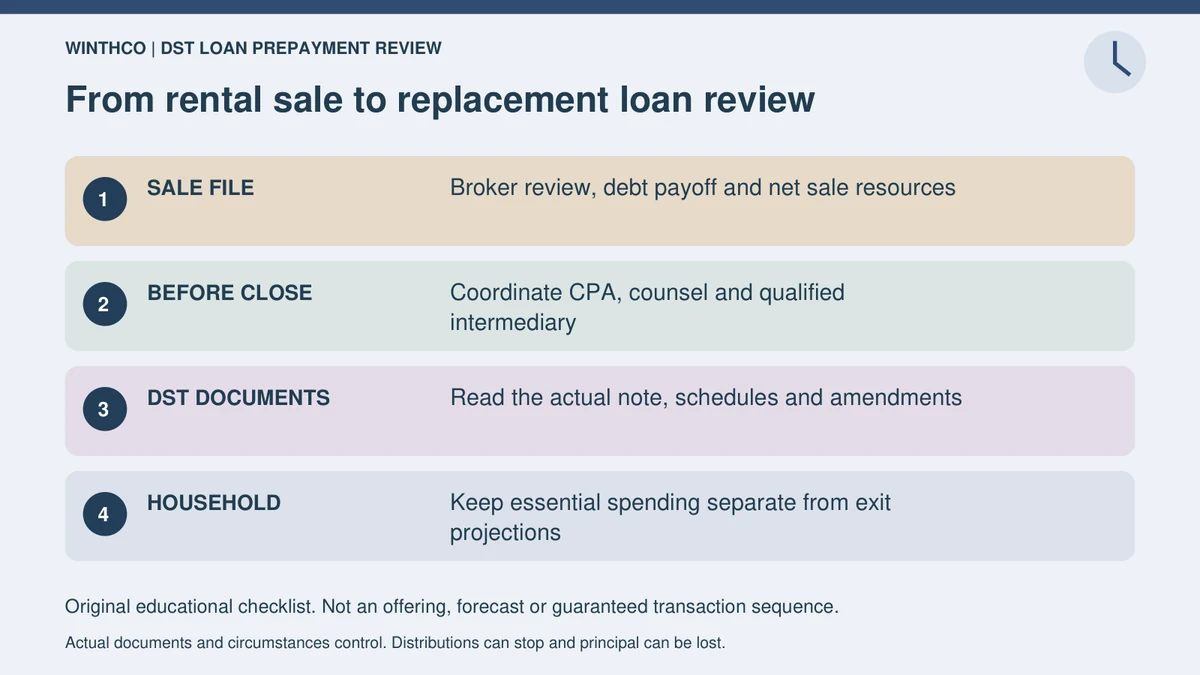
Start with the investment property you plan to sell. Interview an appropriately licensed realtor or commercial broker about relevant experience, valuation evidence, marketing, fees and closing coordination. Assemble the current loan and sale records. Then carry that discipline into the replacement-property review: understand not only how debt is serviced during ownership, but what may be required to release the property when an exit is proposed.
If a deferred exchange is contemplated, coordinate the CPA, attorney and qualified intermediary before closing or receiving proceeds. The IRS generally requires identification within 45 days after transfer and receipt by the earlier of 180 days or the applicable tax-return due date, including extensions. Deferral is not elimination, and cash retained or debt changes can affect gain recognition. The 1031 mortgage coordination guide provides context, not an assurance about a particular payoff or tax result.
Share your timeline and investment range. A Winthco team member will follow up with you.
Maturity asks when the remaining loan balance becomes due. Prepayment asks what the agreement permits or charges when repayment occurs earlier. Those are related but different questions. A projected sale date, contractual loan maturity and the end of a prepayment restriction may fall on different dates. Request the actual calendar rather than assuming a stated holding period aligns them.
The OCC's commercial-real-estate lending handbook discusses how prepayment penalties relate to a lender's exposure when borrowers refinance as interest rates decline. This is bank-supervision guidance, not a DST suitability standard. For an investor, the practical question is narrower: which provisions actually apply to this borrower, property, loan and proposed transaction?
Ask the reviewing team to identify the signed note, amendments, prepayment provisions and relevant schedules. Have counsel reconcile any discrepancy between the offering summary and underlying loan terms. A marketing description of fixed-rate financing does not establish that early repayment is inexpensive, permitted immediately or available on a date chosen by an individual beneficial owner.
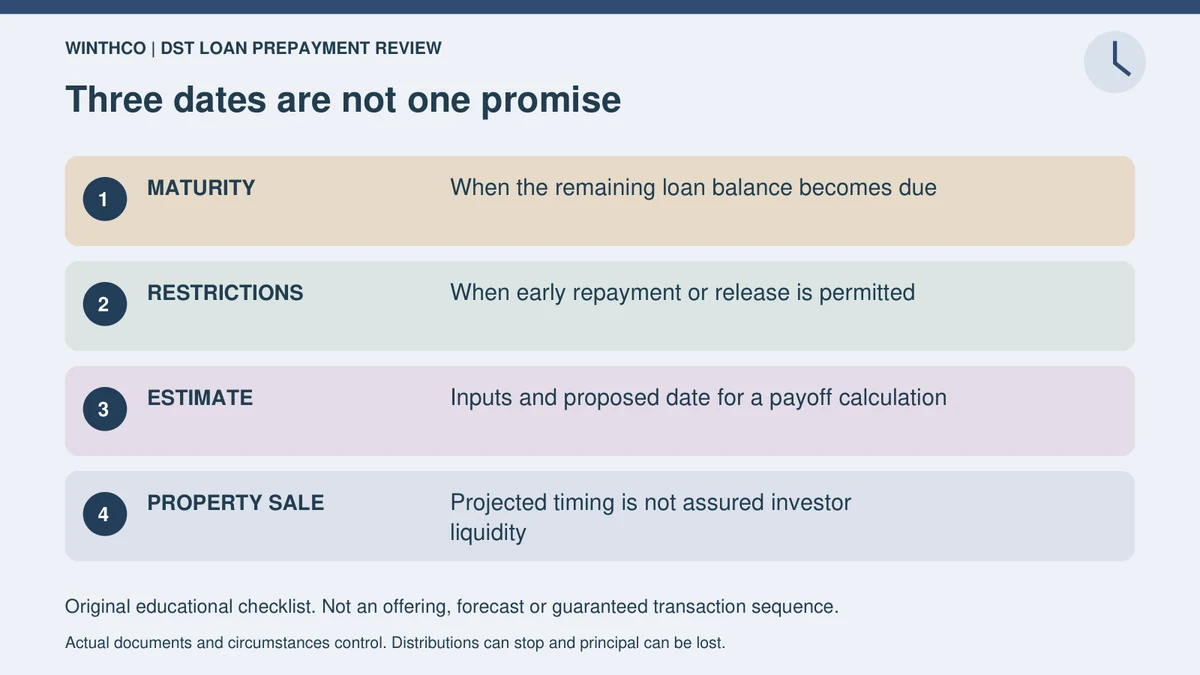
Loan materials may describe a lockout, a scheduled premium, yield maintenance or defeasance. Do not treat those labels as interchangeable or assume every DST loan offers a choice among them. Ask counsel which mechanism applies, what triggers it, whether exceptions exist and which documents establish the answer. Avoid applying a percentage found in an unrelated loan example.
JPMorgan Chase's commercial-real-estate explanation distinguishes yield maintenance, involving early loan repayment and a premium, from defeasance, which substitutes qualifying securities as collateral to release the property while the loan remains in place. Its discussion concerns loan mechanisms, not approval of a DST. Actual availability, eligibility periods, collateral and transaction requirements depend on the governing documents.
Ask whether an applicable mechanism involves notice periods, minimum charges, outside professionals or other transaction costs. Request a written explanation of what the estimate includes and excludes. A term described as an open period should still be checked for its precise dates and any remaining requirements; it should not be translated into an unconditional promise of a cost-free exit.
Discuss your DST questions with Winthco →
Request a dated estimate for a stated transaction date, with the source of each assumption. Identify principal, accrued interest, any premium or collateral-substitution costs and other applicable expenses separately. Ask which values are contractual and which depend on market inputs or completion timing. A model prepared when the property was acquired is not a current lender or servicer quote.
Ask who is authorized to obtain and interpret the quote, when it expires and how changes in the closing date would be handled. Do not contact a property's lender as though a prospective investor were the borrower. Use the authorized diligence process and ask the sponsor's team for the underlying support through approved channels.
Compare estimates prepared on a consistent basis. An earlier exit with one assumed sale price and a later exit with a different expense definition do not isolate the prepayment issue. Ask for a reconciliation that makes the assumptions visible. The leveraged DST review is useful background, but a leverage label or loan-to-value ratio cannot answer the actual cost of releasing collateral.
Request a bridge from assumed gross property value to estimated cash available after loan obligations, sale expenses, other liabilities and applicable fees. Identify the treatment of reserves and any preferred or other contractual allocations. Ask which charges are already included so the same expense is not deducted twice or omitted because it appears in a separate schedule.
A favorable appraisal or sale-price assumption is not itself evidence of a favorable net result. The DST valuation review separates property value, acquisition price and investor proceeds. Apply the same discipline to payoff costs: show where they enter the model and how they change the amount available for distribution, without presenting the output as a promised outcome.
Separate the property's transaction from an individual owner's ability to sell an interest. Selling a DST interest can involve its own transfer restrictions, buyer eligibility and pricing questions. A property-level premium does not necessarily describe the cost of an interest transfer. Conversely, a theoretical interest buyer does not establish an available market or compel the property's sale.
WATCH & LEARN
Equity Advantage 1031 Exchange discusses management demands and DSTs as a possible alternative. This third-party video supplies general ownership context, not loan-payoff advice, an endorsement or a promise of income, liquidity or tax treatment. Original resource · Watch on YouTube ↗
Educational context only. The discussion does not establish the suitability, returns or tax treatment of an investment.
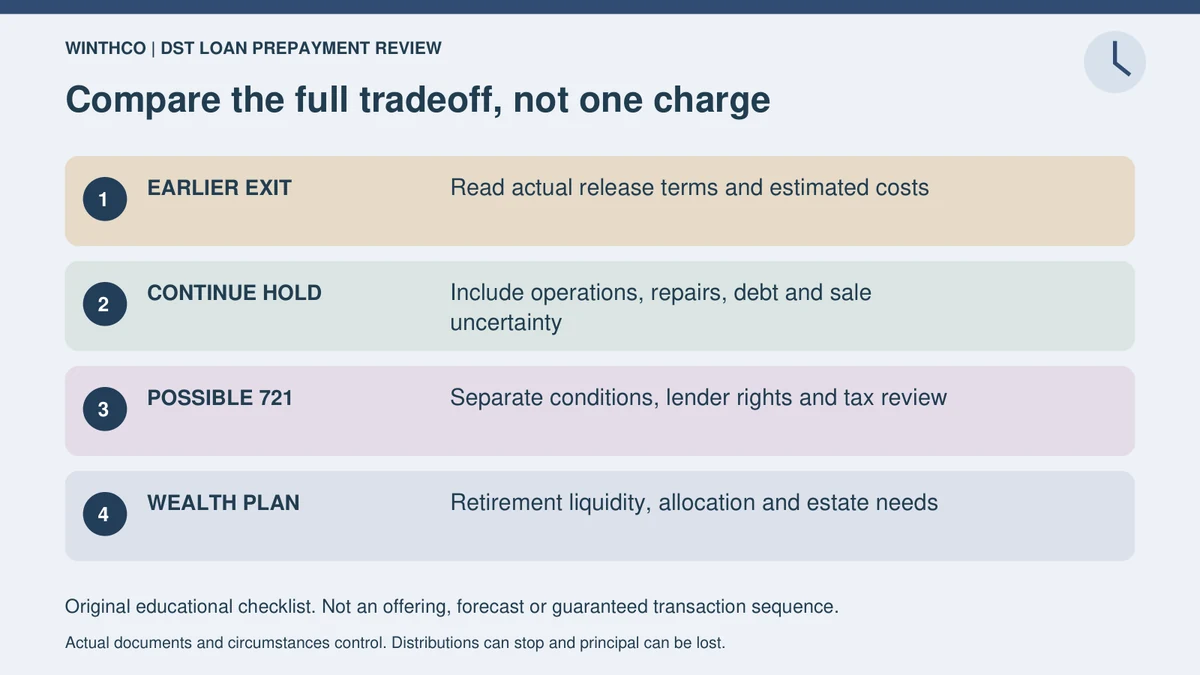
Consider a hypothetical property with an earlier sale opportunity while restrictive loan terms still apply and a later potential sale date after those terms change. This is not an actual offering or client result. Comparing only a potentially lower future payoff charge misses the costs and risks of continuing ownership, including operations, repairs, vacancy, financing and uncertain future sale value.
Ask for supported scenarios using the actual contractual dates and clearly labeled sale assumptions. Examine what changes if the earlier closing is delayed or the later sale does not occur. The DST loan-maturity guide addresses the separate risk of a balloon balance coming due. Waiting for one restriction to expire should not conceal an approaching maturity or refinancing dependency.
There is no universal rule that paying a premium is always wrong or waiting is always better. Ask who can decide, what conflicts or compensation may influence the proposal and how the decision would be communicated. The useful result is a documented tradeoff, including downside cases, not a prediction that one timing strategy will produce a particular return.
A potential contribution to an operating partnership under Section 721 is a separate, conditional proposal. Ask counsel whether the actual loan would remain, be assumed, require consent or be addressed another way, and what costs could arise. Do not assume a contribution automatically bypasses lender rights or solves an unfavorable exit estimate.
The IRS partnership framework generally addresses contributions of property for partnership interests, subject to exceptions and transaction facts. Operating-partnership units and ordinary REIT shares generally are not direct Section 1031 replacement real property. IRS Revenue Ruling 2004-86 analyzed a specified DST arrangement with limited trustee powers, including restrictions on debt renegotiation; it does not authorize every desired financing change.
If a possible later contribution appears in materials, review who controls it, conditions, valuation, fees, debt effects and resulting unit restrictions. It may never occur. A proposed 721 path does not guarantee cash liquidity, an automatic conversion or tax-free FIFO withdrawals of basis. Evaluate today's property and loan documents without assuming a later event will repair their limitations.
DST ownership may reduce direct management responsibilities while leaving substantial property, tenant, sponsor, debt, fee, conflict, concentration and tax-law risks. Investors have limited control and may face prolonged illiquidity. Distributions can change or stop and principal can be lost. DST private placements are generally offered to accredited investors through offering documents; eligibility is not proof of suitability or protection from loss.
The SEC warns that private placements may involve limited disclosure, difficulty selling and total loss. FINRA emphasizes reviewing concentration and liquidity across holdings. Compare an uncertain exit calendar with accessible savings and essential spending. The DST downside-scenario review helps test overlapping risks rather than treating one favorable payoff assumption as protection for the whole plan.
Connect the property decision with existing financial assets, 401(k)s, IRAs, retirement-income needs, asset allocation and beneficiary or estate coordination. Winthco's wealth-management conversation can include tax-professional coordination without assuming a rollover, transfer or advisory engagement is appropriate. Compare relevant options, costs and services separately. Use the prospect form for your planning question, not confidential loan or account documents; request an approved secure process if later review requires records.
| Decision | Evidence to request | What to avoid assuming |
|---|---|---|
| Maturity date | When the remaining balance becomes due | It is the same as the projected sale date |
| Prepayment terms | What an earlier transaction permits or costs | A fixed rate means unrestricted repayment |
| Dated estimate | Inputs, transaction date and included expenses | An old model is a current payoff quote |
| Net proceeds | Value less actual obligations and costs | Gross sale price equals investor cash |
No. Maturity is a contractual debt date; an exit projection is an assumption. Neither assures an individual investor immediate liquidity.
No universal charge should be assumed. Ask counsel to identify the applicable terms in the actual documents.
No. They are different mechanisms, and a borrower may not have a choice between them. Review the agreement and obtain qualified assistance.
Not necessarily. Ask who prepared it, the transaction date and inputs used, and whether an authorized current quote exists.
No. Continued ownership can introduce expenses, operating risks and changes in sale value. Compare the complete scenarios, not just one charge.
No. It may not occur and resulting interests may remain restricted. Loan consents, costs and tax consequences require separate review.
Sources checked November 2, 2026. This article explains general concepts; your facts and the applicable documents control.
Winthco DST services · Winthco evaluation overview · Editorial standards
Risks and due diligence
Learn how to review DST acquisition costs, ongoing expenses, financing charges and exit fees without relying on a single headline number.
Read guide →DST due diligence
Review DST loan maturity, balloon payments and exit assumptions before exchanging a rental. Prepare questions about debt and household liquidity.
Read guide →DST due diligence
Learn how to review DST appraisals, compare acquisition costs and separate property value from investor proceeds before a 1031 exchange.
Read guide →Explore Winthco’s main DST article collection
Share your timeline and investment range. A Winthco team member will follow up with you.